I will be teaching this, starting in a few weeks.
#freeuniversity #brighton #philosophy #instagram
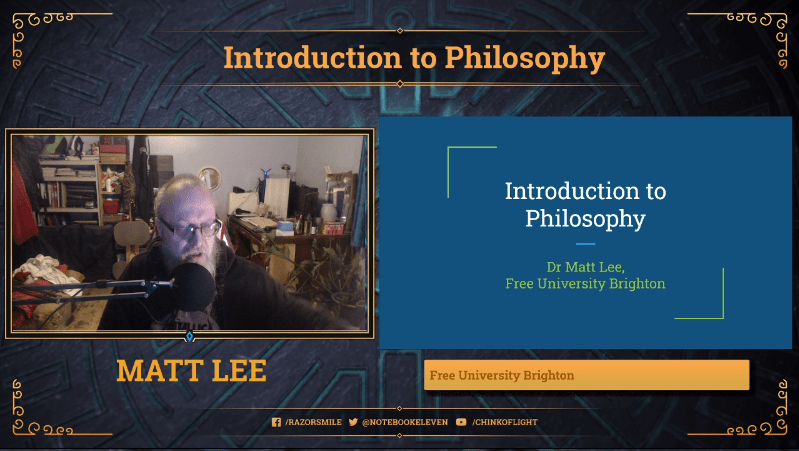
I’ve started a new course at the Free University Brighton, a short 4 week introductory course. The first session this week gave a brief account of what philosophy is and an even briefer introduction to the cogito argument in Descartes. The FUB students then went on to a Zoom seminar for an hour and we had an interesting discussion about thought, thinking and the differences between the way we might usually understand thinking and the way that philosophy approaches it. The sessions are on Monday evenings on Twitch, over here – https://www.twitch.tv/razorsmile – if you fancy helping me out a little then I’d really appreciate a ‘follow’ on the Twitch channel, once I get to 50 followers a whole bunch of other functions open up. (If you want to be super helpful then chuck me a ‘subscribe’ on the YouTube channel too). Anyhoo, here’s the first session from the archived recordings on YouTube.
The COVID crisis meant that the Free University of Brighton moved online during the Summer term and I was teaching a philosophy course on Existentialism, mainly focused on Kierkegaard’s Fear and Trembling, followed by a close look at Sartre’s account of pre-reflective consciousness in Transcendence of the Ego, Sketch for a Theory of the Emotions and his chapter on Bad Faith in Being and Nothingness.
I decided, after some research into options, to host lectures on Twitch and then do seminars via Zoom. I’ve added a new page to the blog that explains how the stream works, which you can check out here.
The aim was to keep the class ‘open’ in some ways, as one of the great joys of FUB is that we have a very open class structure. Often I find that FUB courses have a core set of students for the class, alongside another section of people who attend more loosely, usually because of time. The open, almost ‘drop-in’ nature of classes is important as it shifts the dynamics in the space – the class isn’t closed in on itself, producing a kind of insularity to conversation, rather the fact that there might be a more random element forces discussions to be alert to assumptions because someone who is following more loosely might need things to be explained differently. I’ve also been interested in the shifts in the Twitch and streaming community, with a large increase in recent years in the ‘Just Chatting’ category, and so it offered an interesting space to experiment with ‘doing philosophy in public’.
I’m still pretty new to that whole Twitch/YouTube streaming space but the class seemed to go well. The lecture streams get automatically recorded on Twitch and then easily exported to YouTube, and you can check out the Existentialism class playlist over at Twitch or on YouTube. One thing I ended up doing was using some specific software, getting to know the tech behind streaming and getting a decent (ish) mic, as there’s nothing worse than poor sound in a lecture type space.
As I mention during the last lecture session (lecture 9), I’m intending to carry on doing a Monday evening stream, the idea being to report on that weeks philosophical research, sometimes chat to others and sometimes to go through specific short texts or sections of text. Monday evenings from about 7pm – if you follow the Twitch channel you can get notified when I go online.
This week I’m hoping to start the ‘weekly research seminar’ sessions by talking to Eric about the ‘Freudian Spaceship’ project we’ve been working on for a few years, where we’re developing a Fanonian Schizoanalysis. One of the things I want to chat about is the role of dreams and dreaming, which I’d rather use as a concept than ‘ideology’ or ‘false consciousness’. Part of the background to this is something Deleuze says about getting trapped in the other’s dream. Here’s a little instagram introduction to that.
//www.instagram.com/embed.js

As a pedagogic device for working on NVC the suggestion I made to my students is that a series of ‘themes’ are identified which then provide a backbone for ‘indexing’ some of the content with a view to building up a ground for exegetical work. The idea would be to take each theme – or at least a selection of them – and find relevant passages within the text in order to then have a focused selection from the text to think about. Obviously these themes interlock but the need to ‘ignore’ some things to focus on others is a methodological tool, enabling us to gain some focus before perhaps expanding again. (This is not, by any means, a comprehensive list of the themes that might be extracted from NVC, nor even a list of the themes which might be thought to be the ‘most central’ or ‘most obvious’. It arises from a particular class and discussion and as such is located in that context is intended to be added to and improved through discussion). (more…)

 Klossowski – Nietzsche and the Vicious Circle – Reading notes for Ch.s 3-5
(These notes are partially exegetical for students and partially exploratory for myself).
CH3
The ‘Eternal Return’ is the thought experiment from Nietzsche, the central presentation of which is found in ‘The Gay Science’, S.341 and runs as follows:
‘The heaviest weight. – What if some day or night a demon were to steal into your loneliest loneliness and say to you: ‘This life as you now live it and have lived it you will have to live once again and innumerable times again; and there will be nothing new in it, but every pain and every joy and every thought and sigh and everything unspeakably small or great in your life must return to you, all in the same succession and sequence – even this spider and this moonlight between the trees, and even this moment and I myself. The eternal hourglass of existence is turned over again and again, and you with it, speck of dust!’ Would you not throw yourself down and gnash your teeth and curse the demon who spoke thus? Or have you once experienced a tremendous moment when you would have answered him: ‘You are a god, and never have I heard anything more divine.’ If this thought gained power over you, as you are it would transform and possibly crush you; the question in each and every thing, ‘Do you want this again and innumerable times again?’ would lie on your actions as the heaviest weight! Or how well disposed would you have to become to yourself and to life to long for nothing more fervently than for this ultimate eternal confirmation and seal?’
In the ‘Will to Power’ #1066 Nietzsche makes a more argumentative presentation although it is still in the form of a hypothetical, a thought experiment (note the opening – ‘If the world may be thought…’ which is akin to saying ‘Just suppose for the sake of argument…’ and then setting up an argument of the If…then… format which I have inserted into the text in italics in this case. If we pay attention to this way of arguing we can see that it is both very compressed and contains a chain of implications from a basic ontological model. The paragraph could be unpacked by trying to reconstruct the line or argument – in other words by trying to make explicit all possible suppressed premises.): (more…)

Reading Chapters 1 and 2 of NVC we come fully and squarely up against the peculiarity of Klossowski’s text. The discussion interprets and does so using a swathe of textual evidence but the interpretation is not a gentle teasing out of an argument, a kind of ‘efficient paraphrasing’, rather it is a positioned interpretation. That is, it offers a reading of Nietzsche that attempts to articulate a position with regards the body of Nietzsche’s work. That is to say, it both suggests a reading of Nietzsche that is a ’cause’ (ie; what Nietzsche says ‘comes first’ and our understanding is the effect of this) and it offers a reading of Nietzsche that makes Nietzsche an ‘effect’ of the reading (such that the reading ‘comes first’ and only through this reading do we come to understand Nietzsche). This curious ambiguity means that the reading is offering a ‘way of reading’. It is, as it were, intended to make us see Nietzsche’s work in a particular way. The danger, of course, is in distorting (‘doing violence to’) the Nietzschean corpus. The question is, what are we to make of Klossowski’s reading? If we were to assess it simply on its textual accuracy, whether it is that ‘efficient paraphrase’ so beloved of secondary academic texts (Introductions to …) then we would miss the performative aspect of Klossowski’s reading, the way in which he wants to do something with the corpus and make it do something anew. Of course we have to allow that Klossowski has a desire to bring some truth to light rather than assume he is trying to mislead us or merely ‘read Nietzsche for his own purposes’ but to do so we have to acknowledge that in some way it is only through making Nietzsche into his own that Klossowski can reveal something interesting about Nietzsche. It is because of this peculiar reciprocity between Nietzsche’s corpus and Klossowski’s reading of it that we should perhaps speak of the ‘Klossowskian-Nietzschean’ (K-N) account offered in NVC rather than think of the book as merely an ‘interpretation’ of Nietzsche in the weak sense of paraphrase.
What is it that Klossowski pushes to the fore then? There is a distrust of thinking as a pure and moral capacity within Klossowski that he wishes to draw out of Nietzsche and pursue. This is grounded in a tension between the individual as thinker and the society of which they are a product. The terms Klossowski uses are the gregarious and the singular (NVC: 4) where the gregarious is the name given to the social aspect and the singular the name given to that which opposes or comes into conflict with the social. The social is above all formed in the context of language, or the ‘code of everyday signs’ and the tension can be understood as one between an immediacy located in the ‘singularity that we are’ and a mediation of that singularity in the ‘code of everyday signs’. Roughly speaking we might think of this as a situation in which we are somehow trapped in language. Each time we try and think or express something, in particular each time we try and express our ‘depth’ (present the ‘true self that we are’, though this phrase is highly troublesome) we are betrayed by language.
This way of presenting things of course assumes that there is some way in which we are which can be betrayed. It would suggest, for example, that there is a real or true (we might say, following Heidegger, an ‘authentic’) self which we cover over and betray (fail to express) simply because any act of expression mediates the immediate. We might want to fall back on means of expression that aren’t linguistic and suggest that art, perhaps, is a means of authentic expression of the immediacy that is our depth precisely because it isn’t caught within the ‘code of everyday signs’. If we do this, however, we need to be careful to avoid an obvious problem – if we ‘read’ an artwork as expressing something more truthfully, and this ‘something’ is taken to be a meaning, then for Klossowski-Nietzsche it looks like we will fall back into the code of everyday signs because the code of everyday signs is not simply language but meaning itself. Meaning is mediation and any search for meaning falls into the position of betraying our depth which is outside of any meaning. Klossowski-Nietzsche claim that “our depth is unexchangeable because it does not signify anything” (NVC: 31). Are we not left at a dead-end then? Can we simply not say or express anything since there is no meaning? This would amount to a form of quietism, of a giving up in the face of a nihilistic understanding of life and the social. This, i think, would be a mistake and a mis-reading of K-N because it would make it difficult to understand the ‘combat’ which it seems is central to the ethical drive of NVC.
The first chapter, in which we find the ‘Combat against Culture’, supposes that there is something of interest in the conflict between the unexchangeable depth of the singular and the gregarious leveling of the social. If the social is a form of indoctrination, an imposition of a morality that commonly makes thinking and the thinker / philosopher into little more than lie-makers that produce ways in which the social can reproduce itself to the detriment of the singular, then where does the impulse or force of the singular come form. Do we posit something like an original singularity to each ‘subject’ which is then swallowed up in the social? Where did this singularity come from, what produced it? It would be a mistake, I believe, to attribute some ‘original subjectivity’ to K-N. Instead we will find the ‘depth’ described as chaos, as a flux or soup of impulses, a chaos that is formed into a singularity. The ‘formation’ of this singularity is what we need to investigate and what K-N will do so through the concept of ‘formations of sovereignty’ found later in NVC. Roughly speaking, the singular is nothing other than a formation of sovereignty in which one impulse (drive, force, instinct are all analogous concepts although not identical) triumphs over another. The “affects are enslaved by other affects – and not (at least not initially) by the affects of other individuals but by those within the same individual” (NVC: 10). It is not the social that ‘imposes’ itself on the singular but rather the singular that trains itself into becoming a ‘reasonable, rational and competent individual (member of society)’. We train ourselves to be slavish, we are not trained and imposed upon by some ‘oppressive’ force from outside. Consciousness triumphs over desire and we become reasonable people (NVC: 10).
(more on Ch 1 and 2 to come)

If one of the first impressions on reading NVC is that something like a ‘psycho-analysis’ is being done then it is worth asking why this impression occurs and what relation to Freud exists. That it should be, in a sense, relatively uncontroversial to suggest NVC ‘reads like’ a psycho-analytic text comes from the emphasis of the biological, biographical and historical interpretation of ‘forces at work’ in Nietzsche, an emphasis on these bio-facts rather than on the texts that resulted. The texts are to be read as expressions of something underneath, something which we might encounter a little like we encounter the unconscious. Texts become symptoms to interpret, something with which to diagnose the ‘real’ or ‘important’ forces that are the ‘truth’ of Nietzsche’s work.
This, however, brings us close to one of the first difficulties. If we take a Freudian psycho-analytic interpretation to occur, as it were, from ‘outside’ the subject then close attention to Klossowski would suggest that the exact opposite is the practice of NVC. For example, in psycho-analytic practice / interpretation the relation of the analyst / interpreter to the analysand / interpreted is crucially important. The establishment of transference, the encounter with an ‘Other’ and the centrality of what i would call the ‘relation as revealing’ suggests a prime importance is given to a kind of sociality. We might say that for psychoanalysis, it is in our ‘being-with’ (mitsein) we find our being. The analyst / interpreter justifies their position on the basis that the addition of their position is necessary to establish this being-with which is a precondition of finding the truth of the analysand /interpreted. This sociality, this being-with, however, is a being-with of subjects and subjects are constituted as language speaking, meaning using beings. Being-with reveals being because it is a kind of ‘being with meaningful beings’. If this seems obscure then let me put it in more colloquial terms.
Take being-with to be ‘sociality’. The claim is something like ‘the way we are with others reveals the way we are’. Thus sociality is just this ‘being with others’ but it is in this ‘others’ that the presupposition can slip through, the metaphysical contraband. To see this think of the situation in which the others are animals, not ‘humans’. The distinction is important because it is as meaning using beings that we place ‘humans’ in a privileged and unthought position of social pre-eminence. Why is it, for example, that the dog you talk to or the cat you confess to cannot play the role of an analyst / interpreter? It is because they cannot offer this ‘mirror of meaning’, they cannot play the role of an analyst because they cannot talk. It is not what an analyst says, of course but the fact that they could say which enables them to play the role they do. It is not that the analysand talks which makes analysis the ‘talking cure’ but rather that the analysand talks to someone who can hear, by which we mean someone who can also talk (and talk back).
How, then, does NVC differ from psychoanalysis?

For my 3rd year students in NMEP. (This is just a brief and partial account of the discussion today and students are welcome to continue the discussion here on on the WebCT bulletin board if they want a little more privacy, this is a public site after all.)
Today we discussed the way in which we think the subject by exploring the problems involved in the idea of ‘loving a robot/loving a simulation/loving a simulacrum’ and how these might be teased apart. A large part of our understanding of both Klossowski and Deleuze’s works on Nietzsche involve us in thinking about the way in which there is a problem for them, what exactly it is that motivates them, as it were, to write and think in the way they do, particularly when the initial impression when confronted by these two works (Nietzsche and the Vicious Circle:NVC and Nietzsche and Philosophy:NP) is one of disorientation. As we approach an exam we need to supplement the detailed exegetical work done in the essays and the reading seminars with a ‘step back’ that enables us to get a broad sense of dynamics and lines of thought. To that end it is important to remember, I suggested, that Nietzsche is one of the ‘masters of suspicion’ (along with Marx and Freud – the phrase itself originates form Paul Ricoeur) and that both Klossowski and Deleuze begin form a position congruent with such suspicion in that they begin thinking by distrusting the way we think and speak. We use words and as we use them assume we know what they mean, until we are asked what they mean when we find confusion and disagreement. The words we use are capable of possessing us with the feeling that we know something, they possess a sense (or affect, feeling) of sense that we need to be suspicious of in order to begin to think critically. This doers not mean we simply throw out our intuitive relation to meanings and the sense of things, since such a rejection would also imply that we somehow knew what it was we were meaning and now reject it. Uncritical rejection is no better than uncritical possession. Thus the task is to ask, how might we think about the concepts of subject when the language and sense of the concept already exists, how might we think, as it were, in spite of the possession of sense. To do this, I suggested, both Klossowski and Deleuze attempt something we can think of as a reframing of the questions, a redrawing of the lines of debate. This idea of a reframing of the problem is perhaps simplifying things but for now, as a kind of working device or ‘rule of thumb’ to enable us to develop understanding (what is called a ‘heuristic‘), it will suffice.

(Notes primarily for the use of my 3rd year undergrad students on the Nietzsche and Modern European Philosophy course, terms 2 and 3, in which we’re studying Klossowski’s ‘Nietzsche and the Vicious Circle’ and Deleuze’s ‘Nietzsche and Philosophy’ and exploring the problematic of post-structuralism. Page references to the Continuum impacts edition of NVC).
The intention here is to follow a ‘reading strategy’ in which we acknowledge that the style of thinking that occurs within NVC (and perhaps more widely within post-structuralist thinkers) is that of a weave or tapestry, in which words and concepts are introduced without explicit definition and these words are then employed (used) within a line of thought. The meaning of the terms within the text is to be produced through the work of the text, such that the book will constitute its own context within which key terms can be thought through rather than simply argued about. This is not to say that argument is irrelevant, not at all, but rather to emphasise something like a principle of ‘meaning is use’ that underlies much of NVC. Structuralism itself made use of ‘binaries’ in order to begin its analysis with structures and not elements (employed/employer: man/woman: expert/amateur etc), for the simple methodological fact that a single term would be an element and if we are to begin with structures then this must mean, in terms of language and conceptualisation, beginning from relations between words or concepts (what for ease I will simply refer to as ‘terms’). Post-structuralism, then, will continue its emphasis on structures, and as such will continue to find much of interest in the technique of using binaries or pairings of terms although it will not want to presuppose a final and definite order that can be produced from such an analysis. Our reading strategy, then, works on the basis of trying to identify interesting ‘key-words’ that we then try to understand conceptually by examining their oppositional terms. Concretely this begins from finding something that we can identify as a claim and then working backwards and forwards within the immediate context in which the claim is made to try and clarify the relations at work in a particular space of the text. These ‘partial analyses’ will then enable us to begin to reconstruct something like a ‘line of thought or argument’ that is made by the text (or perhaps, better, one of many lines of argument that will be made by the text).
Beginning at the bottom of page 8 and going onto page 9, we find some of the central questions within the first chapter, ‘The combat against culture’, sitting at the head of a short (3 paragraphs) line of argument. Here, as part of that partial analysis just mentioned, I want to pick out four ‘key-words’: reciprocity, idiosyncracy, culture and objectivation.
 So today I’m talking to the students in my existentialism class about the phenomenological moment, the encounter with the given which is presupposed in any account of how we encounter the world and which gives us back the world from a skeptical move which might try to doubt it or suggest it’s an illusion. As part of this I was saying that the world, the self, thinking are all primarily ‘just given’ and then we need to explore on top of that the how of the giving of the world, the self, thinking. This is to say, the world is, but how it is has still to be described. On the basis of this, of course, phenomenology offers us descriptions of this how the world is given, and can come up with some strange, some beautiful descriptions – and so here’s an example, the phenomenology of typewriters by Richard Polt. I’m not going to say anything directly about Polt’s essay in this post, maybe later, but this is for my existentialism and phenomenology students…
http://staff.xu.edu/~polt/typewriters/typology.html
 razorsmile :: philosophy//magic //revolution