In the fourth session of the seminar course we look at the last of our teachers in this project, Deleuze and Guattari (mainly Guattari to be honest). The notes for the session are below the video.
TFS Session 4
In many ways the project is best understood as being located within schizoanalysis, in fact, the self-description we offer is that we’re thinking a Fanonian Schizoanalysis, one where the wretched of the earth are thought entwined with the wretched earth, one where the voices of the revolutionary in Fanon or Guattari are in chorus, resonant and vibrant. There is still the question that has been raised, of what difference does this make. What difference does thinking make, particularly when the mode of thinking is one in which the rational intellect is no longer master. Part of the answer comes from the idea of abstract machines.
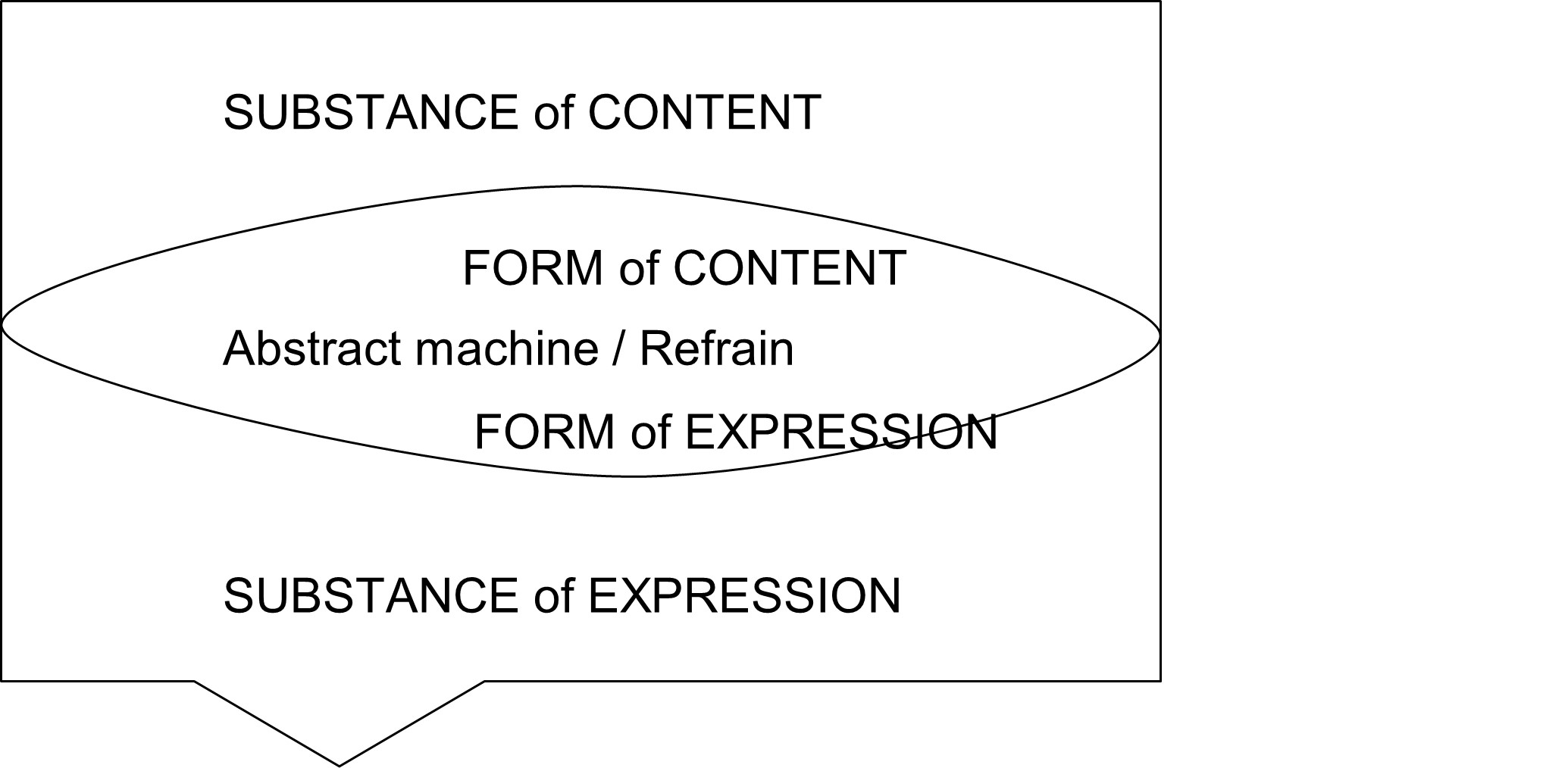
In the first chapter of Guattari’s Chaosmosis – an ethico-aesthetic paradigm, it’s made clear that the idea of an abstract machine derives from a “brilliant intuition” from the linguist Hjelmslev (p23). It’s also clear that the role of the abstract machine as found in linguistics is to be expanded, pushed out beyond the domain of language into the “extra-linguistic, non-human, biological, technological, aesthetic, etc” (p24). Guattari continues:
The problem of the enunciative assemblage would then no longer be specific to a semiotic register but would traverse an ensemble of heterogeneous expressive materials. Thus a transversality between enunciative substances which can be, on one hand, linguistic, but on the other, of a machinic order, developing from ‘non-semiotically formed matter’, to use another of Hjelmslevs expressions.
These couple of sentences immediately drop us into the strange world of Guattari’s schizoanalytic cartographies, where there is this intense jargon or complexity, where amidst a swirl of concepts, connections and strange words, a strange dynamic can be sensed, one in which the world itself speaks, or something like that.
Let’s just work through this passage. ‘The problem of the enunciative assemblage’ – let’s begin there. To enunciate, to speak well, to enunciate your words.
Think here of the way an accent is so often a component of speech. Or think of the mouth, its formation and function, the throat, the lungs, the diaphragm. Breath and breathing. Rhythm, connotation, association. Or power, a judge handing down a sentence, a word within a specific frame of power – “Detention!” shouts the teacher. Or the famous example of someone shouting “Fire!” – it makes a difference when it’s in a crowded cinema, or perhaps when it’s on a firing line, as the enemy approaches.
The ‘problem of the enunciative assemblage’ is basically the problem of how that which speaks is able to do what it does. The functioning of the enunciative assemblage – how it learns to do what it does, how the functions ‘operate’ in practice, how we work out what ‘minor components’ make up the ‘major assemblage’. All these questions, and more, form ‘the problem of the enunciative assemblage’.
Within Guattari’s account in the first chapter of Chaosmosis, he’s specifically looking at the relation between subject and object, very traditional philosophical territory in many ways, so in large measure, the problem of the enunciative assemblage is approached via the ways in which the relation of an object to a subject develop. This is also where we find Guattari’s emphasis on ‘the productions of subjectivity’ and it can be easy to slip back into the human a little too quickly at this point. So, a word of caution – the schizoanalytic framework takes language to be only one situation within a wider context of non-linguistic enunciative assemblages.
Guattari again, slightly earlier in the passage just cited:
“…we would like to resituate semiology within the scope of an expanded, machinic conception which would free us from a simple linguistic opposition between Expression / Content, and allow us to integrate into enunciative assemblages an indefinite number of substances of Expression, such as biological codings or organisational forms belonging to the socius.” (ibid)
Notice the way that the desire in this passage is to be ‘freed up’, via the concept of machines, the ‘machinic conception’. The strategic argument here arises from the aim of ‘freeing’ a way of understanding language from a ‘simple linguistic opposition’.
Why and How? These two issues are distinct, but the abstract machine is part of the How…
Abstract Machine
Before we get onto more details of this ‘how’, we should first pay attention to the ‘why’.
Here the guiding question is something like, who is speaking? The way in which this question should be heard is important, however. It should be contrasted, or at least thought in tension with, the question ‘what is speaking’?
‘What is speaking’, for example, might enable us to see that there are other forces at work in expression – forces such as the unconscious, or forces such as the racialised value system of colonialism. For example, might we say that in Fanon, what is speaking in ‘the black mans experience’, as he describes it in Black Skin, White Masks, is both racism, in other words the value system of racism, in which the black man is inferior and the resistance to that value system that expresses something named as human. Two different drives or dynamics in tension.
But who is speaking? This is Fanon himself. Not some structure, not some training, nor even some biography, but nonetheless Fanon is who speaks here. Or part of Fanon, at the very least.
Who is speaking?
There’s a key formula that can be found all over the place when it comes to psychoanalysis, and it goes something like this: the subject of psychoanalysis is the subject of transference.
Let’s think, for a moment, about that analytical model of the unconscious drive. There is, in Freud, a basic tension between id and ego that I described last week as a kind of ‘domestication’ model. Unruly, free energy is organised into a coherency over time by its relations with the self-conscious ego. This is a kind of self-organising process, no strict architect at hand, rather a set of major factors and their interactions. Id, ego, pleasure, sociality. Self-organisation takes place, subjects form personalities if you like, but within a system of effectively pre-established factors. We assume certain things, the free energy of the id for example, or the restrictive nature of the social, and then work out our ‘causal narrative’ from these factors. Accidental factors, trauma for example, impact as something like ‘external forces’ and so we have quite a rich set of characters to form a story with. The idiosyncrasies of the individual can be accommodated as ‘tones’ or ‘colours’ within a basic plotline. Yet the plotline has to be assumed. The story is already told, just not the details of the moments.
So in the process of analysis, what is speaking is less the details, the manifest content that we encounter in the words, actions, emotions of an individual, more the plot point of the story itself, the latent content. Transference is the process by which the conversation in the analysis is recognised as expressing not just the people sitting in the room but the characters that accompany the individuals. The past. The story so far. Transference is the moment when the refrain from another character is expressed in the words or actions of the therapist. In more Jungian language we might find the sense of projection and archetype, and there’s a sense in which transference and projection are trying to think something similar. Often these ‘transferential relations’ are encountered through feeling – “I feel like this is what my mother says”.
What speaks, then? What speaks, for psychoanalysis, is the past, the way body and thought connected, the way a word or object was felt. The past over-codes the present and future. What speaks is the past, not the future.
How would we even be able to hear the future?
Perhaps this speaks to the ‘why’ of the abstract machine.
The abstract machine is the core of an assemblage, its nuclei. Guattari often compares abstract machines with Universals, or with Abstractions. Yet the comparison is disjunctive, one of comparison and distinction. The abstract machine is different from the Universal or the Abstraction in that it offers an open, rather than a closed, form of consistency.
This is no doubt an odd phrase, a form of consistency, but for now let’s just think of this in terms of something like ‘that which enables us to take an object as an object’. Out of the various different elements and moments that make up a tree, for example, there is some kind of consistency that brings them together as the tree, like this tree. This binding together, this is a coming to consistency, a coming together or a being taken together. If we’re thinking of trees, or tables (famously), we might talk about an Idea or Form or even a Concept of the tree, some abstraction that operates as a way of bringing together various specific things.
Now, the abstraction or Universal has been a long-standing strategy in philosophy to understand difference and diversity alongside sameness and unity. Traditionally we have those who think such things as Universals exist and those who think that they don’t and that it’s all in a name, one of the reasons the opponents of Universals are called Nominalists. The disagreement is around the question of whether Universals exist or not. Are they needed? Are they, as it were, “out there”? For the Universalist, the problem is one of explaining where this “out there” is. They can explain how we bind things together, making a unity out of diversity with abstraction, but they have to assume something like a special realm of Universals – and mostly they don’t want to go fully Platonist and declare that there’s a realm of Forms, eternal and shining bright. On the other hand the Nominalist doesn’t need a special realm of abstractions that we have access to, they can rest on the fact that we just happen to call some things by the same name. The problem then is that these names are pretty arbitrarily applied. We’ve no real grounds other than habit for thinking that there’s a consistency between various things we think of as trees. In both cases, however, there’s an inbuilt passivity here. We either recognise universals that already exist or we submit to habits of naming things, habits that already exist. The past dominates the present. The form of consistency is thus a mode of passivity.
This is the why of the abstract machine – to produce an open form of consistency as opposed to a closed form.
One of the reasons for this openness is that the abstract machine organises the past as much as the future. This means that something like retroactive causation is being suggested, but that brings with it a whole bunch of problems. Let’s avoid this for the time being. Instead, let’s look a little at the ‘how’ of the abstract machine.
If the ‘why’ is that we have an open form of consistency rather than a closed (and we might want to explore in more details why we want an open form of consistency) then the ‘how’ is that the abstract machine produces consistency without causality and it does so, in part, because causality arises from consistency.
Consistency arises from a binding together of forms. This why Guattari was so fascinated, I think, with the way Hjelmslev had his four concepts – expression/content and substance/form. It meant that, at some point, there was a common formal moment that could be posed as the moment of constitutive consistency of both a form of content and a form of expression that produced substances (substances of expression and substances of content). This common productive space of forms – or rather of consistencies – is what’s also embraced in Freud in terms of desire and in Marx in terms of labour.
Here we continue to look at our teachers in the project, each of whom contributes to the development of a Fanonian Schizoanalysis. The notes from the session are below the video.
The Earth As A Freudian Spaceship: Session 3, 7th June 2021 – On Freud
Freud as our teacher
What can we learn from Freud? As I mentioned in Session 2, when I talk of ‘learning from’ it’s not a simple matter of grabbing an argument from some thinker, of mining some seam of cleverness, it instead involves reflecting on how the person speaks to us, what it is that calls to us from the work. This often involves noticing how a particular phrase, formula or model grabs our attention.
Close reading is an important skill in the practice of philosophy, slow reading and close reading involve paying attention to the way the philosopher has written, even to how they might inadvertently import unthought elements into their work. It’s a crucial form of philosophical interpretation, but it aims at understanding the author and this aim is assumed to be neutral. Whilst close reading is valuable and important, this ‘neutrality assumption’ is a booby trap. It assumes that there’s some clean ‘truth’ that we can access. Moreover, it assumes that this aim of understanding the author is unproblematic, that it’s right.
Why is this a booby trap? As we pursue the thought of a philosopher, as we try to carefully understand, it’s too easy to forget the bodies involved. Our bodies. It’s too easy to take on the persona of ‘the intellectual’, ‘the one who knows’ or ‘the one who pursues the truth’. What’s forgotten are the bodies. Why this text? Why this author? Why this particular thought? The responsive bodies, the organising bodies, the ancestral bodies, these are too easily forgotten as we slip into the comfortable neutrality of ‘the intellect at work’.
Something here speaks to how we understand the process within which we are working when we try to understand something. These processes of understanding, of learning, are caught up in the institutions within which they are carried out – the University and the School for example. They are also caught up in the processes that prompt the desire to learn.
This “desire to learn”, what if it is a desire to quieten some trouble? If everything is easy, everything works, nothing troubles us, then what would prompt us? Put aside the purely functional (I need to get X qualification to get Y job) and consider instead the desire to learn as a response to the problems of living. Something doesn’t work, doesn’t feel right, seems hidden or obscure and we want to know – or, more, we want to quieten the disquiet we feel. Our bodies need a way of dealing with the disquiet, of settling the tension, of restoring calm. One way is to learn, to have a moment of insight, or clarity – a moment of understanding. This settles us for the night, tucks us in, gives us a sense of empowerment – “at least I know why it’s happening, at least I know what is happening. Aha! Yes, of course! That makes perfect sense!” We understand, and we no longer need to learn. We have settled things. We have quietened the chatter in our heads and simplified the tensions.
The point here is not to denigrate understanding or to deny the effectiveness of learning, rather it’s to point to an element of the process that is forgotten, which is that it’s hard to learn if it involves an increase in discomfort, if it makes us feel less secure, less certain, less sure of ourselves. And all learning involves a degree of discomfort because it must involve a movement from ‘not knowing’ to ‘knowing’ (or perhaps, from feeling like we don’t know to feeling like we do know). To learn is to encounter the fact that we didn’t know, and this is perhaps fine in the abstract, but it might be a little less comfortable if what we are learning about implicates our ignorance. If we learn, for example, that a way of speaking or acting was harmful. We see this problem playing out at the moment in the discussions around racism. Such discussions aren’t neutral, they involve us, they implicate us, they touch us. So we find that concepts such as ‘white fragility’ arise as ways of trying to articulate this implicated relationship the participants have in the conversation about race.
When Fanon speaks of the ‘epidermalisation’ of a structure, he is pointing to this implication of the body, to its involvement. The skin is a point of contact with structure or system or process.
Just to remind ourselves, this is Fanon from the Introduction to Black Skins, White Masks –
The analysis we are undertaking is psychological. It remains, nevertheless, evident that for us the true disalienation of the black man implies a brutal awareness of the social and economic realities. The inferiority complex can be ascribed to a double process: First, economic. Then, internalisation or rather epidermalisation of this inferiority.
Fanon, Black Skin, White Masks
Two things call to me in this passage, two things speak to me, prompt me to want to learn. The first, perhaps, is the word ‘epidermalisation’. It crystallises something, it sits there waiting to be heard, to talk some more. The second came later and it’s the word ‘brutal’. “The true disalienation of the black man implies a brutal awareness of the social and economic realities.” A brutal truth, a brutal awareness. Not easy, not comfortable, not an easy truth but a brutal truth. Something here calls us to notice the bodies involved, the experiences involved, the difficulty involved. Avoiding that awareness seems, in this context, quite understandable. Why put yourself through such a process? For Fanon, it seems the claim is that only the brutal can be a path to true disalienation. It’s important, I think, not to hear this as some sort of humblebrag. It’s not because it’s somehow a higher form of awareness (look at me, how strong I am!). Rather it’s because it’s only through the body, only in going through the body that the black man (to use Fanon’s phrase) can encounter this process of racism, “the social and economic realities”.
It’s here that Freud comes in. Arrogantly puffing on the cigars that were to destroy him, he engages precisely in such an attempt at ‘brutal awareness’. His breakthrough work, The Interpretation of Dreams, is a form of self-analysis. His dreams, his desires, his self is what fascinates him, something that is made obvious in the letters he writes to Wilhelm Fliess as he writes the Interpretation. Freud brings the body to bear on the self and in doing so produces a huge machinery of concepts, a huge cacophony of ideas that constantly seem to squirm and shift, all in the service of the attempt at brutal awareness.
(ASIDE: Or perhaps, in the service of an attempt to present as though engaged in an act of brutal awareness. Such a form of presentation – ‘only I can face up to the truth of human desire and sexuality – might well produce both insights and obfuscations. In a fascinating reading of Freud’s Interpretation called Freud’s Wishful Dream Book, Alexander Welsh carefully, and slowly, reads the Interpretation as embodying Freud’s ambition in a ‘wish to know’. Welsh analyses and tracks the body in the text, its pleasures. “Theory”, Welsh suggests, “sometimes takes refuge in knowingness, akin to the knowingness that is a source of so much pleasure in the dream book” (p131). A page later Welsh remarks, after noting the sweeping nature of Freud’s claims, specifically the claim that “every dream is the fulfilment of a wish” that it is “exhilarating to make sweeping claims, and the immediate payoff may be credit for a universal theory of dreams, the discovery of a scientific law” (p132). This notices how the ideas are not neutral, not clean, but are instead dirty thoughts, implicated in the body and its desires, pleasures and dynamics.)
Reading Freud is exasperating. He makes things slide, squirm and shift as he brings the body to bear on consciousness. Crucially ( a word I noticed I was using a little like a ‘tick’ in the last session when I reviewed it) – crucially, Freud multiplies the self. No longer is there a singularity here, no longer a simple point, but now we have these multiple moments, each struggling with each other.
A quick review of some basic Freudian concepts, just a naming. The Id, the Ego and the Superego. Manifest and Latent content. Repression, both primary and secondary. Primary and Secondary process. Cathexis, abreaction, transference, sublimation, displacement and condensation. There’s this whole panoply of terms and concepts in Freud, one that is some widespread as to produce a whole system, a language of psychoanalysis. One of the most interesting texts about Freud is in fact called just that, The language of psychoanalysis. Written in the 1970s by Jean Laplanche and Jean Bertrand Pontalis, it presents at first sight as a kind of ‘dictionary’, with entries for all the ‘basic’ concepts from Freud, each entry naming a concept and giving a little account of it. As you begin to read you realise that there are these little asterisk marks, these little stars after some words, each star indicating another Freudian concept, another entry in the text. It’s as though it’s a hyperlinked text and you can begin anywhere and track these threads of connection between one concept and another. A beautiful book, one to get lost in, but one that makes it even clearer that with Freud you either buy into it, or you don’t. There’s no royal road to Freudianism, rather there’s this curious machinery of concepts that appears to call to some, and repel others.
I don’t buy it, not fully, not to the extent that I could live in the Freudian space, but at the same time, there’s this compelling sense of a new kind of narrative of the self, a new kind of way of encountering the human, the body, the mind. As I said, the primary component of this new narrative is the multiplication of the self, how Freud organises the self as a complex interplay between different forces and drives, rooted in the body, expressed in consciousness. As part of this interplay of forces, we encounter the difficulty of a neutral knowledge, but also – crucially – the engagement with an insight.
In the last session, one of the things I was pointing to at the end was those conceptual systems, such as those of Fanon or Marx, which present us with structures that constitute oppressions – the colonised, the racialised, the proletarianised for example – which, to the extent that they explain the oppression, produce an impersonal imposition. At the same time, and this is far clearer in many ways in Fanon, the affirmation of life in the face of such impersonal systems is just as much as part of the conceptual system. My interest, in this situation, was in how we might think of these moments of the affirmation of life and how we might nurture, cultivate, sustain such moments. The question becomes less one of understanding and moves to the question of survival – how can we survive? How can we sustain the moments of breakthrough that we encounter in the affirmation of life to produce a breakdown in the systems that alienate? The lessons of psychoanalysis are perhaps to be found less in the squirming systems, from Freud to Klein or Lacan, than in these engaged attempts to form breakthroughs, to sustain breakthroughs. Put bluntly, what makes psychoanalysis interesting is its purpose, which is not one of knowing, but one of changing a constituted reality.
Psychoanalysis would be worthless as a theory without psychoanalysis as a practice. (And this will apply to both the revolutionary and the sorcerer as well, which is one of the reasons these three conceptual persona form part of the way we have been responding to the world). What’s curious is that the practice would equally be worthless without the theory. And yet there is no causal relation here, there’s not a mechanical movement from the theory to action. It’s not like learning an engineering problem, where we – crudely speaking – might say something like the following – have a goal, conceive a solution, work out the strengths and weaknesses of a material with which you can build the solution and then test. The more accurate my theory of, say, the properties of physical material and forces, the more accurate my initial building of a solution. There is a test and refine loop, such that the practice can inform the theory, but fundamentally the theory is the ground of the practice. In psychoanalysis, the relation is more like a marriage, a co-dependency, a co-constitution. The theory might be complete bullshit in reality, but like a good story, does it engage the audience, does it enable the imagination to move, does it produce shifts in the bodies engaged. Engineering or physics might require accuracy of the representation of the world, whereas psychoanalysis requires a workable relation – and in terms of our response to the world, the workable relation is more urgent than ever.
A closer look at Freud (just a start)
At this point, let’s look a little more closely at some of what Freud says. I’m looking at the text, An outline of psychoanalysis. This is something Freud writes in 1938, something he leaves unfinished and which is published in 1940, just after his death. It’s not quite his last text but it’s close to it. It presents as a codification of psychoanalysis. It’s not a case history, nor is it one of the more fluid, slippery texts that Freud produces throughout his life, where there is a to and fro, a discussion of his ideas in which counter-arguments and difficulties are staged. Rather this is a plain text, direct, straightforward, with the tone of the scientific biology from which Freud’s work arose and to which he always appeared to aspire. It’s as though we are reading a textbook, a teaching aid or a creed. Maybe, given the moment it’s produced, just as he’s dying from a horrendous cancer of the mouth brought on by the continual sucking on the cigars, he feels a need to stamp his mark, his standard, on the growing field of psychoanalysis. The last word on the matter.
Here is the opening of Chapter 2:
The power of the id expresses the true purpose of the individual organism’s life. This consists in the satisfaction of its innate needs. No such purpose as that of keeping itself alive or of protecting itself from dangers by means of anxiety can be attributed to the id. That is the business of the ego, which is also concerned with discovering the most favourable and least perilous method of obtaining satisfaction, taking the external world into account. The super-ego may bring fresh needs to the fore, but its chief function remains the limitation of satisfactions.
The forces which we assume to exist behind the tensions caused by the needs of the id are called instincts. They represent the somatic demands upon mental life. Though they are the ultimate cause of all activity, they are by nature conservative; the state, whatever it may be, which a living thing has reached, gives rise to a tendency to re-establish that state so soon as it has been abandoned. … (p5, OP, London 1949)
Even in this short description of the psychic apparatus, we can see these multiple forces, this multiplied self. The four factors at play – Id, Ego, Super-Ego, External World; the so-called ‘principle of constancy’ that produces this ‘natural conservatism’ of the id; the relationship of control or struggle for dominance between the various elements of the psyche that ensues. At the heart of it these ‘instincts’ (ASIDE: Trieb, drive, instincts – cf. Laplanche and Pontalis, Instinct (or Drive), p214).
One of the lines that speaks in this passage is this, speaking of the instincts – “they represent the somatic demands upon mental life”. This, coming after those opening lines, that opening move in which the “true purpose” of the individual organism’s life is identified with the instincts of the id, and the ego is relegated to a kind of ‘negotatior’ with the external world, is a remarkable embodying of the kind of being that we are. Think of this for a moment. The ego, that thing we might say ‘is me’, where I say I and where I am conscious of myself, is nothing more than a mediator between my ‘true purpose’ and the world. Immediately we let slip something like a paternal or parental function. The ego is there to prevent my id from crashing and burning. It’s not there to know, or to illuminate, but to protect. The “ultimate cause of all activity”, the id, is like an idiot, in need of the protection of the conscious ego that can negotiate with the external world, protect me from myself.
This ‘self-protection’ dynamic is central to Freudianism and one of the things that’s at the root both of the interesting narratives of behaviours that it produces as well as its inherent conservatism and expulsion of joy. You can almost see the whole relationship of a sensible adult protecting the wild child, crushing the child within under the boots of mediocre normality, urging conformity. Stability. Caution. Conformity. Compliance. Protection. These are the watchwords of the Freudian machinery, the watchwords of the Viennesse bourgeois. This is the very model of domestication.
It becomes even clearer in a sense, this model of domestication, if we look a couple of pages earlier. At the end of the first chapter we find the distinction between the ego and the super-ego. The ego deals with the external world via the development of experience (memory), “avoiding excessive stimuli (through flight), by dealing with moderate stimuli (through adaptation) and, finally, by learning to bring about appropriate modifications in the external world to its own advantage (through activity). As regards internal events, in relation to the id, it performs that task by gaining control over the demands of the instincts…”. This basic relationship of domestication is then complicated, according to Freud, because of the long childhood of the human, which leaves a kind of imprint or trace of the parents’ own mode of domesticating their child. The ego is then in a constant struggle to domesticate the id in a way that is compatible with its own domestication by its parents. This curious domestic drama, translated into a theoretical model of the psyche, seems almost transparently to reproduce the self-image of comfortable bourgeois family life. However, after this little soap opera is played out there are two interesting moments. The first suddenly displaces the family and places us back in the social, somewhere near to where Fanon would develop his concept of sociogenesis. This is Freud:
The parents influence naturally includes not merely the personalities of the parents themselves but also the racial, national and family traditions handed on through them as well as the demands of the immediate social milieu which they represent. (emphasis added, Freud, ibid, p4).
He goes on to note that, like the id, the super-ego must “represent the influence of the past”, whereas the ego is “principally determined by the individual’s own experience, that is to say by accidental and current events”. The id and the super-ego stand, therefore, as the somatic and the social. The ego lives at the border of these two constitutive moments, domesticating the animal into the social. Interestingly the last move of this first chapter reinforces this curious sense of the real tension being between somatic and social factors. Again, here is Freud:
This general pattern of a psychical apparatus may be supposed to apply equally to the higher animals which resemble man mentally. A super-ego must be presumed present wherever, as in the case of man, there is a long period of dependence in childhood. The assumption of a distinction between ego and id cannot be avoided.
Animal psychology has not yet taken in hand the interesting problem which is here presented. (ibid)
This last move is one of those things that once again speak. The human-animal distinction, which would seem so central to psychoanalysis in many ways – the more so the more we emphasise language, as with Lacan perhaps – appears here to dissolve. The psychic apparatus of id, ego and even super-ego are not human, but are here presented as parts of any ‘higher animal’. Dolphins, whales, maybe the big cats, chimps and apes and even dogs maybe – minds proliferate well beyond the human.
Putting this interesting moment aside for now, the other thing to note is this relationship of the id and the super-ego to ‘the past’. It might seem obvious what is meant here, biological heredity and social tradition for example. Yet what slips by too quickly is the fixed nature of this past. It’s happened, it’s there, it’s not changeable – it’s a kind of necessity. Note how the ego is the current lived experience, determined by “accidental and current events”. In the last session I spoke about the tension between socialising nature and naturalising society and how, along this tension, we can find the problem of what, in the first session, I named as ‘the personification of process’. Freud, in this moment, appears to be naturalising society. He appears to be taking it as causal, but fixed, a ‘natural fact’. This is in many ways the archetypal structure of the social, including of capitalism – the transformation of a contingency based on human choices and decisions into a natural fact immune to agency. We can thus see here the importance of the specific way in which Fanon poses sociogeny when he places it into a causal relation and at the same time posits it as contingent and subject to change.
Even more briefly on Daniel Stern (and Marx)
Marx still lingers in the background here. As I mentioned in the last session, his analysis of the social relations of labour, of how we work, is such that capitalism is described in terms of a machinery of forces, much in the same way that Freud describes a machinery of forces to explain the psyche. In Marx’s case, however, the machine itself is central to the machinery of forces. The three factors of the labour process – the work itself, the subject of work and the instruments of labour – are organised in a specific way within capitalism, understood a society of commodity production.
Commodities are specific things, not just stuff made by people. It names the type of objects produced, claims that the social relations these objects embody are different under capitalism than in other social structures. Briefly, the commodity is thing that’s produced by work, but the work is not directed simply at producing something useful, or that someone needs. It continues to have this element in it, what is called use-value, but it also has this other, stranger element, exchange-value. Things are made to be sold.
This rather simplified way of putting things marks a crucial shift in the dynamics of the machinery of the labour process. It re-organises social relations. In doing so it re-organises the human who does the work, transforming work from a practice grounded in satisfying needs and desires, to work structured and disciplined according to the logic of exchange value. The ‘id’ of capitalism, the ‘driving force’, the “ultimate cause of all activity” to use Freud’s phrase, is the fact that this new arrangement found in the commodity enables the production of value, as if by magic. This new value produced, ‘profit’, arises from the transformation of work into a commodity itself. As Marx says,
“the specific use value which this commodity possesses [of being] a source not only of value, but of more value than it has itself. This is the special service that the capitalist extracts from labour-power, and in this transaction he acts in accordance with the ‘eternal laws’ of the exchange of commodities” (Capital, Vol 1, Ch.7, Section 2; p188 Lawrence and Wishart, 1977)
The capitalist doesn’t “pay the worker for their work” but instead purchases labour-power. Capital captures the power of work and in doing so transforms it from being productive of life, to being productive of value, a value that is controlled by the capitalist. Capitalism thus marks a radical shift in the control of the power of human work, human activity. It is this capturing of control that we encounter as the alienation of labour.
I bring forward this brief excursion back into Marx in order to notice two things. First, that at the heart of Marx is an account of the radical transformation of social relations. Capitalism is a specific social relation and is no more a natural fact. He goes on to try and establish a theory of history, a general account of how social relations change over time, called historical materialism. This is embodied in the phrase from the Communist Manifesto, “the history of all hitherto existing society is the history of class struggles.” Maybe, maybe not. The point is here not to buy into historical materialism, only to not the contingency of the social, that it’s not a natural fact, that it changes, quite radically. Second, this emphasis on social relations and the different forms they can take also plays out in dealing with the psyche. I just want to indicate one other model of the machinery of the mind, the way in which the psyche is formed in relation with the world, and that is the model of Daniel Stern. I want to mention Sterns model because it is used by Felix Guattari, who I will be looking at in the next session.
Stern proposes four different forms of the self, each of which ‘layers’ upon the other. Instead of a single narrative development, as in Freud, governed by a dynamic of domestication, Stern suggests a gradual complication of what it means to ‘have a self’. These four layers are as follows:
The sense of an emergent self, which forms from birth to age two months (continuity)
The sense of a core self, which forms between the ages of two and six months (subjective perspective)
The sense of a subjective self, which forms between seven and fifteen months (intersubjective)
The sense of a verbal self, developing from 2 years onwards (language acquisition, abstraction and narration)
What’s interesting about Sterns model is that it gives a different way of thinking about the machinery of the mind. In each new layer, more complex relations with the social world are available, yet each ‘layer’ remains and continues.
Stern develops this model in his book The interpersonal world of the infant and develops it further from this initial model in a revision where he adds two more layers. At the moment what’s important is not the details of Sterns’ theories, which we can look at in more detail if we want to later. What’s important is the way in which this model still places centrally the relation to the social but displaces the curious domestic drama of the taming of the id. What also matters, returning to the remarks at the beginning of todays session, is the way in which this model ‘speaks to us’.
The complexification and multi-layered set of dynamics that Stern suggests are things that speak to us, more than much of the domestic dram of Freud. It’s models like these that we pick up and run with when we begin to think in terms of one-to-one, group and community relations as ‘modes’ in which we encounter and respond to the world, something I mentioned in the first session and which is part of the second and third sections of the book.
This is the first session from my recent seminar course. Below the video are the notes from that first session. The seminar explored the ongoing project I’m working on with Dr Eric Harper called ‘The Freudian Spaceship’, an attempt to develop a Fanonian Schizoanalysis. The videos from the series, held during my Monday night philosophy session on Twitch, are being uploaded to my YouTube channel and Facebook page, so these notes are the text accompaniments to those video sessions. As part of the course, participants were reading through a text called ‘Breath’ that is part of the project. There are a few printed versions available, as well as a PDF, get in contact with me if you would like a copy.
TFS Session 1 – Thinking the World – notes
Session 1
Thinking the world as a Freudian Spaceship
What are we talking about when we speak of a Freudian Spaceship?
We imagine the Earth as a Freudian Spaceship – in other words, as the home of life moving through space and which is not just alive in its own right but which is also alive in a Freudian sense, that is, as ‘driven’, as comprised of drives and an unconscious formed by a moment of primary repression. It’s a working tool, one that we hope enables us to try and think beyond our own perspective as human, or animal and to try to become something other.
This use of an image or idea is also a key part of our methodology. We develop three figures (‘conceptual personae’) that we think offer modes of living that we affirm or that we can learn from – the revolutionary, the sorcerer and the psychoanalyst. We try to allow our intuitions and a ‘poetics’ into our thought as a way of allowing our bodies to speak as well as our minds. We pay attention to ‘signs’ or ‘symptoms’ and try to assemble them together into something like a ‘Body’ as a way of thinking that doesn’t dismiss rationality and yet doesn’t deny the irrational. Above all we try to find a way to respond to the world around us with honesty, knowing all the while that this is never a simple matter, bound up as it is within our own social, psychical and physical needs.
The ‘Freudian Spaceship’ is a name we give to the complex assemblage of the Earth, the World and the Planet. We might also call this our home. At the very least it is a home of life, and it is life that we pay attention to in thinking the world.
For example, the litany Earth – World – Planet (is greater than) the name ‘world’ (not just plural – but in each case there are different forms, perhaps even different laws (or at least, perhaps different ‘laws’ that matter – ie: that make a difference).
The struggle against bad abstractions. (The problem of scale – totalisations / universalities)
Concrete: Our thinking is prompted by the problem that presents itself in the conjunction of two ongoing situations, climate change and the Black Lives Matter struggle. (The problem of response – captured / freed).
Our primary resources are Schizoanalysis (Freud, Marx), the work of Franz Fanon (sociogenesis, colonialism) and our own biographies. From these we try to make tools to think with (The problem of ‘concepts’ or, toolmaking thought – ends / efficiencies).
Tools: multiple scales / forms / assemblages (Earth / World / Planet; One to One, Group, Community; Psychoanalyst, Sorcerer, Revolutionary) – Breathdrive (reconceiving the libido) –
The Interval (production of thought). We try to develop poetic formulas (comply or die) not to express something but to connect things (and see how they look, ‘in the light of…’).
Personification of processes
At what scale is the problem a problem, the event an event?
In what situation is a response capable of freedom?
With what tools does thinking operate?
Example – Michael Heinrich discussing Marx (YT Video – Karl Marx’s Monetary Theory of Value, https://youtu.be/gmYFtpfdVn4?t=2376 ) – just described a logic of capitalism where abstract processes dominate individuals, describes in terms of personification of processes – asked a question. ‘Choice of Marx to do science in this way, to start with categories, to imagine that persons are personifications of categories … what in Capital makes it right?’ – Heinrichs response: pragmatic, does it work (does the description from the logic of the categories map to the description from the activity of persons.)
Heinrich: “To justify this program we just have to see if the analysis works…” (eg: Chapter 2 of Vol 1, what commodity owners have to do, does this match to the ‘form determination’ in Chapter 1).
What scale do the ‘form determinations’ of Capital appear from? (History, Political Economy, Society, the Human). What ‘scale’ do my tools of thinking come from, work on? (This is not a ‘question to be answered’ but a kind of ‘methodological checking’.)
Philosophy often appears at a particular scale of thinking – one that is expansive, all-consuming, ‘universal’ etc – a grasping of the whole. Yet each time it’s also singular, specific, a grasping of the whole from a position. There is no ‘view from nowhere’.
This ‘nowhere’ – also no view from ‘no when’ – the sub species aeternitas of Spinoza as the final, complete position of ‘adequate knowledge’. The common tropes of philosophy – to assert the need for SSA, or the denial of its adequacy (the former, rationalism, necessity, law; the latter, empiricism, contingency, accident).
Rather than considering these as ‘opposed’, rather try think of them as ‘scales’ (this is the word I will be using, we may need to adjust/clarify).
Paying attention to different objects (different assemblages, different collections of things interacting). The scales multiply and can be multiplied, but the gamble is that of the triple or threefold minimum – at a minimum, think threefold (three folds). Think at three different scales. Why? Because it enables us to think at the intersections not the oppositions. Don’t need to think every scale possible (impossible) but rather the plurality of actual scales.
(This is not a law, it’s an attempt, an experiment, ‘see what happens’).
Training as a personification of process
Couch to 5k – personal example – at what scales does ‘the app’ appear, at what scale does it exist (be / be interacted with?)
(1) a political/social policy scale – health, well-being, medical support – limits to how quickly, for example, the training can be done, who can be reached by such a program etc – perhaps a social scale (World)
(2) in the encounter of ‘the person personifying the process’ – the runner – the decision to run, to use this app, familiarity with / access to tech, the encounter with the body as ‘running’, breath – perhaps an ‘embodied’ scale (Earth)
(3) at the scale of the micro-macro physical – gravity (space station running), perhaps the ‘hard science’ scale (Planet).
Which ‘process’ is being personified? (Which processes?). (Be careful of self-reference – ie when the process in question is personification (becoming persons) how do the process and the person fit together? (The process and the person and the ‘fit’ as a general theme).
It’s not a question of the ‘whole’ or of ‘holistic’ thinking, rather the interest lies in the tensions between scales (where one ‘scale’ operates against another, counter-acting, counter-vailing).
The ‘personification of processes’ as living the tensions.
ASIDE: But … Production / Anti-production
The example of the lock and key – the production of controlled connection dependent on the materials rigidity/solidity – yet this brings with it the ‘counter-acting’ process of friction.
Rather than a bad abstraction, which has ‘No where, No when, No what’ structure // Space and Place; Time and Process; Materials and Interactions.
We want to produce a dirty thought. (Ambiguity and Nuance, Vague edges and Cross-fertilisation).
Session 2
“Because of this the difference between Western and non-Western cultures is not the difference between civilized and primitive. That is an ideological reading. The difference is that between the first commodity-culture in the history of human existence and all other cultures. A mutation has occurred.” Sylvia Wynter, Ethno, or Sociopoetics?, p.12
(Part One of Session Two)
Breath (reflections on Part One)
Can the body host the breath?
What can be seen across the world is the problem of the breath, breathing. To explore this problem of hosting the breath we need to pause and reflect on the section called ‘Breath.’
In that section of this text we try to express our encounters with this moment, a moment we call ‘the time of the last breath’. It is not an analysis, but an expression of intensity, raw intensity and an attempt at honesty in the expression of an intensity, the effect of having had our own breath taken away when faced with what seems like a slow, horrific descent into the suffocating world our children are growing up into. Affected with anger, but also always with a hope and love that a thoughtful witnessing can embrace unforeseen connections which link to networks of resistance. The hope that the reader will be as enraged or even better, more enraged. The intention is the production of hope as enraged engagement with networks of action.
It takes our breath away to see the levels of violence against black lives. It takes our breath away to see the rise of resistance to this violence. It takes our breath away to see the forest fires, to know about the dying oceans, to listen to stories of disaster, death and destruction. All so unnecessary. It takes our breath away to see such deliberate disaster. This list could go on and on until we run out of breath. What takes our breath away perhaps most of all, what is almost too obvious to have to acknowledge, is that this is deliberate disaster.
Agasp that capitalist gain can bomb land. Profit obtained by not only gaining access to resources but letting the bombed citizens pay for the so-called rebuilding. This shock doctrine (Naomie Klein) is akin to the way the way police in some parts of Afrika will arrest sex workers, rape them and then get the sex worker to pay to be released.
In the face of this deliberate disaster, what kind of response can we cope with? Tears, anger, frustration, desolation, all these affects flow through us just as they also flow through our communities. Grief is perhaps the easiest way to describe this. Grief is also a troublesome idea however.
In grief we encounter the death of the loved one, whether they were family, or community, or even just an ‘image’. Yet in grief we encounter death as it is, arriving from the outside to cleave open the present, placing some into the realm of the ancestors whilst leaving others bereft of a future. As we move through grief we regain a future, this time reconfigured to include a new set of ancestors, where the people we grieve for take their place. This new future, with our new ancestors, re-organises us. We become a new person, perhaps a child without a parent or a partner without their companion. The grief recedes as the new future arrives.
It’s for this reason that grief, whilst perhaps the easiest way to describe our response to the contemporary moment, is insufficient as a concept. In grief, death has arrived. Yet in our contemporary moment death is becoming the horizon of life, no longer arriving from the outside but now embedded into the future of our present life. In grief death arrives and a new future is opened, whereas in our contemporary moment death is coming, always coming, and the future appears increasingly as forever closed.
When it comes to death the Western therapeutic cure is one preoccupied with letting go, moving on, but it is challenged. Narrative therapy, for example, invites one to talk to the dead. This is not about belief in an afterlife but a reframing of the process of mourning. The process of inviting our ancestors to bear witness alongside us through what’s been called a ‘critical melancolia’.
Ranjana Khanna notes that within the nation state there is something that cannot be mourned. For Khanna, it is impossible to totally digest the past, resulting in a critique of agency that engages us in what they call a ‘critical melancholy’ as the trace of trauma remains and its symptomatic embodiment is haunting. It presents an ethical, political and communal challenge to be present to that which critically insists. The strategy is to develop the persistence of the insistent, rather than its digestion or dissolution.
That strategy of dissolution is, in Philip Derbyshire’s reading of Khanna, ascribed to Nicolas Abraham and Maria Torok, who are described as having “revised Freud?s theory” and in so doing “Ferenczi?s distinction between introjection and incorporation as an underpinning to the distinction between mourning and melancholia, becomes central. Mourning is achieved through introjection, the full assimilation of loss; melancholia involves the incorporation of the unassimilable, which, encrypted, evades integration and entails a process of endless lament.” Derbyshire goes on to claim that “in opposition to Abraham and Torok’s therapeutic strategy, which designates melancholy as pathological and attempts to decrypt the buried loss and articulate the unassimilated into narrative, turning loss into ordinary mourning, Khanna holds that the unassimilable must remain as such.” There is an echo of Claude Lanzman here, who claims that there is an obscenity to understanding when it encounters the holocaust. To ask why is too easily a salve, aiming to explain, to assimilate, to quieten the body that is choking.
Extinction is not death, it is far worse, it is the destruction of the future and the loss of the ancestors. This transformation encounters death no longer as an outside that interrupts, rather death now becomes us in ways anticipated by Foucault with the concept of docile bodies. Is it any wonder that the fascination with zombies has grown so much in the last decade or two? Our ‘collective unconscious’ expresses itself in stories of a living death, and living with a living death. Given the weight of this terror, how are we to live?
We acknowledge that in expressing our encounter with the contemporary moment within the ‘Breath’ text we present yet another dying light. We might describe ourselves as ‘war weary’, having been trapped inside the class war all our lives, played out across multiple spaces, in multiple ways. We still feel, but we also know that to feel is to fear, and ‘fear is the mind killer’ (Bion).
How to deal with this? How is it possible to look into our contemporary moment and feel without becoming numb, without relying on some kind of ‘moral heroism’ where we force ourselves to ‘face things’? For the psychoanalyst Wilfrid Bion, most famous perhaps for his work on groups, when the body is in pain but the risk to feel the pain is too dangerous, then experience is evaded. His call is to learn from experience, to be modified by the affective dimension of expression which becomes thought-feeling and feeling-thought.
The all too common strategies of ‘facing reality’ are presented as simple moral choices, but if we have learnt anything as psychoanalysts, philosophers or revolutionaries it is that the desire to live outruns any moral choices that might need to be faced up to. The difficulty is that this desire to live is too often channeled by capitalism in a self-destructive direction, either into individualism or into group dynamics that depend on a border or an ‘Other’ against whom the group defines themself. Information overload, forced habits that evade experience, thoughtless-ness prevails in the place of thoughtfulness and embodied thinking/feeling, touched by events
Whilst we would agree with the slogan “don’t mourn, organise”, quite what has to be organised is still unclear. What we think is that what needs to be organised is the interplay of new and old ways of coming to the support of life, becoming life. This is perhaps our ‘proposal’, if we had one, if we were able to make one.
It is to the question of life that we must turn our face if we want to think and live beyond the moment of the last breath.
How can we think about life? Perhaps here the breath plays its most interesting role as both a fact and concept, as a way of getting to grips with life. Life breathes but cannot breathe without a host, like thoughts cannot occur without a thinking apparatus (Bion). We might almost go so far as to say that life is primarily breath, the drive to breath, the drive ‘to breathe easily’.
The Earth breathes, the organism breathes, there is even a kind of historical or temporal breath, operating at a scale of the global climate and ecosystem.
Fundamentally breath is a metabolic dynamic, the core thread of changes and movements of energy that constitute life. Without breath, death. Without a host, no breath. The breath cannot be abstracted from the breathing bodies, as it entwines the corporeal and incorporeal in a process that produces the life that is both embodied and entangled, connected. Networks of bodies/hosts breathing into other bodies/hosts. In breathing the body is infiltrated by the world, no longer distinct but incorporated into a system, into a web and network of struggling, squirming survival.
To think about life, then, is to think about the breath as it is hosted within the system of bodies. Is the breath constricted, is it full, does it gasp or struggle, or is it easy and calm. From the panic attack to the dreaming body, the breath is hosted by the bodies it flows through, sometimes held, sometimes released. In our contemporary moment, we claim, the way in which the breath is encountered is quite specific, it is encountered as limited from the outside, in what we have called the choke-hold.
The breath is held captive, not hosted, not welcomed, not treated as the stranger that needs somewhere to rest before moving on. We live within a system that is a poor host to the breath, treating it like a slave or possession when it needs to be welcomed as our necessary outsider.
So our question, can the body host the breath, is a way for us to try and think about whether change, revolution, can be made real, whether and how we can become good hosts. Not you, not me, but us, for the emphasis is community. This plays out across the system as a whole as well as within the specific bodies each of us is that forms part of the global network. It ranges across the possibilities for climate survival as well as the breathing practices of the person attempting to find a way to live within a world of the choke-hold. It ranges from the figure of the revolutionary to that of the psychoanalyst to the sorcerer at the edge of the field, each of whom offers ways of breathing that have potential for loosening the grip of the choke-hold.
So it is through this question – can the body host the breath – and these conceptual personas, figures – the revolutionary, the psychoanalyst and the sorcerer and the children of the future – that we begin to try and think about a future beyond grief, beyond the choke-hold and within the present.
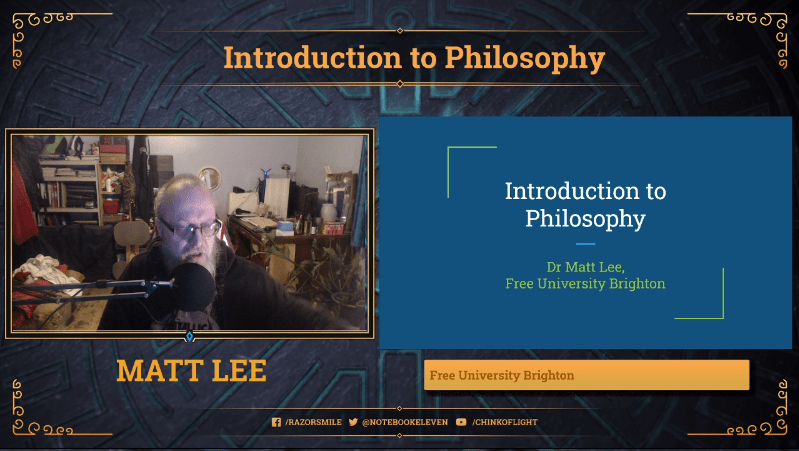
I’ve started a new course at the Free University Brighton, a short 4 week introductory course. The first session this week gave a brief account of what philosophy is and an even briefer introduction to the cogito argument in Descartes. The FUB students then went on to a Zoom seminar for an hour and we had an interesting discussion about thought, thinking and the differences between the way we might usually understand thinking and the way that philosophy approaches it. The sessions are on Monday evenings on Twitch, over here – https://www.twitch.tv/razorsmile – if you fancy helping me out a little then I’d really appreciate a ‘follow’ on the Twitch channel, once I get to 50 followers a whole bunch of other functions open up. (If you want to be super helpful then chuck me a ‘subscribe’ on the YouTube channel too). Anyhoo, here’s the first session from the archived recordings on YouTube.
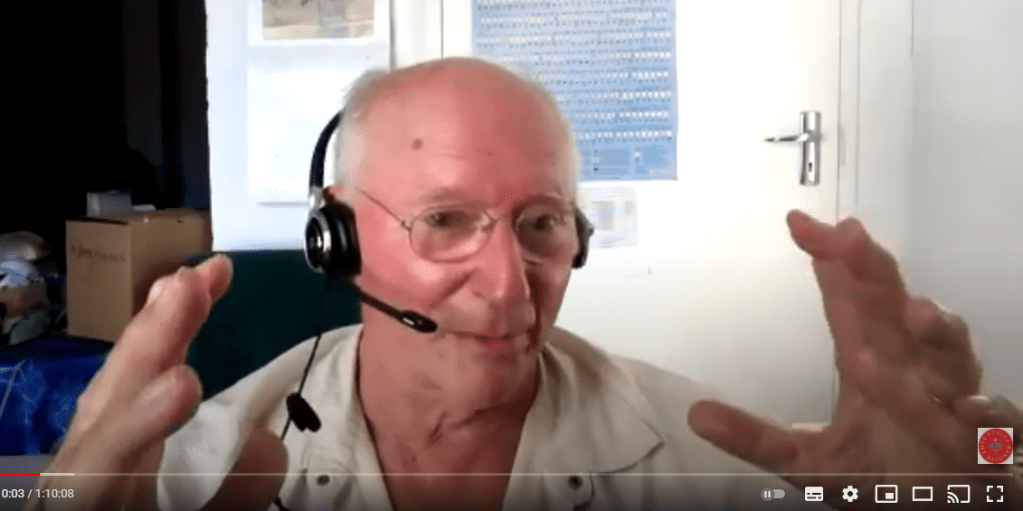
The ever fascinating Ramsey Dukes talks about how he came into magic, his experience of the Abramelin ritual, his connection to early chaos magick and the rebirth of the OTO in the UK, as well as comments on the nature of ritual practice in groups that is insightful.





 razorsmile :: philosophy//magic //revolution