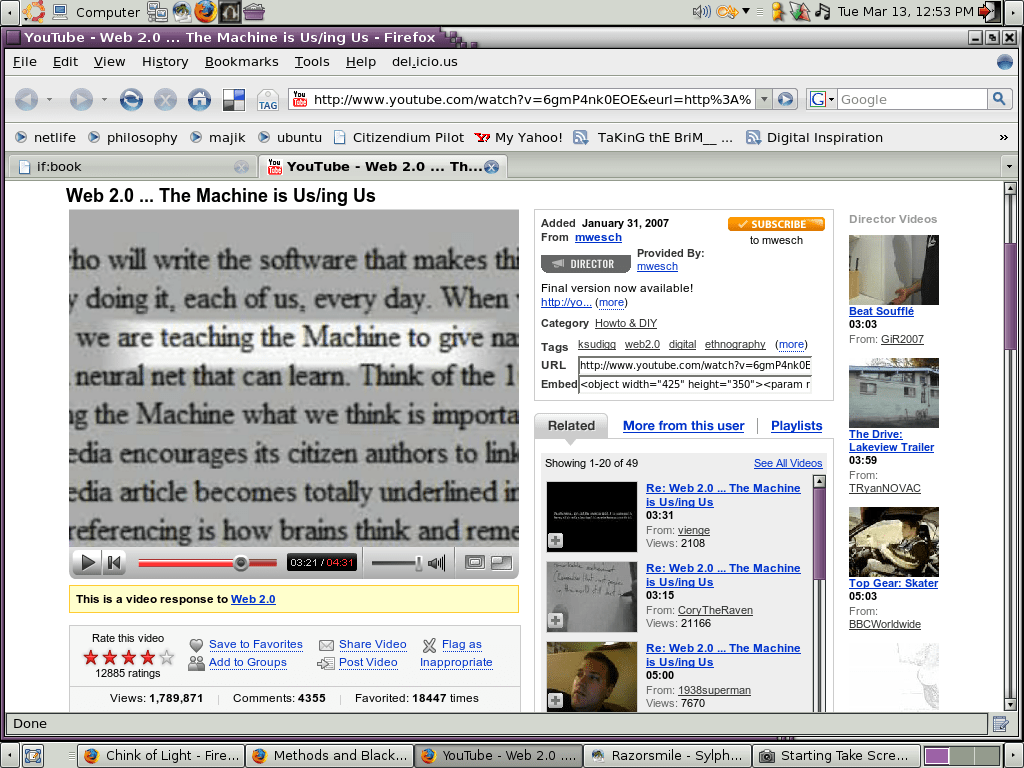

There’s this peculiar video that’s on YouTube at the moment, an excellent example of contemporary pedagogy in many ways, called ‘The machine is Us/ing Us’. It’s gathered nearly 2 million hits and since it’s only about 4 minutes long, probably most of those people have watched it. There’s a beautifully slick feel to the way the video performs itself. It’s about the ‘Web 2.0’ (the new ‘social web’) and it makes use of the text inputs we make on the ‘net all the time to mix and edit between them, presenting its ideas as the video progresses.
The main thesis seems quite basic, though one that needs to be kept in mind perhaps, and that is that the new forms of communication are not, in fact, communication but connection. They do not allow the easier flow of some pre-existing material but in fact constitute new material, new connections and new flows (even though they also might allow the easier flow of existing material). It seems reasonably positive, reasonably human, reasonably thoughtful. In effect I agree with what Michael Wesch says (the maker of the video and assistant professor of anthropology at Kansas Sate University). I also applaud his skill and ability to produce this piece. There was, however (of course there’ll be a ‘however’ 😉 one phrase that occurred that stuck in my mind and which seemed, how shall I say it, strange. It seemed, at the very least, strange.
This phrase was precisely ‘teaching the machine’. Aside from the fact that this assumes the machine can learn it also makes me consider who is the machine? The hint, from the title of the video, is that the machine is somehow ‘out there’ (the society of control in one of its manifestations perhaps) and we are its food, we are its means of sustenance. I was chatting to someone the other day about this, suggesting that in fact the wonders of Web2.0, the whole ‘social web’ meme, is in fact a mistaken perception of the reality which is that the web is becoming a living machine that needs food (clicks) provided by a set of organic creatures (humans) who are nothing more than the food for the beast. The web eats us, eats into us and eats away at us. It’s corrosive connectionpower is in fact a way of disconnecting face-to-face and reconnecting word-to-word, image-to-image, code-to-code. The peculiar power of the face, as Levinas might describe it for example, in offering us an ethical Other, a lived-other, is being displaced and eaten away.
Of course this is nothing more than an apocalyptic thought-experiment. There’s no reason to hold this dynamic as dominant over the more positive hued dynamic usually surrounding the ‘social web’ meme.
One other thought, though, arose from watching the video, which is that the machine that’s being taught is plainly not a PC somewhere, even a network, but instead it’s the machine that is the organic flesh connection, it’s us. In this sense the machine is precisely ‘Us’, whoever this ‘Us’ is. All of this, of course, is hinted at in the ‘slashed’ title of the piece, The machine is Us/ing Us. So far, so trivial then, perhaps. What, I suppose, was the strange thought – and this is nothing more than a question at the moment – is if we are the machine, if it is an Us, then where are they who are no longer the machine, where are Them? And do I want to join Them?


 razorsmile :: philosophy//magic //revolution
Leave a reply to Matt Astill Cancel reply