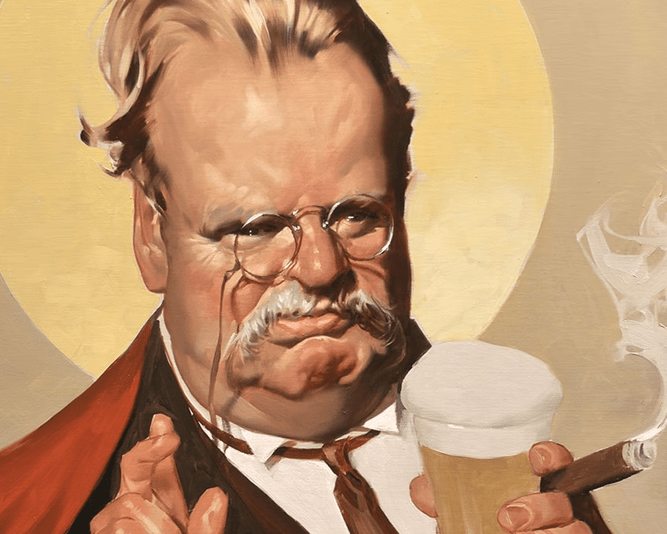
Zizek, in an essay that primarily focuses on the debate between Derrida and Foucault on the subject of ‘madness’, makes some interesting comments on the nature of the limit. To quote at some length:
This brings us to the necessity of Fall: what the Kantian link between dependence and autonomy amounts to is that Fall is unavoidable, a necessary step in the moral progress of man. That is to say, in precise Kantian terms: “Fall” is the very renunciation of my radical ethical autonomy; it occurs when I take refuge in a heteronomous Law, in a Law which is experience as imposed on me from the outside, i.e., the finitude in which I search for a support to avoid the dizziness of freedom is the finitude of the external-heteronomous Law itself. Therein resides the difficulty of being a Kantian. Every parent knows that the child’s provocations, wild and “transgressive” as they may appear, ultimately conceal and express a demand, addressed at the figure of authority, to set a firm limit, to draw a line which means “This far and no further!”, thus enabling the child to achieve a clear mapping of what is possible and what is not possible. (And does the same not go also for hysteric’s provocations?) This, precisely, is what the analyst refuses to do, and this is what makes him so traumatic – paradoxically, it is the setting of a firm limit which is liberating, and it is the very absence of a firm limit which is experienced as suffocating. THIS is why the Kantian autonomy of the subject is so difficult – its implication is precisely that there is nobody outside, no external agent of “natural authority”, who can do the job for me and set me my limit, that I myself have to pose a limit to my natural “unruliness.” Although Kant famously wrote that man is an animal which needs a master, this should not deceive us: what Kant aims at is not the philosophical commonplace according to which, in contrast to animals whose behavioural patterns are grounded in their inherited instincts, man lacks such firm coordinates which, therefore, have to be imposed on him from the outside, through a cultural authority; Kant’s true aim is rather to point out how the very need of an external master is a deceptive lure: man needs a master in order to conceal from himself the deadlock of his own difficult freedom and self-responsibility. In this precise sense, a truly enlightened “mature” human being is a subject who no longer needs a master, who can fully assume the heavy burden of defining his own limitations. This basic Kantian (and also Hegelian) lesson was put very clearly by Chesterton: “Every act of will is an act of self-limitation. To desire action is to desire limitation. In that sense every act is an act of self-sacrifice.”
(Zizek; Cogito, Madness and Religion: Derrida, Foucault and then Lacan, http://www.lacan.com/zizforest.html, Lacan.com 2007; accessed 3/12/2012. The Chesterton quote is from Orthodoxy, FQ Publishing, 2004. The passage is also found in Mythology, Madness, and Laughter: Subjectivity in German Idealism; Markus Gabriel and Slavoj Zizek, Continuum 2009, p98. Emphasis added.)
The reference to Chesterton is interesting, particularly when put back into context. Chesterton is a curious figure, not one I resonate with. For Zizek he appears as a kind of perennial coach. For my part, my distaste probably stems from the whiff of hypocrisy that attends the Catholic intellectual. The suggestion of Sainthood that was apparently once raised in relation to Chesterton only added to that bad smell. Despite this, the role of paradoxical thinking in his work is one that, elsewhere, I have found fascinating and it is no doubt this role of paradox that Zizek latches onto and that underlies that particular formula Zizek extracts. The Chestertonian formula is aimed at those, like Nietzsche, who are taken to have a general and productive or positive concept of the will. The will, for Chesterton, is negative, a privative, restrictive concept that always, by definition, limits by negating. To quote Chesterton, again at some length:
(more…)

 razorsmile :: philosophy//magic //revolution