Category: sorcery

  • Vide, Aude, Tace

    Vide, Aude, Tace

    Pagans, occultists and magicians seem increasingly incapable of being silent.  The horizon of the occult community seems increasingly dominated by the rapid rise of publications, books and trinkets for sale and the increasingly vociferous voices that seem insistent on telling us how it is.  The noise is almost overwhelming, the signal increasingly distorted.

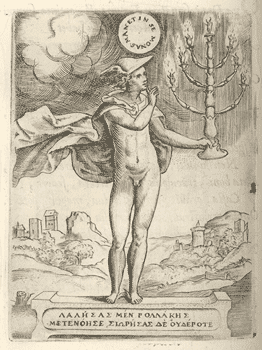
    HermesasHarpocratesHarpocrates, son of Isis and “the god who holds his tongue, and urges silence, thumb in mouth”, has long been a favourite figure amongst magicians.  Usually the connection is with the notion of secrecy, one shared by the masons in the figure of Angerona.  It is the association with secrecy that has been the reason the lesson of silence has slipped away from too many within the pagan, occult and magical community.

    Secrecy is connected with abuses of power, with manipulation and exclusion and often rightly so.  The power of secrecy is partially connected to its capacity to manipulate so this is unsurprising.  It has, like many substances, a pharmakon nature – too much is a poison, just enough is efficacious, but how much is just enough?  Yet Harpocrates is not simply about secrecy, it is the source for the ‘sign of silence’, of the ‘Tace’ in the motto Video, Aude, Tace – to see, to dare, to be silent.  Secrecy and silence are not the same, though closely related.  Secrecy, if just enough is taken, can be a means of binding together those who are allowed into a group and hold its secret as the thread of their interiority as well as a tool for prompting direct experience as one searches for the secret.  Silence, on the other hand, is a source of self-control and a means for opening the ear onto the world.  It is also a consequence of the realisation that all occultists should hold as first principle – words are power.  To speak is to act.   If one insists on simply speaking all the time then most likely what occurs is a directionless acting.

    In our current Western society this notion of silence – of ‘holding your tongue’ – goes against much that informs the implicit imperatives of capitalism.  The idea that one should ‘express yourself’ or ‘speak truth to power’ are thought to be liberating and important to hold to, although this is actually a doubtful truth.  Occasionally these ideas may apply, occasionally, but in general the rule ‘hold your tongue’ has more sense and should perhaps be the default.  Unless absolutely necessary and no other course is possible, holding ones tongue is usually the least damaging course of action – and for one, very simple reason.  To act is to assume knowledge and has great risk because it is almost always certain that something in that situation we are acting on is beyond our knowledge.  To act is to trust in ourselves that our act is a positive effect on the world and such trust should be assumed only with some humility.  To act is to dare.

    Please_Do_Not_Feed_The_TrollSilence also has other benefits.  In communities that exist online, in social media like facebook, forums and blogs, it is too easy for conversations to become explosive.  This is a long recognised factor in internet communication in general and  led to the early identification of the fairy figure of the Troll.  Once identified it was also recognised that the only effective way of dealing with Trolls is to stop feeding them, hence the numerous DNFTT acronyms that sprung up in early forms of the ‘net.  The role of the social media in community life, particularly in small communities of affinity, is highly problematic.  It mitigates against the possibility of silence, because anyone anywhere can simply blurt out anything they want.  Moreover those words, often spoken in haste, drunkenness or anger, can then remain indelibly etched onto the record, lingering and mouldering.   In addition these social media continue on 24/7 whereas the actual community of bodies may only meet once every now and then.  The social media, once thought to facilitate, now becomes dominant and the body meetings become distorted through the continuous presence of the online, often unthought, words that never seem to cease being spoken.

    It’s not only social media, however, that brings the problem of too much talk, it’s also the ‘literary’ nature of many communities, the absence of the oral imperative.  With the amount of books, magazines, journals, musical compositions and media in general people begin to become part of a community only through these disembodied extensions of their selves.  Instead of these media becoming aids and providing assistance, as tools, to a more profound and rounded (body included) community, what tends to occur is that the community disappears into the tools, the texts and medias that fly forth in an era of increasing expression.  This then produces a curious dynamic, whereby if one doesn’t ‘produce’ these things then one doesn’t exist.  The dynamic is to force people to speak, to produce, to ‘express themselves to exist’.  Even when they do produce, however, the drive of the form insists that once is not enough, they must do it again, and again, junkie to the new ephemerality of the mass media form.

    In all of this, in the online disputes, the flood of new productions, the trivialisation and – let’s be frank – increasing stupidity and tedium of these expressions, all that is occurring is the gradual assimilation of the occult community into the wider capitalist imperative (eat, consume, die).  The occult spark itself will dwindle inside these communities, taken up and living on elsewhere, in secrecy and silence.  The occult communities will be unlikely to learn those lessons it needs to as long as it maintains its incessant cacophony of expression, its incessant drive to talk rather than listen, its incessant failure to learn the lesson of silence.

    Consider for a moment what exactly would be lost if everyone simply shut up for a year.  Instead of writing that new article, posting that oh so necessary comment on the latest crucial problem that has flared up online or getting the latest piece of media online and sold out, just shut up and listen.  Stop talking, producing, insisting on expressing yourself.  Stop and read, stop and wait, stop and just be, for a while, someone who watches and sees, who watches and sees not just what others say but how you react to that, how it makes you feel, what it makes you think, what you might learn.  Allow the world to be something your own existence is part of, allow yourself to be visible not to others but to yourself.  Then, before opening your mouth again, think about whether there is a positive answer to the question – do I need to say this? Note that this is not the question, do I want to say it but do I need to say it?  If that need is only for yourself, only because you feel you would burst without saying it, then your are – and should recognise – inflicting yourself on others.  This is not something to be shunned.  At times it is perhaps vital to someone’s spirit to do so but it is, nevertheless, an infliction, not a liberation.  It is necessary to scream into the void at times, but it is still a scream.  We might sometimes need to scream but we must want to stop, to be at a point when the scream is not dragged from us.  We must want to be able to be silent, to desire that calm being of a moment of peace and quiet.  If that desire is to be fulfilled then we, too, must become part of the silence, not the constant, oppressive, cacophony. The lesson of silence is not, in its heart, one of oppression but one of liberation.
  • Cerridwen’s Cauldron

    Cerridwen’s Cauldron

    The full moon this month, November, brings razorsmile and morrigan together to begin the Cerridwen’s Cauldron rite.  This is a year long (year and a day) cookfest, in which each month a cauldron is simmered up for 3 hours, certain things chucked in and cooked, the whole gradually forming a melting pot for the year.

    The rite is one we picked up from a Druid at the local camp of the Anderida Grove, one of the central features of my families magical practice over the last half a dozen years or more.  The Grove holds open rituals at the Long Man of Wilmington, where we first encountered them.  The open rituals offered a space in which the whole family could attend a magical ritual and we took along our three kids on an intermittent basis.  As we got to know the Grove we found out about their twice yearly camps and these provided a weekend of intense community which has proven to be a central defining feature of our magical practice, both for me and morrigan and for our children, who have grown up with a pagan practice in their background life.  Within our culture it is difficult to enable a different spiritual or religious practice to exist in an unforced way because of the dominance of the organised religions.  This is all the more acutely felt perhaps with the raising of children.  It seems authoritarian to impose an alternative perspective on spirituality on one’s kids so the ability to allow such an alternative to simply exist in the cultural background activity is crucial, something the Grove and their camps has enabled and for which I’m profoundly grateful.

    Neither myself nor morrigan identify as druids however, never having joined the Grove or any druid order such as OBOD.  Druids feel like fellow members of a community but that community is diverse and plural, of necessity.  I have long identified as a chaos magician, albeit that this is now unfashionable, and have always felt a closer affinity to the idea of witch craft or cunning.  The craft aspect, the rural and archaic nature of the mythology, the crooked path and the connections with the land form a distinct set of connection points that overlap with the druidic traditions but remain distinct.  In my own case this has perhaps most noticeably manifested itself in the relation to the Greek pantheon, Hekate in particular and later Aion.  These two names are central to my own personal practice although morrigan has, as may be evident from her name, a far closer resonance with the celtic mythologies and traditions.

    The Cauldron rite was introduced to us at the Grove’s camp when it focussed on Cerridwen.  The camp organises a focussed ritual event that involves some 50 or more participants in large scale ritual work and the Cerridwen event involved a journeying ritual, enacted in a mix of psychodrama and physical movement, that recapitulated the story of the Cauldron of Knowledge.  Gwion Bach or Taliesin is a key figure for the druids and it is via the story of the Cauldron of Cerridwen that Gwions’ origin is told.  The Cauldron is a source object, one created by a witch or magician to intervene into the world.  Like most acts by a witch, however, the world has its own dynamics which can’t be foreseen and which take up and transform the initial intentions.  Learning to negotiate the desire and intention to intervene in the world with the unforeseeable intricacies of the worlds own responses to this intervention is a central aspect of the witch wisdom.

    The rite consists of a simple enough procedure.  Each month, for a year, at full moon, a cauldron is heated, not boiled, with specific ingredients added each month.  The ingredients depend in part on the cycle of the year.  The end result is an alchemical mixture, rather than a simple chemical one, because whilst it will have a chemical substrate the length of time the mix is steeped, the continual background presence of the rite, the actual activity of watching the pot heat and the associations this activity builds all lead to a multilayered activity.  It is this multilayered nature of activities which is central to my own magical practice.  The chemical substrate of the cauldron’s contents, for example, are important and I will no doubt find more about these as I go through the rite.  The first ingredients are simple moonwater and pine resin, for example, which chemically produce a hydrocarbon rich liquid base, hydrocarbons providing an active ‘connection matrix’ for the coming ingredients.  The long strings of molecules created in the base enable further molecular connections to be established more easily.  To collect these ingredients, however, we went back to two specific places which have been important to us.  The water came from the first, Hekates Fountain in Brighton, a site of personal work from nearly a decade ago.  The other site, Stanmer Park, is another site of working as well as a place in which one of the family dog’s is buried and where my kids spent large amounts of time when they were young.  Moreover the rite itself and these particular ingredients were collected last year, immediately after the camp when we encountered the rite.  We had intended to begin the Cauldron work last November but the fates thought otherwise.  So the rite, simple enough on its own terms, traces a line of connections through a decade of activity, memory and intention.

    As the candles burned down I covered the cauldron in red leather and tied it tight to seal it until next month, placing it gently back amongst the altar, a mixture of objects practical and symbolic.  I turned to pick up and clear away the candles only to burn my thumb and forefinger quite harshly.  Immediately I was sent into the future, to the end of the rite, which consists of us taking in 3 drops of the liquid, hot and fresh from the cauldron, by dropping them on our thumbs which we then plunge in our mouth to cool, in imitation of the way in which Gwion accidentally tasted from the cauldron in the story.  Still more layers.

  • Sorcery and the minoritarian

    Sorcery and the minoritarian

    There are few things which sorcerers share, indeed this may even be central to the very practice of sorcery itself. To this extent sorcery forms, almost par excellence, an example of the ‘minoritarian’. This concept, derived from Deleuze and Guattari, names a practice of deviation from a standard. It is distinguished from the merely minor, which is akin to a minority practice, by being instead the process of ‘becoming-minor’. Given a standard (‘I should get a paying job to support myself‘) there will be a majority that incarnate this standard and a minority who do not. The minoritarian, however, is neither the major nor the minor but the resistance to the fixation of any standard, major or minor. The minoritarian resists encapsulation and stasis and not out of a voluntaristic decision but precisely as an ‘impulse’ which is active and dominating, if not actually dominant. It is not that the minoritarian is a response to a pre-existing major position but rather it is a necessary companion or contamination of any major position. The minor might be a reaction to a major and capable of being understood only in terms of the major but the minoritarian is a necessary ‘coming along with’. It comes along with any major position. It is, in this sense, an unconscious of forces. If the major is the name we give to the coalescence of forces in a particular configuration, a stabilised set of values and norms, then the minoritarian is that set of forces which swirl on the edges and underneath the central major current. Sorcery, in this sense, is minoritarian – it has swirled its way through centuries and millenia of human practice and will no doubt continue to do so. Nothing, after all, speaks to its demise and everything to its continual existence. (more…)

  • The call of the woods

    The call of the woods

    For the last two or three years I have been mainly working within temple spaces.  These have varied from rooms booked in community centres to my own altar space. The one thing shared by these various spaces however is that they are indoors. This might seem obvious and inconsequential but in fact for most of the time on my path I have worked outdoors. I always used to work indoors as well but the vast bulk of my work, celebratory or ritual, was outdoors.

    (more…)

  • Philosophy and sorcery

    Philosophy and sorcery

    Just a caveat emptor…this is more a list for me, the blog posts are often ‘crystals’ of longer pieces I work on, quite often changing drastically as they develop.  Moreoever the connections between any of these posts will no doubt be less than obvious to anyone other than me, at least until I get the book finished when you would probably be able to track some genealogy.

    • I published ‘What I do as a sorcerer’ over on Gods and Radicals.
    • ‘Memories of a sorcerer’: notes on Gilles Deleuze, Austin Osman Spare and Anomalous Sorceries – available here and here
    • To survive da’ath –  thoughts on initiation as a strategy- short version video available here and details of other versions available here
    • The fluid body – brief note, available here
    • What is chaos majik – with some thoughts on naming and sorcery connection, and the Bartleby tactic, available here
    • Diamond time, daimon time – brief note on temporality (derived from sorcerous working, Aion) available here
    • That which is core being – some notes on individuation available here
    • The breath as an organ – notes on breathing and consciousness available here
    • Ah Pook the Destroyer – notes on temporality (incl. some thoughts on Oak/Holly King) available here
    • Fotamecus – ‘what do we understand by time’ section of project available here
  • My dying breath is a magician.

    My dying breath is a magician.

    breathMy dying breath is a magician.

    This sits, written in chalk dust, on the board, bored bored bored board. Metaphor, all three elements from Aristotle, those elements it’s not supposed to have (supposedly), the tradition that’s opposed (opposedly) by Lakoff and Derrida, with metaphor as domain translations or catechresis as metaphoric literality.

    The moment that is unexplainable is the new. The poetic metaphor. That which is ruled out of court or which doesn’t fit into the domain maps of Lakof (is it one F or two?) and Johnson, that which doesn’t accept itself as catechresis, which isn’t reducible to simply a concept. He focuses on one moment. For some of the terms of the proportion there is at times no word in existence; still the metaphor may be used. Each time the word that seems to be used is a good metaphor and allows someone to see something.

    I never know what to make of this. I remember a long time ago a science fiction story about a community of blind people, about the way in which they adapt their social environment to become a touchable space and interlacing bodies, about – I think – someone on the run who takes refuge in this community, about the strange eroticism of the body in a space where the blind revel in exploring the positivity of the touch that is dominant without ever falling foul of a notion of lack (there is never any lack).

    To talk of seeing things is just too facile. So they use the greek don’t they – theorein – to see. Theoria, theoros, the spectator, theoreo, to look at. Supposedly. The greek root seems to be thea. My dictionary cites it as ‘a seeing, looking at’ as well as, in the listing before that which mentions sight – with a minor change of accent – goddess. But they wouldn’t deign to speak of the goddess.

    My dying breath is a magician.

    The story, the anecdote (good philosophy always needs a good anecdote), is about a lecturer on Hegel, Professor Harris, this is Paul’s anecdote not mine, a lecturer on Hegel who is tedious, boring, Hegelian (all Hegelian’s are fools) and who is being listened to by Paul and his colleague and Paul turns to his colleague and says ‘Harris is Quixote’ but not the Quixote of the first book alone but also of the second where the Quixote of the first book victimises the Quixote of the second who is the real Quixote of the fictional Quixote that Cervantes invents who now reveals Harris as tilting at Hegelian windmills. ‘Harris is Quixote’ is said with some humour but Harris is then lost, like the Quixote of the second book, under the weight of the metaphor, the new vision.

    I see him anew. This is the only form of new metaphor. I see it anew.

    My dying breath is a magician.

    I sit and stare at this chalk dust line. The magician brings about a magical event. The magician transforms things.

    Like a dying breath.

    My dying breath is a magician.

    My explanation is death.

    The metaphor can be paraphrased but the poem cannot.

    My explanation is death.

    “Metaphor is the application of an alien name by transference either from genus to species, or from species to genus, or from species to species, or by analogy, that is, proportion. Thus from genus to species, as: ‘There lies my ship’; for lying at anchor is a species of lying. From species to genus, as: ‘Verily ten thousand noble deeds hath Odysseus wrought’; for ten thousand is a species of large number, and is here used for a large number generally. From species to species, as: ‘With blade of bronze drew away the life,’ and ‘Cleft the water with the vessel of unyielding bronze.’ Here arusai, ‘to draw away’ is used for tamein, ‘to cleave,’ and tamein, again for arusai- each being a species of taking away. Analogy or proportion is when the second term is to the first as the fourth to the third. We may then use the fourth for the second, or the second for the fourth. Sometimes too we qualify the metaphor by adding the term to which the proper word is relative. Thus the cup is to Dionysus as the shield to Ares. The cup may, therefore, be called ‘the shield of Dionysus,’ and the shield ‘the cup of Ares.’ Or, again, as old age is to life, so is evening to day. Evening may therefore be called, ‘the old age of the day,’ and old age, ‘the evening of life,’ or, in the phrase of Empedocles, ‘life’s setting sun.’ For some of the terms of the proportion there is at times no word in existence; still the metaphor may be used. For instance, to scatter seed is called sowing: but the action of the sun in scattering his rays is nameless. Still this process bears to the sun the same relation as sowing to the seed. Hence the expression of the poet ‘sowing the god-created light.’ There is another way in which this kind of metaphor may be employed. We may apply an alien term, and then deny of that term one of its proper attributes; as if we were to call the shield, not ‘the cup of Ares,’ but ‘the wineless cup’.” (Aristotle, Poetics, XXI)

  • Create’n’charge a qabalistic talisman

    Create’n’charge a qabalistic talisman

    Intent:

    Wealth

    Creation:

    We decided the sphere of Tiphareth, centrally located on the tree and associated with harmony, was the kind of wealth we wanted – a quality of success and assuredness in all levels. Checking out the traditional meanings of the four sixes in the tarot cards helped confirm this was the place to be.

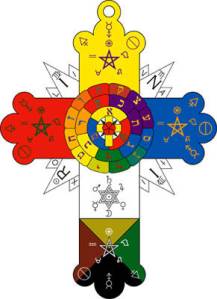
    Cutting a yellow piece of card into a hexagon, using this nifty method yielded two associations straight away and the material base for the talisman. Next, sigils – created using the Golden Dawn’s favoured machine, the Rosy Cross Lamen (pictured). Four holy names, four qabalistic worlds, one cheat sheet in Donald Michael Kraig’s book Modern Magick that transposes Hebrew into English (I didn’t have much time) created four symbols that were transposed in freehand onto the talisman. Then one more – the intent, rendered illegible using the classic Spare method. This final step felt like it added a required personal touch to the symbols through the art of creating a ‘good looking’ sigil.

    Launch conditions:

    Moon: waxing, almost full

    Day: Sunday (day of sun = Tiphareth, innit)

    Planetary Hour: Sol (approx 10.20pm) – This one was interesting because I had all but abandoned the idea of doing the ritual in the correct planetary hour thanks to a bout of inertia during the day. I thought I better work it out just in case, and realised that according to my calculations the planetary hour I needed had started a couple of minutes ago, which was very convenient – and stopped me arsing about any longer.

    Divination: I-Ching hexagram 31, Conjoining. Keywords: influence, connection, excite. Changing lines indicate way is open.

    Body/Mind: Basically, hungover. But through the worst of it.

    Charging Ritual:

    I basically followed the method outlined by Kraig in his book because I’ve used it before and it works.

    1. LBRP
    2. Banishing Ritual of the Hexagram
    3. Middle Pillar
    4. Change middle pillar energy to golden yellow
    5. Grasp talisman in hands and feel energy fill it
    6. Vibrate Angelic Order, Archangel and God names, after first asking for their presence/assistance
    7. Draw invoking pentagram of earth over talisman six times, each time vibrating godname
    8. Place talisman in container – I tried silver foil this time as an experiment, it seemed appropriate
    9. BRH and LBRP again, but I did these the other way round
    10. End

    Notes:

    Not as much physical, kinaesthetic sensations of heat and energy as experienced in past, probably due to poor physical condition of magician. Otherwise, a focused, involving ritual. Felt good and clean afterwards – head fuzziness lifted, perceptions clear.

  • Simple Raphael boon rite

    Simple Raphael boon rite

    June 2nd working

    The group had to divert its work after the initial Enochian operation because of some members having pressing concerns of life and death that they had to spend time on.  One of our number was away and dealing with such an issue so we opened out temple space in the usual way, which takes about 20 minutes to half an hour, then had a brief period of meditation before we devised an impromptu rite.  The intention was to offer support, love, healing, concern – call it what you will – to this other member of the group and to ask Raphael for a boon or aid in that process.

    We placed one member in front of the scrying mirror.  3 others formed behind her.  We settled and then one person gently guided us verbally in a pathworking style entrance to Tiphareth, the Golden Temple with the child and the king.  Once we had reached the child and they had placed their hand on our heart and filled our bodies with liquid light we began to chant the God-name of Tiphareth, YHVH Aloah Va Daath.  We chanted this for at least five minutes, maybe ten, until we began to feel exhausted, each of us keeping up with the other two, the scryer still and staring into the mirror.  We gradually found a resonant place at which the chant faded and left.  The three callers then took a deep breath in, synchronising with each other as they did, before calling our the name of Raphael.  The call to the angel was repeated, as loudly and passionately as possible, with entreaty, a total of 6 times.  The scryer then asked for our boon for our friend.

    The rite was simple, lasting little longer then 20 or 25 minutes.  Most noticeable was a huge amount of energy, all 3 of the callers had tears in their eyes by the end of the call.  The scryer received a strong response and spoke for a little while after asking for our boon.

    We ended with grounding food and drink, chat, settling back.

  • Laying the table

    Laying the table

    Holy Table and Sigillum

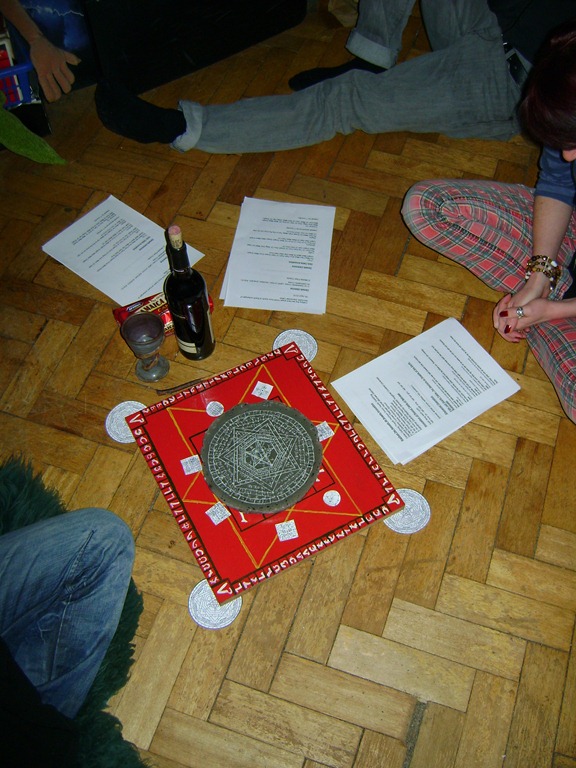
    On Wednesday just gone we gathered together for the first action in the ongoing Enochian work we began this year.  The scryer for the session was unwell, toothache, so the five of us that were there took the Holy Table and Sigillum Dei Aemeth that had been made for the workings and performed the action up to the end of the ‘Temple Ceremony’ as a form of ‘activating’ the table and sigillum.  The script for the rite is linked here and there are some pictures taken during the making of the Holy Table linked to the picture on the left.

    It was a good rite, with a strong LBRP and Middle Pillar chants.  This was very satisfying, as last time we’d been active we’d been using the SIRP.  The ‘Temple Ceremony’ aspects from DuQuette’s book then followed, the 7 chants of the Holy Table side letters, then the 7 chants of the middle 12, each one first 3, then 4.  After this the calling fo the 49 names of the Sigillum and the whispering incantation of the Round table of Nalvage.  We noted that each of us whispering, almost to themselves, the final Nalvage chant had a kind of re-centring role after the earlier chants of the letters.  Those whispered chants at the end were repeated until each person felt they ended, rather than in unison, which may be why they worked like that.

    After that we banished with laughter and chatted about the rite.  Timewise it seemed to take about 35-40 minutes only to get to the elemental scrying operation.  That would mean that there is enough time in the rite so far for there to be a comfortable scrying session of anything from 10 minutes to half an hour, with possibly room for other activity after the scrying if we wanted to consider that at a later point.  It’s possible we might find scrying sessions go on longer, though I doubt it at this early stage of the work.