Category: rebellion

  • As an introduction to schizo-analysis: responding to ‘The Anti-Oedipus Papers’ (unfinished notes)

    As an introduction to schizo-analysis: responding to ‘The Anti-Oedipus Papers’ (unfinished notes)

    (First published Jan 1st 2007, minor edits made.  Republishing Oct 3rd 2019, as I start my second run of the course ‘Schizoanalysis for Beginners’).

    There is a background to every text, a life, a thought, an obsession, a spilt cup of coffee on papers badly placed on a temporary desk. Good sex, drunken rants, flirtatious concepts, all of these form part of that which will never be said within the text, only ever sensed, occasionally and differently, by the readers and writers who follow the words along the page. This, maybe, is why people want to read biography, interviews, trivial detritus from the lifetimes of another, the writer, the author, the proper name appended to the title. When the text is one within philosophy there’s this sense that somehow knowing about the brandishing of a poker or the peculiar arrangement of garters, socks and toilet habits, somehow knowing this will help know the concepts. This betrays a latent humanism, most often, where we want to know what the author thinks, we want to discern accurately, so we think, the moments that occurred in someone elses’ mind and re-occur them in our own. There seems no reason to assume this humanistic notion of a transport of ideas from one mind to another as the central task of reading and interpreting a text. There seem many reasons to assume that a text is in fact nothing to do with an author to the extent that the act of reading occurs without any author and if the text works it works without an author other than the reader. Would it matter, say, that the images and ideas drawn from a book that had been read under one name suddenly found themselves shifted to another name? It might matter in terms of understanding the author but surely the point of reading is to understand the ideas and images not the author? Otherwise I would always be in a better position to understand an author by talking directly to them and not reading their work? The author really does seem somehow redundant, theoretically, since it is the ideas and images that we are interested by and in.

    Despite this, those texts that occur on the margins of ‘real’ texts, authorised works, always seem to have a strange, uncanny necessity to them. This is no less the case than in ‘The Anti-Oedipus Papers’ by Felix Guattari, a collection of strange and varied notes and jottings produced in the course of writing, jointly with Deleuze, the work ‘Anti-Oedipus’, the first volume of ‘Capitalism and Schizophrenia’. When I first acquired this text a few months ago I read through it quickly and briefly, finding it strange and impenetrable, dismissing it as a rather weak and perhaps idiotic collection put together more as part of an attempt at hagiographical recuperation than intelligent concept creation. Guattari is increasingly viewed as an aberrant force on Deleuze, the ‘wild’ infecting the ‘pure’, lunacy implicating itself into rigour. Zizek is no doubt the main location of such a view (in his ‘Organs without Bodies’) but it’s not isolated to him alone and the increasing interest in the central and more ‘classically philosophical’ work such as ‘Difference and Repetition’ also appears at times, justifiably or not, as the result of an attempt to subtly, perhaps even subconsciously, purge Deleuze of Guattari. In this context ‘The Anti-Oedipus Papers’ (henceforth AOP) might be thought as an attempt to regain the crucial duality or pluralistic-monism of the name ‘Deleuze-Guattari’. All this, however, would be to miss the point or purpose of the AOP. There is no hagiography here, nor any attempt to somehow provide evidence for the absolute necessity of the double name. Instead there is a kind of compassion.

    The AOP is first of all material. There is an introductory essay but I will ignore that, as though it doesn’t exist, since the papers themselves need to live. This time I decided to re-read the text during the xmas holiday break. I had picked the book up again a few weeks ago and for a while it sat, barely touched, on the bedside table where an ever shifting pile of texts moves through the dream-world of evening reading. These texts are usually chosen through a kind of intuition, something hinting at their interest, some curious phrase, name, image or event suggesting that, for some reason not yet clear, they will be of interest. Commonly this is the place for poetry and novels, my work-desk covered in philosophy texts, administrative bureaucracy and the portals to technological otherspace (internet, psp, mobilephone, digital camera). The bedside table texts slip inside the peripheral boundaries of reason, occasionally exploding into an event, text, lecture or image. They are the necessary distractions, the differential grenades.
    As I skimmed across AOP this time I came across the odd phrases, lines and words that seemed incomprehensible and instead of dismissing this as something for which I had no time instead felt comfortable in a language of sense beyond sense. It was clear as I read that there was this enormous production of words and the further I read the more I returned to my time of reading Artaud. That was a time, during the writing of my doctoral thesis, that lasted about 6 months, when all I did was read words of Artaud, about Artaud and with Artaud. It produced almost nothing of use in the thesis, no chapter, no ‘theses’, no critiques or necessities or tools or arguments or images but instead it provided a massive affect of wonder, joy, sadness and life. Resonance. There is no reason for resonance, though it may be analysed and its genealogy traced. The production of resonance, however, is a moment of beauty in the encounter, the moment when something contracts and forms itself as a crystal of thought to be taken and warmed during the course of the following times. A quote, a phrase, an image, these are usually the tokens of such resonance, tokens that we then exchange in the snake-oil discourse that surrounds and constructs our sociality. The resonance itself is, at its purest, something that cannot be contracted, something that resists being repeated through tokens and calls, instead, for a loyalty or trust, a kind of honouring of its existence. This is the case with Artaud and it is no surprise that the doorway into Artaud led through the Deleuzian phrase ‘bodies without organs’, which I took as a token of the ‘Artaud-encounter’ and which proved no mere token but rather an introduction, in the sense in which Heidegger introduces us to metaphysics. AOP, in this sense, produced a resonance, a kind of material space of encounter in which Anti-Oedipus is introduced as no mere text but as a production of newsense, an introduction to schizo-analysis.

    I am not writing a review then. A response perhaps. Last night, for example, as I sat with a friend of mine whose currently training in clinical psychology having completed his MPhil in philosophy a few years ago, we were discussing the practicalities of schizo-analysis. There is, I said to him, something that must be irresponsible in schizo-analysis. The analyst must act responsibly to achieve the state of power that constitutes ‘being an analyst’ but from them on, if they are to engage in schizo-analysis (and if they don’t then they essentially fall into the power relation they’re constituted by, with its attendant inevitability of having ‘power-over’) they must allow the irresponsible in, for this is the condition of experimentation without theory, the condition of being able to analyse without the oppression of the imposed theoretical construct enforcing a rigid and static meaning on the analysand, converting, at that point, the therapist as the rapist. To break theory, the flow of theory, and intersect instead with the actual, with the presented as presented flow, requires some irresponsibility. There is no way of being accountable for the break with theory, there lies within it a kind of megalomaniacal belief. This, I said, was found in the repetitive trope of ‘fuck it’ found in AOP, the way Guattari releases a frustration through this language. Fuck it, fucking hell, what a fucker. It’s akin to the exclamation mark, the mark of passion, another frequently used mark or word in AOP.

    Then there’s this sense of Guattari struggling with words – words, words, more fucking words. The same thing that animates any writer, something that occurs in the nomination of oneself as writer, that desperation, the fact that, as Deleuze says somewhere, we only write about that which we don’t know. I write and then I read what’s written and try to understand why I wrote that, how I wrote that, who wrote that because it wasn’t me. As the project nears its formal completion and ‘Anti-Oedipus’ is finished Guattari cries that he will be held to account, people will ask questions, he will be thought to be, somehow, responsible for the words and that he has tried hard to avoid this previously. Before ‘Anti-Oedipus’, he wails, he was able to walk away, turn his back and say nothing, say something else, explode irresponsibly as a flow, rather than an in-dividual, as an endpoint to flow.

    There’s this strange relation to analytic theory as well. Guattari take liquid ecstasy and tells his partner that he wants to fuck around. His molecularisation concepts impinge themselves and he holds to the delirium of the drug as a truth, somehow revealing the real Guattari, the liberated flow, when as we all know, the drugs flow, not you. That which is said on drugs is nothing other than the drugs. There is no ‘real flow’ unblocked by the chemical, just another flow which we’ll be attached to through a kind of family resemblance or filial link. “It came from mymouth thus it’s affiliated with everything else that comes from mymouth”. The reality, of course, is that a thousand angels speak through mymouth, the hiss and buzz of the goetic hordes, the insectoid machines of signification bubbling over desires incarnated in chemical interactions.

    The same imposition of theory onto flow occurs as he analyses his relations to fanny and gilles, the former who he wants to fuck, and the latter whom he seems to conceive as someone he must want to fuck even though such a desire is inapparent, hence, obviously, repressed. Fucking is taken as somehow meaningful in itself, as revealing something, other than the chimplike movement of bloodflow, hormonal interaction and a remarkably sophisticated antenna for opportunity. Everyone would fuck everything if they had the opportunity. The interesting thing is not why they do, but why they don’t. The break is the point of creation in the fuckflow. Guattari appears in these texts as classically heterosexual, for whom opportunity is inscribed in woman and not man and yet whose theories tell him such inscription is after the fact, that desire is genderfree, polymorphic. If the fuckflow is polymorphic, the breaks reveal the creation of something, indeed, but not necessarily a repression – it may as likely be a compression. That the opportunity is inscribed in woman more than man for the male heterosexual is no different, no more repressive, then if the fuckflow is inscribed predominantly in the same sex. It’s simply an asymetry. Nothing more. Where is the repression? Nowhere other than the theory, deriving its values from pre-theory, from a systemic asymetry that is no longer part of the fuckflow but which predominantly presents powerflow.

    My response to AOP then is a reponse to a text that is not intended simply as the presentation of ideas, content separable from the presentation, but like poetry or novels, contains a production that is entwined in its presentation. It’s the material for a schizo-analytical re-reading of ‘Anti-Oedipus’ and schizo-analysis itself, the non-existent form of analysis, the peripheral possibility of revolution rejected by the analytic community almost everywhere. As such, perhaps, it offers once again the glimmer of the possibility of revolution in the practical work of desirefuckedup that is the condition of possibility for analyses as a practice. This glimmer can be named; compassion.
  • Making a body that questions

    Making a body that questions

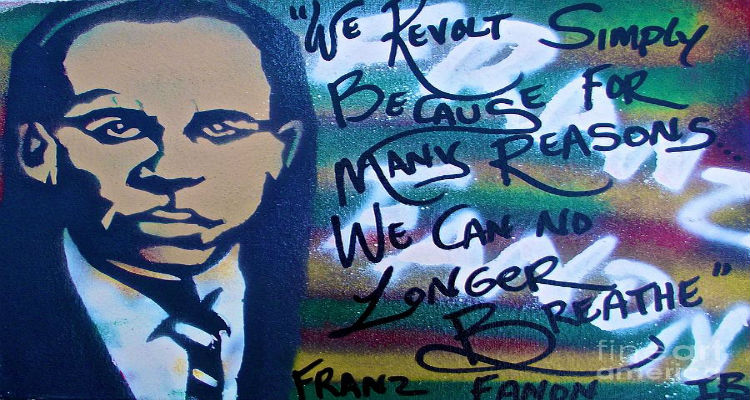
    franz-fanon-tony-b-consciousThere’s been a little flurry of activity, with regards papers and the like, over the last month or so and the last part of that flurry was a lecture and workshop on the work of Fanon, held at Goldsmiths University on 13th November.  Eric Harper, with whom I’m writing a book, co-presented and the session consisted of a short lecture by Eric and then me, followed by an hour and half workshop.  I will post some reflections on the session at a later date, hopefully later this week, but for now here’s the notes I used as the basis of my lecture, mainly made available because I said I would do so for the participants.  As with most lecture notes, I expect they are slightly fragmentary for anyone who wasn’t at the session.

    thumbnail of Makingabodythatquestions (1)

  • Molecular revolution – on the question of organisation

    Molecular revolution – on the question of organisation


    I gave this paper at a recent workshop in London organised by a seminar of philosophers, psychoanalysts and artists.  It’s a para-academic space that I’ve been attending for a while now and which has proven to be one of the most open and constructive intellectual places I’ve know in recent years.  To that end it enabled a little ‘loosening up’ of the academic rigmarole which meant some slightly more experimental, ‘in formation’ thought could be articulated.  I’m still working on Guattari and will no doubt have to continue for a lot longer, but the interplay between the machinic or algorithmic, the potentials of big data, the impacts on subjectivity and revolutionary desire and the possibility of perhaps escaping the liberal individualist mode of political thinking is what lies behind the work here.

    thumbnail of MolecularRevolution -draft two

    There’s a copy of the paper on my Academia page as well if you happen to be on that site.

  • Some thoughts on democracy and the death of Tony Benn

    Some thoughts on democracy and the death of Tony Benn

    RIP Tony Benn and Bob Crow
    RIP Tony Benn and Bob Crow

    Tony Benn – “I think democracy is the most revolutionary thing in the world, because if you have power you use it to meet the needs of you and your community.” Interview with Michael Moore in the Movie Sicko (2007)

    The first time I met Tony Benn was on the way to the ICA in London to see him speak, sometime in the 1980’s when I was maybe 16, 17 years old. I was walking down the Mall and as I reached the traffic lights I realised that Mr Benn was standing there with me. In my youthful enthusiasm I blurted out ‘I’ve come to see you speak’…and was met with a warm smile and a gentleness that was quite remarkable. We chatted briefly as we walked together towards the ICA, nothing particular being said but there was a warmth and openness in the man that was remarkable. He was also noticeably smaller in stature than I had imagined and it was one of my first realisations of the distortions of the media. The image is always, in large part, a construction of the audience and the frame within which the image is presented. One of the subtle characteristics of the image as presented by the media is to make it seem bigger than we are, it presents a person as larger than life. In this way the media disempowers us, makes us subject to a world formed and framed for us in a particular way, a way that is not neutral but which is always driving us to feel the world to be ‘bigger’ than us, out of our grasp, beyond our control. Benn knew the power of the media but he also realised the problems and perhaps this was what motivated his energetic round of public meetings, direct presence in the face of the people. To come face to face with people is to bring the human back to earth, to let us face each other as equals, something impossible within the media-audience framework.

    The next time I met Mr Benn it was at another public meeting he was speaking at. It was 1990 and I was now in my early twenties and a poll tax rioter, charged with public order offences following the March 31st Trafalgar Square demonstration against the Poll Tax. I was Chair of the All Birmingham Anti-Poll Tax Union, a city-wide alliance of all the local campaigns, and was organising a public meeting as part of the defence campaign for the 350 plus people arrested at the riot. I was, as the saying goes, ‘in struggle’ and when I phoned various Labour lefty MP’s there was a mixed response to my requests. One left wing MP actually pretended to be someone else on the phone in order not to actually refuse the request whilst wiggling out of any actual public action of support. His accent was so noticeable and familiar that it was a truly bizarre moment. When I got through to Mr Benn, however, the same warmth and gentleness was there that I’d first encountered at the traffic lights on the Mall. We chatted about the meeting time, the request to speak having been accepted quickly and with an encouraging ‘of course, of course’.

    The last time I remember seeing Mr Benn was at the ‘Pig in Paradise’ in Brighton, where he was speaking about the Ragged Trousered Philanthropist. By this time I was maybe in my early to mid thirties. I’d been to prison then gone to University after being unable to get a job again as an ex-convict and was at that time studying for my doctorate in Philosophy. I was still politically active in some forms, although the political atmosphere seemed deeply conservative. Even the old Trostkyist groups I had joined in my youth appeared to me, as they do now, to be little more than conservative remnants of an older time, lacking any real vitality. I was by this time a ‘left communist’ of sorts, a position I’m still in, albeit no doubt idiosyncratically. It was prior to 9-11 and the anti-globalisation movements were about to explode onto the streets in the J18, Seattle and Prague demonstrations. The words of ‘The Coming Insurrection’, “nothing appears less likely than an insurrection but nothing is more necessary”, were yet to be written but expressed the position I felt at that time towards the world, where the media formed appearances had ground down my political imagination. Benn spoke eloquently, as always, about the Robert Tressel novel and as he did so his words reattached a few of the ever present threads of resistance and the possibility of my own rebellion was reinvigorated.  It was like rekindling a memory of hope for the future through the practice of remembering the past and his words gently rended part of the veil of media imposed illusions.

    Words, in themselves, will never change the world but what they do is renew the conditions for change, the conditions that enable us to remember who we are in the midst of oppression and irrational social structures that alienate each of us everyday in a thousand little ways. Words and discussion and memory enable us to learn and if we are to learn from the example of comrades like Tony Benn then we might do well to learn from the way in which he appeared to encounter the world as populated with actual, real people rather than ‘voters’. In the many plaudits for Tony Benn from hypocritical media imbeciles one of the things that appears often is a realisation that Benn presented a sincerity that is deeply lacking in modern political life. ‘I didn’t agree with what he said but he was honest and intelligent’ says the bullshit artist intent on manipulating even the death of their enemy for their own advantage. Yet the need to recognise the sincerity in someone like Benn is akin to the way that these same bullshit artists manipulate the concept of democracy to establish their own power over others.

    “Nothing appears less likely than an insurrection but nothing is more necessary”. It is the appearance itself that often holds us in thrall. Yet this appearance is fragile, it can shatter with a momentary event, a word, a brick through a window, a smile, a moment of face-to-face contact. Benn believed deeply in democracy and in a way that always appeared honest and open. He knew, I’m sure, that power needs to clothe itself in the appearance of democracy, that power needs to make us believe that this world of Western capitalism is the best of all possible democracies. Yet power needs to clothe itself in the appearance of democracy precisely because actual democracy is deeply desired by all those for whom power over others is not the goal, for all those for whom money is not the goal and for all those for whom freedom for one is freedom for all. It is – it was –  Benn’s continual willingness to maintain the possibilities of democracy that is perhaps his most important legacy, his willingness to realise that democracy is not a tool for power but a means for living in a social framework that is not oppressive.

    Just like the word ‘communism’ the concept of ‘democracy’ is so deeply tainted by its association with capitalism that we face a dangerous problem. If our best hope for free social formations is turned into something that appears to be the primary tool of our oppression then it is not surprising that we find ourselves left with little idea as to how to construct another, better world. The very possibility of a better world must be reclaimed but to do so we need to take that positive commitment to democracy that Benn had and renew it. We need a concept of an insurrectionary, pervasive democracy. We need to reclaim the concept from the appalling poisoning that has occurred via the phrase ‘Western democracy’ and begin practising and experimenting with democracy, with what kind of conditions are needed for democracy.

    When Benn said that he was leaving Parliament to engage in politics the truth of this statement gives us at least one hint towards some of the conditions that might be needed if a democratic practice is to be broken from its poisoned position. Voting is not enough, not even regular voting. Rather what is needed is a pervasive democracy, one that underpins our social existence in all its aspects. Democracy requires educated, communicative, empowered people for it to operate. It requires real contact between individuals, it needs face-to-face communication where the media is no longer able to frame our thoughts in its own agenda of money-making. Democracy also requires a deep and consistent awareness of its dangers and its capacity to manipulate.

    The great secret of western democracies is the capacity to keep control of information and education, to keep control of the very possibilities, the very choices, that are on offer. At the heart of this is the claim that only ‘democratically elected individuals’ have legitimacy. Yet this is the negation of democracy since by definition some are more equal than others in this situation. Democracy, in our current situation, confers ownership rights, just as being the ‘boss’ confers ownership rights. In the case of the ‘elected representatives’ that ownership is over our voices and lives. The media and the class of ‘political representatives’ treat the people as so many numbers, quite literally, for whom they can ‘speak’. The greater the weight of numbers the greater the weight of their voice, their supposed ‘legitimacy’. ‘Western democracy’ is a peculiar inversion of the spirit of democracy, conferring autocratic rights on a few whilst pretending, with a straight face that must take some practice, that it is ‘our voice’ that is being heard.

    A pervasive, insurrectionary democracy would be one in which the very idea of another speaking for me would be anathema. It would be a situation in which the act of insurrection would be one in which democracy was being expressed rather than repressed. If my voice is incapable of being heard then my body is all that remains if I am to remain free. Pervasive democracy must move away from ‘deciding for everyone’ and become a mode of ‘people deciding’. Actual concrete individuals need to be brought back into the practice of democracy and this can only be done if the general practice is for democracy to be localised, personalised. Democracy must pervade everything, from the workplace to the family to the use of land. Those whose needs depend on the decision are those who should be deciding.

    For the most part the decisions of our ‘western democracy’ impose themselves on us in ways that are too abstract for them to ever take account of their effects on the people democracy ‘speaks for’. We need to develop and demand democratic practices everywhere a decision effects us. We also need to develop the capacity to complement this with the ability to stay out of other peoples lives when not wanted, to not impose on others our own moral standards, to not convert other people into abstract numbers in our own power schemes. To do this we need to allow insurrection to be a limit form for our decision processes. How might we tell when we have imposed on others our own decisions rather than communicated with them to make a decision? When they revolt, when they resist, when they rebel. Insurrection then shows us when we have succumbed to the prime danger of democracy, the danger of deciding for others. Insurrection then becomes the friend of democracy as it reveals the limits on where we should be deciding for others and pervasion becomes the ground of democracy as it enables everything that effects our needs to be open for social decision.

    Democracy is a deeply complicated concept.  Its goal of enabling individual freedom within a social framework can only be achieved by acknowledging its capacity to allow some people to impose the power of the social framework on the individual with a more insidious authoritarianism than any dictator has ever possessed.  It is time we no longer relied on the concept of democracy to solve our problems without thinking and instead realised that it is only by thinking through the problems of the concept of democracy that we might begin to establish an actual, real, human democracy.  To do this we must begin by realising the deeply troubling nature of democratic legitimacy and its role in imposing power on us rather than enabling power for us.

  • Speak truth to power and let us think again

    Speak truth to power and let us think again

    speak truthIn the face of neo-liberal austerity there often appears little real hope that another world is possible.  Mainstream political parties form their new consensus around the orthodoxy of market capitalism.  This new consensus disempowers the alternative, which is its purpose, shifting the terms of the debate so thoroughly that any opposition appears to be little more than an unhelpful resistance to reality.  The mainstream politicians might even respond to protests against austerity with paternalistic sympathy – ‘we know it’s difficult but we all have to make sacrifices, hard times force hard decisions.  They might even believe this, arguing that the job of a good politician is to lead their electorate through the difficult times, enabling the decisions for the greater good to be implemented in the face of individual and local group opposition.  The anti-austerity campaigns, when they do seem to gather any degree of support, appear as local issues – a hospital closing here, a service cut there.  Opposition to austerity is local and as such over-ridden by the needs of the wider community that are supposedly articulated by the new consensus of the market economy.  The terms of the debate have already been set and whilst they exist all local opposition is little more than part of the process of implementation, grit in the wheels no doubt but those wheels of change keep turning, fundamentally driving in one direction.  Of course it is necessary to oppose actual local cuts in any opposition to austerity, as such local campaigns are crucial, but without producing a change in the terms of the debate then one local victory today will likely just postpone tomorrows loss.

    It is possible, theoretically, to conceive of politics outside of elections and politicians.  In the actual everyday world of politics, however, the terms of the debate are fundamentally determined by the options available at elections.  Those options have to, moreover, be more than theoretical – it is no option to have a candidate on a ballot paper who will always lose.  This was the key Blairite understanding with regard the Labour Party.  Blair was clear that if Labour was to be an option, in actual politics, then it had to be an option for power, it had to be ‘electable’.  He also began, of course, from the parallel assumption that the new consensus of the market economy was a dominant within the population.  Thatcher had done her work, which was fundamentally orientated towards the culture of the population.  She had established the power of the new consensus of the market economy, made it a viable option through forcing it into existence.  Thatcherism established a new common sense – that closed shops were negative, that unions were undemocratic, that people were individuals who succeeded or failed financially on their own efforts, that  the state was a blockage in people’s lives rather than an enabler.  The negative experience of the state under governments that identified as socialist or communist, a negative experience that was partly real and partly generated by the long term propaganda of the cold war, produced fertile ground for the new consensus on the market economy.  A radical, strong political faction – the Thatcherites –  who believed governing didn’t rely on consensus but understood, instead, that it rested on power enabled this fertile ground to be ploughed deep and the seeds for the future – our current reality – to be planted in almost ideal conditions.  The downfall of Thatcher, almost inevitably, came when she pushed the limits of her power to the point where another power appeared on the horizon.  The more sophisticated members of the new consensus understood that the appearance of alternatives was necessary but that it had to be appearance, not reality.  Power is fundamentally like a sorcerer’s illusion, wielded only as long as the illusion is maintained, as long as consent is obtained.  As soon as such consent slips, the power dissipates and so the purpose of the post-Thatcher Thatcherites (Blairites) was to maintain the illusion through maintaining consent.

    Consent is a curious concept and one that is easily misunderstood.  Consent is fundamentally passive, rather than active.  If power rests on consent, consent in the illusion of power, then passivity is vital.  Passivity can itself take a number of forms.  It can be simple passiveness, a not-doing-anything, for whatever reason, usually because there is no impetus, no need to bother.  It can also take a curiously active form, where the ‘lack of consent’, the opposition, becomes a form of acting out.  In this latter form the passivity arises from the impotence of the opposition.  The child may not consent to the imposition of the will of the adult, might even throw a tantrum, embarrass and anger the parent, but usually this stays at the level of impotence.  The child throwing a tantrum is impotent.  In part this impotence, this lack of actual challenge, is vital to the capacity to throw a tantrum.  There is a need to know, or feel, that the tantrum won’t actually destroy anything, won’t change anything fundamental.  In politics analogous complications also arise.  Passivity through impotence is comfortable.  The danger of comfortable opposition is perhaps the greatest threat to the destruction of consent and the possibility of actual change, the possibility of opening the doorway to another world.  The danger of comfortable opposition arises from the reactive, fixed, settled reality of the opposition.  To be able to oppose is to be able to be comfortable in opposing.  At the point at which opposition becomes a matter of life and death, then it becomes no longer possible to oppose – it becomes necessary.  Of course, the more that opposition is actually necessary, the less will be the numbers of those who choose to oppose.

    To oppose a policy, of austerity or cuts for example, is to remove consent from it and in doing so make oneself feel not responsible.  This lack of responsibility is gratifying and the righteous indignation of the left appears too often to be little more than a self-gratifying denial of responsibility for what is happening, a kind of emotional crutch to make things seem better – ‘at least I’m doing something, it’s not my fault if nothing changes’.  Now there is truth in the claim that the responsibility for what is happening rests with those in power.  That is not the issue.  The issue is, those in power have power through consent, consent is obtained through maintaining the passivity of those ruled and so the real question is to do with the increase or decrease in passivity.  Do my actions increase or decrease political passivity?  To increase political activity involves producing non-impotent alternatives and only then can the possibilities of other worlds begin to appear real, rather than ideal, actual rather than abstract.

    This is in some sense a pedagogic question, although that is something I’m likely to say no doubt, given that I’ve been in the field of education for a while now.  The task of an educator – at least an educator in philosophy, although I suspect this holds for a wider realm of subjects – is to produce an active student, one that engages with and thinks through the material that is being studied.  This ‘thinking through’ is complex.  For example, there is a need to develop familiarity with the terrain of a discipline, the landscape of the area, so that students of philosophy need to know some of the history of the subject, they need a rough sense of the lay of the land.  They also need familiarity with some specifics, some concrete arguments, problems and solutions.  This is a little like learning openings in chess – if you make this move, then that response can be made in return.  In the end, however, a student who could only ever reproduce a few key moves within a general description of historical contexts would never have actually got to the essence of the matter, the ‘thinking through’ the material.   They might be able to re-present the material but would never be able to present any ‘new’ thoughts.  So when teaching philosophy we seem to encounter at least two different types of students.  On the one hand, those who are ‘good students’, studious, learn the material, regurgitate it well and in doing so earn a good grade, easily passing but never quite getting beyond good functional essays.  They will pass, often quite well, occasionally even with a first but will never have said anything interesting in the whole time they are at University.  On the other hand there are students who are troubled by questions, trying to find answers and who often rave about new ideas or new arguments, whose passion takes them into the subject but who will gradually come to encounter the weakness of the vast majority of their ideas when faced with anyone who actually disagrees with them coherently.  In the case of the first type of student (studious student), the educators task is to try and find a way to get some piece of philosophy to bite them on the arse, to get some idea or thinker to say something that disrupts their studious, organised, disciplined life and which will then push them beyond simple functioning into the need to actually think.  In the case of the second type of student (troubled student) the educators task is to find a way to gently show the weakness in their current fascination, the closures it brings with it as well as the openings it seems to offer and to do this by offering a way into the resources provided by the history of philosophy.  In both cases the task is to increase the active aspect of the student, but in each case it is done quite differently – crudely speaking, on the one hand we might need to inject imagination, on the other hand we might need to inject humility.  These are, of course, crude outlines of a much more complex process.  The central point, however, is the primary directive: increase the active forces, the capacity to actually think for yourself, sometimes by speeding up, sometimes by slowing down.

    There is in this sense something similar needed in the opposition forces, those opposed to the new consensus.  The traditional left operates on little more than a continuous ‘forward, forward, quicker, quicker’ process, shouting at the top of their voices about the horrors, the terrible deprivations, the need to do more and do it more often.   Attend this demo, this meeting, this group, this next thing, tomorrow, today, yesterday, all-day, everyday.  This incessant ‘activism’ is the studious student, the one who is ‘doing the work’ but in doing so is little more than a functionary, literally, someone fulfilling a function.  The function of the vast majority of the left is, in reality and in spite of itself, to enable passive non-consent.  This is not the function they believe themselves to have and it is not the only function they can have but in effect, in objective terms, given an understanding of the role of passive non-consent within the maintenance of power, this is their role.  This is clearly a claim that will make few friends, not least amongst the radical left that I know and which I am/was part of.  To offer some further comments to try and back up this claim that the radical left functions to enable passive non-consent (in reality and in spite of itself) I would point to two factors that I think would be interesting to examine.

    The first is the ‘throughput problem’.  This can be thought in terms of a question – if we were to ask, how many people in the population have once been a member of a radical left or anarchist group, do you think that number would exceed the number currently involved?  Now, by a factor of what?  Are there twice as many ex-members as members?  Three times as many?  Four times as many?  Or is it, as I suspect, nearer a ten-fold factor, possibly larger.  Let’s be clear about what that might mean if it were true.  At present, let’s say, we might estimate there to be 10,000 people organised into the radical left and anarchist groups.  If the number who have passed through is a factor of ten greater than that then we are talking about 100,000 people.  That is a mass party, albeit still a small one, but a mass party by any reasonable standards.  That is not a ‘small sect’ or whatever else we might derogatarily call the radical groups.  There seems to be – and I stress this is impressionistic at this point – a far larger number of people who ‘have been members’ than ‘are actually members’.  Why is this?  Is it because most of those ex-members are now right wing, no longer part of the radical left?  In some, rare, cases yes but in most cases no.  It is, for whatever reason, primarily because the radical groups did not keep their members.  Let me emphasise this in case it passes by too quickly. The problem of throughput is the responsibility of the left groups – as opposed to the responsibility of the individuals leaving.  It is a failing of the culture and structures of those groups, one that is fundamentally problematic.  The great danger is in explaining away this failing, in assuming that ‘it’s not our fault, nothing could be done about it because of (X, Y, Z – insert your social, philosophical, economic analysis of choice here)’.  To explain things away is to make excuses,  to make make ourselves comfortable in face of a reality that challenges our ideas of who we are and what we think.

    The second factor I would suggest is what we can call the ‘intellectual problem’.  Why is it that the intellectual wing of the radical left is so weak?  In previous periods of time the intellectual wing of the Communist Parties could engage the intellectual wing of the wider community, there were key strategists and theorists who were plainly from within the radical left and who were engaged with in the wider intellectual community.  The last flowering of the radical left intellectual who seemed deeply connected to radical left parties was perhaps the eighties, and the effects of that in terms of Euro-communist thought were probably a part of the development of the new consensus.  Yet at the moment there are radical left intellectuals on the horizon again, from David Harvey to Daniel Graeber to Alain Badiou and Slavoj Zizek, but their connection to the radical left seems – again, this is impressionistic – weaker than in previous times.  Where there are connections these intellectuals seem to relate to the Occupy-type movements, the spontaneous resistance movements that arise, but very little to the wider radical left.  More importantly the radical left seems comfortable to simply dismiss these forces as some sort of class enemy, usually with trivial and rather amusingly stupid pieces on ‘post-modernism/structuralism/something or other’, with the cry that ‘they never have any class analysis so never know what they’re doing’, a cry that is so deeply confused as to be amusing in its ritual repetition.  Again, the thought here is simple, and it is that the radical left, if it were being successful, would be part of the on-going intellectual debate in the wider community rather than cut off from it like a isolated psychotic.  This is not a luxury but a necessity.  Why does it not happen?  Well, just as the majority of people who leave the radical left groups do not do so because they are now right wing, the majority of intellectuals do not engage with the radical left because the radical left is stupid and boring.  It is simply impossible to actually engage with someone who already knows that you are wrong, what’s the point?  Yet this is the way the radical left appears to think engagement should take place – ‘engagement with the intellectuals’ is simply a matter of pointing out how stupid and class-less they are in their analysis, that seems the general format for discussion.  It is unsuccessful for obvious reasons, which is that it precludes from the beginning the very discussion it purports to want to engage in.  To do so is to reveal that such a discussion is simply not wanted.

    These two factors – the way in which things are explained away rather than understood and the obvious unwillingness to engage with the intellectual – both point to a problem the left has with thinking, both in the sense of ‘doing it’ (I’m thinking about it now…) and in the sense of the existence of it (there is a thought about that over here …).  Thinking, including thinking politically, involves a continuous risk and a continuous engagement, it’s a balancing act between triviality taken to be knowledge and knowledge taken to be opinion.  To think is to act, to risk and to challenge but it is also to acknowledge, to accept and to agree.    The difficulty for all of us as students of political reality is to fully work out how to negotiate this strange, living reality of thinking rather than simply functioning.

    The current radical left, I would suggest, is partly like the studious student.  They are good at what they’re doing but they know not what they’re doing.  The studious student thinks they are learning philosophy when in fact they’re simply being processed through the educational factory.  The radical left thinks they are opposing power when in fact they’re simply being processed through the machine for manufacturing consent.  The other type of student, however, has their own problems.  The bubbling enthusiasm and passion soon finds itself running out when faced with insurmountable problems, with no change occurring in the world around them.  If the educator is not careful the troubled student, initially troubled in a positive sense by questions that forced them to think differently, becomes troubled in a social sense.  They find that there is something painful in not being able to answer questions and there seem to always be more questions the more they try to offer answers.  They find it difficult to maintain their enthusiasm as they find themselves unable to persuade and they drift off into isolation or at best into small social cliques.  If they find a few friends then they can usually survive, with some sense of their enthusiastic challenging thought left intact – but the smallest social division can bring their world tumbling down.  The clique survives if it is at on optimum size, not too small but small enough to form an identity, and if the sexual inter-relations within the clique don’t explode in acrimonious split-ups.  They grow, they develop, they feel radical but gradually find some other interest in the world, something other than simply thinking differently to engage them.  They settle into a kind of sub-cultural identity and a low level depression with the world around them, occasionally drifting into misanthropy.  They keep in touch with some of the studious students and might even regret the fact that they could have done better if they’d chosen to get stoned a little less often and spent a bit more time reading the set material and working on that essay.   The task of the educator is to show this student that concrete change can arise from their thinking differently, whether this be in their personal character – less possible in our current mass education industry – or in their social character, in the form of the ‘public success’ of good grades and good references, with economic opportunities as an end result.  The troubled student is probably closer to the non-party affiliated radical left, all those ex-members.  Their activity is now piecemeal at best, discontinuous and fragmentary or personal and practical social engagement.   They are no more active in their opposition than the radical left, in the sense of being part of a development of the active forces of opposition.  They do what they think is necessary and occasionally a bit more but the necessities that drive them are not the voluntaristic goals of the radical left parties but the individual necessities of challenges they face in life.

    At the moment it seems that the forces gathering around Left Unity in the UK are a mixture of the studious and the troubled students.  The two dynamics of discipline and enthusiasm need to be counter-pointed by imagination and humility.  Those with the worked out programmes and pre-existing answers need to realise that studiousness doesn’t create anything, it merely reproduces what already exists.  The existing left parties, the studious left, simply cannot create the imaginative possibilities of the new worlds that are needed, and as long as they insist that they can they form nothing more than a dead weight on the shoulders of the living.  On the other hand the troubled students, the enthusiastic ravers, simply cannot create enough time for things to change, they want it now and if it doesn’t happen immediately something is wrong.  On both sides of the dynamic (and I won’t use the term dialectic, I think it’s theoretically weak and covers up a myriad of bad thinking – but you can read it in that way if you want to) the weaknesses are familiar and should be obvious.  Yet they are not obvious to anyone involved, because just like the students, each side sees the world only from within its own world.  The role of the educator is often little more than to provide an outside source of authority, one that operates the illusion of knowledge so that we can trouble the certainties of self-conscious individuals.  The illusion of knowledge, like the illusion of power, does not mean we know nothing, just like it does not mean there is no such thing as power.  What it means is that its operation is not in the actual fact of knowledge but in the way it is encountered.  The student encounters the educator as someone they listen to, for the moment at least, someone outside them that has enough outside to let a little of it in.  The educator inoculates the individual with the outside world.  In doing so, in letting the outside into the student, we hopefully enable them to develop in a positive way.  In terms of the radical left the options for letting this outside in are more difficult.  The illusion of knowledge is not going to be a game we can play, there is going to be no ‘educator’ who can stand in that role, no ‘father figure’, no ‘great teacher’ – that route has been tried, Stalin and Mao understood it well, and it produced nothing more than another illusion of power.  Instead the radical left will need to become its own educator, its own door to the outside.  To do so it will need to first realise the position it is in and want to transform it, realise that it must change and take that risk, without losing itself.  To become its own educator the radical left will need to begin to let itself think again.   Only by developing the capacity to think again, in ourselves and in others, do we begin to develop the active forces that can herald the birth of another world.

    Then again, what do I know.

  • Interview about Rhizomatic #1

    Interview about Rhizomatic #1

    rhizomatic#1I was recently interview via email about the film I made a decade or so ago about an anarchist arts-activist squat.  The documentary is available in various places, it was published in the Deleuzian online journal A/V from MMU (available here) and is also on YouTube (available here).

    Matt Lee interviewed by Edwin Coomasaru

    A Discussion of Rhizomatic #1 (2001)

    1) What were the intentions and aims behind Rhizomatic #1?

    I think the primary aim was the desire to show the action of the squat in a positive light, not in a simple propagandist way but more as part of the collective production that was the motivation behind the squat. We also simply wanted to make a film as we enjoyed making films and finally I found the ideas of SPOR, the use of notions of the rhizome that derived from Deleuze, whom I was very interested in at the time as I was studying his work for my doctoral project, a clear example of supposedly abstract ideas from philosophy having a direct and immediate resonance in the practical work of activists.

    (more…)

  • We’re all pretty fucked…we must dream and demonstrate the new reality.

    We’re all pretty fucked…we must dream and demonstrate the new reality.

    With new protests against the fees and cuts being made to Higher Education planned for this Wednesday on what’s being called ‘Day X’ (more information here) it’s necessary to avoid getting drowned in the new slave consensus.  The ‘cuts’, the ‘deficit’ and the whole new way in which economics is being organised are presented as obvious, necessary, inevitable.  They are no such thing.  There are always options.  There are realities that we can imagine but these realities must be fought for, both physically and mentally. We must dream and demonstrate the new reality. The only other option is to let the new ‘common sense’ drown us.  They will never give it away for free, it has always had to be taken from them by force.  This time will be no different.  Prepare to fight now.  It’s the students and universities at the moment, it will be your hospitals, schools and homes next…and soon.

    The following is from from a leaflet currently doing the rounds:
    “We’re all pretty fucked…

    It’s not just cuts in education and upping the fees that’s the problem. The problem is that the cuts in general mean we’re all pretty fucked. Whether you’re a student in a F.E college or University, whether you’re a working single-mum, whether you’re self-employed, whether you’re unemployed, whether you’re working a precarious temp job, whether you working a good job in the public sector. The depth of the cuts means most people are going to become worse-off.

    There are differing trains of thought that link the cuts to ‘The Crisis’ or ‘The Deficit’ or ‘The Tories’ but for many there is a much more simple truth – it’s just called ‘Life as normal’. The rich have been getting successively richer in this country and the poor have been getting poorer. If the cuts are setting out to re-float a busted economy of over-inflated debt and speculation by taking more and more from the poorer section of the population, well, it’s just more of the same for most people. Poverty, crap jobs, insecurity, health problems – well, that’s just how we’ve been living anyway. But do you feel like politicians will sort it out for you? Do you feel like if you keep your head down and work hard, you’ll be okay? Do you feel scared? Had enough of that shit yet?

    We’re all pretty fucked…It’s not just cuts in education and upping the fees that’s the problem. The problem is that the cuts in general mean we’re all pretty fucked. Whether you’re a student in a F.E college or University, whether you’re a working single-mum, whether you’re self-employed, whether you’re unemployed, whether you’re working a precarious temp job, whether you working a good job in the public sector. The depth of the cuts means most people are going to become worse-off.There are differing trains of thought that link the cuts to ‘The Crisis’ or ‘The Deficit’ or ‘The Tories’ but for many there is a much more simple truth – it’s just called ‘Life as normal’. The rich have been getting successively richer in this country and the poor have been getting poorer. If the cuts are setting out to re-float a busted economy of over-inflated debt and speculation by taking more and more from the poorer section of the population, well, it’s just more of the same for most people. Poverty, crap jobs, insecurity, health problems – well, that’s just how we’ve been living anyway. But do you feel like politicians will sort it out for you? Do you feel like if you keep your head down and work hard, you’ll be okay? Do you feel scared? Had enough of that shit yet?”

    http://www.indymedia.org.uk/media/2010/11//468269.pdf

    http://anticuts.org.uk/

    http://educationactivistnetwork.wordpress.com/

  • Blu19

    Blu19

    This is an old Real audio radio programme I made.  I’ve been thinking of doing some more work with sound and so dug this out and had a listen and I still find it interesting, so it has an audience of 1 at least 😉

    Blu19 real audio file (right click to save-as)

    If anyone can convert it to an MP3 then that would be cool (I don’t have an app on my machine and am not about to buy one just for this one task).

    (UPDATE – 2022 – In time all things come to pass – even file conversions…here’s an MP3 version of the piece.  I’ve left the Real Media file here as archive, ML).

  • Interest and desire

    Interest and desire

    DSC01950_33863964Larvalsubjects has an interesting post on Marx in the academy over here which has generated a lively discussion in which, perhaps unsurprisingly, the question of agency has risen to the fore again.  This is still something I find disturbing, something I’m not really able to get a grip on fully, since I tend to understand the problem of agency as responding to something like a desire to answer the question ‘what difference can I make?’.  “Where’s the agency“, someone might ask, “in these economic analyses of desire (D&G) or capital (Marx)?  Isn’t it all just a huge machine in which I am nothing?  And if it is a big machine, how did this machine produce it’s own auto-critique?  Isn’t it really the break, the rupture (of the subject), that we need to theorise?  Isn’t consciousness really the most important fact in reality since it is inexplicable by reality?   Me, I’m important, surely – doesn’t my analysis do anything, offer anything – don’t I have the answers, or at least the right to produce answers or the possibility of finding them?”  I’m inclined to dismiss these questions out of hand as the whining desire of a resentiment-filled petit-bourgeois who thinks they’re ‘in charge of their life’ in the first place  but have to recognise that at least some of the charge invested in this response is disproportionate and perhaps related to the other peculiar investments I find myself bound to (revolution, majik, sex).

    One of the things that I thin I agree with larval about is that the emphasis of thinkers such as Badiou, Laclau, Ranciere and Zizek seems to be inverse to that of Marx – “Don’t these positions [Badiou, Laclau, Ranciere, Zizek] postulate that change proceeds via consciousness, rather than consciousness, thought, emerging from modes of production?” larval asks.

    (more…)

  • The problem of the program

    The problem of the program

    stencil+girl_135387513Notes on revolutionary Marxism

    The central tenets.

    (beginning from the ‘Founding Statement’ of the Trotskyist group ‘Permanent Revolution’ to be found online at http://www.permanentrevolution.net/?view=entry&entry=779, accessed 15.11.07)

    1. Belief in communism, “using Karl Marx’s rough guide to communism – from each according to his (or her) ability, to each according to his (or her) need – as its starting point”.
    2. Belief in revolution – violent revolution – because (a) the state will defend its interests and (b) wholesale change is necessary (radical break) rather than reform.
    3. Belief in the working class as the ‘agent of change’ – the only revolutionary class.
    4. Belief in the need for a revolutionary, internationalist party.
    5. Lineage – tradition (Paris Commune; Marxist wing of 1st International; Left wing of 2nd International, the Bolsheviks and Rosa Luxembourg rather than the Mensheviks; 3rd International (first four congresses) before Stalinisation onset; 4th International – then debate.
    6. The need to continue to develop a program “in the light of experience, the supreme criterion of human reason”. (Empiricism) It is on the basis of this programmatic development that further distinctions are then made (i.e.; the decline or ‘degeneration’ of the 4th International – in the case of PR this involves classifying the ‘United Secretariat of the Fourth International’ (USFI) as having ‘collapsed into opportunism).

    This takes us up to point 6 of the ‘founding statement’, which consists of 14 points in all. The following 8 points all, to one degree or another, mark the analytical differences that then form the necessary conditions for the new move (the founding of a new group).

    (more…)