Category: politics

  • Reading Notes 29 8 2015

    Reading Notes 29 8 2015

    (Caveat – reading notes are NEITHER summaries NOR commentaries, they operate as individuated sets of connections and references, individuated on my own research paths.)

    Gary Genosko, A-signifying semioticsThe public journal of semiotics II (1), January 2008, pp 11-21

    (I’ve been struck by the a-signifying and machinic recently, so this is part of some research into that area.)

    The essay is short and tight, with the use of ATM / magstripes to illustrate the role of a-signifying semiotics (ASS).  ‘Reorientation’ argument, attempting to place AAS on the table for semioticians.  (1) suspend hierarchy of sign/signal, where signal is lower in status because of capacity to be “computed quantitatively irrespective of their possible meaning” (def. Eco), (2) quantitative / machinic aspect of signals to be theorised as positive, not negative.  Signals as subset of ASS, the latter theory being what underpins the retheorisation of the signal.

    Signals are ASS to the extent they transmit information.  But ASS [“non linguistic information transfer” (p12)] fundamentally are: non-representational, non-mental, strict and precise.  Operation through ‘part-signs’ (aka. particle-signs, point-signs).  No ‘lack’ of meaning in ASS (not “denying something to someone” p13) and not reducible to a behaviourist model.  ASS part of the route by which the Ucs. can be theorised outside structuralist and psychoanlaytic models.  (The ‘exit from language’).

    Signifying semiologies (SS) form on “the stratified planes of expression and content” which are “linguistified”.  The SS structured by “the axes of syntagm and paradigm” (syntagmatic = series of terms (c0-present), paradigmatic = constellation of terms, indeterminate (lacking co-presence).  Bosteels suggests ASS ‘add a third, diagrammatic axis’ but “this is a conservative maneuver, at best” (p14).  Nor enough to take ASS as ‘disturbing’ binary of SS, as this still allows despotic signifier to reign – “It would be easy to trap a third axis in the prodcution of a certain kind of subjectivity if it was always linked to a specific expression substance like a despotic signifier.  This despotism may be deposed if it is linguistic, but it’s relation to power, even the power of the psychoanalyst, is not vanquished” p14).  [The despotism that comes to mind here is that of the therapist, guru, ‘master’, even if they use extreme non-linguistic forms (Primal therapy perhaps as an example here?  What about art therapy, eg the LSD therapy with holocuast survivors, or ‘art brut’?  A connection with the logic of sensation here perhaps but a very different ‘tone’ in that concept compared to ASS?).]

    [ASS deployed in ‘cultural’ analysis would appear to be strictly opposed to the Geertzian model but would they ground an ‘experimental science in search of law’?  That seems unlikely, but if not then what prevents law- or function-procedures from operating or being established?]

    ASS ” ‘automate’ dominant significations by ‘organizing systems of redundancy’ on the levels of expression and content: automation entails normalization, invariance and consensus” and also “stabilization”(p14) and as such are inherently political (micro-p) rather than ‘scientific’.  (The ASS ‘operationalise local power’ and such operations are ‘encoded in the magstripe‘.)

    SS in fact rely upon ASS, the former being deployed as ‘tools’.  [Is there here an ‘ideology’ type idea of the SS as ‘illusions’ benefiting, for example, class interests.  The central difference being that there are no ‘ideas’ necessary in this type of activity, no ‘ideology’ is needed for ‘ideology’ to operate.  Ideology, itself, as a kind of SS, deployed by an ASS.  Is this a latent / manifest divide again?]

    ASS is machinic, machine is not limited to technical devices but despite this Guattari’s “repeated description of how the a-signifying semiotics trigger processes within informatic networks highlights the interactions initiated with a plastic card bearing a magnetic stripe in activating access to a bank or credit account, engaging an elaborate authentication process, makes it clear that we are dealing with a complex info-technological network.” (p15)  [This does sound as though there is something specific to modern capitalism with regard ASS, but even if ASS derived from or depended on ‘complex info-technological networks’ (ITN) it would seem appropriate to describe the brain as just such an ITN, particularly once engaged in technics, particularly if that technics is one of things rather than ideas (here I’m thinking of Barad – “Apparatuses are not Kantian conceptual frameworks: they are physical arrangements” – Barad, 2007, 129).  There is something in the ‘trigger’ that makes me think of neuro-biological structures as well.  This would push ASS into a space where they might perhaps be able to ground an Ucs on something other than meanings / language.  Still, even if an ‘extended’ brain (via technics), how far would this be capable of being operationalised?  Into the Earth itself?  Or stopping at the World? (ASS of evolutionary dynamics, extended phenotype perhaps, pushing into the Earth and beyond the World?)]

    “Triggering is the key action of part-signs”. (p17).  Guattari cited – “algorithmic, algebraic and topological logics, recordings and data processing systems that utilize mathematics, sciences, technical protocols, harmonic and polyphonic musics, neither denote nor represent in images the morphemes of a referent wholly constituted, but rather produce these through their own machinic characteristics” (p18).  Constraint does not close the machine but is the condition of its productivity within the space of ‘machinic potentialities’.

    The role of triggering – Guattari “extricates himself from the Piercean trap of subsuming diagrams under Icons” (p17), distinguishing between the semiotic regimes of the image (symbolic) and the diagram (a-signifying).  This is a “relatively straightforward … splitting of diagrams from icons and substitution of reproductive fro productive force” (p18).

    Brief paragraph on the Hjelmslevian form/content appropriation that Guattari makes (p18-19).

    Final section (V) on the connection to politics (an ‘essential’ connection) via the role of information and organisation.  “Repetitive machinic signaletic stimuli are the stuff of the info capitalist technoverse” (p19).  The ‘means of escape’ [always this question] – “the key to overcoming this straightjacket of technological deterministic formal correspondence would be to look at the alternative ontological universes opened by a-signifying semiotics and the kind of subjectivities attached to them” (p20).

    Other references:

    Karen Barad, Meeting the universe halfway, Duke 2007.

  • The class war in our heads

    The class war in our heads

    1469799942301.jpg_5631408793549855746Why bother with Freud today, a century after his work and ideas first began to have their effect?  Is psychoanalysis really taken seriously anymore?  Isn’t the whole dirty, sorry, splintered image of psychoanalysis something to be forgotten, something to put behind us as one more moment of false enlightenment?

    The image of psychoanalysis within the Western intellectual realm is deeply problematic, rejected by many as inherently unscientific, accused by others of being little more than charlatanism and self-serving duplicity and yet the practice remains, indeed it often appears like it is increasingly called for by health practitioners and state services.  If the intellectuals tend to relegate psychoanalysis to curious theory, the state and capital still find it to have some place in the tools of modern governance.  Why bother with Freud today?  One answer is that we have no option to consider Freud again and again because in modern capitalist society, if we are to think against the stream, against the state, against capital, then we are faced with the effects of Freudianism, of psychoanalysis, in the very tissue of our lives.  In the realm of advertising and public relations we encounter the legacy of Edward Bernays and the tradition of manufacturing consent, in the clinical practices of everyday life we find human lives can be affected, often positively, by psychoanalytic techniques and in the malaise or revolutionary politics we re-encounter – time and again – the problems of self-repression group psychology that Reich so notoriously placed centre stage.  The fact that Freud still haunts our streets and minds might, however, suggest a more radical surgery is needed, that we need to redouble our efforts to unmask the charlatans, convince others of the unscientific nature of the whole practice and finally eject the psychoanalysts from polite society.

    A lingering doubt remains, however, that this is not the right course of action.  Not least this arises because of the peculiar polarisation of positions that can be encountered in modern debates about agency, politics, the mind and consciousness.

    On one side we find the neuroscientists who increasingly develop their capacity to understand the wiring of the brain as well as their skill at re-engineering the mind.  There is no avoiding the fact that neuroscience is rapidly developing into one of the most fascinating and powerful new tools in the human arsenal of war against the given, a war led by science, which finds wonder and joy in the subjugation of nature and the extension of the possibilities of human life.  Neuroscience does already and will increasingly offer new possibilities for liberation and yet this is not its central purpose and it has equal potential to provide weapons of mass subjugation.  Neuroscience is powerless to answer the question of who rules the technology, who wields the policies and potentials of the capacities it will unleash.  It will no doubt produce those who cry out at the conversion once more of ploughshares into weapons but it has no inherent capacity to prevent such conversion and the likelihood of those who rule successfully using such tools as weapons is, as always with any technology, bordering on the absolute.   Nor does it have any power over the risks of the profit potential of the mass deployment of neuroscientific techniques, the insidious conversion of yet another piece of knowledge into a simple means of extending the range of exchange values regardless of the consequences.  Neither the state, nor the capitalist, care much for ethics, empowerment or human extension other than as means to their own inherent goals – those goals, as always, being distinct from often humanistic concerns that might motivate the neuroscientists.

    On the other side, however, we find too often the simplistic claim that no matter how much the physicalist tells us about the psychical, there will always remain some leftover capacity to choose, to act against our natures, to make ourselves differently in the face of our biological destiny or structure.  We can affirm, in the face of the physical, the irreducibility of the psychical, although this crude dualism is often couched in far more sophisticated terms nowadays.  The realm of freedom, of self-giving laws, of loyalty to the idea, of choice, this, we are told, trumps the scanners and chemicals and scalpels.  If only that were so but who, today, can seriously hold to a concept of some mysterious power that appears to resist the physical in a simply willful way.  We can no more avoid our brains than we can gravity.  And yet…

    It is not for a middle path that we need to look again, yet again, at Freud.  It is, instead, because of a completely different option opened up by Freud (and by Marx and Nietzsche), one that is not inherently fixed on the often unthought assumption that the goal is to determine the way things are determined, by reasons or causes or a mixture of both perhaps.  Freud offers one of the routes to the senses of production within which we might find both the production of determinations and the production of indeterminations.  These senses of production, modes of production, are more than simply determinations because they are the conditions of any concrete determinations.    They are – and this cannot be avoided – far more complex processes than any to be found in either the physical or the psychical.  The very distinction between a mind and a body is resultant from, grounded in, such modes of production and is no more a natural fact than the division between the ‘races’ or ‘genders’ or ‘classes’.  To put it crudely – and with a view to shunning away from this text all who are already inherently agents of capitalism – there is a class war in our heads.  Freud is worth turning to again because he was perhaps the first to encounter this, even if he distorted it as he did so.  To fight this war we cannot simply discard those tools of the enemy that work, they must instead be turned from weapons back into ploughshares.

    If this emphasis on the class war suggests a partisan relation to the material at hand, then so be it.  Only those who are too stupid to know that tools need to work no matter what task they are used for would think that such partisanship perverts enquiry.  This emphasis is, of course, one that places universal abstractions and absolute truths in the service of some wider goal, the goal of the liberation of the working class and the oppressed from the disgusting spectacle of capitalism.  This language, however, is riddled with connotations that have little practical use any more.  The days of the Communist Party – official or otherwise – are over, the mass party having given way to the mass movement and thence into the mass war.  We have been living in the Third World War for the last twenty years at least, probably longer, a war not amongst nation states and the capitalist class but a war against the working class and the oppressed.  Yet the greatest single fact of this war is it is always ‘over there’.  If the front lines of the war ever reach you in the form of guns and bombs and drones this is just the particular technology deployed in specific geopolitical spaces.  At all other times the war ‘over there’ goes on everywhere and nowhere and the casualties mount up in so-called ‘symptoms of modernity’ – mental health problems, curious behaviours, collective impotence and the failure of politics as a place of solutions.   At one point the class war occurred in the factory and the streets.  Now it has occupied the mind.  There is a class war in your brain.

    This is to state baldly, polemically, what needs to be argued for, it is little more than assertion at this stage and the task at hand is to offer some insight into this war and some tools with which to fight it that are not already in the hands of the enemy – and there is without doubt an enemy.  We are not ‘all in this together’ nor have we ever been.  We may only hope that if we fight and win we might be able, at some point, to remove the enemy from reality and consign the very concept to what will eventually become a pre-history of the new earth.

    The cards are on the table.  Our first question arises from the basic problem, which is not an intellectual one, abstract and polite, but a problem of determinate social production.  The question is then, what, in the face of the onslaught of a capitalist society, can Freud offer us as tools of understanding and weapons of survival?  If you want the polite, but insidiously abstracted version of this question, we might naively say something like “In the face of life, how can Freud offer us means of coping, or helping others cope?”  If we did, however, use such insipid words then we would, at once, be complicit with the very problem that forces us to find weapons of survival in the first place.   This thus brings us to our second question – does psychoanalysis offer us the means by which we might arm ourselves?  The response to this is firmly, hysterically, negative.  The prison warder is no friend, even if the prisoner must at times smile and say “yes sir”.  We are not left with a simple rejection, however, and it is because of a curious problem that arises – we are not the first to note this of course – between Freud and psychoanalysis as an institution that we will explore whether the tools are instead to be found in schizoanalysis.  We think schizoanalysis might offer weapons of liberation – and we say ‘might’ very consciously and explicitly because we are not yet, perhaps never will be, certain of this.  The ghost of Freud will therefore be joined by those of Deleuze and Guattari.  Hopefully we have, at this point, driven away the last of the readers we wish to avoid.


  • Networked flesh

    Networked flesh

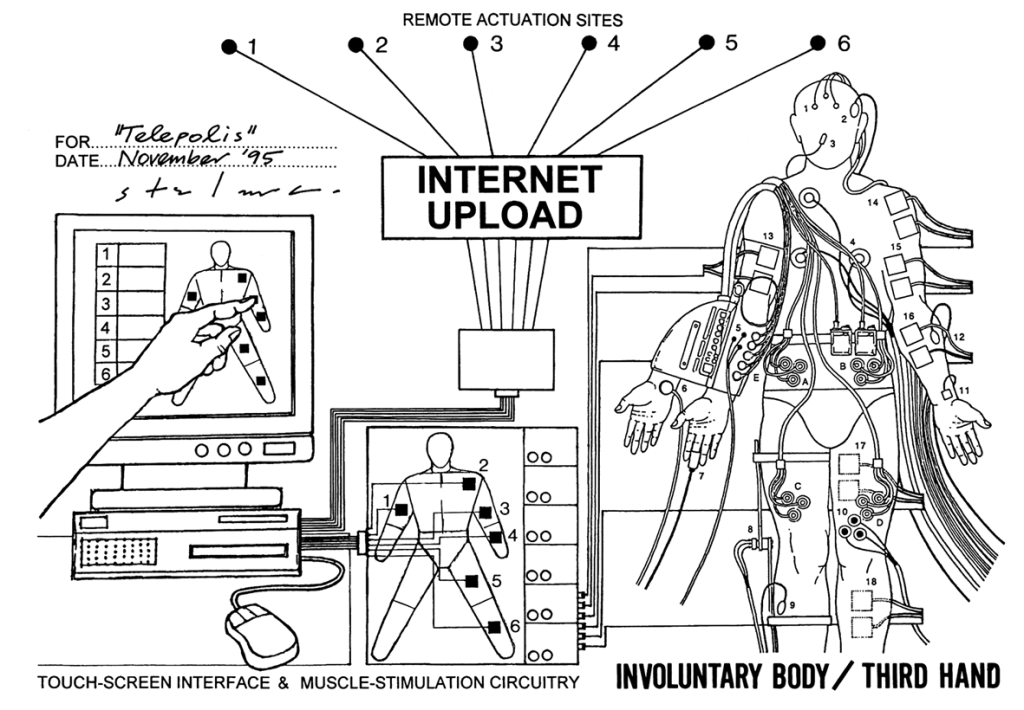
    Fractal flesh - http://cec.sonus.ca/econtact/14_2/donnarumma_stelarc.html
    Fractal flesh

    The question that is pressing in arises from the political problem, the problem of politics in itself, as politics.  Put bluntly, why is there such a thing as ‘politics’?  It is impossible to avoid this problem because we are always caught within the realm of the political.

    An individual member of the human species might find themselves able to step aside from the social, even whilst having inevitably derived their minds from it, but only as a result of the social itself, as a result of some brief area left aside, fallow, by the socialisation of the world.  The social spreads, like the viral trace of the species, across the world.  This is no anthropocentrism and it is not restricted to the human species – the ‘environment’ is nothing more than the complex totality of the multiple systems of social tracks left by the various species of organic life, some more dense and heavy than others.

    The human species treads hardest however.  In fact, the human species treads so heavily that it marks a qualititative break in natural dynamics.  It is not anthropocentric to acknowledge the specificity of the effects of the human species, the discontinuity between the tracks left by the human species and those of – almost – any other living organism.  It borders on the unnatural.

    The discontinuity is able to be understood best when encountering the heaviness of the human tread.  The traces of the social lie on the surface of the natural, the organic formed within the limits of the inorganic.  There are no societies of stones but there are many societies within the stones.  The stones form the fuel for the cells, constitute the surface on which the the social traces of the organic leave their mark.  Each layer rests on the preceding layer.  Yet the human tears through the layers, its weight unable to be borne by the supporting surfaces.

    It is this tearing of the surfaces that produces the political.  As the human species develops the capacity to rip open the world, as it transforms from the simply social animal, from the collective swarm of flesh that is each organism, it encounters the counter-effect of its increasing capacity for the transformation of the world.  This counter-effect is the reconstitution of the human flesh swarm as a new surface, no longer a swarm but now a network of nodes, with a variability of connection, a variability that produces differentials of power across the network.  The human swam transforms into a variable network of power and it is as this variability that politics is born.  Politics is the form of the variable human network that has gradually replaced the swarm of flesh from which it arises.  The type of species that we are is a specific result of the counter-effects of the capacities evolution produced in one form of the flesh.  We are, although not in the way Aristotle perhaps thought, the political animal.  Our animality is specific because we are a political flesh.

    In this situation politics exists not because of needs needing fulfilment, nor because of ideas that want realisation, nor even because of freedom that requires expression.  Politics results from the counter-effect of our capacities as an organism.  Central to these capacities is collective or social labour.  Our break-point with almost all other organisms lies not in language but in social labour.  Social labour is not merely a quantitative addition of arms and muscles but is instead the re-organisation of specific forms of work carried out by an organism into a social form of work that is qualitatively more powerful, social labour.

    Imagine two groups of human beings in conflict, both equally large.  Battle lines are drawn between these two groups as they meet in open territory, maybe a hundred on each side, all armed with little more than bones and clubs.  Now if one side has the capacity to become organised, to act as one, to unite their intentions, to follow orders and to ensure each individual animal acts as a cell within a greater whole, then it is inevitable that they will win the battle.  The more sophisticated that organisation the greater power it has.  Smaller number can overwhelm larger because of their organisation into social labour, into collective labour.  No longer a mere mass of flesh the new organisation brings forth a new organism, one that is now not mere flesh but the network of flesh become body.  It is this simple, basic, fundamental natural fact about social labour that is the ground of our reality, a reality that is inherently, inevitably, political.  Politics exists because social labour exists.  Social labour, however, is the catalyst of a counter-effect, the formation of a new body that rests on the shoulders of the flesh and drives it in its own direction.  For the most part this networked body of the flesh, this body of social labour, operates blindly, and in that sense politics arrives as an externality, as a new force in the world, one that we are still, desperately, trying to master before it drives us off the cliff of extinction.  Our options are to renounce social labour and descend into the earth as flesh once again or to internalise the networked flesh of the body of social labour and become the agents we imagine ourselves to be.

  • Some thoughts on democracy and the death of Tony Benn

    Some thoughts on democracy and the death of Tony Benn

    RIP Tony Benn and Bob Crow
    RIP Tony Benn and Bob Crow

    Tony Benn – “I think democracy is the most revolutionary thing in the world, because if you have power you use it to meet the needs of you and your community.” Interview with Michael Moore in the Movie Sicko (2007)

    The first time I met Tony Benn was on the way to the ICA in London to see him speak, sometime in the 1980’s when I was maybe 16, 17 years old. I was walking down the Mall and as I reached the traffic lights I realised that Mr Benn was standing there with me. In my youthful enthusiasm I blurted out ‘I’ve come to see you speak’…and was met with a warm smile and a gentleness that was quite remarkable. We chatted briefly as we walked together towards the ICA, nothing particular being said but there was a warmth and openness in the man that was remarkable. He was also noticeably smaller in stature than I had imagined and it was one of my first realisations of the distortions of the media. The image is always, in large part, a construction of the audience and the frame within which the image is presented. One of the subtle characteristics of the image as presented by the media is to make it seem bigger than we are, it presents a person as larger than life. In this way the media disempowers us, makes us subject to a world formed and framed for us in a particular way, a way that is not neutral but which is always driving us to feel the world to be ‘bigger’ than us, out of our grasp, beyond our control. Benn knew the power of the media but he also realised the problems and perhaps this was what motivated his energetic round of public meetings, direct presence in the face of the people. To come face to face with people is to bring the human back to earth, to let us face each other as equals, something impossible within the media-audience framework.

    The next time I met Mr Benn it was at another public meeting he was speaking at. It was 1990 and I was now in my early twenties and a poll tax rioter, charged with public order offences following the March 31st Trafalgar Square demonstration against the Poll Tax. I was Chair of the All Birmingham Anti-Poll Tax Union, a city-wide alliance of all the local campaigns, and was organising a public meeting as part of the defence campaign for the 350 plus people arrested at the riot. I was, as the saying goes, ‘in struggle’ and when I phoned various Labour lefty MP’s there was a mixed response to my requests. One left wing MP actually pretended to be someone else on the phone in order not to actually refuse the request whilst wiggling out of any actual public action of support. His accent was so noticeable and familiar that it was a truly bizarre moment. When I got through to Mr Benn, however, the same warmth and gentleness was there that I’d first encountered at the traffic lights on the Mall. We chatted about the meeting time, the request to speak having been accepted quickly and with an encouraging ‘of course, of course’.

    The last time I remember seeing Mr Benn was at the ‘Pig in Paradise’ in Brighton, where he was speaking about the Ragged Trousered Philanthropist. By this time I was maybe in my early to mid thirties. I’d been to prison then gone to University after being unable to get a job again as an ex-convict and was at that time studying for my doctorate in Philosophy. I was still politically active in some forms, although the political atmosphere seemed deeply conservative. Even the old Trostkyist groups I had joined in my youth appeared to me, as they do now, to be little more than conservative remnants of an older time, lacking any real vitality. I was by this time a ‘left communist’ of sorts, a position I’m still in, albeit no doubt idiosyncratically. It was prior to 9-11 and the anti-globalisation movements were about to explode onto the streets in the J18, Seattle and Prague demonstrations. The words of ‘The Coming Insurrection’, “nothing appears less likely than an insurrection but nothing is more necessary”, were yet to be written but expressed the position I felt at that time towards the world, where the media formed appearances had ground down my political imagination. Benn spoke eloquently, as always, about the Robert Tressel novel and as he did so his words reattached a few of the ever present threads of resistance and the possibility of my own rebellion was reinvigorated.  It was like rekindling a memory of hope for the future through the practice of remembering the past and his words gently rended part of the veil of media imposed illusions.

    Words, in themselves, will never change the world but what they do is renew the conditions for change, the conditions that enable us to remember who we are in the midst of oppression and irrational social structures that alienate each of us everyday in a thousand little ways. Words and discussion and memory enable us to learn and if we are to learn from the example of comrades like Tony Benn then we might do well to learn from the way in which he appeared to encounter the world as populated with actual, real people rather than ‘voters’. In the many plaudits for Tony Benn from hypocritical media imbeciles one of the things that appears often is a realisation that Benn presented a sincerity that is deeply lacking in modern political life. ‘I didn’t agree with what he said but he was honest and intelligent’ says the bullshit artist intent on manipulating even the death of their enemy for their own advantage. Yet the need to recognise the sincerity in someone like Benn is akin to the way that these same bullshit artists manipulate the concept of democracy to establish their own power over others.

    “Nothing appears less likely than an insurrection but nothing is more necessary”. It is the appearance itself that often holds us in thrall. Yet this appearance is fragile, it can shatter with a momentary event, a word, a brick through a window, a smile, a moment of face-to-face contact. Benn believed deeply in democracy and in a way that always appeared honest and open. He knew, I’m sure, that power needs to clothe itself in the appearance of democracy, that power needs to make us believe that this world of Western capitalism is the best of all possible democracies. Yet power needs to clothe itself in the appearance of democracy precisely because actual democracy is deeply desired by all those for whom power over others is not the goal, for all those for whom money is not the goal and for all those for whom freedom for one is freedom for all. It is – it was –  Benn’s continual willingness to maintain the possibilities of democracy that is perhaps his most important legacy, his willingness to realise that democracy is not a tool for power but a means for living in a social framework that is not oppressive.

    Just like the word ‘communism’ the concept of ‘democracy’ is so deeply tainted by its association with capitalism that we face a dangerous problem. If our best hope for free social formations is turned into something that appears to be the primary tool of our oppression then it is not surprising that we find ourselves left with little idea as to how to construct another, better world. The very possibility of a better world must be reclaimed but to do so we need to take that positive commitment to democracy that Benn had and renew it. We need a concept of an insurrectionary, pervasive democracy. We need to reclaim the concept from the appalling poisoning that has occurred via the phrase ‘Western democracy’ and begin practising and experimenting with democracy, with what kind of conditions are needed for democracy.

    When Benn said that he was leaving Parliament to engage in politics the truth of this statement gives us at least one hint towards some of the conditions that might be needed if a democratic practice is to be broken from its poisoned position. Voting is not enough, not even regular voting. Rather what is needed is a pervasive democracy, one that underpins our social existence in all its aspects. Democracy requires educated, communicative, empowered people for it to operate. It requires real contact between individuals, it needs face-to-face communication where the media is no longer able to frame our thoughts in its own agenda of money-making. Democracy also requires a deep and consistent awareness of its dangers and its capacity to manipulate.

    The great secret of western democracies is the capacity to keep control of information and education, to keep control of the very possibilities, the very choices, that are on offer. At the heart of this is the claim that only ‘democratically elected individuals’ have legitimacy. Yet this is the negation of democracy since by definition some are more equal than others in this situation. Democracy, in our current situation, confers ownership rights, just as being the ‘boss’ confers ownership rights. In the case of the ‘elected representatives’ that ownership is over our voices and lives. The media and the class of ‘political representatives’ treat the people as so many numbers, quite literally, for whom they can ‘speak’. The greater the weight of numbers the greater the weight of their voice, their supposed ‘legitimacy’. ‘Western democracy’ is a peculiar inversion of the spirit of democracy, conferring autocratic rights on a few whilst pretending, with a straight face that must take some practice, that it is ‘our voice’ that is being heard.

    A pervasive, insurrectionary democracy would be one in which the very idea of another speaking for me would be anathema. It would be a situation in which the act of insurrection would be one in which democracy was being expressed rather than repressed. If my voice is incapable of being heard then my body is all that remains if I am to remain free. Pervasive democracy must move away from ‘deciding for everyone’ and become a mode of ‘people deciding’. Actual concrete individuals need to be brought back into the practice of democracy and this can only be done if the general practice is for democracy to be localised, personalised. Democracy must pervade everything, from the workplace to the family to the use of land. Those whose needs depend on the decision are those who should be deciding.

    For the most part the decisions of our ‘western democracy’ impose themselves on us in ways that are too abstract for them to ever take account of their effects on the people democracy ‘speaks for’. We need to develop and demand democratic practices everywhere a decision effects us. We also need to develop the capacity to complement this with the ability to stay out of other peoples lives when not wanted, to not impose on others our own moral standards, to not convert other people into abstract numbers in our own power schemes. To do this we need to allow insurrection to be a limit form for our decision processes. How might we tell when we have imposed on others our own decisions rather than communicated with them to make a decision? When they revolt, when they resist, when they rebel. Insurrection then shows us when we have succumbed to the prime danger of democracy, the danger of deciding for others. Insurrection then becomes the friend of democracy as it reveals the limits on where we should be deciding for others and pervasion becomes the ground of democracy as it enables everything that effects our needs to be open for social decision.

    Democracy is a deeply complicated concept.  Its goal of enabling individual freedom within a social framework can only be achieved by acknowledging its capacity to allow some people to impose the power of the social framework on the individual with a more insidious authoritarianism than any dictator has ever possessed.  It is time we no longer relied on the concept of democracy to solve our problems without thinking and instead realised that it is only by thinking through the problems of the concept of democracy that we might begin to establish an actual, real, human democracy.  To do this we must begin by realising the deeply troubling nature of democratic legitimacy and its role in imposing power on us rather than enabling power for us.

  • Rhizomatic threads for a friend #1

    curious face on the wall_34183397

    Adam Curtis, who is one of the most interesting film-makers in/from the UK at the moment, produces these fascinating documentary/filmic essays where he trawls the archives and retells histories that lie just under our consciousness.  His BBC blog is over here http://www.bbc.co.uk/blogs/adamcurtis/ and some of his films seem to be available via this blog (http://adamcurtisfilms.blogspot.co.uk/) and over here (http://thoughtmaybe.com/by/adam-curtis/).

    ‘It felt like a kiss’ and ‘The century of the self’ are both great.  On his blog there was also this fascinating essay on the interface between ghost stories and the tv – http://www.bbc.co.uk/blogs/adamcurtis/posts/the_ghosts_in_the_living_room

    There is an amusing criticism (‘he’s all style over substance’) over here (http://youtu.be/x1bX3F7uTrg) which is witty (if a little light on content itself).

  • Speak truth to power and let us think again

    Speak truth to power and let us think again

    speak truthIn the face of neo-liberal austerity there often appears little real hope that another world is possible.  Mainstream political parties form their new consensus around the orthodoxy of market capitalism.  This new consensus disempowers the alternative, which is its purpose, shifting the terms of the debate so thoroughly that any opposition appears to be little more than an unhelpful resistance to reality.  The mainstream politicians might even respond to protests against austerity with paternalistic sympathy – ‘we know it’s difficult but we all have to make sacrifices, hard times force hard decisions.  They might even believe this, arguing that the job of a good politician is to lead their electorate through the difficult times, enabling the decisions for the greater good to be implemented in the face of individual and local group opposition.  The anti-austerity campaigns, when they do seem to gather any degree of support, appear as local issues – a hospital closing here, a service cut there.  Opposition to austerity is local and as such over-ridden by the needs of the wider community that are supposedly articulated by the new consensus of the market economy.  The terms of the debate have already been set and whilst they exist all local opposition is little more than part of the process of implementation, grit in the wheels no doubt but those wheels of change keep turning, fundamentally driving in one direction.  Of course it is necessary to oppose actual local cuts in any opposition to austerity, as such local campaigns are crucial, but without producing a change in the terms of the debate then one local victory today will likely just postpone tomorrows loss.

    It is possible, theoretically, to conceive of politics outside of elections and politicians.  In the actual everyday world of politics, however, the terms of the debate are fundamentally determined by the options available at elections.  Those options have to, moreover, be more than theoretical – it is no option to have a candidate on a ballot paper who will always lose.  This was the key Blairite understanding with regard the Labour Party.  Blair was clear that if Labour was to be an option, in actual politics, then it had to be an option for power, it had to be ‘electable’.  He also began, of course, from the parallel assumption that the new consensus of the market economy was a dominant within the population.  Thatcher had done her work, which was fundamentally orientated towards the culture of the population.  She had established the power of the new consensus of the market economy, made it a viable option through forcing it into existence.  Thatcherism established a new common sense – that closed shops were negative, that unions were undemocratic, that people were individuals who succeeded or failed financially on their own efforts, that  the state was a blockage in people’s lives rather than an enabler.  The negative experience of the state under governments that identified as socialist or communist, a negative experience that was partly real and partly generated by the long term propaganda of the cold war, produced fertile ground for the new consensus on the market economy.  A radical, strong political faction – the Thatcherites –  who believed governing didn’t rely on consensus but understood, instead, that it rested on power enabled this fertile ground to be ploughed deep and the seeds for the future – our current reality – to be planted in almost ideal conditions.  The downfall of Thatcher, almost inevitably, came when she pushed the limits of her power to the point where another power appeared on the horizon.  The more sophisticated members of the new consensus understood that the appearance of alternatives was necessary but that it had to be appearance, not reality.  Power is fundamentally like a sorcerer’s illusion, wielded only as long as the illusion is maintained, as long as consent is obtained.  As soon as such consent slips, the power dissipates and so the purpose of the post-Thatcher Thatcherites (Blairites) was to maintain the illusion through maintaining consent.

    Consent is a curious concept and one that is easily misunderstood.  Consent is fundamentally passive, rather than active.  If power rests on consent, consent in the illusion of power, then passivity is vital.  Passivity can itself take a number of forms.  It can be simple passiveness, a not-doing-anything, for whatever reason, usually because there is no impetus, no need to bother.  It can also take a curiously active form, where the ‘lack of consent’, the opposition, becomes a form of acting out.  In this latter form the passivity arises from the impotence of the opposition.  The child may not consent to the imposition of the will of the adult, might even throw a tantrum, embarrass and anger the parent, but usually this stays at the level of impotence.  The child throwing a tantrum is impotent.  In part this impotence, this lack of actual challenge, is vital to the capacity to throw a tantrum.  There is a need to know, or feel, that the tantrum won’t actually destroy anything, won’t change anything fundamental.  In politics analogous complications also arise.  Passivity through impotence is comfortable.  The danger of comfortable opposition is perhaps the greatest threat to the destruction of consent and the possibility of actual change, the possibility of opening the doorway to another world.  The danger of comfortable opposition arises from the reactive, fixed, settled reality of the opposition.  To be able to oppose is to be able to be comfortable in opposing.  At the point at which opposition becomes a matter of life and death, then it becomes no longer possible to oppose – it becomes necessary.  Of course, the more that opposition is actually necessary, the less will be the numbers of those who choose to oppose.

    To oppose a policy, of austerity or cuts for example, is to remove consent from it and in doing so make oneself feel not responsible.  This lack of responsibility is gratifying and the righteous indignation of the left appears too often to be little more than a self-gratifying denial of responsibility for what is happening, a kind of emotional crutch to make things seem better – ‘at least I’m doing something, it’s not my fault if nothing changes’.  Now there is truth in the claim that the responsibility for what is happening rests with those in power.  That is not the issue.  The issue is, those in power have power through consent, consent is obtained through maintaining the passivity of those ruled and so the real question is to do with the increase or decrease in passivity.  Do my actions increase or decrease political passivity?  To increase political activity involves producing non-impotent alternatives and only then can the possibilities of other worlds begin to appear real, rather than ideal, actual rather than abstract.

    This is in some sense a pedagogic question, although that is something I’m likely to say no doubt, given that I’ve been in the field of education for a while now.  The task of an educator – at least an educator in philosophy, although I suspect this holds for a wider realm of subjects – is to produce an active student, one that engages with and thinks through the material that is being studied.  This ‘thinking through’ is complex.  For example, there is a need to develop familiarity with the terrain of a discipline, the landscape of the area, so that students of philosophy need to know some of the history of the subject, they need a rough sense of the lay of the land.  They also need familiarity with some specifics, some concrete arguments, problems and solutions.  This is a little like learning openings in chess – if you make this move, then that response can be made in return.  In the end, however, a student who could only ever reproduce a few key moves within a general description of historical contexts would never have actually got to the essence of the matter, the ‘thinking through’ the material.   They might be able to re-present the material but would never be able to present any ‘new’ thoughts.  So when teaching philosophy we seem to encounter at least two different types of students.  On the one hand, those who are ‘good students’, studious, learn the material, regurgitate it well and in doing so earn a good grade, easily passing but never quite getting beyond good functional essays.  They will pass, often quite well, occasionally even with a first but will never have said anything interesting in the whole time they are at University.  On the other hand there are students who are troubled by questions, trying to find answers and who often rave about new ideas or new arguments, whose passion takes them into the subject but who will gradually come to encounter the weakness of the vast majority of their ideas when faced with anyone who actually disagrees with them coherently.  In the case of the first type of student (studious student), the educators task is to try and find a way to get some piece of philosophy to bite them on the arse, to get some idea or thinker to say something that disrupts their studious, organised, disciplined life and which will then push them beyond simple functioning into the need to actually think.  In the case of the second type of student (troubled student) the educators task is to find a way to gently show the weakness in their current fascination, the closures it brings with it as well as the openings it seems to offer and to do this by offering a way into the resources provided by the history of philosophy.  In both cases the task is to increase the active aspect of the student, but in each case it is done quite differently – crudely speaking, on the one hand we might need to inject imagination, on the other hand we might need to inject humility.  These are, of course, crude outlines of a much more complex process.  The central point, however, is the primary directive: increase the active forces, the capacity to actually think for yourself, sometimes by speeding up, sometimes by slowing down.

    There is in this sense something similar needed in the opposition forces, those opposed to the new consensus.  The traditional left operates on little more than a continuous ‘forward, forward, quicker, quicker’ process, shouting at the top of their voices about the horrors, the terrible deprivations, the need to do more and do it more often.   Attend this demo, this meeting, this group, this next thing, tomorrow, today, yesterday, all-day, everyday.  This incessant ‘activism’ is the studious student, the one who is ‘doing the work’ but in doing so is little more than a functionary, literally, someone fulfilling a function.  The function of the vast majority of the left is, in reality and in spite of itself, to enable passive non-consent.  This is not the function they believe themselves to have and it is not the only function they can have but in effect, in objective terms, given an understanding of the role of passive non-consent within the maintenance of power, this is their role.  This is clearly a claim that will make few friends, not least amongst the radical left that I know and which I am/was part of.  To offer some further comments to try and back up this claim that the radical left functions to enable passive non-consent (in reality and in spite of itself) I would point to two factors that I think would be interesting to examine.

    The first is the ‘throughput problem’.  This can be thought in terms of a question – if we were to ask, how many people in the population have once been a member of a radical left or anarchist group, do you think that number would exceed the number currently involved?  Now, by a factor of what?  Are there twice as many ex-members as members?  Three times as many?  Four times as many?  Or is it, as I suspect, nearer a ten-fold factor, possibly larger.  Let’s be clear about what that might mean if it were true.  At present, let’s say, we might estimate there to be 10,000 people organised into the radical left and anarchist groups.  If the number who have passed through is a factor of ten greater than that then we are talking about 100,000 people.  That is a mass party, albeit still a small one, but a mass party by any reasonable standards.  That is not a ‘small sect’ or whatever else we might derogatarily call the radical groups.  There seems to be – and I stress this is impressionistic at this point – a far larger number of people who ‘have been members’ than ‘are actually members’.  Why is this?  Is it because most of those ex-members are now right wing, no longer part of the radical left?  In some, rare, cases yes but in most cases no.  It is, for whatever reason, primarily because the radical groups did not keep their members.  Let me emphasise this in case it passes by too quickly. The problem of throughput is the responsibility of the left groups – as opposed to the responsibility of the individuals leaving.  It is a failing of the culture and structures of those groups, one that is fundamentally problematic.  The great danger is in explaining away this failing, in assuming that ‘it’s not our fault, nothing could be done about it because of (X, Y, Z – insert your social, philosophical, economic analysis of choice here)’.  To explain things away is to make excuses,  to make make ourselves comfortable in face of a reality that challenges our ideas of who we are and what we think.

    The second factor I would suggest is what we can call the ‘intellectual problem’.  Why is it that the intellectual wing of the radical left is so weak?  In previous periods of time the intellectual wing of the Communist Parties could engage the intellectual wing of the wider community, there were key strategists and theorists who were plainly from within the radical left and who were engaged with in the wider intellectual community.  The last flowering of the radical left intellectual who seemed deeply connected to radical left parties was perhaps the eighties, and the effects of that in terms of Euro-communist thought were probably a part of the development of the new consensus.  Yet at the moment there are radical left intellectuals on the horizon again, from David Harvey to Daniel Graeber to Alain Badiou and Slavoj Zizek, but their connection to the radical left seems – again, this is impressionistic – weaker than in previous times.  Where there are connections these intellectuals seem to relate to the Occupy-type movements, the spontaneous resistance movements that arise, but very little to the wider radical left.  More importantly the radical left seems comfortable to simply dismiss these forces as some sort of class enemy, usually with trivial and rather amusingly stupid pieces on ‘post-modernism/structuralism/something or other’, with the cry that ‘they never have any class analysis so never know what they’re doing’, a cry that is so deeply confused as to be amusing in its ritual repetition.  Again, the thought here is simple, and it is that the radical left, if it were being successful, would be part of the on-going intellectual debate in the wider community rather than cut off from it like a isolated psychotic.  This is not a luxury but a necessity.  Why does it not happen?  Well, just as the majority of people who leave the radical left groups do not do so because they are now right wing, the majority of intellectuals do not engage with the radical left because the radical left is stupid and boring.  It is simply impossible to actually engage with someone who already knows that you are wrong, what’s the point?  Yet this is the way the radical left appears to think engagement should take place – ‘engagement with the intellectuals’ is simply a matter of pointing out how stupid and class-less they are in their analysis, that seems the general format for discussion.  It is unsuccessful for obvious reasons, which is that it precludes from the beginning the very discussion it purports to want to engage in.  To do so is to reveal that such a discussion is simply not wanted.

    These two factors – the way in which things are explained away rather than understood and the obvious unwillingness to engage with the intellectual – both point to a problem the left has with thinking, both in the sense of ‘doing it’ (I’m thinking about it now…) and in the sense of the existence of it (there is a thought about that over here …).  Thinking, including thinking politically, involves a continuous risk and a continuous engagement, it’s a balancing act between triviality taken to be knowledge and knowledge taken to be opinion.  To think is to act, to risk and to challenge but it is also to acknowledge, to accept and to agree.    The difficulty for all of us as students of political reality is to fully work out how to negotiate this strange, living reality of thinking rather than simply functioning.

    The current radical left, I would suggest, is partly like the studious student.  They are good at what they’re doing but they know not what they’re doing.  The studious student thinks they are learning philosophy when in fact they’re simply being processed through the educational factory.  The radical left thinks they are opposing power when in fact they’re simply being processed through the machine for manufacturing consent.  The other type of student, however, has their own problems.  The bubbling enthusiasm and passion soon finds itself running out when faced with insurmountable problems, with no change occurring in the world around them.  If the educator is not careful the troubled student, initially troubled in a positive sense by questions that forced them to think differently, becomes troubled in a social sense.  They find that there is something painful in not being able to answer questions and there seem to always be more questions the more they try to offer answers.  They find it difficult to maintain their enthusiasm as they find themselves unable to persuade and they drift off into isolation or at best into small social cliques.  If they find a few friends then they can usually survive, with some sense of their enthusiastic challenging thought left intact – but the smallest social division can bring their world tumbling down.  The clique survives if it is at on optimum size, not too small but small enough to form an identity, and if the sexual inter-relations within the clique don’t explode in acrimonious split-ups.  They grow, they develop, they feel radical but gradually find some other interest in the world, something other than simply thinking differently to engage them.  They settle into a kind of sub-cultural identity and a low level depression with the world around them, occasionally drifting into misanthropy.  They keep in touch with some of the studious students and might even regret the fact that they could have done better if they’d chosen to get stoned a little less often and spent a bit more time reading the set material and working on that essay.   The task of the educator is to show this student that concrete change can arise from their thinking differently, whether this be in their personal character – less possible in our current mass education industry – or in their social character, in the form of the ‘public success’ of good grades and good references, with economic opportunities as an end result.  The troubled student is probably closer to the non-party affiliated radical left, all those ex-members.  Their activity is now piecemeal at best, discontinuous and fragmentary or personal and practical social engagement.   They are no more active in their opposition than the radical left, in the sense of being part of a development of the active forces of opposition.  They do what they think is necessary and occasionally a bit more but the necessities that drive them are not the voluntaristic goals of the radical left parties but the individual necessities of challenges they face in life.

    At the moment it seems that the forces gathering around Left Unity in the UK are a mixture of the studious and the troubled students.  The two dynamics of discipline and enthusiasm need to be counter-pointed by imagination and humility.  Those with the worked out programmes and pre-existing answers need to realise that studiousness doesn’t create anything, it merely reproduces what already exists.  The existing left parties, the studious left, simply cannot create the imaginative possibilities of the new worlds that are needed, and as long as they insist that they can they form nothing more than a dead weight on the shoulders of the living.  On the other hand the troubled students, the enthusiastic ravers, simply cannot create enough time for things to change, they want it now and if it doesn’t happen immediately something is wrong.  On both sides of the dynamic (and I won’t use the term dialectic, I think it’s theoretically weak and covers up a myriad of bad thinking – but you can read it in that way if you want to) the weaknesses are familiar and should be obvious.  Yet they are not obvious to anyone involved, because just like the students, each side sees the world only from within its own world.  The role of the educator is often little more than to provide an outside source of authority, one that operates the illusion of knowledge so that we can trouble the certainties of self-conscious individuals.  The illusion of knowledge, like the illusion of power, does not mean we know nothing, just like it does not mean there is no such thing as power.  What it means is that its operation is not in the actual fact of knowledge but in the way it is encountered.  The student encounters the educator as someone they listen to, for the moment at least, someone outside them that has enough outside to let a little of it in.  The educator inoculates the individual with the outside world.  In doing so, in letting the outside into the student, we hopefully enable them to develop in a positive way.  In terms of the radical left the options for letting this outside in are more difficult.  The illusion of knowledge is not going to be a game we can play, there is going to be no ‘educator’ who can stand in that role, no ‘father figure’, no ‘great teacher’ – that route has been tried, Stalin and Mao understood it well, and it produced nothing more than another illusion of power.  Instead the radical left will need to become its own educator, its own door to the outside.  To do so it will need to first realise the position it is in and want to transform it, realise that it must change and take that risk, without losing itself.  To become its own educator the radical left will need to begin to let itself think again.   Only by developing the capacity to think again, in ourselves and in others, do we begin to develop the active forces that can herald the birth of another world.

    Then again, what do I know.
  • We’re all pretty fucked…we must dream and demonstrate the new reality.

    We’re all pretty fucked…we must dream and demonstrate the new reality.

    With new protests against the fees and cuts being made to Higher Education planned for this Wednesday on what’s being called ‘Day X’ (more information here) it’s necessary to avoid getting drowned in the new slave consensus.  The ‘cuts’, the ‘deficit’ and the whole new way in which economics is being organised are presented as obvious, necessary, inevitable.  They are no such thing.  There are always options.  There are realities that we can imagine but these realities must be fought for, both physically and mentally. We must dream and demonstrate the new reality. The only other option is to let the new ‘common sense’ drown us.  They will never give it away for free, it has always had to be taken from them by force.  This time will be no different.  Prepare to fight now.  It’s the students and universities at the moment, it will be your hospitals, schools and homes next…and soon.

    The following is from from a leaflet currently doing the rounds:
    “We’re all pretty fucked…

    It’s not just cuts in education and upping the fees that’s the problem. The problem is that the cuts in general mean we’re all pretty fucked. Whether you’re a student in a F.E college or University, whether you’re a working single-mum, whether you’re self-employed, whether you’re unemployed, whether you’re working a precarious temp job, whether you working a good job in the public sector. The depth of the cuts means most people are going to become worse-off.

    There are differing trains of thought that link the cuts to ‘The Crisis’ or ‘The Deficit’ or ‘The Tories’ but for many there is a much more simple truth – it’s just called ‘Life as normal’. The rich have been getting successively richer in this country and the poor have been getting poorer. If the cuts are setting out to re-float a busted economy of over-inflated debt and speculation by taking more and more from the poorer section of the population, well, it’s just more of the same for most people. Poverty, crap jobs, insecurity, health problems – well, that’s just how we’ve been living anyway. But do you feel like politicians will sort it out for you? Do you feel like if you keep your head down and work hard, you’ll be okay? Do you feel scared? Had enough of that shit yet?

    We’re all pretty fucked…It’s not just cuts in education and upping the fees that’s the problem. The problem is that the cuts in general mean we’re all pretty fucked. Whether you’re a student in a F.E college or University, whether you’re a working single-mum, whether you’re self-employed, whether you’re unemployed, whether you’re working a precarious temp job, whether you working a good job in the public sector. The depth of the cuts means most people are going to become worse-off.There are differing trains of thought that link the cuts to ‘The Crisis’ or ‘The Deficit’ or ‘The Tories’ but for many there is a much more simple truth – it’s just called ‘Life as normal’. The rich have been getting successively richer in this country and the poor have been getting poorer. If the cuts are setting out to re-float a busted economy of over-inflated debt and speculation by taking more and more from the poorer section of the population, well, it’s just more of the same for most people. Poverty, crap jobs, insecurity, health problems – well, that’s just how we’ve been living anyway. But do you feel like politicians will sort it out for you? Do you feel like if you keep your head down and work hard, you’ll be okay? Do you feel scared? Had enough of that shit yet?”

    http://www.indymedia.org.uk/media/2010/11//468269.pdf

    http://anticuts.org.uk/

    http://educationactivistnetwork.wordpress.com/

  • Welcome to the Civil War – Tarnac9 update

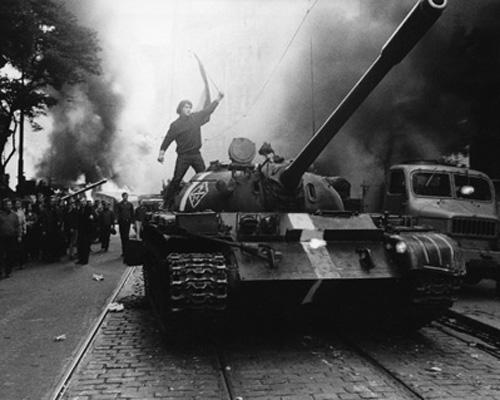
    1968josefkoudelkabt7Websites with information on the Tarnac9:

    the US support committee – http://tarnac9.wordpress.com/

    the main French support site – http://www.soutien11novembre.org/

    fragments from ‘Introduction to Civil War’ – http://www.softtargetsjournal.com/v21/tiqqun.php

    ———————————-

    1.  The elementary human unity is not the body—the individual—but the form-of-life.

    10. Civil war is the free play between forms-of-life; it is their principle of co-existence.

    12. The point of view of civil war is the point of view of the political.

    23. Hostility puts me at a distance from my own power.

    72. The sphere of hostility can be reduced only by extending the ethico-political domain of friendship and enmity. This is why Empire has always failed to extend this domain, despite all its protestations in favor of peace. The becoming-real of the Imaginary Party is simply the formation—by contagion—of a plane of consistency where friendships and enmities can freely deploy themselves and make themselves legible to one another.

    (from ‘Introduction to Civil War‘)

    ———————————-

  • We Have Begun… FREE THE TARNAC 9 – A statement of support by Giorgio Agamben

    call_front This is from Semiotext, via Fark Yaralar? = Scars of Différance. It is in reference to the arrest of people in France on ‘terrorist’ charges, notably of Julien Coupat from Tiqqun.  The Tiqqun book, a small 88page book that fits in your back pocket and has been distributed free across Europe in recent months, is one of the most interesting and provocative political, philosophical texts to have arisen in the last 50 years.  It marks a shift from the initial moves made by people such as Monsieur Dupont, to the beginnings of a strategic political position that looks testable and – perhaps more interestingly – worth testing.  In the face of the current conjuncture of economic, political and philosophical tremors (albeit the latter in a reasonably disparate way, perhaps just another perturbation that is normal) this ‘Call’ is worth noticing.

    If anyone can translate from the French the short piece that is contained in this file – or has a French translation of it – that would be useful.  In the meantime, perhaps something like Agamben’s public statement might be organised over in the UK or more widely.

    ………………

    La_Fabrique.doc

    A recent operation by the French police, intensively covered by the French and to some extent international media, ended in the arrest and indictment of nine people under anti-terrorist laws. The nature of this operation has already undergone a change: after the revelation of inconsistency in the accusation of sabotaging French railway lines, the affair took a manifestly political turn. According to the public prosecutor: “the goal of their activity is to attack the institutions of the state, and to upset by violence – I emphasize violence, and not contestation which is permitted – the political, economic and social order.”

    The target of this operation is larger than the group of people who have been charged, against which there exists no material evidence, nor anything precise they can be accused of. The charge of “criminal association for the purposes of terrorist activity” is exceptionally vague: what constitutes “association”, and how are we to understand the reference to “purposes” other than as a criminalization of intention? As for the qualification “terrorist”, the enforced definition is so broad that it could apply to practically anything – and to possess such and such a text or to go to such and such demonstration is enough to fall under this exceptional legislation.

    The individuals who have been charged were not chosen at random, but because they lead a political existence. They have participated in demonstrations, most recently against the less than honorable European summit on immigration in Vichy. They think, they read books, they live together in a remote village. There has been talk of clandestinity: they have opened a grocery store, everyone knows them in the region, where a support committee has been organized against their arrest. What they are looking for is neither anonymity nor refuge, but rather the contrary: another relation than the anonymous one of the metropolis. In the end, the absence of evidence itself becomes evidence against them: the refusal of those who have been charged to give evidence against one another during their detention is presented as a new indication of their terrorism.

    In reality, this whole affair is a test for us. To what degree are we going to accept that anti-terrorism permits anyone to be arrested at any time? Where are we to place the limit of freedom of expression? Are emergency laws adopted under the pretext of terrorism and security compatible with democracy in the long term? Are we ready to let the police and the courts perform an about-turn in the direction of a new order? It is for us to respond to these questions, and first by demanding the end of these investigations and the immediate release of these nine people whose indictment is meant as an example for us all.

    ………………….

    A statement of support by Giorgio Agamben is pasted in below.

    TERRORISM OR TRAGICOMEDY?
    call_back

    On the morning of November 11, 150 police officers, most of which belonged to the anti-terrorist brigades, surrounded a village of 350 inhabitants on the Millevaches plateau, before raiding a farm in order to arrest nine young people (who ran the local grocery store and tried to revive the cultural life of the village). Four days later, these nine people were sent before an anti-terrorist judge and “accused of criminal conspiracy with terrorist intentions.” The newspapers reported that the Ministry of the Interior and the Secretary of State “had congratulated local and state police for their diligence.” Everything is in order, or so it would appear. But let’s try to examine the facts a little more closely and grasp the reasons and the results of this “diligence.”

    First the reasons: the young people under investigation “were tracked by the police because they belonged to the ultra-left and the anarcho autonomous milieu.” As the entourage of the Ministry of the Interior specifies, “their discourse is very radical and they have links with foreign groups.” But there is more: certain of the suspects “participate regularly in political demonstrations,” and, for example, “in protests against the Fichier Edvige (Exploitation Documentaire et Valorisation de l’Information Générale) and against the intensification of laws restricting immigration.” So political activism (this is the only possible meaning of linguistic monstrosities such as “anarcho autonomous milieu”) or the active exercise of political freedoms, and employing a radical discourse are therefore sufficient reasons to call in the anti-terrorist division of the police (SDAT) and the central intelligence office of the Interior (DCRI). But anyone possessing a minimum of political conscience could not help sharing the concerns of these young people when faced with the degradations of democracy entailed by the Fichier Edvige, biometrical technologies and the hardening of immigration laws.

    As for the results, one might expect that investigators found weapons, explosives and Molotov cocktails on the farm in Millevaches. Far from it. SDAT officers discovered “documents containing detailed information on railway transportation, including exact arrival and departure times of trains.” In plain French: an SNCF train schedule. But they also confiscated “climbing gear.” In simple French: a ladder, such as one might find in any country house.

    Now let’s turn our attention to the suspects and, above all, to the presumed head of this terrorist gang, “a 33 year old leader from a well-off Parisian background, living off an allowance from his parents.” This is Julien Coupat, a young philosopher who (with some friends) formerly published Tiqqun, a journal whose political analyses – while no doubt debatable – count among the most intelligent of our time. I knew Julien Coupat during that period and, from an intellectual point of view, I continue to hold him in high esteem.

    Let’s move on and examine the only concrete fact in this whole story. The suspects’ activities are supposedly connected with criminal acts against the SNCF that on November 8 caused delays of certain TGV trains on the Paris-Lille line. The devices in question, if we are to believe the declarations of the police and the SNCF agents themselves, can in no way cause harm to people: they can, in the worst case, hinder communications between trains causing delays. In Italy, trains are often late, but so far no one has dreamed of accusing the national railway of terrorism. It’s a case of minor offences, even if we don’t condone them. On November 13, a police report prudently affirmed that there are perhaps “perpetrators among those in custody, but it is not possible to attribute a criminal act to any one of them.”

    The only possible conclusion to this shadowy affair is that those engaged in activism against the (in any case debatable) way social and economic problems are managed today are considered ipso facto as potential terrorists, when not even one act can justify this accusation. We must have the courage to say with clarity that today, numerous European countries (in particular France and Italy), have introduced laws and police measures that we would previously have judged barbaric and anti-democratic, and that these are no less extreme than those put into effect in Italy under fascism. One such measure authorizes the detention for ninety-six hours of a group of young – perhaps careless – people, to whom “it is not possible to attribute a criminal act.” Another, equally serious, is the adoption of laws that criminalize association, the formulations of which are left intentionally vague and that allow the classification of political acts as having terrorist “intentions” or “inclinations,” acts that until now were never in themselves considered terrorist.

    — Giorgio Agamben
    Libération, November 19, 2008

  • Zizek Omnibus / Lacan dot com

    Zizek Omnibus / Lacan dot com

    DSC01953_33864018(Updated today, 4thFeb 08, so links work)

    An email today brings news of a wealth of Zizek material on Lacan.com, all of which looks interesting.    Zizek was also on Radio4 yesterday – there is this humorous mention in the introduction the presenter gives to Zizek about how he is so ubiquitous within intellectual life that one academic has proposed starting an ‘anti-Zizek league’ (at the mention of which we hear Zizek, in the background, saying ‘give me his name…’ and the presenter deferring on doing so in public…).  My own reaction to Zizek is curious, since on the one hand I think that there is a tension between the Zizekian/Lacanian philosophical analyses and the Deleuzian/Guattarian analysis around the question of lack and the productive ontological forces, a tension in which I find myself trying to draw on D/G against Z/L, whilst at the same time I am encouraged by the simple fact that Zizek is capable in our contemporary de-politicised and in some respects de-racinated intellectual culture of standing explicitly as a Marxist and as oppositional to capitalism.  It reminds me of times during my active political life (by which I mean, when I was an active member of a revolutionary organisation) when there would be a kind of separation of discursive spaces, such that within a specific space a criticism (sometimes quite violent and extensive) might be raised against another political perspective which would, on no account, be expressed outside that particular space, in the ‘everyday’ world as it were.  To do so would be tantamount to a kind of betrayal and such activity is what is often called ‘sectarianism’, a practice in which the criticism and combat against another group (sect) would become more important that any common goals.  This peculiar practice is still one I find myself engaged in at various points, though I increasingly wonder about its efficacy.  More on that another time perhaps…for now, have a listen to the Slovenian and perhaps spend a little time perusing some of the fascinating resources listed below…

    [display_podcast]

    (more…)