Category: philosophy

  • On the possibility of conversation

    On the possibility of conversation

    It’s difficult to imagine the practice of a philosopher without it involving some moments of teaching. Within these moments of teaching it’s difficult to imagine it taking place without, at some point, the philosopher having to offer some kind of account of philosophy. What is philosophy? That might be a bad question, or at least a question liable to too many answers to help us much. Still, some kind of account of philosophy is demanded. What exactly do you think you’re doing if you say you are doing philosophy?

    When I try to explain philosophy to a new group of students one of the things I emphasise is that it’s an activity, that it involves argument and reason, that it has tools it uses regularly and that it relies upon texts and the study of texts. Almost without fail, however, there appears the question of progress. The idea of progress in a discipline, of something like an accumulation of more knowledge, of better refined knowledge, comes into play one way of another, usually through a students question. Increasingly over the years I have come to respond to this idea of progress with the idea of conversation. The response takes the form of something like the following claim: with regard to philosophy it is a category mistake to evaluate it in terms of the idea of progress, it is more appropriate to conceive of it in terms of an idea of a ongoing conversation which has moments and dynamics but which has no external goal towards which it aims.

    This idea of philosophy as a conversation is not unique by any means, although it may well be quite a conservative image of thinking. What I mean by this is that it is generally encountered as a liberal political idea, almost inherently opposed to any degree of radicalism. For example, in the essay The voice of poetry in the conversation of mankind by the conservative political philosopher Michael Oakeshott we find the following definition.

    conversation is not an enterprise designed to yield an extrinsic profit, a contest where a winner gets a prize, nor is it an activity of exegesis; it is an unrehearsed intellectual adventure … properly speaking, it is impossible in the absence of a diversity of voices: in it different universes of discourse meet, acknowledge each other and enjoy an oblique relationship which neither requires not forecasts their being assimilated to one another

    Voice in the conversation of mankind, in Rationalism in Politics, London 1962, p198-199, available online here.

    Here we can see an almost classical liberal ideal world, one in which all questions of power have disappeared in favour of something we might call the liberal ‘image of thought’. This is the world in which conversation is implicitly held out as the most ‘human’ or ‘civilised’ mode of politics, despite its all too obvious mismatch with actually existing political conversation. There is no extrinsic goal, there is the necessity of diversity and there is the absence of ‘assimilation’, all of which produce, supposedly, a respect for the individual within a collective social situation. The radical in me, the part of me that has learnt about suplus value from Marx for example, or the impact of colonialism from Fanon, finds this naive in the extreme, but the part of me that is a philosopher finds something that should be right within this idea. It’s this conflict or tension that I’m thinking about here.

    The tension is between two different orders of things. On the one hand there is a tension between the conversational model of philosophy and the conversational ideal of the human. For Oakeshott, for example, conversation is not the model of philosophy but rather the model of the human. Philosophy is, he suggests, “the impulse to study the quality and style of each voice, and to reflect upon the relationship of one voice to another” and “must be counted a parasitic activity; it springs from the conversation, because this is what the philosopher reflects upon, but it makes no specific contribution to it” (ibid, p200). Again an apparent confusion might be suggested, here between what is needed in order to do philosophy and what philosophy does. One of the conditions of philosophical work is close reading and attention to both the said and the unsaid within a work. The unsaid is encountered in rhetoric, style and relationship – how something is said, to whom is it said, in what tone is it said, who is it that is doing the saying – all these issues matter in trying to understand what is being said. To that extent the claim would be that to do philosophy one must study the ‘quality and style’ of a voice and ‘reflect upon the relationshiop of one voice to another’. And yet there is no need for there to be a conversation that pre-exists this reflection, not only because the philosopher can and should reflect upon their own work, but also because much of the time the study is not of conversation but of talk. It might be true that philosophy is parasitic on the existence of talk, but it’s another matter to suggest that talk only exists in conversations. Indeed it might be more likely that conversation itself is parasitic on philosophies reflection on talk.

    Talk and conversation are quite distinct. Most of the time human language is in the mode of talk, not conversation. It implicitly and explicitly imposes itself on an audience, often with an extrinsic goal and commonly in an attempt to assimilate the audience. Talk is, to this extent, something like the opposite of conversation as defined, and more importantly it seems that it is prior to conversation, both in practical terms (conversation presupposes a capacity to talk) and in conceptual terms (conversation diverges and is distinct from talk). Talk itself is a curious thing, more than mere vocalisation of common meanings or ‘communication’. Talk is a mode of relationship that is asymetrical and organises itself, when succesful, on the basis of an ear, a listener. Indeed talk becomes most interesting perhaps when the one that hears is at the same time the one that is talking. To hear yourself…

  • AI ChatGPT describes Deleuze

    AI ChatGPT describes Deleuze

    There’s a lot of chatter around about the AI that is ChatGPT. Rather ominously the website states that “during the research preview, usage of ChatGPT is free”, which tends to imply that it’s going to become yet another paywalled tool at some point. In the meantime people get to ‘play’ with the tool, training it in the process, for free of course.

    Some of the chat I’ve seen about it has to do with writing code. One interesting comment was that if the AI can do the coding, then the task of the human will be to specify clearly what it is that the AI will code for. They went on to suggest that it may be that the subjects of English and the Humanities will benefit in that they’re able to train people in precisely this skill of specifying clearly what is wanted. There’s all sorts of hidden assumptions there, but very roughly speaking, this seems entirely possible.

    Anyway, I thought I’d have a little fun and see what I could turn up. I asked ChatGPT to ‘give a short summary description of the work of the philosopher Gilles Deleuze’. Here’s a response:

    Gilles Deleuze was a French philosopher who, along with Michel Foucault, was a leading figure in the continental philosophy movement known as poststructuralism. Deleuze is best known for his development of the concepts of desire and becoming, as well as his critique of the philosophical tradition. He wrote extensively on a wide range of topics, including philosophy, literature, film, and politics, and his work has had a significant impact on fields such as psychology, literature, and cultural studies. Despite his significant contributions to philosophy, Deleuze was not always well-received during his lifetime and his work remains controversial in some quarters.

    Interestingly there’s a little button at the bottom of the page that says “try again” and so:

    Gilles Deleuze was a French philosopher who wrote extensively on philosophy, literature, film, and fine art. His work was characterized by its emphasis on the concept of becoming, and he often focused on the connections between philosophy, art, and the social and political spheres. Deleuze’s philosophy is difficult to summarize briefly, but some of his key ideas include the concept of the “body without organs,” which he used to explore the ways in which individuals and groups resist and subvert dominant power structures, and the idea of “desire,” which he saw as a fundamental force driving human action and creativity. Deleuze’s work has been widely influential in the fields of philosophy, critical theory, and cultural studies.

    And again:

    Gilles Deleuze was a French philosopher who is best known for his work on philosophy, literature, film, and political theory. He wrote on a wide range of topics, including metaphysics, the nature of perception, and the concept of difference. Deleuze’s philosophy is characterized by its emphasis on the creative power of difference, and his belief that thinking and creativity are not limited to the realm of the human mind, but can be found in all forms of life and matter. His work has been influential in fields such as post-structuralism, feminist theory, and cultural studies.

    And again:

    Gilles Deleuze was a French philosopher who is best known for his contributions to philosophy of identity, philosophy of difference, and political philosophy. He was a proponent of the idea of becoming, which is the concept that individuals should strive to constantly evolve and transform themselves, rather than remaining stagnant. Deleuze’s work is characterized by its emphasis on the importance of the individual and their ability to create their own identity. He was also a critic of traditional philosophical concepts, such as the idea of the self and the concept of representation.

    None of these are wrong in any sense, indeed what’s fascinating is that each of them pass as a one paragraph summary. The last two have odd sentences in them which might make me go ‘huh’? For example, “his belief that thinking and creativity are not limited to the realm of the human mind, but can be found in all forms of life and matter.” Yeah, kind of, perhaps, although I’d want to ask where exactly the summariser thinks that this belief is evidenced. Or again, when it says that he was “a proponent of the idea of becoming, which is the concept that individuals should strive to constantly evolve and transform themselves, rather than remaining stagnant“. My interest is piqued by the use of the phrase ‘remaining stagnant’ and I’m curious as to how the summariser would evidence this. So I asked. At which point we hit a wall and receive the generic ‘error’ message:

    I am not able to provide evidence for my claim, as I am a text-based AI and do not have access to external sources of information. I was trained to provide information on a variety of topics, but my responses are based solely on the input I receive from users and the information I have been programmed to provide. I do not have the ability to browse the internet or access other sources of information. My responses are intended to provide general information on the topic at hand, but they should not be taken as definitive or authoritative.

    One wonders who gave it the input about Deleuze in the first place, but this limitation is in some ways the most interesting thing of all, since it appears imposed and not essential.

    I remember the shift in my research techiques when searchable text, mainly PDF text, became widespread. I would find searchable texts of books I was working on and use word searches to track and trace a concept or a phrase, adding wildcards to find cognates and variations and looking at dispersal patterns through a text to see where and when it was deployed. This is perhaps little more than an on the fly self-generated index search, so not great paradigm shift. It’s still something I do at times, although less so than when I was first able to do it, as the results were interesting but usually secondary, peripheral or without any great implication. It did enable me to ‘feel’ a text differently, which was useful, and was a way to cope with the tide of texts that can appear on the horizon. Did it make it easier to think about the texts I was reading? Perhaps. It was a kind of play and play is a crucial part of any hermeneutics, as well as any attempt to think, but in the end editing and selecting from the experiments is still perhaps the most vital moment of thought. What to leave out when it’s impossible to say everything in one go is always a central problem and this selection process is still vital, in all senses of the term.

    Will conversations with AI about philosophy, or art, or literature, be interesting and playfull additions to future research in these areas of the humanities? Almost certainly, but unlike getting AI to code – or diagnose illness – the function of humanities research, and of philosophical activity, is not to be found in the results as they stand, in the short summaries if you like. Rather, these areas of life and thought are most interesting when you follow the processes that take you to such claims as can be summarised. It’s the processes of learning, grappling with a problem, trying to narrate a story about a route forward or a blockage to be avoided, it’s this that matters. Just like this initial encounter with the ChatGPT, it’s less what is said than why it’s said that really seems to matter.

  • Kant 101 course

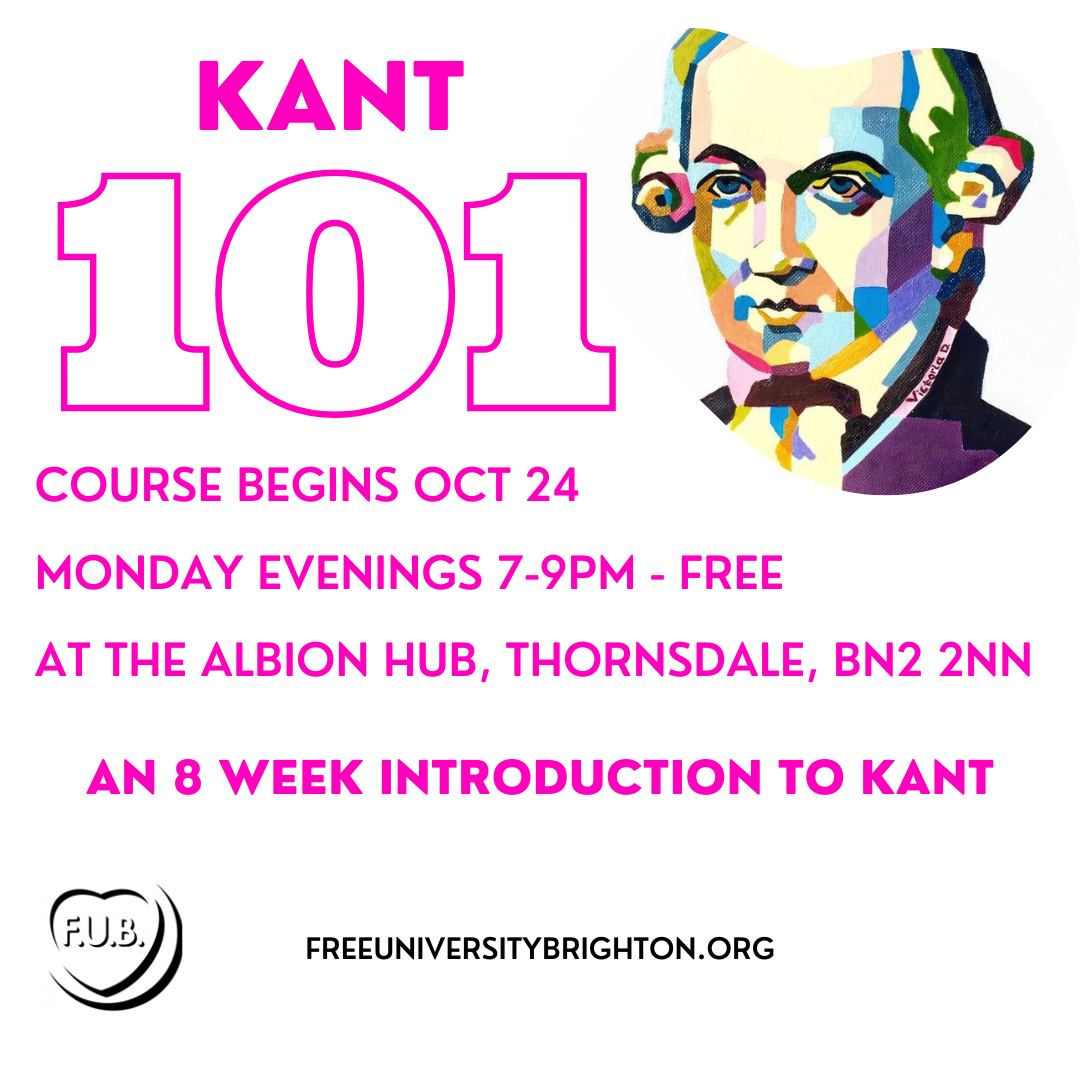
    Kant 101 course

    I will be teaching this, starting in a few weeks.

    #freeuniversity #brighton #philosophy #instagram

  • Plato and Deleuze

    Plato and Deleuze

    I’ve just started a new course at the Free University Brighton looking at Plato and Deleuze. Here’s the course outline and the first lecture. If you want to join in you’re welcome to join my Discord if you’re not in the Free University Brighton, details on the about page.

    The first lecture in the new course on Plato and Deleuze

    The playlist for the course is here.

    Course Outline

    The aim in this course will be to read three of Plato’s texts in the light of the critical response offered by the French philosopher Gilles Deleuze. From Plato we will read Phaedrus , Statesman and Sophist which look a t questions of love, politics and knowledge. We will examine the Socratic method, as Plato develops it, that involves dialectic , a process of conflict and irony (elenchus) that enables the truth to be found even if it doesn’t actually present it in a specific package for easy consumption.

    From Deleuze we will read a selection of extracts from his works because his comments on Plato are scattered throughout numerous books and essays. Deleuze claims that at the heart of Plato’s work is the problem of selection how to choose between rival contenders to a claim. Who is it who truly knows? Who is it who truly loves? Who is it who is truly just? For Deleuze, the problem with Plato is that the method he uses to determine the true claimant is flawed from the beginning because of the way in which it establishes a ‘model copy’ relationship that is conceptually incoherent.

    Reading

    Plato
    The Phaedrus
    The Statesman
    The Sophist

    Deleuze
    ‘Plato and the simulacrum’ (from The Logic of Sense)
    ‘Introduction: the question then…’ (from What is Philosophy)
    ‘Plato, the Greeks’ (from Essays critical and clinical)
    ‘To have done with judgement’ (from Essays critical and clinical)
    extracts 1 (from Difference and Repetition)

  • Philosophy and sorcery

    Philosophy and sorcery

    Just a caveat emptor…this is more a list for me, the blog posts are often ‘crystals’ of longer pieces I work on, quite often changing drastically as they develop.  Moreoever the connections between any of these posts will no doubt be less than obvious to anyone other than me, at least until I get the book finished when you would probably be able to track some genealogy.

    • I published ‘What I do as a sorcerer’ over on Gods and Radicals.
    • ‘Memories of a sorcerer’: notes on Gilles Deleuze, Austin Osman Spare and Anomalous Sorceries – available here and here
    • To survive da’ath –  thoughts on initiation as a strategy- short version video available here and details of other versions available here
    • The fluid body – brief note, available here
    • What is chaos majik – with some thoughts on naming and sorcery connection, and the Bartleby tactic, available here
    • Diamond time, daimon time – brief note on temporality (derived from sorcerous working, Aion) available here
    • That which is core being – some notes on individuation available here
    • The breath as an organ – notes on breathing and consciousness available here
    • Ah Pook the Destroyer – notes on temporality (incl. some thoughts on Oak/Holly King) available here
    • Fotamecus – ‘what do we understand by time’ section of project available here
  • The fluid body

    The fluid body

    The way in which we act towards objects has limits. There is no getting around the bluntness of death and injury, the bluntness of ‘objects’ however we conceive them. It seems, then, that my conception of objects somehow needs to acknowledge this inability to avoid the bluntness of death and injury whilst simultaneously getting around this bluntness to ‘carry on’. The conception itself needs to carry on and a conception which simply flounders in the face of the need to act is pretty useless and simply won’t survive. Well, perhaps it would survive – but at the very least we might wish it not to thrive.

    The Taoist central image for the manner of living, the act of living, is to act as water. Obviously if the problem is perceived as a riddle then the answer might be given as ‘water’. This metaphorical principle, “act as the water would act, flow, flow”, assumes something it is no help overcoming – which is that you are not already flowing. How to begin? No image of a principle that doesn’t enable us to ‘go on’, to act from the situation of the image, is ever going to enable us to learn anything. Even the Taoists need their words to learn the way.

    The word is the central tool of the sorcerer. If they have any force, then such as it exists manifests in a word, a verb, it happened. What if the event, however, only ever occurs in the pure past? What if the event has always only ever happened. Happened. Not happening but happened. What happened? This is the space into which sorcery slips. It slips into this space because the sorcerer forced it.

    The sorcerer breaks open the word (or perhaps even those who break open the word open into sorcerous practice). To break open the word is to make something happen. The word is trapped inside itself, manifest only through gutturality, warped into actuality. The word is the concept is the god goddess mythopoetic manifestation of manifestation, that moment of machinic production, law like, immutable, eternal. That moment which has always happened and is never happening.