Category: necessity

  • Philosophy – Kant 101: Session 1 Notes

    Philosophy – Kant 101: Session 1 Notes

    Mon Oct 31 at 9:22am

    Session 1

    Kant’s great breakthrough is to redefine what it is to know something. In doing so he shifted the activity of philosophy, moving it away from what some might call wild speculation into the ways and things of the world that made up ‘metaphysics’, into a much more restricted world of ‘epistemology’. He is the key figure in a major turn in philosophy, the epistemological turn.


    What is this epistemological turn?

    It’s a response to a problem. What is the problem? Let’s call it ‘the scandal of philosophy’.


    It’s sometimes claimed that philosophy never gets anywhere, that it doesn’t achieve anything. This claim is often one of comparison, comparing the huge achievements that have been obtained through the scientific method to the seeming emptiness of philosophy. The claim often says things like – philosophers keep talking about the same problems, philosophers can never agree on a solution to any problem, philosophers nit-pick and argue over trivialities. Often the basic problem seems to be that there is no way of learning the results of philosophical activity, there’s no-one there to, as it were, give us an answer to the meaning of life, even though philosophers have supposedly been working on this question for two and a half thousand years.

    It’s a strange comparison and one that I would reject.

    But of course, you would reject it, someone says, you’re a philosopher defending your futile exercise – you’re biased, you’re self-interested, you’re not being honest. There is, no doubt, a position that I speak from, one that, as a philosopher, as someone engaged in philosophical practice, is a position of the ‘insider’. From inside philosophy I claim that philosophical practice is worthwhile, productive, meaningful and even ‘socially useful’, whereas from outside this can easily be dismissed as self-indulgent hubris.

    This is not a new issue, a new problem. Today we might find Brian Cox, or before him Stephen Hawking, decrying the uselessness of philosophy. In Kant’s time, however, a similar problem exists. In fact, we might even say that in Socrates time a similar problem exists. It might even be always the case that philosophy appears as a kind of strange and useless, even actively harmful, activity. The contemporary outcry over post-modernism, or relativism, or Derrida, or whatever, is in many ways just another incident in a long history dating back to the accusations of ‘corrupting the youth’ that were levelled against Socrates.

    Kant, for example, is sometimes quoted in the following way:

    “it always remains a scandal of philosophy and universal human reason that the existence of things outside us (from which we after all get the whole matter for our cognitions, even for our inner sense) should have to be assumed merely on faith, and that if it occurs to anyone to doubt it, we should be unable to answer him with a satisfactory proof.” (CPR, Bxxxix)

    This is in the Preface to the second edition of the Critique of Pure Reason, in a footnote. Quite a long footnote. In fact, a footnote that puts forward an argument that tries to prove the existence of things outside us. Now Kant does hold that there is a scandal to philosophy. A few pages earlier, for example, he speaks explicitly of such a scandal (Bxxiv).

    But it’s important to actually put things in context and read what Kant is saying, because there’s something interesting here that is one of the keys to both understanding Kant and to understanding why the Kantian problem – more generally, that is, the philosophical issues which Kant addresses – still plays such a crucial role in modern Western philosophy (to such an extent that modern Western philosophy might be said to be haunted by the ghost of Kant, or to pivot around his centre of gravity).
    Here is the more interesting point, more interesting that is than merely saying something like “philosophy is a scandal because it can never achieve any answers or results”.

    Kant begins from the position that metaphysics is a “remarkable predisposition of our nature” (CPR, Bxxxii). We cannot help but wildly speculate, it is something in us that pushes us beyond experience into making claims about God, or morality, or the true. There is an innate metaphysical urge, a dynamic that pushes us to ask questions that go beyond the world. We are, we might say, born to transcend.

    The problem is not in this activity itself, in this desire or urge to go beyond, to transcend, the problem is when philosophers think that this urge can be satisfied by reason, that rational answers to questions such as the existence of God are possible. Kant is direct – the issue is not with the “the great multitude (who are always most worthy of our respect)” (CPR, Bxxxiii) and their desires to go beyond what is in front of them – to find meaning, God, eternity, or souls for example – rather the scandal lies in philosophers who claim to do something that is impossible. Kants’ response is to try and lay out, with as much rigour as possible, exactly what it is that reason can do, and what it can’t. This exercise is logically prior to trying to answer any question. This exercise will produce limits to reason. If there’s a word that is central to Kant, it’s this, limit. What are the limits of reason? What can it do and what can it not do? Put more bluntly, what are the limits to knowledge – what can we know and what can we not know – what is possible, and what is impossible. This, in a nutshell, is the epistemological turn.

    Now we have to back up a bit and distinguish two distinct components here – let’s call them the general desire towards metaphysics and the limit finding role of critique. It’s crucial to remember both these elements, in large part because in modern Western philosophy, when it comes to epistemology, the first of these tends to be forgotten. We tend to find a focus on knowledge, its limits and functions and various lines of dispute about possible ways to respond to the question ‘what can we know’? What is less thought about, written about and discussed is this first element, the general desire for metaphysics, ways in which we might respond, for example, to a question such as what do I want to know?

    The tension between what I want to know and what I can know is important and runs throughout Kants’ works I believe. When, for example, he writes in the same Preface that he had to “deny knowledge in order to make room for faith” (CPR, Bxxx), this is too easily read as simply religious faith, and in some ways dismissed for the vastly secular audience of contemporary philosophy. We don’t need to find room for faith, it might be claimed, so really all the matters in Kant are the ways in which he denies knowledge.

    In some ways this is fine, it’s a partial reading of Kant, it adheres to the key ‘productive’ moment of his philosophy – the limits and arguments for the limits that Kant discovers. However, it’s neither a rounded account of Kant, nor one that is – outside philosophy – of that much interest. Maybe a little, but not much. Outside philosophy people are still most interested in those metaphysical questions – and the philosophers who have learnt from Kant simply respond with something like, well we can’t say anything about those things, we can’t know anything, you’ll have to just stick with faith. So, philosophy now becomes something deeply disappointing in a different way to the previous scandal of getting a different answer from every philosopher. Now philosophy becomes a source of almost arrogant disappointment, a little like the grinch adults who take pleasure in telling the young child that Father Christmas isn’t real.

    Kant is more interesting than this. He has both components – knowledge and desire – and takes both seriously. When we approach Kant, when we try to get to grips with him, we need to hold onto that idea that both knowledge and desire are fundamental, and to be clear that desire is not somehow opposed to or inferior to knowledge. Both knowledge and desire are fundamentally important, the task is not to deny one in favour of the other, rather the job of the epistemologist (the speculative philosopher, the transcendental philosophy) is to try to diagnose bad mixtures from good mixtures. The transcendental philosophy is closer to the art of the poisoner than the skills of the scientific experimenter. It’s a matter of dosages, contexts, purposes. In particular the ‘disease’ to be diagnosed is called ‘transcendental illusion’. This wonderful phrase – transcendental illusion – is something to pay attention to as, in many ways, it’s the key problem that the Critique is aiming to overcome.

    First let’s distinguish between empirical illusion and transcendental illusion. The former is something like an optical illusion. One of the things that is fascinating about an optical illusion is that, even when it is pointed out to you – in other words, even when you understand that it is an illusion – it can still operate. Illusion is not error, rather it is a particular way in which things appear. If you understand an optical illusion, for example, whilst you may not be able to not see it, you can correct for it in your understanding and in any implications you draw.

    A transcendental illusion, however, is not quite so simple. Fundamentally, a transcendental illusion is not one located within the use of the senses, like an empirical illusion, but rather arises from an inherent dynamic in the use of reason. It is not a logical illusion, Kant claims (CPR A296/B353), because a logical illusion is dispelled as soon as attention is paid to the rules of logic that are being used. In other words, logical illusion is more like an error that can be corrected – we went wrong somewhere in our logic, and we go over it again and find our mistake, the illusion dissipates. Let’s quote Kant here:

    “Transcendental illusion, on the other hand, does not cease even though it is uncovered (e.g., the illusion in the proposition: “The world must have a beginning in time”). The cause of this is that in our reason (considered subjectively as a human faculty of cognition) there lie fundamental rules and maxims for its use, which look entirely like objective principles, and through them it comes about that the subjective necessity of a certain connection in our concepts on behalf of the understanding is taken for an objective necessity, the determination of things in themselves. This is an illusion that cannot be avoided at all, just as little as we can avoid it that the sea appears higher in the middle than at the shores, since we see the former through higher rays of light than the latter, or even better, just as little as the astronomer can prevent the rising moon from appearing larger to him, even when he is not deceived by this illusion.” (Kant CPR, A297/B354, emphasis added)

    But if we cannot avoid it, then how do we deal with it? Like an empirical illusion, we can correct for it. This is the role of a major part of the Critique, called the Transcendental Dialectic, which aims to show us how to identify the differences between subjective principles (and necessities) and objective principles (and necessities). Whilst this is a complicated procedure in practice, the basic idea – that there is something that easily can go wrong with reason and that it rests on a confusion between the subjective and objective – is enough to work with for now.

  • Molecular revolution – on the question of organisation

    Molecular revolution – on the question of organisation


    I gave this paper at a recent workshop in London organised by a seminar of philosophers, psychoanalysts and artists.  It’s a para-academic space that I’ve been attending for a while now and which has proven to be one of the most open and constructive intellectual places I’ve know in recent years.  To that end it enabled a little ‘loosening up’ of the academic rigmarole which meant some slightly more experimental, ‘in formation’ thought could be articulated.  I’m still working on Guattari and will no doubt have to continue for a lot longer, but the interplay between the machinic or algorithmic, the potentials of big data, the impacts on subjectivity and revolutionary desire and the possibility of perhaps escaping the liberal individualist mode of political thinking is what lies behind the work here.

    thumbnail of MolecularRevolution -draft two

    There’s a copy of the paper on my Academia page as well if you happen to be on that site.

  • Learning necessities

    Learning necessities

    It seems a strange thing to want to do, to learn the necessities. It makes me think of learning very different types of thing. On the one hand, it seems like a positive axiom that would benefit everyone in their day to day life – ‘learn the necessities’. Work out how to do the basic functions that enable one day to follow another, one meal to follow another, in order to be able to do anything else. The trouble perhaps is that almost immediately I begin to hear a parental tone, ‘learn the necessities before you go gallivanting’. As the parental tone comes into mind, the obvious axiom becomes less clearly one to be simply accepted. An axiom in the parental tone has very different connotations from one emanating from an internal rational harmony with the axiom, which is how it’s tone is first heard.

    Part of the nature of the parental tone is that it inspires rejection – and rightly so. Unless the parental tone made the teenager feel like someone simply repeated the obvious endlessly the right tone hasn’t been achieved by the parent. Repetition of the obvious is the nature of parental advice, possibly the basis of much parental language as a whole if the truth be told. There’s no escaping the overwhelming presence of the role when in the role of being a parent. It’s not an open space of creativity. The parent is the drawdown on creativity in many, many ways and necessarily so. The parent who doesn’t fulfil the role of drawing down the dynamic of the creative teenager runs the risk of that abdication enabling failure at a catastrophic level. Isn’t this the lesson of Icarus?

    It seems all the more curious then to find Nietzsche, seemingly, advocating a kind of extreme drawing down of the creative chaos we now mostly encounter within teenager lives. It’s not a teenage chaos, of course, it simply happens that it’s teenagers who currently present this chaos in my own parental space. The chaos that my teenagers let me encounter can be found in many many more spaces, by far and away most of them being adult spaces, adult chaos, adult spaces in which what we realise is that the chaos is there because it can be anywhere and everywhere, because it’s an amorphous chaos.  It’s this amorphous chaos that Nietzsche seems to be trying to draw down when he declares his desire to ‘learn more and more to see as beautiful what is necessary in things’ (GS 276). This amorphous chaos, which might manifest in western teenage sociality might elsewhere manifest as war, or bureaucracy, or management practice. It’s a chaos of differential drives and entwined tensions. Moreoever it seemed at some points, as we read through Nietzsche, that he declared a love for this amorphous chaos, a love that was filial and affirmative. ‘Chaos sive natura’, as Lawrence Hatab notes (Hatab 14). This affirmation seems at odds with the need to learn the necessities, necessities of life. It is a tension that comes out in that curous antithetical axiom that Nieztsche offers us, Amor Fati.  ‘I want to learn more and more to see as beautiful what is necessary in things: then I shall be one of those who make things beautiful.  Amor fati: let that be my love henceforth…’ (GS 276 in Hatab 20).

    The tension, between affirming the chaos and affirming the learning of the necessities, resolves, for Hatab, through a reading of the Nietzsche that foregrounds his ideas about the Greek tragic centrality of the agon.  Hatab offers us an ‘existential naturalism’ in his Nietzsche, a meaningful compromise of meaning and science.  This is a naturalism that seems to accept science yet with the caveat that this type of naturalism is ‘not a reductive naturalism in terms of scientific categories, but an embrace of the finite limit conditions of world existence as the new measure of thought’ (Hatab 7).  This type of caveat, however, is highly problematic.

    For Hatab the existential naturalism of Nietzsche will entail learning specific necessities, necessities that derive from an ontology of differential drives and entwined tensions that Nietzsche posits in his concept of the ‘will to power’.  At the heart of those entailments is a general axiom regarding infinity and the infinity of truth in particular. For Hatab’s Nietzsche appears to deny an atemporal essence of truth and in doing so also deny truth any temporal infinity.

    Hatab’s sketches what he calls a chronophobia, a condition diagnosed by Nietzsche with regard to the nature of Western thought.

    —————-

    Lawrence Hatab, Nietzsche’s Life Sentence: Coming to Terms with Eternal Recurrence, Routledge, 2005

  • Zizek, Chesterton and restrictions.

    Zizek, Chesterton and restrictions.

    Zizek, in an essay that primarily focuses on the debate between Derrida and Foucault on the subject of ‘madness’, makes some interesting comments on the nature of the limit.  To quote at some length:

    This brings us to the necessity of Fall: what the Kantian link between dependence and autonomy amounts to is that Fall is unavoidable, a necessary step in the moral progress of man. That is to say, in precise Kantian terms: “Fall” is the very renunciation of my radical ethical autonomy; it occurs when I take refuge in a heteronomous Law, in a Law which is experience as imposed on me from the outside, i.e., the finitude in which I search for a support to avoid the dizziness of freedom is the finitude of the external-heteronomous Law itself. Therein resides the difficulty of being a Kantian. Every parent knows that the child’s provocations, wild and “transgressive” as they may appear, ultimately conceal and express a demand, addressed at the figure of authority, to set a firm limit, to draw a line which means “This far and no further!”, thus enabling the child to achieve a clear mapping of what is possible and what is not possible. (And does the same not go also for hysteric’s provocations?) This, precisely, is what the analyst refuses to do, and this is what makes him so traumatic – paradoxically, it is the setting of a firm limit which is liberating, and it is the very absence of a firm limit which is experienced as suffocating. THIS is why the Kantian autonomy of the subject is so difficult – its implication is precisely that there is nobody outside, no external agent of “natural authority”, who can do the job for me and set me my limit, that I myself have to pose a limit to my natural “unruliness.” Although Kant famously wrote that man is an animal which needs a master, this should not deceive us: what Kant aims at is not the philosophical commonplace according to which, in contrast to animals whose behavioural patterns are grounded in their inherited instincts, man lacks such firm coordinates which, therefore, have to be imposed on him from the outside, through a cultural authority; Kant’s true aim is rather to point out how the very need of an external master is a deceptive lure: man needs a master in order to conceal from himself the deadlock of his own difficult freedom and self-responsibility. In this precise sense, a truly enlightened “mature” human being is a subject who no longer needs a master, who can fully assume the heavy burden of defining his own limitations. This basic Kantian (and also Hegelian) lesson was put very clearly by Chesterton: “Every act of will is an act of self-limitation. To desire action is to desire limitation. In that sense every act is an act of self-sacrifice.”

    (Zizek; Cogito, Madness and Religion: Derrida, Foucault and then Lacan, http://www.lacan.com/zizforest.html, Lacan.com 2007; accessed 3/12/2012.  The Chesterton quote is from Orthodoxy, FQ Publishing, 2004.  The passage is also found in Mythology, Madness, and Laughter: Subjectivity in German Idealism; Markus Gabriel and Slavoj Zizek, Continuum 2009, p98. Emphasis added.)

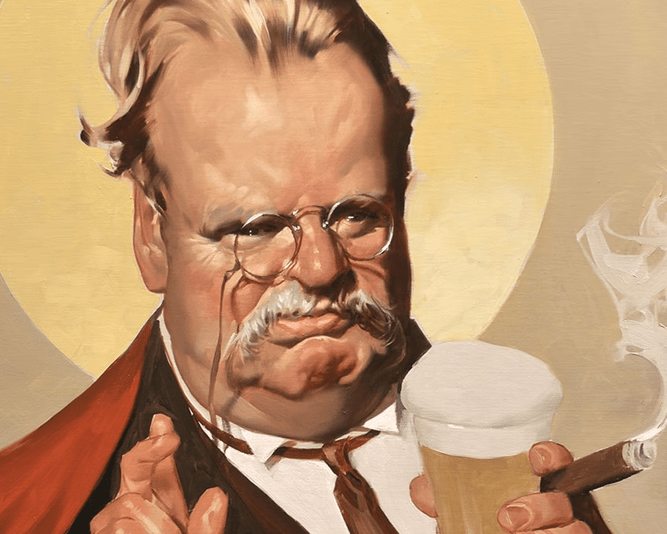
    The reference to Chesterton is interesting, particularly when put back into context.  Chesterton is a curious figure, not one I resonate with. For Zizek he appears as a kind of perennial coach. For my part, my distaste probably stems from the whiff of hypocrisy that attends the Catholic intellectual. The suggestion of Sainthood that was apparently once raised in relation to Chesterton only added to that bad smell. Despite this, the role of paradoxical thinking in his work is one that, elsewhere, I have found fascinating and it is no doubt this role of paradox that Zizek latches onto and that underlies that particular formula Zizek extracts. The Chestertonian formula is aimed at those, like Nietzsche, who are taken to have a general and productive or positive concept of the will.  The will, for Chesterton, is negative, a privative, restrictive concept that always, by definition, limits by negating.  To quote Chesterton, again at some length:

    (more…)
  • The off-switch as the ground of the Unconscious

    In a report of recent neuroimaging techniques, the lead scientist said the following – “our findings suggest that unconsciousness may be the increase of inhibitory assemblies across the brain’s cortex” (See here).  The statement is taken to be supportive of a particular theory about consciousness put forward by Susan Greenfield, which may or may not be the case.  Greenfields hypothesis seems, on the face of it, simply another form of modularity thesis about consciousness and although her metaphor of consciousness as a ‘dimmer’ switch rather than a binary state of on/off may be a good metaphor, it’s also rather obvious.  Did anyone actually think consciousness was a simple state that one either ‘had’ or didn’t have?  If they did, it seems rather absurd.  That said, the neuroimaging work, in probing the dynamics of the brain as it rises and falls into consciousness, sounds fascinating.  The spectral consciousness that begins to appear on the horizon as a result of increased levels of communication and signalling between neural assemblies in the brain doesn’t directly answer the central problem with any modularity concept when applied to the mind, rather than the brain, however – which is the question of how the parts become the appearance of a whole, the extent of what we might call the ‘holistic reality’ of the mind.  There’s much interesting discussion of this problem, some of which is usefully summarised in Carruthers article ‘Moderately massive modularity’.  In general Carruthers account of this holistic reality rests in the architecture sketched, in which language enables us to “build non-domain-specific conscious thinking out of modular components”.  All of this is fascinating stuff and at some point I want to explore the details of this in more depth.  For now, however, I want to pursue another thread, albeit in a kind of rambling ‘thinking out loud’ way.  As is common on this blog these are notes for myself, part of the process of thinking through things.

    What struck me as I read that phrase from Professor Pollard, the lead scientist on the neuroimaging work, was this idea that the increase of inhibitory processes is the ground of the unconscious.

    (more…)

  • the two types of causation

    the two types of causation

    curious+face+on+the+wall_34183397From the very beginnings of organised philosophical thought there has been a keen awareness of the problem of causality. In its most basic form this problem arises whenever the concept of freedom is considered. To be free is to be uncaused. This basic axiom has considerable implications. If we agree that ‘to be free is to be uncaused’ then it seems like we face two simple options as implications of this axiom. Either we deny that there is any such thing as freedom or we deny that cauality is universal. This simple axiom, that to be free is to be uncaused, produces a quite strange and difficult tension between these implications. On the one hand we might want to affirm freedom as real and present. In general we might want to go further and not only affirm the actual reality of freedom but also affirm it as something to be valued and retrieved in the face of its removal. On the other hand we want to affirm the capacity to know the world and the conection between the various facts of the world, connections of causality. Freedom breaks open the world, whilst causality constructs its’ connections and it would seem we want the strange mixture of freedom within a connected world. One of the basic responses to this type of tension has been to suggest that there are, in fact, two types of causes. Everything is thus connected through the concept of cause, but the connections are variable dependent on which of the two types of cause is in play. We thus reconcile freedom and cause by turning freedom into a type of causal force. (more…)

  • Leibniz, necessity, god

    Leibniz, necessity, god

    DSC01952_33863989Philosophers no longer talk about God and if they do nobody listens. At the time of Leibniz and the Enlightenment the reverse was the case – philosophers always talked about God and if they didn’t then nobody listened. This, no doubt, was a hangover from the impregnation of Christianity that occurred in the middle ages, during which time the bastard child of philosophy and Christian apologetics is produced, what Heidegger would later call ‘onto-theology’. Being (the ontos) is spoken of within the framework of God. This is the butchery of philosophy by Augustine and Aquinas, the butchery of pagan thought by monotheistic madness. A language and framework that is in effect absent from the initial movements of Socrates and Plato comes to dominate any attempt to think. To think without God becomes, by the time of the Leibniz, almost impossible. At the same time, to think with God also becomes almost impossible. Thought is threatened by God since metaphysical abstractions now implicate God. The situation is analogous to artists under Stalin’s regime. To speak is to speak of God – or Stalin – and so to speak is to invoke danger and attention, not always a good idea.

    At the heart of Leibniz is a peculiar pairing of two seemingly opposed ideas that produces a problem. On the one hand there is the idea that the world – Being – must have a necessity to the way it is. On the other hand there is the idea that God – the supreme Being – must be free and ultimately unconstrained by anything, including any necessities of mere matter. We can encounter this problem in the following way. Let us assume that God exists and has created the world, indeed all of Being. Let us also assume, following Leibniz for a while, that the world which exists is ‘the best possible world’. Now Leibniz wants to argue that the world is the best possible world because it must be the best possible world – it is not the best by accident but because only the best possible world could exist. Thus, if God created the world and it is the best possible world is it the best possible world because God created it or did God create it because it is the best possible world.

    The problem is right here – was God forced by ‘some sort of necessity’ to create the world as it is because it is the best possible world that there could be? Did God have no choice over how the world is – or even that the world is? If this is the case, then God is powerless in the face of this necessity – nothing more than an empty origin.

    The situation gets worse, however, if we try and say that the world is the best possible world because God created it. If God is free to create any world and the world that is created is the best possible world then we can ask why is this world better than any other? It must be because God chose the best, between more than one option– but for it to be the best there must be some reason that can be given, it must be more than a mere whim of God. God, then, becomes again subject to the reason behind the choice of one world over another and couldn’t have acted freely if he acted rationally since he would have had no choice. Alternatively the world is a mere whim and in that case it cannot be said to be in any real sense the best. Either the world has a necessity – in which case God is subject to that necessity – or it is a mere whim, in which case it might very well have been different, indeed it might still now be very different from the way we experience it. If the world is a whim of God we are left with the problem of the Caliph’s vision1.

    It’s not just Leibniz who works with this difficulty. In Descartes too we find the problem of why and how God relates to Being. If God is given complete freedom then what’s to stop him from having a huge joke at our expense? What prevents God from making the false seem true and the true seem false, from making the appearance radically different from the reality? If we respond, because God is good, then surely if God is good he would have created the best of all possible worlds and then we are back to the lack of freedom on the part of God. God is free and the world is possibly a joke or the world is necessarily the way it must be – the best – and thus God is no more and no less free in his creativity than the mathematician is in the production of a solution to a given problem.

    1 Nicholas Rescher, following Bertrand Russell, poses the problem as a formal dilemma and as follows – ‘According to the Principle of Perfection [what I have been referring to here as ‘the best of all possible worlds] God acts in the most perfect way possible with regard to the creation of the world, and he does so either necessarily or freely. If he does so necessarily his freedom is destroyed, and all that follows as a result of his perfection – i.e., everything that happens in the world – is necessary. If he does so freely, in accord with Leibniz’s principle, a sufficient reason must be adduced for this free act, and this in turn must be either free or necessitated. Thus an infinite regress is initiated.’ (Rescher, 1967: 43-44) Rescher’s formulation of the formal problem (that of an infinite regress) avoids the problem of the powers or forces at play in the inter-relation between the concepts of God and Necessity.

  • Naive notes on crowned anarchy

    Naive notes on crowned anarchy

    To call life itself just or unjust, to conceive life as samsara or suffering, is to judge life and to do so from outside life, from some position which is the ground of a judgement. To encounter life, respond to it, is inevitable and not all responses are equal, this much is inevitable. Too often, however, this encounter and response is thought of as a judgement. To not judge does not mean to not respond or that any response is as good as any other. There are different responses in life, different lives if you like – or different types of life. Life produces its own end, life drives itself to death but in the encounter with death there is another space of response, this time one that shows us the two fundamental ways of response, affirmation and negation, more life or never ending death.

    How am I to think of life? The philosopher must ask this question. They must, moreover, continue to ask this question and to encounter the force of this question with responses – the philosopher must not simply ask an idle question but encounter the problem of the question, the problem the question arises from, responding with thought, with emotion, with passion, with action. Encounter and response constitute the activity of thought and living, though too often this dynamic to-and-fro is congealed, by the social, into regulated habits, pre-formed responses such as the response of the subject, ‘I think…’. Living is a poor name for the habits and habitats of the human. We are all, inevitably, products of the social, products of the inhuman and yet we are not inevitably condemned to remain nothing but product, commodity, object. It is not a matter of striving to become a subject since the subject is that which is subservient, the subject of the monarch. Rather it is a matter of striving for monarchy itself, becoming a crown within life but not a ruler, judge or controller. Crowned anarchy, this is the watchword, a monarch of creation, a singular moment that adds to the abundance of singular moments. In more traditional terms, this is the assumption of an imperative to autonomy, the self (auto) lawmaking (nomos) reality.

    (more…)

  • Relations and reactions

    Relations and reactions

    dancing+graffiti_40910987In a post on Marx’s dialectical method and Deleuze, Steven Shaviro makes the interesting claim that it is Deleuze’s pluralism that is transcendental.  It is the theory of relations that Deleuze has which underpins his pluralism and this theory of relations, presumably, would be the place to look for a transcendental structure in the sense of a ‘condition of possibility’-type argument (Shaviro makes it explicit he’s referring to a Kantian transcendental when talking of Deleuze’s ‘transcendental pluralism).  Indeed this is plainly the case for Shaviro, since the article begins from the differences and similarities between dialectics and Deleuzian thought in terms of their theory of relations.  He suggests a strong commonality around this area of theory of relations, arguing that:

    There are definite commonalities. (1) Both the Hegelian/dialectical language of negativity, and the James/Bergson/Deleuze language of virtuality, insist that all those things that are omitted by the positivist cataloguing of atomistic facts are altogether real. (2) Both locate this reality by asserting that the relations between things are as real as the things themselves, and that ‘things’ don’t exist first, but only come to be through their multiple relations. (3) Both construct materialist (rather than idealist) accounts of these relations, of how they constitute the real, and of how they continually change (over time) the nature of what is real.  (4) Both offer similar critiques of the tradition of bourgeois thought that leads from Descartes through the British empiricists and on to 20th century scientism and post-positivism. (numbers in brackets inserted)”

    (more…)