Category: magick group

  • On Catkins and Lawrence

    ‘Do you really think, Rupert,’ she asked … ‘do you really think it is worth while?  Do you really think the children are better for being roused to consciousness?’ …

    ‘They are not roused to consciousness,’ he said, ‘consciousness comes to them willy-nilly.’

    ‘But do you think they are better for having it quickened, stimulated?  Isn’t it better that they should remain unconscious of the hazel, isn’t it better that they should see it as a whole, without all this pulling to pieces, all this knowledge?’

    ‘Would you rather, for yourself, know or not know, that the little red flowers are there, putting out for the pollen?’ he asked harshly …

    ‘I don’t know,’ she replied …

    ‘But knowing is everything to you, it is all your life,’ he broke out.  She slowly looked at him.

    ‘Is it?’ she said.

    ‘To know, that is your all, that is your life – you have only this, this knowledge,’ he cried, ‘There is only one tree, there is only one fruit in your mouth.’

    … She was sometime silent.  ‘Is there?’ she said at last, with the same untouched calm.  And then in a tone of whimsical inquisitiveness:  ‘What fruit, Rupert?’

    ‘The eternal apple,’ he replied in exasperation, hating his own metaphors.

    ‘Yes,’ she said.  There was a look of exhaustion about her.  For some moments there was silence.  Then, pulling herself together with a convulsed movement, Hermione resumed, in a sing-song, casual voice.  ‘But leaving me apart, Rupert; do you think the children are better, richer, happier, for all this knowledge; do you really think they are?  Or is it better to leave them untouched, spontaneous.  Hadn’t they better be animals, simple animals, crude, violent, anything, rather than this self-conscious, this incapacity to be spontaneous.’ … ‘Hadn’t they better be anything than grow up crippled, crippled in their souls, crippled in their feelings – so thrown back – so turned back on themselves – incapable – ‘  Hermione clenched her fist like on in a trance – ‘of any spontaneous action, always deliberate, always burdened with choice, never carried away.’ … ‘Never carried away, out of themselves, always consciousness, always self-conscious, always aware of themselves.  Isn’t anything better than this?  Better be animals, mere animals, with no mind at all, than this, this nothingness -‘

    ‘But do you think it is knowledge that makes us unliving and self-conscious?’ he asked irritably.

    She opened her eyes and looked at him slowly.  ‘Yes,’ she said.  She paused, watching him all the while, her eyes vague.  The she wiped her fingers across her brow, with a vague weariness.  It irritated him bitterly.  ‘It is the mind,’ she said, ‘and that is death.’  She raised her eyes slowly to him:  ‘Isn’t the mind – ‘ she said, with the convulsed movement of her body, ‘isn’t it our death?  Doesn’t it destroy all our spontaneity, all our instincts?  Are not the young people growing up today, really dead before they have a chance to live?’

    ‘Not because they have too much mind, but too little,’ he said brutally.

    ‘Are you sure,’ she cried, ‘It seems to me the reverse.  They are over-conscious, burdened to death with consciousness.’

    ‘Imprisoned within a limited, false set of concepts,’ he cried.

    But she took no notice of this, only went on with her own rhapsodic interrogation.  ‘When we have knowledge, don’t we lose everything but knowledge?’ she asked pathetically.  ‘If I know about the flower, don’t I lose the flower and only have the knowledge?  Aren’t we exchanging the substance for the shadow, aren’t we forfeiting life for this dead quality of knowledge?  And what does it mean to me after all?  What does all this knowledge mean to me?  It means nothing.’

    ‘You are merely making words,’ he said; ‘knowledge means everything to you.  Even your animalism, you want it in your head.  You don’t want to BE an animal, you want to observe your own animal functions, to get a mental thrill out of them.  It is all purely secondary – and more decadent than the most hide-bound intellectualism.  What is it but the worst and last form of intellectualism, this love of yours for passion and the animal instincts?  Passion and the instincts – you want them hard enough, but through your head, in your consciousness.  It all takes place in your head, under that skull of yours.  Only you won’t be conscious of what ACTUALLY is; you want the lie that will match the rest of your furniture … It’s all that Lady of Shallot business,’ he said, ‘you’ve got that mirror, your own fixed will, your immortal understanding, your own tight conscious world, and there is nothing beyond it.  There, in the mirror, you must have everything.  But now you have come to all your conclusions, you want to go back and be like a savage, without knowledge.  You want a life of pure sensation and “passion”.’

    He quoted the last word satirically against her.  She sat convulsed with fury on violation, speechless, like a stricken pythoness of the Greek oracle.

    ‘But your passion is a lie,’ he went on violently.  ‘It isn’t passion at all, it is your will.  It’s your bullying will.  You want to clutch things and have them in your power.  You want to have things in your power.  And why?  Because you haven’t got any real body, any dark sensual body of life.  You have no sensuality.  You have only your will and your conceit of consciousness, and your lust for power, to KNOW …

    ‘Spontaneous!’ he cried.  ‘You and spontaneity!  You, the most deliberate thing that ever walked or crawled!  You’d be verily deliberately spontaneous – that’s you.  Because you want to have everything in your own volition, your deliberate voluntary consciousness.  You want it all in that loathsome little skull of yours, that ought to be cracked like a nut.  For you’ll be the same till it is cracked, like an insect in its skin.  If one cracked your skull perhaps one might get a spontaneous, passionate woman out of you, with real sensuality.  As it is, what you want is pornography – looking at yourself in mirrors, watching your naked animal actions in mirrors, so that you can have it all in your consciousness, make it all mental.’ …

    ‘But do you really WANT sensuality?’ [Hermione] asked puzzled.

    Birkin looked at her, and became intent in his explanation.  ‘Yes,’ he said, ‘that and nothing else, at this point.  It is a fulfillment – the great dark knowledge you can’t have in your head – the dark involuntary being.  It is death to one’s self – but it is the coming into being of another.’
  • Quite how to do it…

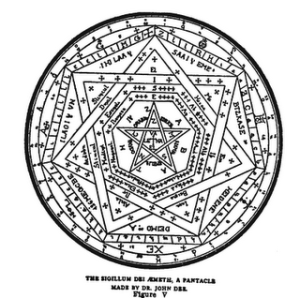
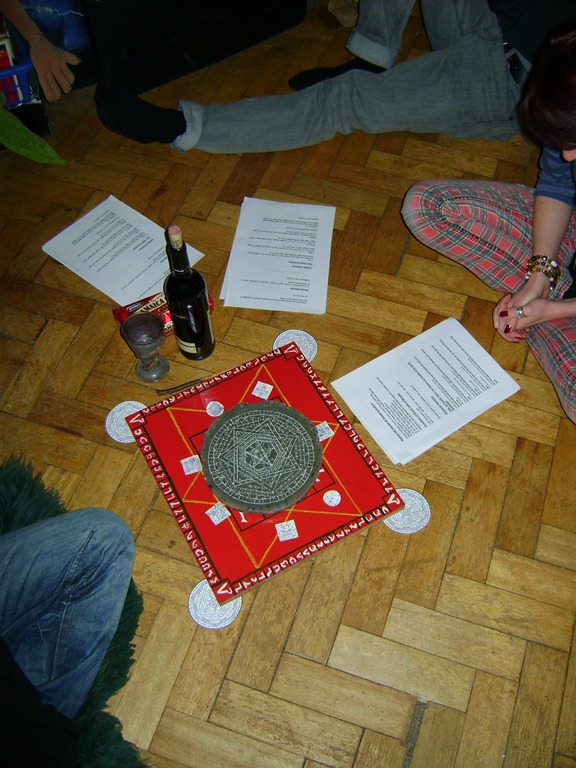
    Sigillum Dei AemethThis post offers a review of the Brighton groups activities so far as we move into a new series of workings and an initial protocol for those new workings.  The first section is the review, the second the protocol of practice.
    Looking back

    The small group of us in Brighton have come together through the activities of the kabbalistic meditation group that was originally set-up in May 2007 as a place of regular group ‘recharge’ activity.  There are some notes on this in earlier posts, some of which also track the changes that take place as the group developed and moved.  Towards the end of last year we once again made a shift to a new phase of work after focussing for a while on practising the SIRP .  The decision we took was to try and practice the Enochian magick that Lon Milo DuQuette had made so accessible in his recent book, Enochian Vision Magick. The start of the new year therefore found us shifting focus from the practice oriented sessions we had been involved with to a series of study sessions in preparation for the Enochian work.

    We have now had four sessions.  The first was an initial planning session for how we were to approach things.  This operated as a kind of overview and then a talking stick session, with a view to maintaining the strengths we had whilst we explored a new practice.  Our first issue was working out how to move into a whole new type of practice without losing what we had so far built.

    In the previous set of practices we had taken a decision very early on to make the sessions very similiar each time in order to establish a simple routine, rather than to have an eclectic mix of activities that shifted and changed every time we met.  In part this came from the initial impulse to form the meditation group, which arose out of a group of magicians, most of whom were ‘chaos magick’ inspired and already meeting in a local CM cell.  In many CM sessions the format is for participants to each bring a rite and then for the group to go through a whole series of different activities during the session.  This can be extremely exciting and vibrant but also quite draining and so the meditation group was almost a reversal of this, with a format that was fairly fixed.  We would meet, do the Qabalistic Cross (x3), an LBRP, the QC again (x3) then a series of Middle Pillar chants, 5 as a round and 5 unified.  After that we would have a silent meditation of 20 mins followed by a pathworking.  This basic format was adjusted at times but in effect the same thing would occur each time, the main difference of content being in the pathworking.

    Gradually we adjusted elements as we developed.  We moved our pathworkings further up the tree, we took it in turns to do these pathworkings and then we shifted from the LBRP to the SIRP.  We did a slightly more organised set of pathworkings (the 3 Letter workings) which aimed to establish a personal contact on the tree for each participant.  One of the participants was an experienced Chi Qung practitioner, so we added some CQ into the beginning of the meetings.  Each change was small and built on the established routine of the sessions.The strengths of these practices lay in their regularity.  This regularity meant we all knew what was going to happen each time we met, or at least the basic outline.  The coherence of the rites was easier to build, energy easier to raise and a sacred space faster to establish because there was little or no need to discuss what we were doing each time we would meet – we simply met, did the work and generated the space in which we existed for that time.  So our first job in planning the new work was to once again build on what we had.

    We had a long chat about what it was people got form the existing work, what stage of development people were at magically and agreed a few groundrules for the new practice.  Some of these are obviously private to the group but I think most importantly we agreed to continue the meditation sessions as ‘energy gains’ in between the Enochian work.  So we will be doing 2 session of Enochian, followed by a 2 session break during which time we will have meditation session.  We also agreed that for the first half dozen or so session of the Enochian practice we would all be there for the session to go ahead.  In our meditation work it usually didn’t disrupt things greatly if one person couldn’t get along for one week, they would simply slip back into it the week after.  In this new practice it seemed sensible to ‘all be new together’.  Once we’ve overcome the initial ‘shock of the new’ together and have a shared vocabulary of experience we can again continue with a session even if one participant isn’t able to get along that week.

    Having established some ground rules we then met again three times to do some study sessions on DuQuette’s book and get a rough, shared familiarity with the material we were going to work with.  The first session looked at the Sigillum Dei Aemeth and everyone drew one out from the various tables and sources.  The second session looked at the Ring, Lamen and Holy Table and then a third session spent time looking at the Holy Tables, clarifying the work in the Aethyrs with the symetrical characters of the Governors and the work in the Elements, with the Golden Talisman and the Elemental squares.  Lots of material, lots of discussion, lots of fun – but all very school-like in many ways.  Last night we finished off this initial set of preparations and sketched out the basic outline of how we’re going to begin the work.

    Looking forward

    In general we’re going to follow DuQuette fairly closely.  Our own flavour of things will probably be most noticeable in the form of Middle Pillar exercise we do, the chanting in the round.  After some discussion, however, this is the agenda of activity for the sessions:-

    1) 3x Qabbalistic Cross, LBRP, 3x Qabbalistic Cross

    2) Middle Pillar Chants

    3) Temple Ceremony ( the Heptarchical operation)

    4) Elemental working (the Scrying session)

    5) Close

    We begin in two weeks (initial session planned for 17th March) to give people time to adjust their practices in preperation.  In particular this means maintaining or renewing regular Qabbalistic Cross, Middle Pillar, and LBRP activity (having been focussed on the SIRP, the shift back to the LBRP will be interesting for people).  It’s a good time to look at the Whare Ra documents again, which you can find over here.  The DuQuette book is the reference for the activity.  He gives a classic form of the LBRP at the start of Appendix 1 (page 191) , the main differences to our previous practice being the triplicity of the Qabalistic Cross (‘Ateh, Malkuth etc’) at the beginning and ending  and the way we pronounce the first pentagram, YHVH.  The Temple Ceremony is what DuQuette calls the ‘ceremony of preparation’ (page 193-195) and the place of  the ‘elemental working’  is indicated on page 193 but the content is effectively given on pages 179 – 181 (this protocol was one of the study session hand-outs).   The content of the elemental workings are the subesctions on pages 179-181 in DuQuette’s book, titled ‘The Call(s)’, ‘Addressing the Hierarchy’ and ‘Calling your target angel’.  DuQuette gives an example which you could work through, replacing this with our first point of activity, one of the the four basic Earth of Earth angels.  I will prepare the Calls and the Address to the Hierarchy for our first session but this is a task that will land on everyone at some point.  For the first session the Scryer and the Recorder have been decided (you know who you are) and the set of questions we use as the base from which to work is given in Enochian Vision Magick on pages 173-174.

    We can use the comments thread here to discuss any initial adjustments we might feel we want to make to this protocol.

  • assorted synchronicities

    I noticed that a few coincidences/synchronicities clustered around our first meeting to discuss working the Enochian system, and later when I finished reading Duquette’s Enochian Vision Magick.

    First John Dee was mentioned in two books I was reading. Then a man with the name got in touch. He sent pictures of himself dressed as Freddy Mercury from Queen. Couple of interesting associations here – of course J.Dee was the Queen’s conjurer, employed in her service at the time for his astrological and other skills. Mercury is analagous with Hermes – my first thought being his role as messenger of the gods and his obvious import in the carrying of messages, which is presumably what we will be doing in the Enochian work. He’s also known as “patron of boundaries and of the travelers who cross them” which seems apt considering the nature of the work being undertaken, which could some kind of trans-dimensonal contact, or at the least a departure from everyday consciousness. Hermes/Mercury has often come up for me, interesting to see his presence here again.

    On the way to the first meeting I called into a newsagent to get something to eat for dinner. I chose a vegetable samosa and went to the counter to pay. The bored looking man at the till had a piece of A4 paper with what looked like four grids on it. The grids were drawn in pencil and contained many small squares. Inside each were either numbers or letters, I’m not sure which. It didn’t look like sudoko, and was hand drawn. I was struck by the superficial similarity of these grids of information to the grids used in the Enochian system. Later, at the meeting we had a plate of vegetable samosas. I don’t make a habit of eating this particular foodstuff, so to choose one and then later be confronted with a plate of them seemed an odd coincidence. As to its occult significance – something about triangles? – I’ll spare you my speculation.

    On Sunday 28/2/10 I finished the Duquette book and noticed a couple of angelic mentions in the same day. First was from the film Southland Tales, when an ex-soldier is about to inject himself with a futuristic drug: “Then you take the blood train. You talk to God without even – without even seeing him. You hear his voice, and you see his disciples. They appear like… like angels under a sea of black umbrellas. Angels who can see through time.”

    An hour later I was reading a book of poetry by Goethe, and turned randomly to poem number 76: Higher and Highest Matters, which contains the lines

    Yet in other dialects men

    and angels make communication:

    Secret grammars, speech of roses,

    And the poppy’s conjugation.

  • Constructing the ‘Three-letters’ into a contact

    Constructing the ‘Three-letters’ into a contact

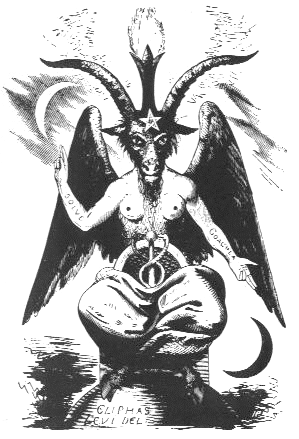
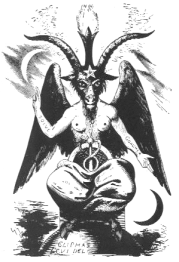
    baphomet2One of the recent experimental workings that the meditation group engaged in was the ‘Three-letters’ working (which I posted about here) in which the Tree of Life was approached in a particular type of way.  The intention of this working is to provide a means by which a practitioner can construct an imaginal means of learning the tree.  No assumption is made about the reality or otherwise of entities and contacts, not least because worrying about reality is not something a magician should be doing – the practice of majik is pure experimentation with knowledge and experience, literally a matter of ‘make something up and see what happens’.  The means of assessment of the success or otherwise of an experiment or working is difficult, although ‘consistency’ is a good rule of thumb.  The greater the consistency of responses received the more powerful they become.  In a sense ‘consistency’ produces a majikal reality – synchronicity, for example, is a form of consistency between situations and the ‘law of sympathy’ relies upon a consistency, a regularity or repetitive structure being formed such that a causality begins to emerge, albeit one that almost deliberately fucks up the ‘ground’ of such causality.  If causality is of the form ‘do X, Y occurs’ then a fucked up causality retains this structure whilst simultaneously undermining it.  There is no reason to majikal causality, merely consistency – it is this that makes it majikal.

    The core of the Three-letter working is three journeys to the bottom supernal triad of the Tree of Life in which each sephiroth is meditated upon with a view to producing a single letter in each case.  These three letters then form the name that is to be given to a contact or teacher or imaginal being who will be able to take the role of interlocutor in future exploration of the Tree.  Produce a name to produce a conversation partner.  There is a set of three path-workings available for the three sephiroth elsewhere on this site but having obtained three letters the next step is to call on the named entity.  To that end the following pathworking is offered, a simple exercise adapted from R.J.Stewart’s books, Living Magical Arts.  The exercise in that book (one I recommend highly, although it may read as slightly anachronistic nowadays, perhaps with a hint of ‘New Age’ christianity even) is called ‘Establishing an innerworld contact’ (pp195-198; Blandford 1987) which should be quite obviously seen as closely connected with the intentions of the Three-letter pathworking.

    The Visualisation

    (do whatever preparations you need in order to be able to concentrate clearly)

    In front of you, in a dimly lit environment, is a door, a wooden arched door, above which is a lamp.  Bring the door to clear vision, as clear as you can make it.  When you feel calm and ready to meet the contact and the doorway is as vivid as you can make it push the door open and step underneath the lamp and through the doorway.

    You are in a square courtyard, in the centre of which is a fountain.  The door you have just stepped through is next to a tree, the courtyard is open to the sky and it is nighttime.  On each of the four walls there is another tree, next to which there are doors.  Four walls, four trees, four doors.

    Begin to walk, slowly, around the courtyard.  Continue walking until you feel settled and the courtyard, the trees, the doors and the fountain are as vivid as they can be.  When you are ready move towards the fountain.

    There is a wall around the fountain and you place you hands on the wall.  You feel the stones beneath you skin.  You hear the water.  Close your eyes and allow yourself to do nothing but listen.  When ready, open you eyes and draw on the wall the three letters you have brought with you.  See them on the wall between you hands, make them come alive, glow and vibrate.  Concentrate on the letters and keep this concentration – as you do so, you hear a door open and footsteps behind you.  Stay focused on the name as the person who has entered the courtyard walks around you just as you did when entering, before they finally stop opposite you on the other side of the fountain.

    Ask them if they are the person your three-letters name.  Do not challenge them to prove it but trust yourself as to whether they are telling the truth.  Once you are happy it is the contact, ask them any questions you want to, about the Tree or about anything else.  Allow the conversation to flow until they stop it.

    Close your eyes again and hold the wall, feeling the stone under your hands.  The contact will leave.  When they have gone, open your eyes, walk around the fountain and move towards one of the doors.  Next to the door you have chosen you will see a symbol or mark of some sort to help you remember which door you use.  Remember that sigil and then leave the courtyard, closing the door behind you and bringing yourself back to the here-and-now.

    Use whatever techniques you prefer to ground yourself again and then make notes on anything interesting.

    Rinse and repeat as necessary…

  • SIRP and Signs

    SIRP and Signs

    The Meditation Group is now two groups, since we grew to 9 and the room was getting a little cramped.  There was also the issue of the new members not having gone through the same process as the previous group of 5 (the Qesheth working mainly) and so we now have 2 groups meeting fortnightly for a while.  The intention is to develop some of the ritual work further in the older group and to go through the Qesheth again in the newer group, with a view to coming together again in the new year.  As usual in these things, with the shake-up a couple of people took the opportunity to re-assess their own work and we said goodbye to them, at least in terms of the Meditation Group.
    So far we’ve been using the Lesser Banishing Ritual of the Pentagram (LBRP), so the next step seems to be to get the Superior Invoking Ritual of the Pentagram (SIRP) in place before moving on to the Hexagram and Rose rituals.  To that end, the following details or diagrams of the SIRP are being posted here for members mainly:

    SIRP 1, SIRP2, Signs1 and Signs2

    Ah yes – and someone was asking about Harpocrates (Horus) – the wikipedia page is here

  • The Three-Letters working

    The Three-Letters working

    The meditation group has begun a new cycle of activity following an influx of members that took us from our regular 5 to a regular 9.  In order to advance this first ‘series’ of workings on the tree (the QShTh, Qesheth working) I decided to add in a specific element which would involve each individual creating their own ‘guide’ for the tree.  The intention is to allow the intuition of the participant to be activated and given body and voice in such a way that the participant can hear their intuitionistic response and use that in addition to the basic outlines of colours, tone and symbology that I might give them.  During the Qesheth activity the bottom supernal is explored and so we are using this also to create the three-letter guides, each letter being activated by a specific pathworking focused on either Yesod, Netzach or Hod, where Yesod gives us a face, Netzach gives us blood and Hod gives us voice.  The order of visiting was Yesod – Netzach – Hod.  The three pathworkings are given here:

    Yesod, Hod and Netzach

    This is, of course, an experimental working and so anyone else wanting to use it it most welcome to, as well as most welcome to leave comments or give feedback.

  • Meditation group – Malkuth to Yesod

    I work an immanent model of the tree, rising up its pathways and growing into the tree.  Practically this means beginning from Malkuth and working towards Hod, Yesod and Netzach in the first instance (the ‘lower supernal’ or first triangulation).  The core of this first triangulation revolves around the 21st path from Malkuth to Yesod, the Tau path, in which there are three moments – Malkuth itself, the path (World) and then Yesod.  Three is the magic number of the tree.

    The temple of Malkuth is approached from a wood, in which we begin.  The greens and browns of the forest, the lushness of life and the tree itself offer our entrance into the trance pathworking.  Coming out of the wood we move onto a grass plain, mountains in the distance, birds in the air, water flowing somewhere near us, we can hear it, and the temple of Malkuth sitting amidst the growth and green of the plain, surrounded and watched over by the archangel of this realm, Sandalphon.  Given time to form its image as we cross the grass towards the temple, we see the four steps leading up to the platform where we find the entrance, the four steps reminding us of the four worlds of the Kabbalah, the platform itself enabling us to pause after climbing the steps, giving us time to acknowledge the motto of Malkuth carved above its entrance, the motto ‘Know thyself’, the motto of Socrates.  As we push open the door the black and white tiles of the floor and the flickering firefly of the Ashim fill our vision and surround us as we step inside.

    The following pathworking is the first in a new series of travels on the tree.

  • Building the temple of Tiphareth

    wands06

    As of writing, May 2008, the Kabbalah meditation group continues and we’ve now been working weekly for over a year, developing a consistent practice and learning a lot as we go.  Our attitude is relaxed and flexible, primarily because the aim of the group was always to provide a space of grounding and recharge for a group of active magicians whose work in other areas can be complemented by this regular co-creation of sacred space.  During the first year we have worked the bottom of the tree, most recently working the Death and Devil paths, gradually building up paths as we go, adding layers of symbolism and becoming intimate with the tree.  We have now completed the QShTh or ‘rainbow’ and have already touched Tiphareth but the time now comes to begin to build Tiphareth.

    When we began we worked the temple of Malkuth, giving us a strong grounding place from which to explore.  The temple was perhaps the most vividly drawn and the one we spent most time in since we would often begin and end a journey by entering and exiting through Malkuth.  Now the same process is to be done with Tiphareth, building it as a vivid ground from which to begin exploring the upper triads of the tree.

    Whilst we use the Dion Fortune text, Mystical Qabalah, as the ‘book’ on the altar space and the ground of the associations we use, the temples are built intuitively, from hints and encounters and spontaneity.  To a large extent this ends up being something that comes from my imagination as I work the paths myself and then share what I’m doing in the pathworking, so I’m aware that there’s probably a huge idiosyncracy in the way in which we work.  At present this seems unproblematic, since this first ascent of the tree aims to install it into our consciousness in a way that enables it to be built upon in future and the tree feels strong enough to sustain any idiosyncratic presentation, at least one that comes from an intuitive response.  The overwhelming nature of the tree and its associations is something I encountered before and in this project there was an unconscious avoidance of any necessity to install a ‘correct’ tree and the emphasis was on ‘what worked’, what enabled people in the group to work the path, visualise strongly and connect intimately.  cups06

    The temple of Tiphareth, then, is being built as a Golden Castle with a Child of Light at its heart.  In our previous approaches we came through the path of  Temperance and the working would involved a scene in which we fired a bow and then became the tip as it flew through the air, before landing in Tiphareth.  Now I wanted to install a direct path into the castle, in the same way that we have a direct path that goes into Malkuth.

    … you walk along a gravel path, through a line of trees that lead to a open grass park, with people playing and relaxing on a sunny day.  You feel the crunch of the gravel under your feet, hear the sounds of the people in the distance.  As you come to the end of the path and move onto the grass, feeling its soft bouncy texture, you feel the warmth of the sun on your face.  You continue towards the Golden castle in front of you towards a doorway.  The door to the castle is on the corner of two walls, with the Castle itself imagined as a hexagon.  You ask Raphaels’ permission before entering the door and once within there are the Malachim, white robed figures moving to and fro along a pathway around the walls.  Within the temple there is a courtyard, at the centre of which is a space of light, bright white light with hints of gold and pink.  You move towards the light until it overwhelms your eyes and surrounds you in its presence.  Gradually shapes become visible as your eyes adjust to the light, though everything is still surrounded by the bright light.  In the centre of the space a child sits on a cushion, behind them a tall crowned man stands.

    swords06 You move towards the child and sit on a cushion next to them.  They place a hand on your chest and rest your hand on theirs and as they do a flow of light can be felt moving into and through you, filling you up, flowing into your body, filling your feet, your hands, your whole being.  The child slowly withdraws their hand, as do you and then they rest it gently on your forehead and offer you pents06a vision.

    The child stands and offers you their hand. You stand and the child leads you, hand in hand, to the the right, where there is a door marked Death.  The child then turns about and walks to the direct opposite side of the space and another door appears, this time marked Devil.  Finally the child leads you back to the centre and you face the crowned man. Around the feet of the man and underneath the cushion the child was sitting on are rose petals.  Behind the man there are five doors, too distant to make out any marking as as yet.  The child lets go of your hand and sits down again, saying goodbye.  You turn to leave, walk back the way you came and find yourself once more in the courtyard with the Malachim, one of whom opens the door and nods goodbye, smiling as they do so.  you leave the Golden Castle, making your way across the grass, onto the gravel path and back to this world …

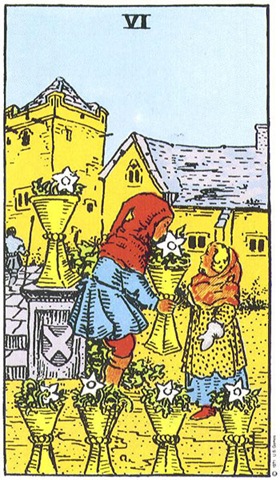
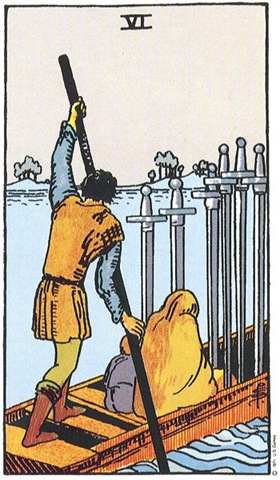
    6 wands – victory, 6 cups – joy, 6 swords – earned success, 6 pentacles – material success

  • Meditation Group – update

    The Kabbalistic meditation group we started with some fellow majicians last year is still going strong, meeting every Tuesday night for nearly a year now.  We’ve begun a ‘second phase’ of work after a couple of weeks break during the Winter Solstice period.  Last year we concentrated on the bottom four sephiroth, building a strong temple base in Malkuth and exploring the other three sephiroth as part of a process of QShTh (Koph, Shin, Tau) or ‘building the rainbow’.  Once this ‘bow’ is built, the arrow is then drawn and fired towards Tiphareth and that is indeed where we have been heading recently.

    We began by getting a second ‘temple base’ centred and fixed, this time not the temple of Malkuth but the temple of Tiphareth, the walls of the temple no longer in stone but now golden, forming a golden castle on a hill which we entered by drawing the bow, focusing on the tip of the arrow-head and then becoming the arrow as we release the bow, landing inside the golden castle to meet the child of light.  We spent some weeks just going there, spending some time with the child of light, allowing the connection to be made through the solar plexus.  Now, however, we’ve begun to explore the pathways towards Malkuth, notably 24 and 23 – death and the devil respectively.  The last two weeks have been focused on path 24, death.

    Here, on the path of transformation (a vague term if ever there was one and one that might be said to apply to the whole of the tree), the taste of earth is again predominant.  Lions and sparrowhawks and battle cries abound, the clash of metal ringing out in the expanse of the heavens.  The flaming red elemental triangle is strong and there is a connection to Geburah, somewhere, though I am unclear about that as yet – I’m assuming, no doubt incorrectly or only partially, that it’s a reflection from the other side of Tiphareth but more will come about that later.

    Having moved from the first supernal to begin working on the second it is appropriate to change some of the techniques we’ve been using as well.  The Kabbalistic cross, the LBRP and the Middle Pillar still form the beginning, although I’ve been thinking of bringing the Hexagram ritual to the group as well but perhaps towards the end of this period in preparation for the next move up.  Following these openings, however, we had previously been doing a simple 20minute empty mind meditation, primarily because this is a ‘no preconceptions’ form which, whilst difficult to achieve ‘perfection’ in (whoever wants to do that is a Fool, literally), is useful in producing a relatively simple state of ‘sit still, be quiet, allow the sounds of the world and your mind to just pass through’.  It was occasionally added to with the three steps a fellow chaote once suggested – Be Still, Be At Ease, Be Aware, in which you simply go from step 1, to step 2 through to step 3 and repeat the process each time you ‘interrupt’ yourself.  Now, however, we’ve begun using the more traditional ‘single point’ meditation of the Golden Dawn neophyte grade, as found in the First Knowledge Lecture, albeit minus the four-fold breath.  Interestingly there’s an ambiguity in the original, in which the meditation appears to be not on the point itself but on “the ideas to which it gives rise” and so we may not be doing anything similar to the practices of GD neophytes at all.  I find the idea of meditating on ideas far too strange, however, no doubt because of a certain hostility to the latent Platonism that I smell there.  The simple image of the point seems far more powerful and appropriate, not least because it is commonly encountered as dynamic, as an auscultatory phenomenon and thus the focus on the ‘breathing’ point allows the practice of settling the breath to occur.

    The other key notions of the First Knowledge Lecture are things I want to build into this stage of the pathworking as well.  We’ve already begun the process of learning the Hebrew of course as well as the sephiroth themselves and as we do we also learn the planetary and conceptual associations as well.  The practical elemental aspects have been limited so far and these and the astrological associations are probably the next layer on the cake that needs adding.  I’m unsure about the Pillars material, however – some sort of decision will have to be made regarding the whole Egyptian thing…not something I’ve ever resonated with myself but obviously central to any continued work with the GD tradition once we’ve established the basics, as it were.  Perhaps the group is just there to establish the basics…we’ll see.

    It is a strange thing to be working through this material again in a group, having last worked it over a good few years ago and then in a solitary situation.  The whole is very familiar but last time I remember – I might see if I can dig out my diaries about this – that the main lesson that I drew was regarding the whole ‘Judaeo-Christian’ aspect of the work.  I came into pagan and majikal practice with a considerable hostility to religion and in many ways still maintain that, though in general I now conceive the hostility as one directed at Priests and the Priesthood rather than Judaeo-Christians in particular – a kind of anti-authoritarianism, I suppose, partially informed by a general political hostility to authority, partially informed by Nietzsche’s genealogy of the slave revolt and the ascetic ideal.  Asceticism, priestliness and that whole monk thing is both powerful and destructive.  My first moves towards exploring any sort of ‘spirit’ (a word I still find peculiar and not altogether comfortable) was via Buddhism, which I soon found to be as deeply imbued by the Priestly ethic – if not more so – than Judaeo-Christianity.  It was Rae Beth who was the first to offer a path that seemed to somehow be inherently anti-authoritarian and yet still able to handle the sacred.  I soon found, however, that witchcraft and majik had its roots in Judaeo-Christian ideas, at least in terms of the language and symbolism with which it articulated itself if not in its inherent ‘spirit’ and so the Golden Dawn proved to be the way in which there was a coming to terms with this symbolism and history, or at least the beginning of such an accounting.

    Now, however, the  ‘JC religion’ thing is much less important.  The child of light, for example, found in the castle of gold of Tiphareth, might be associated with the Christ figure but is associated with a whole gamut of other sacrifice symbols.  If we understand sacrifice through Christ then we forget that it is only through an understanding of sacrifice that Christ means anything anyway.  Sacrifice is something inherently other than the simple figure of Christ, whilst at the same time incarnated in that figure amongst many others, many of whom I’d probably prefer the tone of.  The Christ figure is bound up with sin, guilt and the appalling trick, as Nietzsche says, of the ‘infinite debt’, a concept so bound into power, authority, capitalism and hate as to be almost inconceivable.  The sacrificial aspect barely remains in the JC religion because of the telos of that particular act.  Distinct from this I would suggest that it’s anathema to a pagan practice to begin from some sin that needs expunging – that is an inherently Judaeo-Christian, perhaps even simply a monotheistic concept (I know little about Islam so wouldn’t comment).  I think the Nimbari’s ‘third principle of sentient life’ – that it is capable of sacrificing itself for the greater whole – is a far more powerful way of understanding what is positive and what is dangerous in the general idea of sacrifice.  The image of sacrifice, however, that symbol, is bound into the body of the Christ figure within the Western majikal and pagan practices and so one way or another needs to be encountered and encountered not just as a danger or as negative.  That, as I say, was the original lesson that I drew from the Golden dawn material – now, however, the question or problem is which other figures might also be bound into that concept, who are these figures and is this in fact the heart of the tree, this notion of sacrifice?

  • Meditation group – week 11

    Sitting on a tree trunk in the old forest. In front of me dense leaves, the colour of mid summer, soft green before it becomes harsh khaki. The bark under my buttocks arranged in fine ridges, grey rather than brown, thin fingers, shallow grooves.

    I stand and begin to walk the path. It’s red, the soil has a dusty quality, smooth and warm. Looking at my feet. They’re moving slowly, falling with certainty. I know this place. I’ve been here many times. And then the forest begins to clear. In front of me is a large, grassy area. To my left I can hear water. The trees fall away from me to my right. I can still hear the birds singing up in the branches. In the distance purple topped mountains. Closer a temple, round, pale skinned, blank windows set into thick walls. There are steps, four of them, massively horizontal, hewn out of light rock, perfectly worked into straight angles. At the top a dias, ridged to form sun rays, and then a door, above which is carved Malkuth. I’ve been here before. I know this place.

    Inside pale becomes glinting orange, the light of sunset. Looking up and the ceiling is a dome, around which runs a balcony. The Ashim sing from the balcony, their flame bodies moving with breath and rhythm. They welcome me, some brush over my skin, with their words and music and spirit bodies. Their heat refreshes me.

    I see the lady, throned, her hair coiled about her head, her arms resting gently at her sides. She smiles. I incline my head. Her clothes are richly decorated, with gold threads and lush red velvets. Although she is antiquated I can sense her agelessness. She is neither young nor old, instead she just is, seated in her place, her proper place, and I am her guest.

    Three doors. On the left one marked XX, Judgement. Going. Not wanting to go. I cry a lot. It is fear real, ethereal. To want and not want. To feel desire and to be repelled. Forwards. Backwards. Swinging time.

    Through the door and the ground is wet, clotted. The earth path here is dark. Underfoot rotting leaves and broken twigs. The leaves squelch. The twigs crunch. They are being squashed, breaking.

    I am in a graveyard. Old tombstones rise before my eyes. One on the right, near the path, is covered in lichen and green moss. I cannot make out the inscription. In the distance I see a mausoleum. It’s square, white, columned with a pyramid roof. Someone important has died. They raised a shrine. Many of the tombstones are broken, lying at crumbled angles. There is a coffinesque one a few yards away. It’s lid is missing. My feet are wet. My hair is bound in elaborate coils and my white shift is damp and clinging to my body. I rise up, blood returns to my lips, it is as if I am waking from a very long dream, a dream that has kept me in this coffin for many years. I watch myself walk towards myself and then I join, black and white with colour. I feel my chill.

    Above me a white light, conical, starting as a pinprick up in the night sky and falling to ground in shafts of luminescence. I don’t need to be scared. I am not blind. Everything is throw into sharp focus as I recognise him from his sword. Michael. He who has counselled me to take the blood of harvest into my wintering heart. He showed me once what to do with the seed, how to tuck it away and keep it safe until the spring would help to bring forth its promise.

    The sword, double edged, shining steel, a hand guard, worked gold. His gown is white. He does not speak. I know already. I always have and always will.

    Another door, thrown open into brilliance, a space with no walls, no floors, no ceilings. I cannot fathom the distance or proportions. This light is blinding and breathtaking. To step in? The door has been opened.

    In front of me a wide staircase, stretching from beneath to above, curving around, encompassing. Marble. Alabaster. Iridescent clouds. I do not require air to be able to breathe.

    Walking down the stairs, a man with a staff, he has two snakes, but I can barely see them. He flickers in and out of my vision, part of the light, part of my perception. The snakes provide the only colour, brown and green, a solidity of muscle and movement. He becomes a she, with breasts, his hair tied behind his head, her feet padding on the marble, all is toneless, there is no silver or gold or sound, just white and light. Silky satin.

    Her lips move. He is talking to me. Hearing has no place in this space. Listening is irrelevant. Lips are moving. There is no strain, no gain. Lips are moving and they are beautiful in their movement.

    She takes me by the hand, but not by the hand. He has my hand and I have her hand, yet there is no grip or force.

    Up the stairs and everything shrinks. At the apex I find myself in a small room. Walls are brushed cream. The floor is boarded with dark wood. Along the walls bookshelves, filled with leather bound tomes. There are desks, a person sitting at each, their backs to me. They are silent. They are working.

    I am led down a central aisle, past the desks. No-one lifts their heads. In small alcoves bell jars sit on plinths. I do not know what is inside them. There is a geared machine, proportioned to fit on a small table. Brass cogs. A turning device. The sphere rotates silently. And then an empty desk. I sit. The wood is very old, a black patina is engraved into a polished dark brown surface. An ink pot. A feathered quill. The feather is beautiful, fine, an abstract white not white. Set into the desk three buttons, brass, big, the size of my palm.

    I press the left button. It shows me everything I know. Rapidly words and images flash in front of my eyes: ‘The Seventh Seal’, incalculate, a magnesium flare. I press the right button. It shows me everything I do not know: colours I have never seen, fascinating words, a wiring diagram. I press the middle button and a book appears, hard backed, dense woven fabric, blacker than black, the titled engraved in silver: ‘HOD’. I open the book and begin to read.