Category: machinic

  • AI ChatGPT describes Deleuze

    AI ChatGPT describes Deleuze

    There’s a lot of chatter around about the AI that is ChatGPT. Rather ominously the website states that “during the research preview, usage of ChatGPT is free”, which tends to imply that it’s going to become yet another paywalled tool at some point. In the meantime people get to ‘play’ with the tool, training it in the process, for free of course.

    Some of the chat I’ve seen about it has to do with writing code. One interesting comment was that if the AI can do the coding, then the task of the human will be to specify clearly what it is that the AI will code for. They went on to suggest that it may be that the subjects of English and the Humanities will benefit in that they’re able to train people in precisely this skill of specifying clearly what is wanted. There’s all sorts of hidden assumptions there, but very roughly speaking, this seems entirely possible.

    Anyway, I thought I’d have a little fun and see what I could turn up. I asked ChatGPT to ‘give a short summary description of the work of the philosopher Gilles Deleuze’. Here’s a response:

    Gilles Deleuze was a French philosopher who, along with Michel Foucault, was a leading figure in the continental philosophy movement known as poststructuralism. Deleuze is best known for his development of the concepts of desire and becoming, as well as his critique of the philosophical tradition. He wrote extensively on a wide range of topics, including philosophy, literature, film, and politics, and his work has had a significant impact on fields such as psychology, literature, and cultural studies. Despite his significant contributions to philosophy, Deleuze was not always well-received during his lifetime and his work remains controversial in some quarters.

    Interestingly there’s a little button at the bottom of the page that says “try again” and so:

    Gilles Deleuze was a French philosopher who wrote extensively on philosophy, literature, film, and fine art. His work was characterized by its emphasis on the concept of becoming, and he often focused on the connections between philosophy, art, and the social and political spheres. Deleuze’s philosophy is difficult to summarize briefly, but some of his key ideas include the concept of the “body without organs,” which he used to explore the ways in which individuals and groups resist and subvert dominant power structures, and the idea of “desire,” which he saw as a fundamental force driving human action and creativity. Deleuze’s work has been widely influential in the fields of philosophy, critical theory, and cultural studies.

    And again:

    Gilles Deleuze was a French philosopher who is best known for his work on philosophy, literature, film, and political theory. He wrote on a wide range of topics, including metaphysics, the nature of perception, and the concept of difference. Deleuze’s philosophy is characterized by its emphasis on the creative power of difference, and his belief that thinking and creativity are not limited to the realm of the human mind, but can be found in all forms of life and matter. His work has been influential in fields such as post-structuralism, feminist theory, and cultural studies.

    And again:

    Gilles Deleuze was a French philosopher who is best known for his contributions to philosophy of identity, philosophy of difference, and political philosophy. He was a proponent of the idea of becoming, which is the concept that individuals should strive to constantly evolve and transform themselves, rather than remaining stagnant. Deleuze’s work is characterized by its emphasis on the importance of the individual and their ability to create their own identity. He was also a critic of traditional philosophical concepts, such as the idea of the self and the concept of representation.

    None of these are wrong in any sense, indeed what’s fascinating is that each of them pass as a one paragraph summary. The last two have odd sentences in them which might make me go ‘huh’? For example, “his belief that thinking and creativity are not limited to the realm of the human mind, but can be found in all forms of life and matter.” Yeah, kind of, perhaps, although I’d want to ask where exactly the summariser thinks that this belief is evidenced. Or again, when it says that he was “a proponent of the idea of becoming, which is the concept that individuals should strive to constantly evolve and transform themselves, rather than remaining stagnant“. My interest is piqued by the use of the phrase ‘remaining stagnant’ and I’m curious as to how the summariser would evidence this. So I asked. At which point we hit a wall and receive the generic ‘error’ message:

    I am not able to provide evidence for my claim, as I am a text-based AI and do not have access to external sources of information. I was trained to provide information on a variety of topics, but my responses are based solely on the input I receive from users and the information I have been programmed to provide. I do not have the ability to browse the internet or access other sources of information. My responses are intended to provide general information on the topic at hand, but they should not be taken as definitive or authoritative.

    One wonders who gave it the input about Deleuze in the first place, but this limitation is in some ways the most interesting thing of all, since it appears imposed and not essential.

    I remember the shift in my research techiques when searchable text, mainly PDF text, became widespread. I would find searchable texts of books I was working on and use word searches to track and trace a concept or a phrase, adding wildcards to find cognates and variations and looking at dispersal patterns through a text to see where and when it was deployed. This is perhaps little more than an on the fly self-generated index search, so not great paradigm shift. It’s still something I do at times, although less so than when I was first able to do it, as the results were interesting but usually secondary, peripheral or without any great implication. It did enable me to ‘feel’ a text differently, which was useful, and was a way to cope with the tide of texts that can appear on the horizon. Did it make it easier to think about the texts I was reading? Perhaps. It was a kind of play and play is a crucial part of any hermeneutics, as well as any attempt to think, but in the end editing and selecting from the experiments is still perhaps the most vital moment of thought. What to leave out when it’s impossible to say everything in one go is always a central problem and this selection process is still vital, in all senses of the term.

    Will conversations with AI about philosophy, or art, or literature, be interesting and playfull additions to future research in these areas of the humanities? Almost certainly, but unlike getting AI to code – or diagnose illness – the function of humanities research, and of philosophical activity, is not to be found in the results as they stand, in the short summaries if you like. Rather, these areas of life and thought are most interesting when you follow the processes that take you to such claims as can be summarised. It’s the processes of learning, grappling with a problem, trying to narrate a story about a route forward or a blockage to be avoided, it’s this that matters. Just like this initial encounter with the ChatGPT, it’s less what is said than why it’s said that really seems to matter.

  • Molecular revolution – on the question of organisation

    Molecular revolution – on the question of organisation


    I gave this paper at a recent workshop in London organised by a seminar of philosophers, psychoanalysts and artists.  It’s a para-academic space that I’ve been attending for a while now and which has proven to be one of the most open and constructive intellectual places I’ve know in recent years.  To that end it enabled a little ‘loosening up’ of the academic rigmarole which meant some slightly more experimental, ‘in formation’ thought could be articulated.  I’m still working on Guattari and will no doubt have to continue for a lot longer, but the interplay between the machinic or algorithmic, the potentials of big data, the impacts on subjectivity and revolutionary desire and the possibility of perhaps escaping the liberal individualist mode of political thinking is what lies behind the work here.

    thumbnail of MolecularRevolution -draft two

    There’s a copy of the paper on my Academia page as well if you happen to be on that site.

  • Reading Notes 29 8 2015

    Reading Notes 29 8 2015

    (Caveat – reading notes are NEITHER summaries NOR commentaries, they operate as individuated sets of connections and references, individuated on my own research paths.)

    Gary Genosko, A-signifying semioticsThe public journal of semiotics II (1), January 2008, pp 11-21

    (I’ve been struck by the a-signifying and machinic recently, so this is part of some research into that area.)

    The essay is short and tight, with the use of ATM / magstripes to illustrate the role of a-signifying semiotics (ASS).  ‘Reorientation’ argument, attempting to place AAS on the table for semioticians.  (1) suspend hierarchy of sign/signal, where signal is lower in status because of capacity to be “computed quantitatively irrespective of their possible meaning” (def. Eco), (2) quantitative / machinic aspect of signals to be theorised as positive, not negative.  Signals as subset of ASS, the latter theory being what underpins the retheorisation of the signal.

    Signals are ASS to the extent they transmit information.  But ASS [“non linguistic information transfer” (p12)] fundamentally are: non-representational, non-mental, strict and precise.  Operation through ‘part-signs’ (aka. particle-signs, point-signs).  No ‘lack’ of meaning in ASS (not “denying something to someone” p13) and not reducible to a behaviourist model.  ASS part of the route by which the Ucs. can be theorised outside structuralist and psychoanlaytic models.  (The ‘exit from language’).

    Signifying semiologies (SS) form on “the stratified planes of expression and content” which are “linguistified”.  The SS structured by “the axes of syntagm and paradigm” (syntagmatic = series of terms (c0-present), paradigmatic = constellation of terms, indeterminate (lacking co-presence).  Bosteels suggests ASS ‘add a third, diagrammatic axis’ but “this is a conservative maneuver, at best” (p14).  Nor enough to take ASS as ‘disturbing’ binary of SS, as this still allows despotic signifier to reign – “It would be easy to trap a third axis in the prodcution of a certain kind of subjectivity if it was always linked to a specific expression substance like a despotic signifier.  This despotism may be deposed if it is linguistic, but it’s relation to power, even the power of the psychoanalyst, is not vanquished” p14).  [The despotism that comes to mind here is that of the therapist, guru, ‘master’, even if they use extreme non-linguistic forms (Primal therapy perhaps as an example here?  What about art therapy, eg the LSD therapy with holocuast survivors, or ‘art brut’?  A connection with the logic of sensation here perhaps but a very different ‘tone’ in that concept compared to ASS?).]

    [ASS deployed in ‘cultural’ analysis would appear to be strictly opposed to the Geertzian model but would they ground an ‘experimental science in search of law’?  That seems unlikely, but if not then what prevents law- or function-procedures from operating or being established?]

    ASS ” ‘automate’ dominant significations by ‘organizing systems of redundancy’ on the levels of expression and content: automation entails normalization, invariance and consensus” and also “stabilization”(p14) and as such are inherently political (micro-p) rather than ‘scientific’.  (The ASS ‘operationalise local power’ and such operations are ‘encoded in the magstripe‘.)

    SS in fact rely upon ASS, the former being deployed as ‘tools’.  [Is there here an ‘ideology’ type idea of the SS as ‘illusions’ benefiting, for example, class interests.  The central difference being that there are no ‘ideas’ necessary in this type of activity, no ‘ideology’ is needed for ‘ideology’ to operate.  Ideology, itself, as a kind of SS, deployed by an ASS.  Is this a latent / manifest divide again?]

    ASS is machinic, machine is not limited to technical devices but despite this Guattari’s “repeated description of how the a-signifying semiotics trigger processes within informatic networks highlights the interactions initiated with a plastic card bearing a magnetic stripe in activating access to a bank or credit account, engaging an elaborate authentication process, makes it clear that we are dealing with a complex info-technological network.” (p15)  [This does sound as though there is something specific to modern capitalism with regard ASS, but even if ASS derived from or depended on ‘complex info-technological networks’ (ITN) it would seem appropriate to describe the brain as just such an ITN, particularly once engaged in technics, particularly if that technics is one of things rather than ideas (here I’m thinking of Barad – “Apparatuses are not Kantian conceptual frameworks: they are physical arrangements” – Barad, 2007, 129).  There is something in the ‘trigger’ that makes me think of neuro-biological structures as well.  This would push ASS into a space where they might perhaps be able to ground an Ucs on something other than meanings / language.  Still, even if an ‘extended’ brain (via technics), how far would this be capable of being operationalised?  Into the Earth itself?  Or stopping at the World? (ASS of evolutionary dynamics, extended phenotype perhaps, pushing into the Earth and beyond the World?)]

    “Triggering is the key action of part-signs”. (p17).  Guattari cited – “algorithmic, algebraic and topological logics, recordings and data processing systems that utilize mathematics, sciences, technical protocols, harmonic and polyphonic musics, neither denote nor represent in images the morphemes of a referent wholly constituted, but rather produce these through their own machinic characteristics” (p18).  Constraint does not close the machine but is the condition of its productivity within the space of ‘machinic potentialities’.

    The role of triggering – Guattari “extricates himself from the Piercean trap of subsuming diagrams under Icons” (p17), distinguishing between the semiotic regimes of the image (symbolic) and the diagram (a-signifying).  This is a “relatively straightforward … splitting of diagrams from icons and substitution of reproductive fro productive force” (p18).

    Brief paragraph on the Hjelmslevian form/content appropriation that Guattari makes (p18-19).

    Final section (V) on the connection to politics (an ‘essential’ connection) via the role of information and organisation.  “Repetitive machinic signaletic stimuli are the stuff of the info capitalist technoverse” (p19).  The ‘means of escape’ [always this question] – “the key to overcoming this straightjacket of technological deterministic formal correspondence would be to look at the alternative ontological universes opened by a-signifying semiotics and the kind of subjectivities attached to them” (p20).

    Other references:

    Karen Barad, Meeting the universe halfway, Duke 2007.

  • beware desyr: anti-oedipus reading notes

    beware desyr: anti-oedipus reading notes

    One of the re-occurring problems that Deleuze & Guattari address within Anti-Oedipus (AO) is that of the apparently self harming act.  This is perhaps most clearly indicated in the way in which they return to the ‘desire for fascism’ within the masses that Wilhelm Reich attempted to address in his book The mass psychology of fascism.  Reich, whom D&G declare  “the true founder of a materialist psychiatry” (AO: 129), was unsatisfied with any theoretical explanation of the rise of fascism that failed to account for its popular support.  They phrase this in terms of desire – “Desire can never be deceived.  Interests can be deceived, unrecognised, or betrayed, but not desire.  Whence Reich’s cry: no, the masses were not deceived, they desired fascism, and that is what has to be explained” (AO: 279).  The argument is a attempt to allow reality to speak, to let the facts back in, in particular the unpalatable fact that there was this support for fascism (this desire).  Such a fact, the argument presumably goes, means that we are faced with the options of (i) either those who voted and marched and applauded the fascists were somehow duped or else (ii) they willingly and knowingly wanted this state of things (which is taken to be a kind of contradictory situation since it is ‘against their own interests’ for the masses to desire fascism).  Unlike a simple despotism in which the autocrat installs themselves through violence, perhaps aided in some sense by passivity, the fascist regime came to power through a popular passion, through the desire of the masses.  This poses the problem of why people desire that which is against their own interests, why people desire that which oppresses them?

    (more…)

  • The breath as an organ

    The breath as an organ

    DSC01951_33860634The snoring man on the train, just behind and to our left, revolts us. Their noise is more penetrating, more cutting, even though it is lower in decibel than the irritating child a few seats in front with their high pitched and hyperactive voice testing the patience of the father figure accompanying them. The snoring man is filthy in his activity, that rasping breath, that grasping for life calling out to be silenced and with its silence comes death. The sound of the breath is a broken tool that reveals its function, its equipmentality as Heidegger would call it, precisely by being heard. That filthy, contaminating breath, no gentle rythmn of life but a crushed, rushing in-out-in-out intimacy that brings the Other too close, too far within the experience of living together that repulses us within our modernity, repulses us because of its forced confinement amongst each other.
    (more…)

  • Principles and Facts – notes

    Principles and Facts – notes

    There’s an interesting online psych project over here at Project Implicit…an interesting thing mentioned on Thought Capital’s blog post about the use of ’empirical data’ in ’evidenced-based meta-analyses’. I presume these EBMA’s are some sort of peculiar category of philosophical activity, perhaps connected to the idea of ’experimental philosophy’ which, whilst fascinating, seems to sometimes miss the point. Can evidence ever establish particular principles of thought? If not, then is it for a philosophy a question of giving up principles or of giving up evidence? Is there a dichotomy here that cannot (in principle or in fact) be resolved?

    This difficulty, of what we might call the distinction between the quid facti and the quid juris is critical to any attempt to understand transcendental philosophy. There is an argument being made (James Williams, Dan Smith etc) that it is in fact principles that are crucial for Deleuze, that the quid juris has in some sense a priority derivable from an affinity of Deleuze’s method with that expressed by Leibniz ’Principle of Sufficient Reason’. Everything has to have a reason for existing, a ratio existendi, rather than simply a reason for being, ratio essendi. In fact, Smith argue, Leibniz in fact added other epistemological and metaphysical conditions in the PSR with the notions of ratio cognoscendi (a reason for how we can know the thing, the principle of indiscernibles) and a ratio fiendi (reason for becoming out of that which already is or law of continuity preventing arbitrary MacGuffin like inventions during the course of an account). The PSR aims to fulfill all that we would ask for in either of the quid moves, such that a question of fact or principle is capable of being responded to by understanding the sufficient reason for a thing.

    (more…)

  • teaching the machine

    teaching the machine

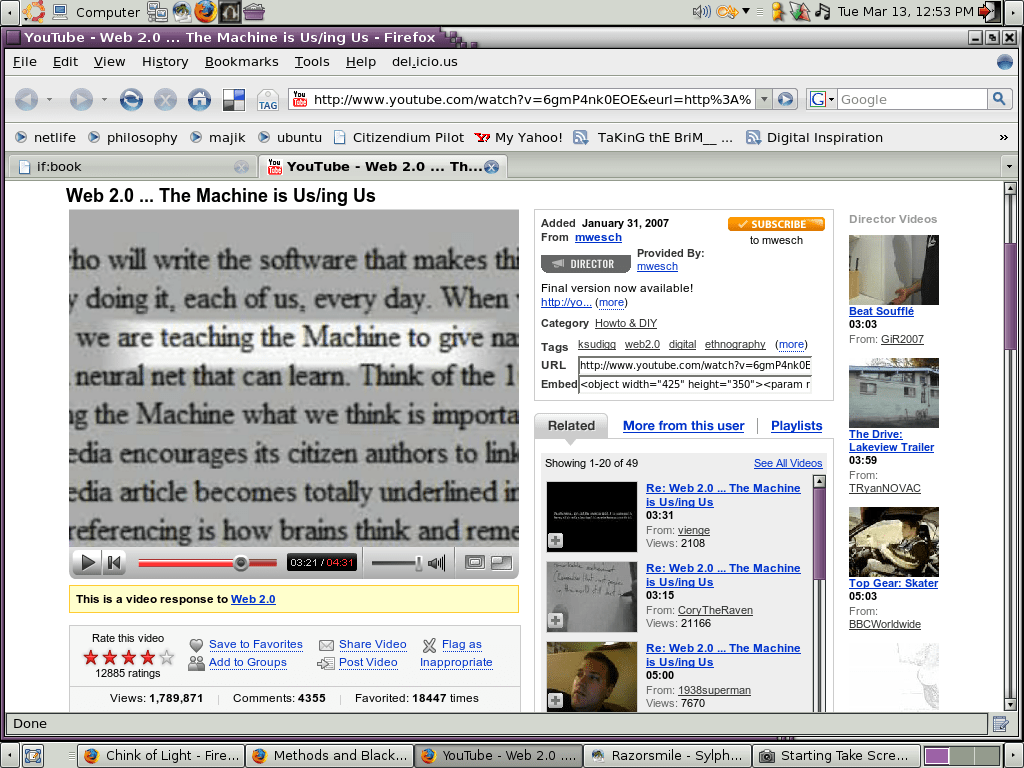
    There’s this peculiar video that’s on YouTube at the moment, an excellent example of contemporary pedagogy in many ways, called ‘The machine is Us/ing Us’. It’s gathered nearly 2 million hits and since it’s only about 4 minutes long, probably most of those people have watched it. There’s a beautifully slick feel to the way the video performs itself. It’s about the ‘Web 2.0’ (the new ‘social web’) and it makes use of the text inputs we make on the ‘net all the time to mix and edit between them, presenting its ideas as the video progresses.

    The main thesis seems quite basic, though one that needs to be kept in mind perhaps, and that is that the new forms of communication are not, in fact, communication but connection. They do not allow the easier flow of some pre-existing material but in fact constitute new material, new connections and new flows (even though they also might allow the easier flow of existing material). It seems reasonably positive, reasonably human, reasonably thoughtful. In effect I agree with what Michael Wesch says (the maker of the video and assistant professor of anthropology at Kansas Sate University). I also applaud his skill and ability to produce this piece. There was, however (of course there’ll be a ‘however’ 😉 one phrase that occurred that stuck in my mind and which seemed, how shall I say it, strange. It seemed, at the very least, strange. (more…)