Category: guattari

  • The Freudian Spaceship – session 4 Deleuze and Guattari with notes

    The Freudian Spaceship – session 4 Deleuze and Guattari with notes

    In the fourth session of the seminar course we look at the last of our teachers in this project, Deleuze and Guattari (mainly Guattari to be honest). The notes for the session are below the video.

    TFS Session 4

    In many ways the project is best understood as being located within schizoanalysis, in fact, the self-description we offer is that we’re thinking a Fanonian Schizoanalysis, one where the wretched of the earth are thought entwined with the wretched earth, one where the voices of the revolutionary in Fanon or Guattari are in chorus, resonant and vibrant.  There is still the question that has been raised, of what difference does this make.  What difference does thinking make, particularly when the mode of thinking is one in which the rational intellect is no longer master.  Part of the answer comes from the idea of abstract machines.

    In the first chapter of Guattari’s Chaosmosis – an ethico-aesthetic paradigm, it’s made clear that the idea of an abstract machine derives from a “brilliant intuition” from the linguist Hjelmslev (p23).  It’s also clear that the role of the abstract machine as found in linguistics is to be expanded, pushed out beyond the domain of language into the “extra-linguistic, non-human, biological, technological, aesthetic, etc” (p24).  Guattari continues:

    The problem of the enunciative assemblage would then no longer be specific to a semiotic register but would traverse an ensemble of heterogeneous expressive materials.  Thus a transversality between enunciative substances which can be, on one hand, linguistic, but on the other, of a machinic order, developing from ‘non-semiotically formed matter’, to use another of Hjelmslevs expressions. 

    These couple of sentences immediately drop us into the strange world of Guattari’s schizoanalytic cartographies, where there is this intense jargon or complexity, where amidst a swirl of concepts, connections and strange words, a strange dynamic can be sensed, one in which the world itself speaks, or something like that.

    Let’s just work through this passage.  ‘The problem of the enunciative assemblage’ – let’s begin there.  To enunciate, to speak well, to enunciate your words. 

    Think here of the way an accent is so often a component of speech.  Or think of the mouth, its formation and function, the throat, the lungs, the diaphragm.  Breath and breathing.  Rhythm, connotation, association.  Or power, a judge handing down a sentence, a word within a specific frame of power – “Detention!” shouts the teacher.   Or the famous example of someone shouting “Fire!” – it makes a difference when it’s in a crowded cinema, or perhaps when it’s on a firing line, as the enemy approaches. 

    The ‘problem of the enunciative assemblage’ is basically the problem of how that which speaks is able to do what it does.  The functioning of the enunciative assemblage – how it learns to do what it does, how the functions ‘operate’ in practice, how we work out what ‘minor components’ make up the ‘major assemblage’.  All these questions, and more, form ‘the problem of the enunciative assemblage’. 

    Within Guattari’s account in the first chapter of Chaosmosis, he’s specifically looking at the relation between subject and object, very traditional philosophical territory in many ways, so in large measure, the problem of the enunciative assemblage is approached via the ways in which the relation of an object to a subject develop.  This is also where we find Guattari’s emphasis on ‘the productions of subjectivity’ and it can be easy to slip back into the human a little too quickly at this point.   So, a word of caution – the schizoanalytic framework takes language to be only one situation within a wider context of non-linguistic enunciative assemblages.

    Guattari again, slightly earlier in the passage just cited:

    “…we would like to resituate semiology within the scope of an expanded, machinic conception which would free us from a simple linguistic opposition between Expression / Content, and allow us to integrate into enunciative assemblages an indefinite number of substances of Expression, such as biological codings or organisational forms belonging to the socius.” (ibid)

    Notice the way that the desire in this passage is to be ‘freed up’, via the concept of machines, the ‘machinic conception’. The strategic argument here arises from the aim of ‘freeing’ a way of understanding language from a ‘simple linguistic opposition’. 

    Why and How?  These two issues are distinct, but the abstract machine is part of the How…
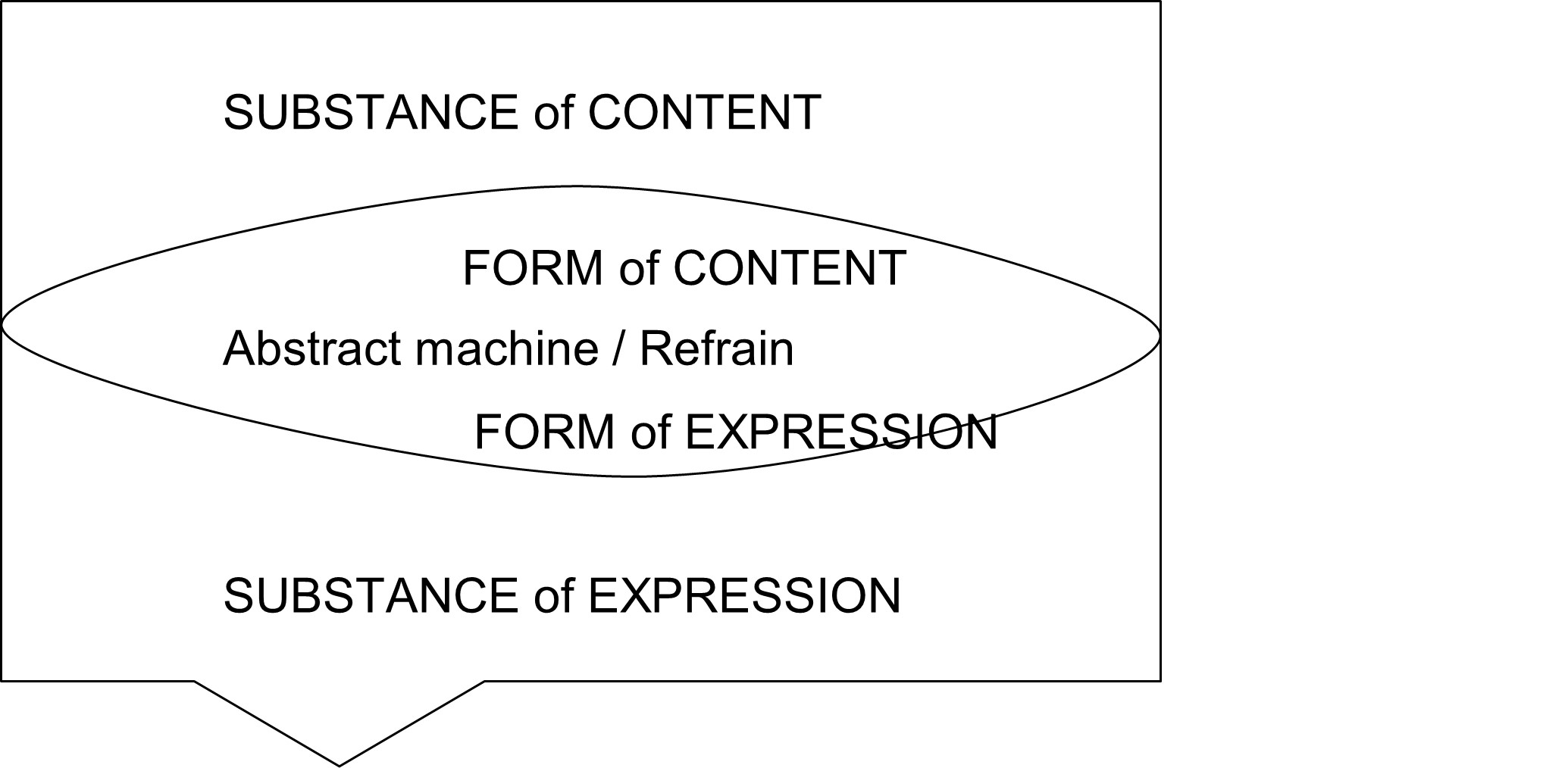
    Abstract Machine

    Before we get onto more details of this ‘how’, we should first pay attention to the ‘why’.

    Here the guiding question is something like, who is speaking?  The way in which this question should be heard is important, however.  It should be contrasted, or at least thought in tension with, the question ‘what is speaking’?

    ‘What is speaking’, for example, might enable us to see that there are other forces at work in expression – forces such as the unconscious, or forces such as the racialised value system of colonialism.  For example, might we say that in Fanon, what is speaking in ‘the black mans experience’, as he describes it in Black Skin, White Masks, is both racism, in other words the value system of racism, in which the black man is inferior and the resistance to that value system that expresses something named as human.   Two different drives or dynamics in tension.  

    But who is speaking? This is Fanon himself.  Not some structure, not some training, nor even some biography, but nonetheless Fanon is who speaks here.  Or part of Fanon, at the very least. 

    Who is speaking?

    There’s a key formula that can be found all over the place when it comes to psychoanalysis, and it goes something like this: the subject of psychoanalysis is the subject of transference.

    Let’s think, for a moment, about that analytical model of the unconscious drive.  There is, in Freud, a basic tension between id and ego that I described last week as a kind of ‘domestication’ model.  Unruly, free energy is organised into a coherency over time by its relations with the self-conscious ego.  This is a kind of self-organising process, no strict architect at hand, rather a set of major factors and their interactions.  Id, ego, pleasure, sociality.  Self-organisation takes place, subjects form personalities if you like, but within a system of effectively pre-established factors.  We assume certain things, the free energy of the id for example, or the restrictive nature of the social, and then work out our ‘causal narrative’ from these factors.  Accidental factors, trauma for example, impact as something like ‘external forces’ and so we have quite a rich set of characters to form a story with.  The idiosyncrasies of the individual can be accommodated as ‘tones’ or ‘colours’ within a basic plotline.  Yet the plotline has to be assumed.  The story is already told, just not the details of the moments. 

    So in the process of analysis, what is speaking is less the details, the manifest content that we encounter in the words, actions, emotions of an individual, more the plot point of the story itself, the latent content.  Transference is the process by which the conversation in the analysis is recognised as expressing not just the people sitting in the room but the characters that accompany the individuals.  The past.  The story so far.  Transference is the moment when the refrain from another character is expressed in the words or actions of the therapist.  In more Jungian language we might find the sense of projection and archetype, and there’s a sense in which transference and projection are trying to think something similar.  Often these ‘transferential relations’ are encountered through feeling – “I feel like this is what my mother says”. 

    What speaks, then?  What speaks, for psychoanalysis, is the past, the way body and thought connected, the way a word or object was felt.  The past over-codes the present and future.  What speaks is the past, not the future. 

    How would we even be able to hear the future?

    Perhaps this speaks to the ‘why’ of the abstract machine.

    The abstract machine is the core of an assemblage, its nuclei.  Guattari often compares abstract machines with Universals, or with Abstractions.  Yet the comparison is disjunctive, one of comparison and distinction.  The abstract machine is different from the Universal or the Abstraction in that it offers an open, rather than a closed, form of consistency. 

    This is no doubt an odd phrase, a form of consistency, but for now let’s just think of this in terms of something like ‘that which enables us to take an object as an object’.  Out of the various different elements and moments that make up a tree, for example, there is some kind of consistency that brings them together as the tree, like this tree.  This binding together, this is a coming to consistency, a coming together or a being taken together.  If we’re thinking of trees, or tables (famously), we might talk about an Idea or Form or even a Concept of the tree, some abstraction that operates as a way of bringing together various specific things. 

    Now, the abstraction or Universal has been a long-standing strategy in philosophy to understand difference and diversity alongside sameness and unity.  Traditionally we have those who think such things as Universals exist and those who think that they don’t and that it’s all in a name, one of the reasons the opponents of Universals are called Nominalists.    The disagreement is around the question of whether Universals exist or not.  Are they needed?  Are they, as it were, “out there”?  For the Universalist, the problem is one of explaining where this “out there” is.  They can explain how we bind things together, making a unity out of diversity with abstraction, but they have to assume something like a special realm of Universals – and mostly they don’t want to go fully Platonist and declare that there’s a realm of Forms, eternal and shining bright.  On the other hand the Nominalist doesn’t need a special realm of abstractions that we have access to, they can rest on the fact that we just happen to call some things by the same name.  The problem then is that these names are pretty arbitrarily applied.  We’ve no real grounds other than habit for thinking that there’s a consistency between various things we think of as trees.  In both cases, however, there’s an inbuilt passivity here.  We either recognise universals that already exist or we submit to habits of naming things, habits that already exist.  The past dominates the present.  The form of consistency is thus a mode of passivity.

    This is the why of the abstract machine – to produce an open form of consistency as opposed to a closed form.

    One of the reasons for this openness is that the abstract machine organises the past as much as the future.  This means that something like retroactive causation is being suggested, but that brings with it a whole bunch of problems.  Let’s avoid this for the time being.  Instead, let’s look a little at the ‘how’ of the abstract machine.

    If the ‘why’ is that we have an open form of consistency rather than a closed (and we might want to explore in more details why we want an open form of consistency)  then the ‘how’ is that the abstract machine produces consistency without causality and it does so, in part, because causality arises from consistency

    Consistency arises from a binding together of forms.  This why Guattari was so fascinated, I think, with the way Hjelmslev had his four concepts – expression/content and substance/form.  It meant that, at some point, there was a common formal moment that could be posed as the moment of constitutive consistency of both a form of content and a form of expression that produced substances (substances of expression and substances of content).  This common productive space of forms – or rather of consistencies – is what’s also embraced in Freud in terms of desire and in Marx in terms of labour.
  • As an introduction to schizo-analysis: responding to ‘The Anti-Oedipus Papers’ (unfinished notes)

    As an introduction to schizo-analysis: responding to ‘The Anti-Oedipus Papers’ (unfinished notes)

    (First published Jan 1st 2007, minor edits made.  Republishing Oct 3rd 2019, as I start my second run of the course ‘Schizoanalysis for Beginners’).

    There is a background to every text, a life, a thought, an obsession, a spilt cup of coffee on papers badly placed on a temporary desk. Good sex, drunken rants, flirtatious concepts, all of these form part of that which will never be said within the text, only ever sensed, occasionally and differently, by the readers and writers who follow the words along the page. This, maybe, is why people want to read biography, interviews, trivial detritus from the lifetimes of another, the writer, the author, the proper name appended to the title. When the text is one within philosophy there’s this sense that somehow knowing about the brandishing of a poker or the peculiar arrangement of garters, socks and toilet habits, somehow knowing this will help know the concepts. This betrays a latent humanism, most often, where we want to know what the author thinks, we want to discern accurately, so we think, the moments that occurred in someone elses’ mind and re-occur them in our own. There seems no reason to assume this humanistic notion of a transport of ideas from one mind to another as the central task of reading and interpreting a text. There seem many reasons to assume that a text is in fact nothing to do with an author to the extent that the act of reading occurs without any author and if the text works it works without an author other than the reader. Would it matter, say, that the images and ideas drawn from a book that had been read under one name suddenly found themselves shifted to another name? It might matter in terms of understanding the author but surely the point of reading is to understand the ideas and images not the author? Otherwise I would always be in a better position to understand an author by talking directly to them and not reading their work? The author really does seem somehow redundant, theoretically, since it is the ideas and images that we are interested by and in.

    Despite this, those texts that occur on the margins of ‘real’ texts, authorised works, always seem to have a strange, uncanny necessity to them. This is no less the case than in ‘The Anti-Oedipus Papers’ by Felix Guattari, a collection of strange and varied notes and jottings produced in the course of writing, jointly with Deleuze, the work ‘Anti-Oedipus’, the first volume of ‘Capitalism and Schizophrenia’. When I first acquired this text a few months ago I read through it quickly and briefly, finding it strange and impenetrable, dismissing it as a rather weak and perhaps idiotic collection put together more as part of an attempt at hagiographical recuperation than intelligent concept creation. Guattari is increasingly viewed as an aberrant force on Deleuze, the ‘wild’ infecting the ‘pure’, lunacy implicating itself into rigour. Zizek is no doubt the main location of such a view (in his ‘Organs without Bodies’) but it’s not isolated to him alone and the increasing interest in the central and more ‘classically philosophical’ work such as ‘Difference and Repetition’ also appears at times, justifiably or not, as the result of an attempt to subtly, perhaps even subconsciously, purge Deleuze of Guattari. In this context ‘The Anti-Oedipus Papers’ (henceforth AOP) might be thought as an attempt to regain the crucial duality or pluralistic-monism of the name ‘Deleuze-Guattari’. All this, however, would be to miss the point or purpose of the AOP. There is no hagiography here, nor any attempt to somehow provide evidence for the absolute necessity of the double name. Instead there is a kind of compassion.

    The AOP is first of all material. There is an introductory essay but I will ignore that, as though it doesn’t exist, since the papers themselves need to live. This time I decided to re-read the text during the xmas holiday break. I had picked the book up again a few weeks ago and for a while it sat, barely touched, on the bedside table where an ever shifting pile of texts moves through the dream-world of evening reading. These texts are usually chosen through a kind of intuition, something hinting at their interest, some curious phrase, name, image or event suggesting that, for some reason not yet clear, they will be of interest. Commonly this is the place for poetry and novels, my work-desk covered in philosophy texts, administrative bureaucracy and the portals to technological otherspace (internet, psp, mobilephone, digital camera). The bedside table texts slip inside the peripheral boundaries of reason, occasionally exploding into an event, text, lecture or image. They are the necessary distractions, the differential grenades.

    As I skimmed across AOP this time I came across the odd phrases, lines and words that seemed incomprehensible and instead of dismissing this as something for which I had no time instead felt comfortable in a language of sense beyond sense. It was clear as I read that there was this enormous production of words and the further I read the more I returned to my time of reading Artaud. That was a time, during the writing of my doctoral thesis, that lasted about 6 months, when all I did was read words of Artaud, about Artaud and with Artaud. It produced almost nothing of use in the thesis, no chapter, no ‘theses’, no critiques or necessities or tools or arguments or images but instead it provided a massive affect of wonder, joy, sadness and life. Resonance. There is no reason for resonance, though it may be analysed and its genealogy traced. The production of resonance, however, is a moment of beauty in the encounter, the moment when something contracts and forms itself as a crystal of thought to be taken and warmed during the course of the following times. A quote, a phrase, an image, these are usually the tokens of such resonance, tokens that we then exchange in the snake-oil discourse that surrounds and constructs our sociality. The resonance itself is, at its purest, something that cannot be contracted, something that resists being repeated through tokens and calls, instead, for a loyalty or trust, a kind of honouring of its existence. This is the case with Artaud and it is no surprise that the doorway into Artaud led through the Deleuzian phrase ‘bodies without organs’, which I took as a token of the ‘Artaud-encounter’ and which proved no mere token but rather an introduction, in the sense in which Heidegger introduces us to metaphysics. AOP, in this sense, produced a resonance, a kind of material space of encounter in which Anti-Oedipus is introduced as no mere text but as a production of newsense, an introduction to schizo-analysis.

    I am not writing a review then. A response perhaps. Last night, for example, as I sat with a friend of mine whose currently training in clinical psychology having completed his MPhil in philosophy a few years ago, we were discussing the practicalities of schizo-analysis. There is, I said to him, something that must be irresponsible in schizo-analysis. The analyst must act responsibly to achieve the state of power that constitutes ‘being an analyst’ but from them on, if they are to engage in schizo-analysis (and if they don’t then they essentially fall into the power relation they’re constituted by, with its attendant inevitability of having ‘power-over’) they must allow the irresponsible in, for this is the condition of experimentation without theory, the condition of being able to analyse without the oppression of the imposed theoretical construct enforcing a rigid and static meaning on the analysand, converting, at that point, the therapist as the rapist. To break theory, the flow of theory, and intersect instead with the actual, with the presented as presented flow, requires some irresponsibility. There is no way of being accountable for the break with theory, there lies within it a kind of megalomaniacal belief. This, I said, was found in the repetitive trope of ‘fuck it’ found in AOP, the way Guattari releases a frustration through this language. Fuck it, fucking hell, what a fucker. It’s akin to the exclamation mark, the mark of passion, another frequently used mark or word in AOP.

    Then there’s this sense of Guattari struggling with words – words, words, more fucking words. The same thing that animates any writer, something that occurs in the nomination of oneself as writer, that desperation, the fact that, as Deleuze says somewhere, we only write about that which we don’t know. I write and then I read what’s written and try to understand why I wrote that, how I wrote that, who wrote that because it wasn’t me. As the project nears its formal completion and ‘Anti-Oedipus’ is finished Guattari cries that he will be held to account, people will ask questions, he will be thought to be, somehow, responsible for the words and that he has tried hard to avoid this previously. Before ‘Anti-Oedipus’, he wails, he was able to walk away, turn his back and say nothing, say something else, explode irresponsibly as a flow, rather than an in-dividual, as an endpoint to flow.

    There’s this strange relation to analytic theory as well. Guattari take liquid ecstasy and tells his partner that he wants to fuck around. His molecularisation concepts impinge themselves and he holds to the delirium of the drug as a truth, somehow revealing the real Guattari, the liberated flow, when as we all know, the drugs flow, not you. That which is said on drugs is nothing other than the drugs. There is no ‘real flow’ unblocked by the chemical, just another flow which we’ll be attached to through a kind of family resemblance or filial link. “It came from mymouth thus it’s affiliated with everything else that comes from mymouth”. The reality, of course, is that a thousand angels speak through mymouth, the hiss and buzz of the goetic hordes, the insectoid machines of signification bubbling over desires incarnated in chemical interactions.

    The same imposition of theory onto flow occurs as he analyses his relations to fanny and gilles, the former who he wants to fuck, and the latter whom he seems to conceive as someone he must want to fuck even though such a desire is inapparent, hence, obviously, repressed. Fucking is taken as somehow meaningful in itself, as revealing something, other than the chimplike movement of bloodflow, hormonal interaction and a remarkably sophisticated antenna for opportunity. Everyone would fuck everything if they had the opportunity. The interesting thing is not why they do, but why they don’t. The break is the point of creation in the fuckflow. Guattari appears in these texts as classically heterosexual, for whom opportunity is inscribed in woman and not man and yet whose theories tell him such inscription is after the fact, that desire is genderfree, polymorphic. If the fuckflow is polymorphic, the breaks reveal the creation of something, indeed, but not necessarily a repression – it may as likely be a compression. That the opportunity is inscribed in woman more than man for the male heterosexual is no different, no more repressive, then if the fuckflow is inscribed predominantly in the same sex. It’s simply an asymetry. Nothing more. Where is the repression? Nowhere other than the theory, deriving its values from pre-theory, from a systemic asymetry that is no longer part of the fuckflow but which predominantly presents powerflow.

    My response to AOP then is a reponse to a text that is not intended simply as the presentation of ideas, content separable from the presentation, but like poetry or novels, contains a production that is entwined in its presentation. It’s the material for a schizo-analytical re-reading of ‘Anti-Oedipus’ and schizo-analysis itself, the non-existent form of analysis, the peripheral possibility of revolution rejected by the analytic community almost everywhere. As such, perhaps, it offers once again the glimmer of the possibility of revolution in the practical work of desirefuckedup that is the condition of possibility for analyses as a practice. This glimmer can be named; compassion.

  • ATP reading notes 7 – the constraints of the constants

    ATP reading notes 7 – the constraints of the constants

    Continuing with Chapter 4 and the third and fourth postulate of linguistics, I’m trying to find a position from which the ‘problem’ that chapter addresses can be understood. As I mentioned in the previous post, the chapter reads in large part as a criticism of linguistics, in a semi-polemical tone, and perhaps because of this its positive content is not always easy to pick out. There are, however, some key notions, such as the role of the order word (the mot d’ordre) and the idea that language operates as a constraint. Taking this as the opening move of the chapter enables us to suggest something like the following: if language is first a form of constraint and because of this is bound up with power and dominance, with policing, then what strategies must be developed to prevent the constraint from becoming restriction. Constraint and restriction are different things. One can be constrained by rules and in so doing participate freely in a game, without restrictions. Alternatively one can be restricted to a particular way of playing and blocked from innovations even if such innovation doesn’t break the rules but re-organises them. In terms of politics and subjectivity this takes on wider ethical and normative connotations. If language constrains and yet at the same time is intimately connected to the very possibility of subjectivity (being able to say ‘I’), then the claim might something like ‘within a dominating normative framework language forms a set of internalised chains’. In this context it is not ‘ideas’ that lock people up – not ‘ideology’ that maintains ‘hegemony’ – but rather the mode of the policing of language, what we might call the operation of the constraints of the constants.

    Whilst the constraint of the constants might be a feature of linguistic practice the operation of such constraints is not but is rather one mode of understanding language. Here we perhaps begin to see the strategy of the chapter. D&G argue throughout Chapter 4 that another way of conceiving language is not only possible but necessary, both politically and theoretically. ‘Linguistics’ is the target of criticism via the four postulates ascribed to it because it fails to understand the constraints of the constants as themselves derived from continuous processes of variation that form the site of political selections. We can accept that language is a practice of constraint organised by the set of constants without falling into the trap of assuming that those constants are ‘natural’, innate or fixed. Chomsky is obviously and clearly one of the key targets of the polemic in the chapter and is the figure of the ‘major’ mode of understanding language in which the constraint of the constants is taken as a kind of fixed or stable feature of linguistic reality. Yet,

    “You will never find a homogenous system that is not still or already affected by a regulated, continuous, immanent process of variation (why does Chomsky pretend not to understand this?). There are not, therefore, two kinds of language but two possible treatments of the same language. Either the variables are treated in such a way as to extract from them constants and constant relations or in such a way as to place them in continuous variation. … Constant is not opposed to variable; it is a treatment of the variable opposed to the other kind of treatment, or continuous variation. So-called obligatory rules correspond to the first kind of treatment, whereas optional rules concern the construction of a continuum of variation.” (ATP 103)

    From this we find the following important implication being drawn:

    “Moreover, there are a certain number of categories or distinctions that cannot be invoked, that are inapplicable and useless as a basis for objections [to the claim that language is a regulated, continuous, immanent process of variation] because they presuppose the first treatment and are entirely subordinated to the quest for constants: for example, language as opposed to speech; synchrony as opposed to diachrony; competence as opposed to performance; distinctive features as opposed to nondistinctive (or secondarily distinctive) features.” (ibid, emphasis and possible ‘object’ added)

    These two different treatments of language are explicitly defined a few pages later as the ‘major’ and ‘minor’ modes of treating language (ATP 106) and the fact that these two modes exist is itself to be accounted for in turn by the order word as the “variable of enunciation that effectuates the condition of possibility of language and defines the usage of its elements according to one of the two treatments” (ibid). To try and state this less formally, what makes language possible are things called ‘order words’ that organise our ways of speaking and this organisation of our ways of speaking can be done in a ‘major’ mode or a ‘minor’ mode’. In the major mode restriction to a norm is the way of organising language whereas in the minor mode creation from a norm is the way of organising language. The major constrains to restrict, whereas the minor constrains to create. What is crucial here is that it is not the order word itself, it is not the constraints, that are the problematic feature, rather it is the operation of the constraints that matters. The ‘major’ or ‘minor’ here are not, then, quantifications but refer rather to major standards or norms and minor deviating practices. Importantly the deviating practices of the minor are identified as the location of autonomy. “Becoming-minoritarian as the universal figure of consciousness is called autonomy” (ATP 106). Becoming-minor, however, is never a fixed constant position, but always something that operates as a flight from ‘the standard’ (deterritorialisation) where ‘the standard’ is part of a process of variation.

    After making this point with regard the order word there is a strange turn in the text that occupies the last three or four pages of the chapter. D&G make the odd statement that “the order word is a death sentence; it always implies a death sentence” (ATP 107). They go on to say that “death is the general incorporeal transformation attributed to all bodies from the standpoint of their forms and substances” (ATP 108). Earlier they argued – as I noted in the first post about this chapter – that the collective assemblage of enunciation organises or polices a set of incorporeal transformations. From this we might assume that different assemblages have varying sets of incorporeal transformations. The example given is of a judge sentencing a convict and maybe it’s possible to imagine a collective assemblage of enunciation that did not have this particular incorporeal transformation as an element in its set. With death, however, we seem to find an element that any set of incorporeal transformations must contain – “Death, death; it is the only judgement, and it is what makes judgement a system” (ATP 107). They continue “in effect, death is everywhere, as that ideal, uncrossable boundary separating bodies, their forms, and states, and as the condition, even initiatory, even symbolic, through which a subject must pass in order to change its form or state” (ibid).

    In this ‘death’ then we find not simple expiration in the colloquial sense, mortality or termination, but something that seems instead closely connected to borders, thresholds, change, transition. The subject here is entwined in a kind of relationship to a ‘death sentence’, to a line it must obey if it is not to ‘die’. The ‘father’s orders to his son’ that they refer to contain within them the possible expulsion of the son from the relationship, the ‘death of the son’, even though this death may not involve the death of the material body that the attribute ‘son of…’ was ascribed to. Father to son: You’re dead to me. This example of a relationship problem, the fact that a relationship can break down in such a way that someone might say “you’re dead to me”, seems to be written into the very operation of language in so far as language is organised through collective assemblages of enunciation that operate on the basis of the capacity to exclude. It’s this capacity to expel the body that underpins the order word.

    At the same time this inherent death sentence within the order word sits alongside the capacity to flee. So the order word contains both expulsion and escape, the former imposed like death and the latter taken up as autonomy. Escape is not simple autonomy however but seems intricately bound into a more complex process of creation, which is perhaps why it is possible to closely align it with autonomy. Escape must avoid ‘black holes’, veering off into some ‘imaginary’, they suggest (ATP 110) and they go on to offer an example from a Herzog film where he says “Who will answer this answer?”

    “Actually, there is no question, answers are all one ever answers. To the answer already contained in a question (cross-examination, competition, plebisicite, etc) one should respond with questions from another answer. One should bring forth the order word of the order word. In the order word, life must answer the answer of death, not by fleeing, but by making flight act and create. There are pass-words beneath order-words. (Il y a des mots de passe sous les mots d’ordre). Words that pass, words that are components of passage, whereas order-words mark stoppages or organised, stratified compositions. A single thing or word undoubtedly has this twofold nature: it is necessary to extract one from the other – to transform the compositions of order into compositions of passage” (ATP 110)

  • ATP reading notes 4 – milieus and abstract machines

    ATP reading notes 4 – milieus and abstract machines

    I missed the reading group on October 13th, when they discussed Chapter 2 (1914: One or several wolves), and so I’m turning to the Chapter 3 10,000BC: The geology of morals. I will return to Chapter 2 when I have time. We read the first half of Chapter 3 on October 20th, up to but not including the paragraph that begins ‘Most of the audience had left…’ (ATP 57) and will continue with the remainder of Chapter 3 next week. As a reminder, these notes are in no way a report of the reading group, rather they are my notes and thoughts which will be informed by the discussion there, but all mistakes and errors are my own.

    The ‘double articulation’ that is the focus of this chapter is that of the ‘codes’ and ‘territories’ that are probably quite familiar to readers of D&G. The processes of code and territory produce many of those curious ‘jargon’ terms so hated by critics, terms like decoding, overcoding, surplus value of code, deterritorialization, reterritorialization. At heart, these two processes, of code and territory, involve processes and because of this the dynamics of those processes, whether they are opening or closing dynamics, are central to D&G’s discussions. What purpose do these processes have in the analytical model of schizoanalysis? They are replacements or alternatives for more traditional philosophical concepts of ‘form’ and ‘content’ and are intended, I think, to transform the analytical categories that are used to understand specific ‘objects’ (concepts) of discussion. So, when talking, for example, about the ‘nature of subjectivity’, we could analyse it in terms of codes and territories rather than in terms of language, experience, ideology, genealogy or substance. We might presumably do something similar for concepts such as ‘nation’, ‘class’, ‘freedom’ or ‘truth’.
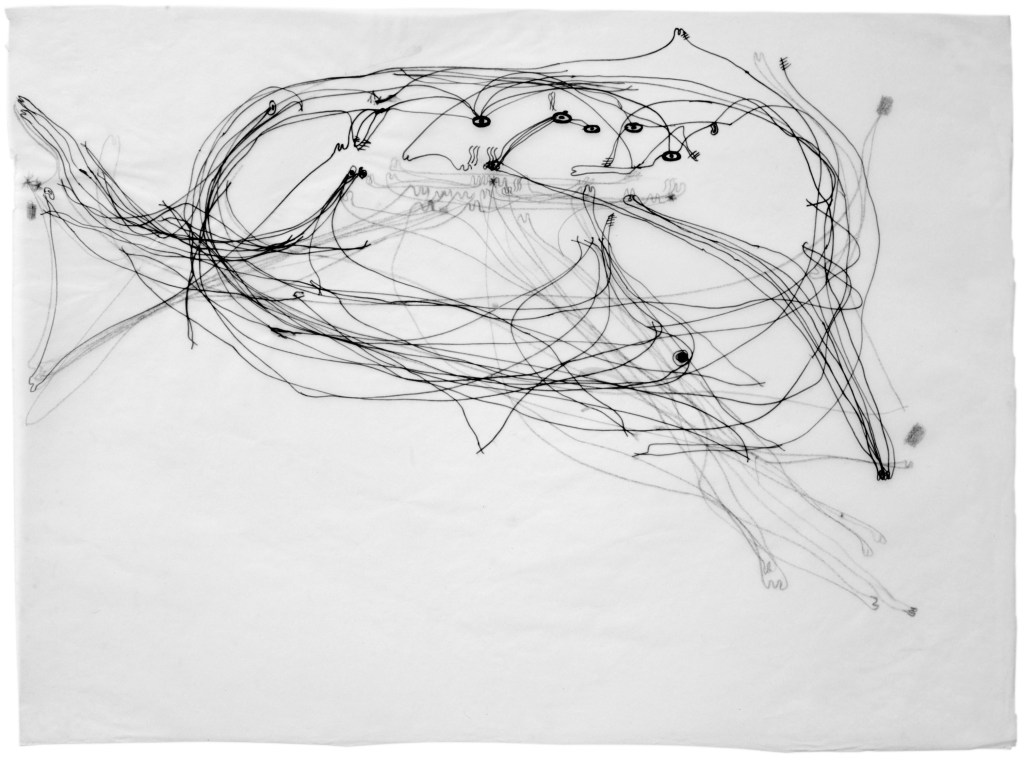

    There is something more than merely a ‘model’ at stake, however, at least the opening of the chapter appears to pose the problem in more fundamental terms. The double articulation of codes and territories – for which the Lobster is an image – is presented as a way to understand the process of ‘stratification’. Stratification arises ‘simultaneously and inevitably’ (ATP 40) alongside or within the ‘unstable, unformed matters’ that constitutes the Earth. Stratification consists “of giving form to matters, of imprisoning intensities or locking singularities into systems of resonance and redundancy, of producing upon the body of the earth molecules large and small and organising them into molar aggregates” (ibid). In other words, stratification – operating through the double articulation of codes and territories – is the process through which something like a ‘primal flux’ comes to be ordered, a process through which the dynamic flows of matter form something like ‘objects’ or ‘substance’.

    Immediately, however, we must double the doubling, specifically we have to take into account the pairing of ‘content’ and ‘expression’ and the fact that each of these terms is, again, doubled. If ‘matter’ is the “unformed, unorganised, nonstratified, or destratified body and all its flows”, then ‘content’ refers to “formed matters, which would now have to be considered from two points of view: substance, insofar as these matters are ‘chosen’, and form, insofar as they are chosen in a certain order (substance and form of content)” whilst ‘expression’ refers to “functional structures, which would also have to be considered from two points of view: the organisation of their own specific form, and substances insofar as they form compounds (form and content of expression)” (ATP 43).

    “Double articulation is so extremely variable that we cannot begin with a general model, only a relatively simple case. The first articulation chooses or deducts, from unstable particle-flows, metastable molecular or quasi-molecular units (substances) upon which it imposes a statistical order of connections and successions (forms). The second articulation establishes functional, compact, stable structures (forms), and constructs the molar compounds in which these structures are simultaneously actualised (substances). In a geological stratum, for example, the first articulation is the process of ‘sedimentation’, which deposits units of cyclic sediment according to a statistical order: flysch, with its succession of sandstone and schist. The second articulation is the ‘folding’ that sets up a stable functional structure and effects the passage from sediment to sedimentary rock.” (ATP 41)

    The first curiosity here is this use of such a ‘geological’ model. It seems, on the face of it, that a model derived from a natural science such as geology is going to produce category mistakes if we deploy it in analysis focussed on the ‘human’. Aren’t issues of meaning, signification, sense and intention more relevant to political and social analysis? Such an assumption begs the question, despite it’s apparent obviousness to many people who are happy to merely assert some human exceptionalism as though it were incontrovertibly the case. Even if we don’t beg the question, however, there seems something a little odd about deploying ‘geological’ models in a text that purports to be about ‘capitalism and schizophrenia’. How might we connect a ‘geological’ concept of stratification to something ‘human’? Whilst this question already assumes too much importance for the human, it might be useful as a way of being able to understand what political or social implications there are in ATP, and that itself might be necessary because I’m assuming that – broadly speaking – most of the people interested in ATP are interested in such ‘human’ issues rather than in subjects such as geology, which is not to deny that there is also possible interest in the text for geologists.

    There is a second curiosity, however, which is that the specific ‘stratum’ that is addressed in the chapter is not geological or even human but the organic. The chapter is staged as a lecture being delivered by Professor Challenger, a character from Arthur Conan Doyle stories. At one point there is clearly a sense of a merging of Challenger with the authors of ATP, most notably when Challenger is described as having “invented a discipline he referred to by various names: rhizomatics, stratoanalysis, schizoanalysis, nomadology, micropolitics, pragmatics, the science of multiplicities.” (ATP 43). Amusingly the text continues as follows – “Yet no one clearly understood what the goals, method, or principles of this discipline were.” (ibid). To return to the discussion in the chapter/lecture hybrid, what we’re reading soon moves from the rather abstract account of double articulation to something more concrete – “the question we must ask is what on a given stratum varies and what does not? What accounts for the unity and diversity on a stratum?” (ATP 45) and this question focusses on the ‘organic’. At the heart of this is a discussion (ATP 45-49) that begins from a staging of the debate between Geoffroy Saint-Hilaire and Cuvier. An account of this debate is given – “Challenger imagined a particularly epistemological dialogue of the dead, in puppet theatre style” (ATP 46) – the purpose of which, however, is to present the ‘paradigm shift’ introduced by Darwin. At the end of the staged debate we find the following passage:

    “We have not even taken Darwin, evolutionism, or neoevolutionism into account yet. This, however, is where a decisive phenomenon occurs: our puppet theatre becomes more and more nebulous, in other words, collective and differential. Earlier, we invoked two factors, and their uncertain relations, in order to explain the diversity within a stratum – degrees of development or perfection and types of form. They now undergo a profound transformation. There is a double tendency for types of forms to be understood increasingly in terms of populations, packs and colonies, collectivities or multiplicities: and degrees of development in terms of speeds, rates, coefficients, and differential relations. A double deepening. This, Darwinism’s fundamental contribution, implies a new coupling of individuals and milieus on the stratum. (ATP 47-48)”

    It is this ‘new coupling of individuals and milieus on the stratum’ that is the link between ‘geology’ and ‘morals’ and through which the first curiosity I mentioned is in some sense made clearer by the second. It is this ‘new coupling’ that offers a productive and ‘transferable’ set of categories, ones that can move across the analysis of the processes of geological sedimentation into the analysis of the processes of individuation more generally, although quite how generally is still up for question as there is plainly no direct and obvious route from Darwinism to politics or sociology, or at least no direct uncontested route since at the very least we can find ‘socio-biology’ suggesting one, albeit highly contested, possibility of generalisation. The route to generalisation taken by ATP, however, is distinct from any socio-biology I’m aware of, primarily because it’s primary category of generalisation is to be the ‘abstract machine’.

    The problem that is posed as the motivation for Challenger’s discussion is the “unity and diversity of a single stratum”, what is it that enables a single stratum to have a “unity of composition, which is what allows it to be called a stratum” (ATP 49). This problem directly arises from the ‘science of multiplicities’, what I called the ‘method of the rhizome’ in my discussions of the first chapter of ATP. If ‘multiplicity’ is to be taken as a substantive and in doing so replace problematics involving a ‘dialectic’ between the One and the All, then the ‘problem of individuation’ can be posed in terms of how it is possible to call something a thing in the singular, in this case, how is it possible to discuss a stratum from within a model of the double articulation of stratification, where at any moment there is always more than one involved – the double bind of double articulation.

    In the paragraph that starts “To begin with, a stratum does indeed have a unity of composition…”, just following a brief remark re-emphasising the staging of the chapter as a lecture by Challenger, an initial move to introduce the abstract machine is made. Here the process of individuation of a stratum is posed in terms of “a change in organisation, not an augmentation” and the factors involved in a relation between a stratum and a substratum are reciprocal rather than hierarchical, hence why D&G declare that “we should be on our guard against any kind of ridiculous cosmic evolution” (ATP 49). A substratum is posed as a milieu, as an “exterior milieu for the elements and compounds of the stratum under consideration, but they are not exterior to the stratum” (ibid). They try to illustrate this reciprocal relation of exterior / interior in the composition of a stratum by first offering the example of a crystalline stratum developing from the seed and medium and then move to claim that “the same applies to the organic stratum: the materials furnished by the substrata are an exterior medium constituting the famous prebiotic soup, and catalysts play the role of seed in the formation of interior substantial elements or even compounds” (ATP 49-50). Crucially there are three elements at work here, viz. (1) the (exterior) milieu, the molecular materials (2) the (interior) seed, interior substantial elements, and (3) the limit of exchange between the two, the “membrane conveying the formal relations”, or surface. The abstract machine is the ‘synthesis’ or result of the reciprocal relations between these three elements and is given the name of Ecumenon in contrast to what they call a Planomenon.

    Before moving forward it’s worth considering why this abstract machine is important. It offers us the mode of individuation that is going to be able to explain the existence of organisation from the background of a disorganised flow of matter, although ‘explain’ might be too strong here – it offers an account or descriptive framework. It’s worth noting that the whole discussion of stratification within which this existence of the abstract machine plays its role is offered from a factical staring point, that is, the ‘simultaneous and inevitable phenomenon of stratification’ is simply offered alongside the account of the ‘body without organs’, “…the Earth, – the Deterritorialized, the Glacial, the giant Molecule…” (ATP 40). Putting aside the status of the description one thing we can note, however, is that the discussion of abstract machines, the production of an ‘Ecumenon’, is a positive account that in many ways can complement the dissolution that is often associated with D&G. Quite commonly we come across an emphasis on ‘how to make yourself a body without organs’, which might be read as a way to ‘liberate’ oneself from having been organised behind our backs by culture or social norms or ‘ideology’, or some other mode of social construction. The discussion in this chapter, however, offers an account of “how to ‘make’ the body an organism” (ATP 41), which offers itself immediately as a compliment, almost as the other side of the coin of that process of ‘making yourself a body without organs’. As such, for those interested in how D&G or schizoanalysis might offer a route to resistance or revolution and who might be left wondering where the constructive or productive process might be discussed, this is one place to look, at how one might conceive something like the abstract machine of revolution.

  • ATP reading notes 3 – mapping and tracing

    ATP reading notes 3 – mapping and tracing

    Turning to the 5th and 6th characteristics of the rhizome – the principle of cartography and decalcomania – we move from discussions of the book, of evolutionary science, of music, to discussions of psychoanalysis, the first real moment in which a continuity between ATP and Anti-Oedipus really makes itself felt.

    First, a brief note on that strange word ‘decalcomania’, and an even briefer note on ‘cartography’. Cartography, or map-making, involves the active ‘making’ of maps and that active ‘making’ element is important here, which is why it is not the principle of ‘maps’ but of ‘cartography’, or more colloquially, of ‘mapping’. The productivity of cartography is put in relationship to the practice of ‘tracing’, which is a restrictive, constricting practice. In one sense we can understand cartography as producing openings and decalcomania as producing constrictions. Decalcomania itself appears to refer to a practice of tracing that developed in the 19th century as a form of decorating pottery. It involved a process of producing a ‘decal’ that was then laid onto pottery or glass and the Wikipedia entry also indicates a couple of other fascinating connections, first to some surrealist practice and second to some work with regard fractals. I’m not sure why D&G would use the idea of ‘decalcomaia’ rather than simply ‘tracings’ here if it wasn’t to at least allude to these particular forms of tracing, since the actual discussion – at least in the English translation – reverts to the term ‘tracings’.

    In terms of the actual principles themselves, it’s important to note that they are not claiming that maps are simply better than tracings, even though at one point they say “the rhizome is altogether different, a map and not a tracing. Make a map, not a tracing.” (ATP 12). In the very next paragraph they attempt to make clear that they do not intend to “revert to a simple dualism” (ie, of the form maps=good tracings = bad). Rather the tracing has the danger of ‘neutralising’ the rhizome and in particular “what the tracing reproduces of the map or rhizome are only the impasses, blockages, incipient taproots, or points of structuration” (ATP 13). Therefore “it is a question of method: the tracing should always be put back on the map” (ibid).

    The map, in this situation, is an open, experimental and productive process, hence why it is possibly better thought of as ‘mapping’ rather than ‘the map’. In one of the most interesting lines, they claim that “the map does not reproduce an unconscious closed in upon itself; it constructs the unconscious. It fosters connections between fields, the removal of blockages on bodies without organs, the maximum opening of bodies without organs onto a plane of consistency” (ATP 12). In the discussion that follows the concrete examples they draw on come from psychoanalysis – Freud on Little Hans and Klein on Little Richard – and here the rhizome connects clearly to the thematics of Anti-Oedipus. In their criticism of psychoanalysis they say the following:

    “You will be allowed to live and speak, but only after every outlet has been obstructed. Once a rhizome has been obstructed, arborified, it’s all over, no desire stirs; for it is always by rhizome that desire moves and produces. Whenever desire climbs a tree, internal repercussions trip it up and it falls to its death; the rhizome, on the other hand, acts on desire by external, productive outgrowths.” (ATP 14)

    It becomes increasingly clear that the rhizome is being developed as a method because of it’s political (micro-political) implications. In this situation, the reference made to the relationship between mapping and tracing as involving a method makes more sense – it is a question of method assuming that we wish to liberate desire, it’s a question of a method for the schizoanalyst. In this context, one small reference stands out and that is to the work of Fernand Deligny. As the discussion on psychoanalysis comes to an end D&G refer to “Deligny’s method: map the gestures and movements of an autistic child, combine several maps for the same child, for several different children.” (ibid) Deligny’s work appears to have become a focus for research in recent years and in particular he seems closely connected to the idea of ‘lines of flight’.

    (Here’s a short essay on what Deligny called ‘wander lines’ that gives a brief introduction to him and his work and have a look at this Google search for recent researches and connections.) Deligny will return in Chapter 8, the ‘Three novellas’ chapter, at an important moment in the discussion of lines of flight, as a key positive source of inspiration (ATP 202-203), and again at the beginning of Chapter 11, ‘Of the refrain’, once more in a positive ‘opening’ moment (ATP 311-312, fn.1).

    After having given these 6 characteristics we find D&G moving the discussion through a kind of loose comparative analysis, whereby they look at the possible understanding of an arborescent/rhizomatic difference in specific fields, primarily in a discussion of a debate from within information science that they read in terms of an arborescent/rhizomatic difference, but there are also comments on the nature of  the difference between West and East in terms of the role of the tree, as well comments about America and bureaucracy. After 4 or 5 pages of this kind of discussion they again summarise the ‘characteristics’ of the rhizome (ATP 21) and then explain their use of ‘plateaus’, which is derived from Gregory Bateson’s work and deployed in order to subvert the book having a beginning, since each plateau is always ‘in the middle’ (intermezzo). Even in this closing discussion, however, we again find a kind of quick, rough and ready comparative analysis being deployed when they briefly discuss history, making the claim that ‘what is lacking is a nomadology’ (ATP 23).

    What we find by the end of this first introductory chapter is a baroque and convoluted form of philosophy, one in which a methodology is put forward (the rhizome) as the means by which a particular practice can be developed (schizoanalysis) but where this is done almost in a performative way, as thought it were presenting an example of the kind of rhizomatic practice being articulated and advocated for. Reading through ATP I am reminded of how often I have spun off into one of the references, such as the Deligny, not in order to simply understand what D&G are saying but because the connection offered through that reference opens a whole new world of possibilities. This ‘opening of a world of possibilities’ is, I think, one of the most important ways of encountering the rhizome, the lines of flight, the multiplicity that is schizoanalysis. It is at times intensely infuriating, particularly if what you want to do is ‘understand’ D&G quickly (usually in order to be able to dismiss it in favour of some preferred model). If, however, the goal is to develop what we might call a ‘schizoanalytic’ method, then this first chapter offers a clear example of both the possibilities and problems involved.

    One final note – the ‘philosophical’ background to much of the discussion of the rhizome – from within the work of Deleuze – lies in the problem of ‘multiplicity’ and at the heart of that are a whole bunch of interesting discussions regarding space and time, discussions that move from Kant’s account of the pure intuitions, through Bergson, Husserl and Heidegger up to the work of Deleuze in his Bergson book and elsewhere. I haven’t really noted any of this in any detail but wanted to leave a couple of references here for when I return to these notes:

    This extract from a lecture by Deleuze on Bergson’s theory of multiplicities, and this useful summary by John Protevi of Chapter 2 of Deleuze’s ‘ book Bergson’ on ‘Time and Free Will’.

    There is also this interesting connection to Anti-Oedipus and what is said about multiplicity as a substantive there:

    It is only the category of multiplicity, used as a substantive and going beyond both the One and the many, beyond the predicative relation of the One and the many, that can account for desiring-production: desiring-production is pure multiplicity, that is to say, an affirmation that is irreducible to any sort of unity. (AO Ch1, Part 6 end of first paragraph: Athlone 42).

    This obviously connects closely to what is said in the 3rd principle of the rhizome (ATP 8).

  • ATP reading notes 2 – the first 4 principles of the rhizome

    ATP reading notes 2 – the first 4 principles of the rhizome

    There are 6 principles of the rhizome that are outlined in the first chapter of ATP. They are introduced as ways of characterising the rhizome, although these are only “approximate characteristics” (ATP 7). There is something a little incongruous about the way they are introduced. The function of these characteristics, approximate as they may be, is to give a definition for the key methodological framework of the book, the rhizome, but the way that D&G introduce this set of defining principles is by saying that “we get the distinct feeling that we will convince no one unless we enumerate certain approximate characteristics of the rhizome” (ibid). The element of this that strikes me as incongruous is this way of phrasing things – “we get the distinct feeling that we will convince no one…” – which sounds almost patronising or dismissive. On the one hand, presumably, they are acknowledging an intention to ‘convince’ but on the other hand the ‘distinct feeling’ reads as though it were a kind of realisation that the people they are trying to convince would fail to follow along if D&G were to simply do their own thing. It’s as though these principles are offered as a kind of sop to stupidity, as though the need for a clear definition cannot be avoided, even though such a definitional mode is itself almost inherently non-rhizomatic because it presents itself as a foundational moment, a root or radicle.

    This performative paradox of a text that advocates rhizomatic readings having to begin by defining what a rhizome is as its foundation is most likely what underlies this odd way of introducing the principles of the rhizome. Despite what they say later in this introduction, that “a rhizome has no beginning or end; it is always in the middle, between things, interbeing, intermezzo” (ATP 25), the book has a physical front and back, it presents in a linear fashion, it builds upon itself as it progresses, it’s a tree, not a rhizome. Advocating for a rhizomatic book inside a book that is classically formed is most odd. In a time of non-linear text functions, with hyperlinks and e-books offering all range of possible horizons of reading, ATP feels a little old-fashioned and incongruous in many ways, advocating for a future in a form from the past that seems almost childishly limited in its possibilities. At the same time, the worry is that something deeper than mere form is the source of the problem here, something closer to the very function of philosophy, reason, argument and ‘convincing’ intellectual positions. Is it, in fact, possible to conceive a rhizomatic thought, one that can begin from the middle? Doesn’t all thought get structured by the fact that it always must begin somewhere and that this beginning is never, can never be, a middle? The problem of the ‘beginning’ of thought would take us right back to Hegel, Husserl and Heidegger and their obsessions with beginnings, and perhaps it’s as an attempt to break away from this that best accounts for the move towards the rhizome.

    The six principles are as follows:

    • 1 and 2 – principles of connection and heterogeneity
    • 3 – principle of multiplicity
    • 4 – principle of asignifying rupture
    • 5 and 6 – principles of cartography and decalcomania

    Some simple observations to begin with. There are supposedly 6 principles but as can be seen the first and last pairs are linked together. It’s also worth noting that in the discussions of both P1&2 and P5&6 the work of Chomsky is in the background as a contrasting perspective. The longest single discussion of any of these principles is of P4, where 3 paragraphs are devoted to it. In comparison P1, 2, and 3 get only a single paragraph each and P5&6 gets 5 paragraphs. It’s also worth noting that the famous example of the wasp and orchid is part of the discussion of P4, asignifying ruptures, not as one might assume from a lot of pub conversation, part of the map/territory discussion of P5&6. Finally, it’s worth noting that P5&6 is not the principle of the map and territory, even though there is a discussion of such, rather it’s the principle of maps and tracings. This notion of the trace, a concept we might more commonly associate with Derrida, is what underlies that strange word ‘decalcomania’. Having made these simple observations, I will briefly work through each principle. Before I do, however, one impressionistic response, which is the following: the presence and centrality of Chomsky, asignification, abstract machines and the rhizome itself seem likely to be derived far more from Guattari than from Deleuze, whereas in Anti-Oedipus the role of the three syntheses, the 5 paralogisms and the general structure of the argument as diagnosing a post hoc ergo procter hoc fallacy within psychoanalysis seems far closer to Deleuze’s classical style of doing philosophy. Roughly and impressionistically speaking this would suggest that of the two volumes of Capitalism and Schizophrenia, Deleuzian influence is strongest conceptually in AO and Guattarian influence stronger conceptually in ATP.

    1 and 2 – principles of connection and heterogeneity – “any point of a rhizome can be connected to anything other, and must be” (ATP 7). This begins the attempt to ‘exit language’ that underpins the rhizome as a method, the attempt to break open the linguistic, language and speaking priorities that dominate philosophy and academic analysis more widely, opening our analyses of assemblages to “organisations of power, and circumstances relative to the arts, sciences, and social struggles.” (ibid). It is not meaning that matter but function, although this does not imply that there is no meaning, only that meanings and connections between meanings are little more than moments of wider, more diverse (heterogeneous) types of connections. In Anti-Oedipusthis is the first synthesis, the synthesis of connection, where desire is involved in ‘putting to work’ the body – its’ formula or mode would be = ‘and’, ‘and then…’ (production).  [Paranoiac machine] (cf. Anti-Oedipus, Ch1, S.1; Ch.2, S3). One of the most notable aspects of the discussion of these first two principle is the claim that their criticism of linguistic models “is not that they are too abstract but, on the contrary, that they are not abstract enough, that they do not reach the abstract machine that connects a language to the semantic and pragmatic contents of statements, to collective assemblages of enunciation, to a whole micropolitics of the social field. (ibid)”. This is the first mention of ‘micropolitics’ to occur in ATP. It is, however, the second mention of these curious things called ‘abstract machines’ which are not to be mistaken for ‘abstractions’. I’m still curious about these ‘abstract machines’. They seem to be deployed against abstractions and universals, aiming to perhaps take over the functional role of those concepts whilst removing the recuperative and neutralising effect that Guattari thinks they have (cf. The Machinic Unconscious p52).

    3 – principle of multiplicity – “it is only when the multiple is effectively treated as a substantive, ‘multiplicity’, that it ceases to have any relation to the One as subject or object, natural or spiritual reality, image and world.” The heart of this principle appears to be an attempt to avoid a series of philosophical problematics that produce paradox or capture arguments, traps that traditional philosophical argument lays for the unwary. In particular, the strategic core of this principle, registered in the phrase ‘only when … effectively treated’, is aimed at attempts to find the essence or unity behind an assemblage under analysis. The key claim here is that “unity always operates in an empty dimension supplementary to that of the system considered (overcoding). The point is that a rhizome or multiplicity never allows itself to be overcoded…” and the reason it can never be overcoded is that in the act of overcoding (as when providing a ‘unity’ through an explanatory essence or principle perhaps) the multiplicity changes its nature (ATP 8). It might be interesting to compare Derrida’s thinking about supplementarity and the quasi-transcendental at this point, but that will have to wait for another time.

    4 – principle of asignifying rupture – “against the oversignifying breaks separating structures of cutting across a single structure” (ATP 9). If there is one moment that indicates clearly why we might accurately describe the project of D&G as ‘post-structuralist’ it might be this. If there was one principle I think is most productive for the practice of rhizomatic thinking that is being advocated for in this first chapter of ATP then I think it is this one. Philosophy and academic thinking, in particular, is so heavily imbued with the need to find ‘dualisms’, dichotomies, structural significations (the ‘break’, ‘turn’ or ‘transformation’) that it runs almost counter to rhizomatic thinking. Instead, the ‘wisdom of the plants’ that we might find by apprenticing ourselves to gardening, growing, cultivation, particular on a small non-industrial scale, teaches us far more easily than intellectual chatter. I’m going to declare an entirely biased position at this point, because I’ve been spending the last few years developing an increasing interest in growing and cultivating but despite this rather comical self-bias I can’t help but shake the sense that there is something critical here, something in the messy, connected, dirty business of gardening that has an insight which might be crucial, methodologically, for grasping the rhizome. It is in some sense trivial, but if you want to know what a rhizome is, start growing potatoes and then try removing them – or simply try and deal with an active rhizomatic organism such as bindweed. It is perhaps no surprise that it is in the discussion of this asignifying rupture that we encounter the charlatan shaman Castenada, there is always a fine line between wisdom and foolishness in the words that come out of the mouths of the shamans, although usually, such distinctions disappear rather abruptly in practice. (The other major example of a rhizomatic practice that appears is that of music – this in part explains the image at the head of the chapter and will no doubt connect to the role of the ‘refrain’).

    Despite this strong connection to a non-intellectual ‘wisdom’ the core point of the rhizome and of the principles that D&G are outlining is still to provide a methodology for analysing assemblages (for analysing systems in the world) that is effective and useful, that is, we might even want to say ‘better’ (although that always depends on what it is better at). In particular the concept of aparallel evolution that is deployed at this point in the discussion connects strongly with debates, practices and possibilities for evolutionary science, in effect suggesting that one method for thinking about nature within an evolutionary framework is better than another, where better here would mean something like ‘having greater explanatory power’ (ie: it would be better abductive reasoning to deploy rhizomatic methodology). In terms of understanding schizoanalytic ‘jargon’, in particular, the concept of deterritorialization, the discussion of aparallel evolution is illuminating. As opposed to the model of ‘lines of development’ and the evolutionary tree, where the most complicated form might be something like co-evolution or forms of symbiosis, aparallel evolution posits a far higher degree of ‘flow’ and ‘conjunction’ – “evolutionary schemas would no longer follow models of arborescent descent going from the least to the most differentiated, but instead a rhizome operating immediately in the heterogeneous and jumping from one already differentiated line to another” (ATP 10).

    At this point I’ll take a break and return to this chapter, beginning from the last two principles, in the next post in this series. This week (13 October) the reading group was covering Chapter 2 (1914: one or several wolves) and next week will be starting on Chapter 3, so my plan is to catch up to where we are at in the group so I can write up my notes after each session.

  • Reading ‘A Thousand Plateaus’ #1 – ‘rhizome, root and radicle’

    Reading ‘A Thousand Plateaus’ #1 – ‘rhizome, root and radicle’


    A new year and a new reading for the London based group, with ‘A Thousand Plateaus’ (ATP from now on) being this years choice. I skipped most of last year when they were reading ‘Difference and Repetition’, mainly because I’m very familiar with that book but also because it doesn’t currently play a central part in my research, so it’s interesting to be back in the space of that reading group.

    I haven’t read ATP in a group setting before but as Guattari has increasingly come to be central to my own thinking, taking over from Deleuze in many ways, ATP and Anti-Oedipus have obviously begun to play more central roles in my work. These posts will aim to contain my notes and reflections as I work through the text.

    For information I will be referring to the 1996 Athlone edition of the text.

    Introduction: Rhizome

    This first chapter took us a couple of weeks to work through, in part no doubt because the first week was given over to introductions, some reading out loud and some ‘set-up’.

    D&G begin the book with self-reflection and methodology, most noticeably with a discussion about what a ‘book’ is. The very first line of ATP refers the reader back to Anti-Oedipus, but also to the multiple authorship of that text. Unlike the other chapters of ATP, this one has no date, reflecting the methodological role it plays with regard the other ‘plateaus’ or chapters.

    Methodologically D&G reject both the unified authorial role and what might be thought of as an established image of what a book is. The book is an assemblage (ATP: 4) but that’s hardly surprising, since assemblage seems such a generic term at this point that anything previously called an ‘object’ is now going to come under the term ‘assemblage’. What is specified is that assemblages have two sides, one that faces ‘the strata’ – which I suppose I read as that side of ontology that focusses on the more stable, fixed sense of things, where we can find ongoing identities and meaning – and another side that faces the ‘body without organs’ (BwO), that rather beautiful concept, derived from Antonin Artaud and developed in Anti-Oedipus. I suppose I read the BwO as something like that side of ontology that focusses on the more changeable, fluid sense of things, where we find something that has not yet entered the realm of identity but which is still fully material, real, bodied (my route into this was though the concept of ‘affect’ in D*G’s text ‘What is Philosophy’, so that’s the colour or tone to this sense of the BwO that I have). The assemblage is that nexus where flux and stability, BwO and Strata, are producing specific forms. Assemblage, then, becomes a concept in some sense analogous to ‘form’, although maybe more like ‘formation’. Perhaps we might substitute salva veritate ‘formation’ for ‘assemblage’.

    One important principle, however, derives from the thought that the book is an assemblage, which is that assemblages are to be specified not in terms of meanings but in terms of ‘quanta’ or function. As such trying to understand some core ‘meaning’ to ATP would be a little bit like trying to describe the deep meaning of a Haynes manual, which is a category error. The Haynes manual either functions well, by enabling someone to fix an engine, or it doesn’t. In practice, however, Haynes manuals tend to be useful to a degree. If you have enough basic knowledge, if you have the tools, if the vehicle or engine you’re working on hasn’t been modified, and if you don’t have any problems in understanding the manual itself, then it is quite probably going to be useful – but that’s a lot of variables to consider. On the other hand, there are often few options available for the person wanting to fix their engine themselves rather than employ a mechanic, although the advent of YouTube tutorials has expanded those possible options. If the analogy is to be pursued, it’s not immediately obvious what role ATP is to play nor what variables are at work in enabling it to be successful.

    Very soon after this first methodological point about books has been made D&G claim something which appears to many people to be problematic. They connect their comments on the book as an assemblage to the wider practice of literature – not, it’s worth noting, the wider practice of philosophy – and say the following:

    “A book itself is a little machine; what is the relation (also measurable) of this literary machine to a war machine, love machine, revolutionary machine, etc – and an abstract machine that sweeps them along? We have been criticised for overquoting literary authors. But when one writes, the only question is which other machine the literary machine can be plugged into, must be plugged into in order to work. Kleist and a mad war machine, Kafka and a most extraordinary bureaucratic machine … (What if one became animal or plant through literature, which certainly does not mean literarily? Is it not first through the voice that one becomes animal?). Literature is an assemblage. It has nothing to do with ideology. There is no ideology and never has been.”

    The thing that is often picked up here is the last couple of lines, in particular the claims about ‘ideology’, but this is to miss the far more curious claim at the heart of this passage. To begin with, ideology is simply not a concept D&G think useful and it’s discarded in Anti-Oedipus as a mistaken notion of truth imposed on the reality of desire. For someone who takes classical Marxism (particularly Frankfurt School stuff), Lacan or Zizek as their touchstone for radical politics this denial of ideology should indicate clearly why D&G are in many ways radically distinct from such positions. As a sidenote, this denial of ideology should also point fairly clearly towards why any ‘political theory’ that might arise from D&G is going to differ from the recent fashion for accounts that come under the framework of ‘political theology’.  Explicating and understanding this denial of ideology would go a long way to clarifying the major differences in position and method between D&G and those other political-philosophical trends. Yet for me it would also miss that curious claim which is far more interesting than worries about political theory, the claim that is framed as a rhetorical question, viz. “Is it not first through the voice that one becomes animal?” In the context of the passage in which this question arises it is literature, or the literary machine, that is a rather important piece of the puzzle.  I’d go so far as to think that the ‘literary machine’ is the most important methodological framework for understanding ATP.

    If this sense of the literary machine is the core methodological mode of ATP, then I think it makes it clearer why the development of the concept of the rhizome, in contrast to the root and radicle, is first explicated in terms of forms of books. If the root book constrains multiplicity by fixing it to a single ‘root’ principle or unifying concept, producing the ‘classical book’, the arborescent model of a literary machine, then the “radicle-system, or fascicular root” (ATP: 5) continues to constrain multiplicity by maintaining this root through a process of withdrawal or supplementarity, which presents as fragmentation but which hides its unifying concept in the depths. This supplementarity is the place where D&G try to distinguish the rhizomatic literary machine from the most ‘radical’ forms of the book, those forms offered by Burroughs, Joyce and Nietzsche, forms where we might suggest that the ‘deep unity’, the ‘spiritual root’ is language itself. “A strange mystification: a book all the more total for being fragmented” (ATP: 6).

    The next couple of moves lead up to the listing of the ‘characteristics of the rhizome’. The first move, having distinguished the rhizome from the root and radicle, is to claim that “the multiple must be made.…”, and this process of construction is described as ‘subtract the unique from the multiplicity’, which isn’t particularly helpful for me.  I don’t have much of a response to this. After this claim regarding the necessity of construction, however, there is another curious move, one in which plant and animal life are brought to the fore, with some sense that the choice of the rhizomatic is one that intends directly to draw upon or learn from the ‘natural world’. There is a deeper problematic here, one which I’ll no doubt return to, but it would form around something like the following question: do D&G use the rhizomatic mode in ATP because they think this is a more ‘natural’ mode, that it somehow has less distortion effects on our understanding of the world? The root and radicle modes of the literary machine are rejected because they constrict multiplicity, with the rhizomatic presumably therefore allowing such multiplicity greater freedom – but does enabling multiplicity this greater freedom somehow better ‘reflect’ reality? Now this imposition of the problem of ‘reflection’ is a huge mistake as it seems clear, even at this early stage in ATP, that any understanding ATP can offer will not be through producing an ‘accurate’ picture, model or reflection of reality, rather it’s going to have a use in so far as it’s productive of becomings we wish to engage in (becoming animal or becoming plant for example). Those ‘becomings’ displace the need that underlies the question of reflection with an alternative route to solutions through the problem that ‘accuracy of reflection’ is trying to overcome. This maybe enables us to refine the question: is the rhizomatic literary machine capable of producing a greater range of becoming-X than the root or radicle literary machine? D&G seem to think so. It’s interesting to wonder why, however, because I think answering this question enables us to understand the role of ‘deterritorialisations’. Roughly, a rhizomatic literary machine, with a greater degree of freedom in its possible connections, a greater degree of freedom as a multiplicity, presents a higher number of vectors of connection with other multiplicities / assemblages, a higher number of lines of flight. This production of a greater range of lines of flight constitutes a better way of connecting (rather than reflecting) the world around. Connection rather than reflection is the mode here. Not ‘is it true’ but ‘is it a good connection’.  After all, truth, if it isn’t simply deflated into triviality, is presumably just some kind, one kind, of ‘good connection’.

    I’ll pause here and take up the ‘characteristics of the rhizome’ (ATP: 7) next time.

  • Capitalism and the schizoanalytic unconscious.

    Capitalism and the schizoanalytic unconscious.

    (These notes provided the basis for a talk I gave to the A2Z group in London, March 31st 2017.  I have uploaded the fuller set of notes as a PDF here)

    “I am interested”, Guattari says, “in a totally different kind of unconscious. It is not the unconscious of specialists, but a region everyone can have access to with neither distress nor particular preparation: it is open to social and economic interactions and directly engaged with major historical currents”.  It is useful to think about Guattari’s interest by considering what he says in another essay – “molecular analysis is the will to a molecular power, to a theory and practice that refuses to dispossess the masses of their potential for desire”.  The schizoanalytic practice is thus a means by which desire is brought front and centre without it being subsumed under the priests of interpretation.

    This desire on the part of Guattari, to liberate the role of desire from the prisons of interpretation, is no doubt tricky to embrace.  As he notes in the essay ‘Everybody wants to be a fascist’, the core of this problem lies in the collective reality of desire.  At one point he reflects on the performative contradiction that might be thought to exist in the situation of an individual lecturer offering this schizoanalytic account – “in reality, everything I say tends to establish that a true political analysis cannot arise from an individuated enunciation” because “the individuated enunciation is the prisoner of the dominant meanings.  Only a subject-group can manipulate semiotic flows, shatter meanings, and open the language to other desires and forge other realities”.  

    This problem, of the individuated enunciation in relation to the group ear, becomes clearly visible when Guattari remarks, in the same essay on fascism, that “what’s the use of polemicising: the only people who will put up with listening to me any longer are those who feel the interest and urgency of the micropolitical antifascist struggle that I’m talking about”.  This acute sense of the limitations of those who will ‘put up with’ him appears to echo the actual practice of engagement with strange and psychotic discourses, no doubt reflecting Guattari’s continual concrete engagement with psychotics in institutions like La Borde.  The difficulties of dealing with the repetitions of psychotic language or behaviour often express themselves in terms of precisely this capacity to ‘put up with’ things, a capacity that the wider socius – outside of a clinical setting – generally lacks.  One of the main difficulties someone with a ‘mental health problem’ encounters is the wearing down of their personal relationships as people refuse to ‘put up with’ behaviours and language that disrupts the smooth functioning of the social machine, a difficulty that is shared by anyone who speaks, writes or thinks in a way that doesn’t conform to the easy-mode game of social cues and interactions.  Most people prefer their games set to easy-mode.  So when Guattari  – who is often identified as one of the ‘deliberately obscure’ thinkers – acknowledges that he is difficult to listen to it might be thought that he is acknowledging the idiosyncrasies of his style.  It is, however, not simply the style of his language but the content of his thought that is what becomes difficult to listen to.

    The relation between the specific enunciator and the group ear, constitute the real terms of actual enunciation.  It stands in contrast with the “universal interlocutor”, that great imaginary face of reason in front of whom every rational speaker is supposed to stand, awaiting judgement.  Analysis, reason, explanation, all operate, for the most part, inside this system of the ‘judgement of God’, in which the particularity of the statements are meant to be swept away in favour of the universality of the supposed ‘truth’ they attempt to articulate.  Yet this strange, abstract model of reason hides in plain sight a simple lie, which is that what is said is what matters.  This lie, that it is what is said that matters, removes that crucial and seemingly incontrovertible reality of the ear.  In practice the users of language constantly negotiate with the ear, constantly re-speak their words as they negotiate with the ear of their interlocutor, a negotiation that constitutes the basis of ‘personal relationships’.  The to-and-fro between one individual and another in an intimate relationship reveals the reality of the ear in the word – what the other hears matters more than what words were used and the words are highly fungible in the struggle to make oneself heard or to hear what someone means.  Anyone who fails to realise this will have many failed relationships.  What you think you said matters less than what they know they heard.

    Whilst this problem of the ear is acute in the relations people have with the ‘psychotic’ individual, it is prevalent to one degree or another in all talk, in all discourse.  It’s not a clean problem, however, not an error that can be corrected.  Rather it’s a dirty problematic, one that refuses to be washed away and which calls for other strategies, ones that cannot be prescribed but which must be acquired.  When Guattari says that the ones who will put up with him are the ones ‘who feel the interest and urgency’ of the problem he is addressing it is crucial to hear this emphasis on feeling.  The collective conversation, this coming together of mouth and ear, is grounded in this ‘vague sense’ that we ascribe to feelings.  It may be true that I feel before I think but what is forgotten is that I don’t stop feeling once I begin to think.  Thought is only ever alive and real, actual, when it is within a specific network of feelings.  There is no actual thought in the pages of a book left on the shelf, at best only virtual thought.  There is no thought without a tone of existence, without an ‘affect’ within which it is both produced and constrained.

    It’s easy to find much talk of ‘affect’ in modern philosophy and critical thought, although it is perhaps waning as the flavour of the month.  Yet the connection between ‘affect’ and the ‘schizoanalytic unconscious’ is strong and thinking them together can amplify their capacity to be useful tools in making the world thinkable.  In the contemporary world the problem of a political future distinct from the one we live in is deeply constrained by the problem of ‘thinkability’.  We hear the idea that “a radically different future is unthinkable”, a point that has been made enough times now to become almost second nature to many.  Yet the problem of the unthinkable future is best encountered not through pessimism but through a kind of joy, a joy that rests in the fact that thought is explosive.  What I mean by this is that thought operates not in a causal sequence but in terms of excessive moments, those breakthroughs, sudden glimpses, the shifts and slides of the ‘aha!’ moment, what sometimes goes under the name of ‘insight’, a term not without it’s own difficult implications.  In this situation if the problem of the moment is that the future is unthinkable then, at the same time, this blockage is deeply fragile.  All it takes is for the thought of the future to arrive for the damn to burst.

    This ‘all it takes’ is not nothing, however, it is not there to suggest an easy way to thinking the future but rather to indicate that peculiar fragility which perhaps cannot be perceived in the present but that, nevertheless, we can wager exists.  The wager becomes easier to make if the stakes are placed on the right horse and it is in this that the role of ‘affect’ and the ‘schizoanalytic unconscious’ can help, predominantly by replacing the ‘cognitive priority’ conception of consciousness.  Within this conception of consciousness thought is conceived as a series of moments,usually moving from starting point to conclusion, whereby an ‘input’ is transformed into an ‘output’.  This model of transformation is deeply delusional and massively idealistic.  It assumes some kind of autonomous module that exists within the ‘mind’ and which mediates the input/output relations, relations in the broad sense between ‘world’ as input and ‘behaviour’ as output.  Instead of such an abstractly autonomous module, consciousness is instead a kind of shape, one that exists within a network of relations and which possesses only as much autonomy as is possible within the particular state of relations.  That network of relations which places limits of the amount of autonomy possible is what can be thought with the concepts of ‘affect’ and the ‘schizoanalytic unconscious’.  The material body that thinks exists inside the social relations it is organised into, which it expresses as a particular set of affects (feelings) that in turn constitute the landscape of its possibilities, it’s ‘schizoanalytic unconscious’.

    These four elements – the material body that thinks, the social relations, the sets of affects and the landscape of possibilities – all operate to constitute a world and each is malleable to a greater or lesser degree.  A political thought which takes each seriously and which understands them to be moments of the articulated whole needs to think of causality less as a sequence of temporal moments and more as a fluid articulation of complex connections between points, as a set of vertices and edges.  The shape that is constituted by the vertices and edges is the contemporary world of the subject, it is, in effect, the shape of consciousness at any particular moment.  Within contemporary capitalism the shapes of consciousness continually undergo a set of pressures that attempt to ‘push’ such shapes into a particular mould, that attempt to fit square pegs into round holes, or more exactly that attempt to fit variable pegs into round holes.  The round hole is constituted by ‘capital’, by an abstract, non-conscious yet non-material force – a law of production – that is capable of direct effect on the points and lines that form the shape.  It’s capacity to deform the shapes of consciousness rests in the force it brings to bear on the shapes of consciousness, forces which produce, amongst others, the idea of the ‘wage labourer’, but which operates, fundamentally, as the primary force acting on contemporary consciousness.  To that extent our problematic can be stated quite clearly – capitalism and contemporary consciousness are connected, but is the connection contingent or necessary?.

  • Making a body that questions

    Making a body that questions

    franz-fanon-tony-b-consciousThere’s been a little flurry of activity, with regards papers and the like, over the last month or so and the last part of that flurry was a lecture and workshop on the work of Fanon, held at Goldsmiths University on 13th November.  Eric Harper, with whom I’m writing a book, co-presented and the session consisted of a short lecture by Eric and then me, followed by an hour and half workshop.  I will post some reflections on the session at a later date, hopefully later this week, but for now here’s the notes I used as the basis of my lecture, mainly made available because I said I would do so for the participants.  As with most lecture notes, I expect they are slightly fragmentary for anyone who wasn’t at the session.

    thumbnail of Makingabodythatquestions (1)

  • Molecular revolution – on the question of organisation

    Molecular revolution – on the question of organisation


    I gave this paper at a recent workshop in London organised by a seminar of philosophers, psychoanalysts and artists.  It’s a para-academic space that I’ve been attending for a while now and which has proven to be one of the most open and constructive intellectual places I’ve know in recent years.  To that end it enabled a little ‘loosening up’ of the academic rigmarole which meant some slightly more experimental, ‘in formation’ thought could be articulated.  I’m still working on Guattari and will no doubt have to continue for a lot longer, but the interplay between the machinic or algorithmic, the potentials of big data, the impacts on subjectivity and revolutionary desire and the possibility of perhaps escaping the liberal individualist mode of political thinking is what lies behind the work here.

    thumbnail of MolecularRevolution -draft two

    There’s a copy of the paper on my Academia page as well if you happen to be on that site.