Category: Golden Dawn

  • Create’n’charge a qabalistic talisman

    Create’n’charge a qabalistic talisman

    Intent:

    Wealth

    Creation:

    We decided the sphere of Tiphareth, centrally located on the tree and associated with harmony, was the kind of wealth we wanted – a quality of success and assuredness in all levels. Checking out the traditional meanings of the four sixes in the tarot cards helped confirm this was the place to be.

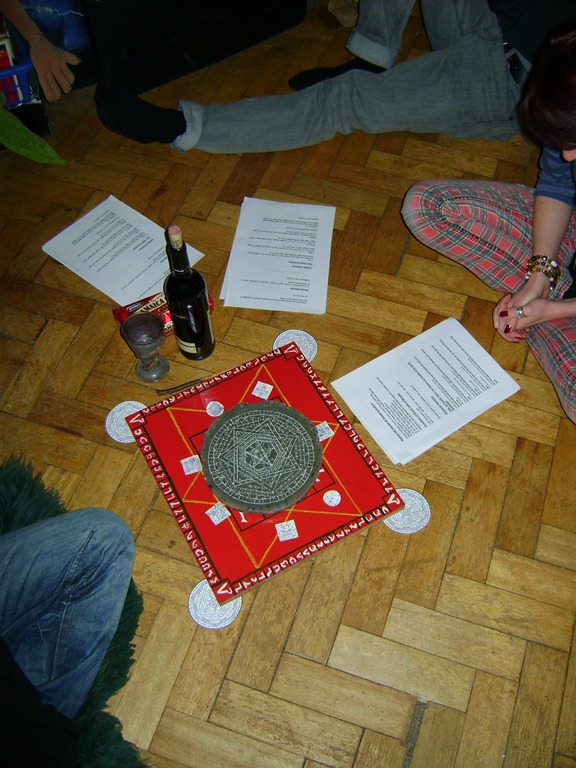
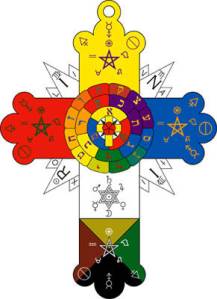
    Cutting a yellow piece of card into a hexagon, using this nifty method yielded two associations straight away and the material base for the talisman. Next, sigils – created using the Golden Dawn’s favoured machine, the Rosy Cross Lamen (pictured). Four holy names, four qabalistic worlds, one cheat sheet in Donald Michael Kraig’s book Modern Magick that transposes Hebrew into English (I didn’t have much time) created four symbols that were transposed in freehand onto the talisman. Then one more – the intent, rendered illegible using the classic Spare method. This final step felt like it added a required personal touch to the symbols through the art of creating a ‘good looking’ sigil.

    Launch conditions:

    Moon: waxing, almost full

    Day: Sunday (day of sun = Tiphareth, innit)

    Planetary Hour: Sol (approx 10.20pm) – This one was interesting because I had all but abandoned the idea of doing the ritual in the correct planetary hour thanks to a bout of inertia during the day. I thought I better work it out just in case, and realised that according to my calculations the planetary hour I needed had started a couple of minutes ago, which was very convenient – and stopped me arsing about any longer.

    Divination: I-Ching hexagram 31, Conjoining. Keywords: influence, connection, excite. Changing lines indicate way is open.

    Body/Mind: Basically, hungover. But through the worst of it.

    Charging Ritual:

    I basically followed the method outlined by Kraig in his book because I’ve used it before and it works.

    1. LBRP
    2. Banishing Ritual of the Hexagram
    3. Middle Pillar
    4. Change middle pillar energy to golden yellow
    5. Grasp talisman in hands and feel energy fill it
    6. Vibrate Angelic Order, Archangel and God names, after first asking for their presence/assistance
    7. Draw invoking pentagram of earth over talisman six times, each time vibrating godname
    8. Place talisman in container – I tried silver foil this time as an experiment, it seemed appropriate
    9. BRH and LBRP again, but I did these the other way round
    10. End

    Notes:

    Not as much physical, kinaesthetic sensations of heat and energy as experienced in past, probably due to poor physical condition of magician. Otherwise, a focused, involving ritual. Felt good and clean afterwards – head fuzziness lifted, perceptions clear.

  • Colours on the tree

    An interesting and useful discussion of the way the grades of the GD, the colours associated with the sephira and the elemental associations combine can be found over at the Mishkan ha-Echad blog.

  • Constructing the ‘Three-letters’ into a contact

    Constructing the ‘Three-letters’ into a contact

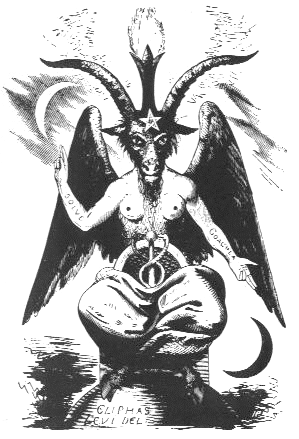
    baphomet2One of the recent experimental workings that the meditation group engaged in was the ‘Three-letters’ working (which I posted about here) in which the Tree of Life was approached in a particular type of way.  The intention of this working is to provide a means by which a practitioner can construct an imaginal means of learning the tree.  No assumption is made about the reality or otherwise of entities and contacts, not least because worrying about reality is not something a magician should be doing – the practice of majik is pure experimentation with knowledge and experience, literally a matter of ‘make something up and see what happens’.  The means of assessment of the success or otherwise of an experiment or working is difficult, although ‘consistency’ is a good rule of thumb.  The greater the consistency of responses received the more powerful they become.  In a sense ‘consistency’ produces a majikal reality – synchronicity, for example, is a form of consistency between situations and the ‘law of sympathy’ relies upon a consistency, a regularity or repetitive structure being formed such that a causality begins to emerge, albeit one that almost deliberately fucks up the ‘ground’ of such causality.  If causality is of the form ‘do X, Y occurs’ then a fucked up causality retains this structure whilst simultaneously undermining it.  There is no reason to majikal causality, merely consistency – it is this that makes it majikal.

    The core of the Three-letter working is three journeys to the bottom supernal triad of the Tree of Life in which each sephiroth is meditated upon with a view to producing a single letter in each case.  These three letters then form the name that is to be given to a contact or teacher or imaginal being who will be able to take the role of interlocutor in future exploration of the Tree.  Produce a name to produce a conversation partner.  There is a set of three path-workings available for the three sephiroth elsewhere on this site but having obtained three letters the next step is to call on the named entity.  To that end the following pathworking is offered, a simple exercise adapted from R.J.Stewart’s books, Living Magical Arts.  The exercise in that book (one I recommend highly, although it may read as slightly anachronistic nowadays, perhaps with a hint of ‘New Age’ christianity even) is called ‘Establishing an innerworld contact’ (pp195-198; Blandford 1987) which should be quite obviously seen as closely connected with the intentions of the Three-letter pathworking.

    The Visualisation

    (do whatever preparations you need in order to be able to concentrate clearly)

    In front of you, in a dimly lit environment, is a door, a wooden arched door, above which is a lamp.  Bring the door to clear vision, as clear as you can make it.  When you feel calm and ready to meet the contact and the doorway is as vivid as you can make it push the door open and step underneath the lamp and through the doorway.

    You are in a square courtyard, in the centre of which is a fountain.  The door you have just stepped through is next to a tree, the courtyard is open to the sky and it is nighttime.  On each of the four walls there is another tree, next to which there are doors.  Four walls, four trees, four doors.

    Begin to walk, slowly, around the courtyard.  Continue walking until you feel settled and the courtyard, the trees, the doors and the fountain are as vivid as they can be.  When you are ready move towards the fountain.

    There is a wall around the fountain and you place you hands on the wall.  You feel the stones beneath you skin.  You hear the water.  Close your eyes and allow yourself to do nothing but listen.  When ready, open you eyes and draw on the wall the three letters you have brought with you.  See them on the wall between you hands, make them come alive, glow and vibrate.  Concentrate on the letters and keep this concentration – as you do so, you hear a door open and footsteps behind you.  Stay focused on the name as the person who has entered the courtyard walks around you just as you did when entering, before they finally stop opposite you on the other side of the fountain.

    Ask them if they are the person your three-letters name.  Do not challenge them to prove it but trust yourself as to whether they are telling the truth.  Once you are happy it is the contact, ask them any questions you want to, about the Tree or about anything else.  Allow the conversation to flow until they stop it.

    Close your eyes again and hold the wall, feeling the stone under your hands.  The contact will leave.  When they have gone, open your eyes, walk around the fountain and move towards one of the doors.  Next to the door you have chosen you will see a symbol or mark of some sort to help you remember which door you use.  Remember that sigil and then leave the courtyard, closing the door behind you and bringing yourself back to the here-and-now.

    Use whatever techniques you prefer to ground yourself again and then make notes on anything interesting.

    Rinse and repeat as necessary…

  • SIRP and Signs

    SIRP and Signs

    The Meditation Group is now two groups, since we grew to 9 and the room was getting a little cramped.  There was also the issue of the new members not having gone through the same process as the previous group of 5 (the Qesheth working mainly) and so we now have 2 groups meeting fortnightly for a while.  The intention is to develop some of the ritual work further in the older group and to go through the Qesheth again in the newer group, with a view to coming together again in the new year.  As usual in these things, with the shake-up a couple of people took the opportunity to re-assess their own work and we said goodbye to them, at least in terms of the Meditation Group.

    So far we’ve been using the Lesser Banishing Ritual of the Pentagram (LBRP), so the next step seems to be to get the Superior Invoking Ritual of the Pentagram (SIRP) in place before moving on to the Hexagram and Rose rituals.  To that end, the following details or diagrams of the SIRP are being posted here for members mainly:

    SIRP 1, SIRP2, Signs1 and Signs2

    Ah yes – and someone was asking about Harpocrates (Horus) – the wikipedia page is here

  • The Three-Letters working

    The Three-Letters working

    The meditation group has begun a new cycle of activity following an influx of members that took us from our regular 5 to a regular 9.  In order to advance this first ‘series’ of workings on the tree (the QShTh, Qesheth working) I decided to add in a specific element which would involve each individual creating their own ‘guide’ for the tree.  The intention is to allow the intuition of the participant to be activated and given body and voice in such a way that the participant can hear their intuitionistic response and use that in addition to the basic outlines of colours, tone and symbology that I might give them.  During the Qesheth activity the bottom supernal is explored and so we are using this also to create the three-letter guides, each letter being activated by a specific pathworking focused on either Yesod, Netzach or Hod, where Yesod gives us a face, Netzach gives us blood and Hod gives us voice.  The order of visiting was Yesod – Netzach – Hod.  The three pathworkings are given here:

    Yesod, Hod and Netzach

    This is, of course, an experimental working and so anyone else wanting to use it it most welcome to, as well as most welcome to leave comments or give feedback.

  • Meditation group – Malkuth to Yesod

    I work an immanent model of the tree, rising up its pathways and growing into the tree.  Practically this means beginning from Malkuth and working towards Hod, Yesod and Netzach in the first instance (the ‘lower supernal’ or first triangulation).  The core of this first triangulation revolves around the 21st path from Malkuth to Yesod, the Tau path, in which there are three moments – Malkuth itself, the path (World) and then Yesod.  Three is the magic number of the tree.

    The temple of Malkuth is approached from a wood, in which we begin.  The greens and browns of the forest, the lushness of life and the tree itself offer our entrance into the trance pathworking.  Coming out of the wood we move onto a grass plain, mountains in the distance, birds in the air, water flowing somewhere near us, we can hear it, and the temple of Malkuth sitting amidst the growth and green of the plain, surrounded and watched over by the archangel of this realm, Sandalphon.  Given time to form its image as we cross the grass towards the temple, we see the four steps leading up to the platform where we find the entrance, the four steps reminding us of the four worlds of the Kabbalah, the platform itself enabling us to pause after climbing the steps, giving us time to acknowledge the motto of Malkuth carved above its entrance, the motto ‘Know thyself’, the motto of Socrates.  As we push open the door the black and white tiles of the floor and the flickering firefly of the Ashim fill our vision and surround us as we step inside.

    The following pathworking is the first in a new series of travels on the tree.

  • Building the temple of Tiphareth

    wands06

    As of writing, May 2008, the Kabbalah meditation group continues and we’ve now been working weekly for over a year, developing a consistent practice and learning a lot as we go.  Our attitude is relaxed and flexible, primarily because the aim of the group was always to provide a space of grounding and recharge for a group of active magicians whose work in other areas can be complemented by this regular co-creation of sacred space.  During the first year we have worked the bottom of the tree, most recently working the Death and Devil paths, gradually building up paths as we go, adding layers of symbolism and becoming intimate with the tree.  We have now completed the QShTh or ‘rainbow’ and have already touched Tiphareth but the time now comes to begin to build Tiphareth.

    When we began we worked the temple of Malkuth, giving us a strong grounding place from which to explore.  The temple was perhaps the most vividly drawn and the one we spent most time in since we would often begin and end a journey by entering and exiting through Malkuth.  Now the same process is to be done with Tiphareth, building it as a vivid ground from which to begin exploring the upper triads of the tree.

    Whilst we use the Dion Fortune text, Mystical Qabalah, as the ‘book’ on the altar space and the ground of the associations we use, the temples are built intuitively, from hints and encounters and spontaneity.  To a large extent this ends up being something that comes from my imagination as I work the paths myself and then share what I’m doing in the pathworking, so I’m aware that there’s probably a huge idiosyncracy in the way in which we work.  At present this seems unproblematic, since this first ascent of the tree aims to install it into our consciousness in a way that enables it to be built upon in future and the tree feels strong enough to sustain any idiosyncratic presentation, at least one that comes from an intuitive response.  The overwhelming nature of the tree and its associations is something I encountered before and in this project there was an unconscious avoidance of any necessity to install a ‘correct’ tree and the emphasis was on ‘what worked’, what enabled people in the group to work the path, visualise strongly and connect intimately.  cups06

    The temple of Tiphareth, then, is being built as a Golden Castle with a Child of Light at its heart.  In our previous approaches we came through the path of  Temperance and the working would involved a scene in which we fired a bow and then became the tip as it flew through the air, before landing in Tiphareth.  Now I wanted to install a direct path into the castle, in the same way that we have a direct path that goes into Malkuth.

    … you walk along a gravel path, through a line of trees that lead to a open grass park, with people playing and relaxing on a sunny day.  You feel the crunch of the gravel under your feet, hear the sounds of the people in the distance.  As you come to the end of the path and move onto the grass, feeling its soft bouncy texture, you feel the warmth of the sun on your face.  You continue towards the Golden castle in front of you towards a doorway.  The door to the castle is on the corner of two walls, with the Castle itself imagined as a hexagon.  You ask Raphaels’ permission before entering the door and once within there are the Malachim, white robed figures moving to and fro along a pathway around the walls.  Within the temple there is a courtyard, at the centre of which is a space of light, bright white light with hints of gold and pink.  You move towards the light until it overwhelms your eyes and surrounds you in its presence.  Gradually shapes become visible as your eyes adjust to the light, though everything is still surrounded by the bright light.  In the centre of the space a child sits on a cushion, behind them a tall crowned man stands.

    swords06 You move towards the child and sit on a cushion next to them.  They place a hand on your chest and rest your hand on theirs and as they do a flow of light can be felt moving into and through you, filling you up, flowing into your body, filling your feet, your hands, your whole being.  The child slowly withdraws their hand, as do you and then they rest it gently on your forehead and offer you pents06a vision.

    The child stands and offers you their hand. You stand and the child leads you, hand in hand, to the the right, where there is a door marked Death.  The child then turns about and walks to the direct opposite side of the space and another door appears, this time marked Devil.  Finally the child leads you back to the centre and you face the crowned man. Around the feet of the man and underneath the cushion the child was sitting on are rose petals.  Behind the man there are five doors, too distant to make out any marking as as yet.  The child lets go of your hand and sits down again, saying goodbye.  You turn to leave, walk back the way you came and find yourself once more in the courtyard with the Malachim, one of whom opens the door and nods goodbye, smiling as they do so.  you leave the Golden Castle, making your way across the grass, onto the gravel path and back to this world …

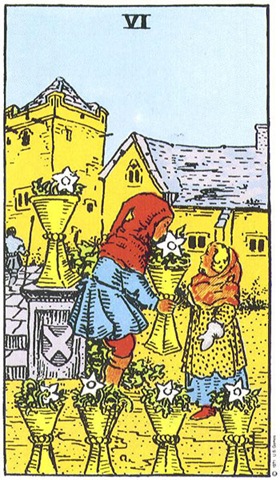
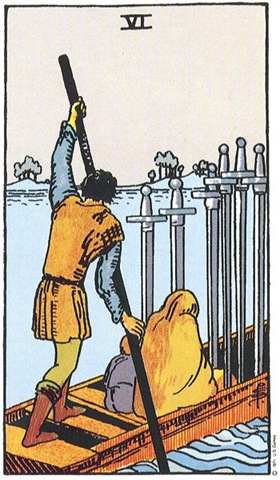
    6 wands – victory, 6 cups – joy, 6 swords – earned success, 6 pentacles – material success

  • Meditation Group – update

    The Kabbalistic meditation group we started with some fellow majicians last year is still going strong, meeting every Tuesday night for nearly a year now.  We’ve begun a ‘second phase’ of work after a couple of weeks break during the Winter Solstice period.  Last year we concentrated on the bottom four sephiroth, building a strong temple base in Malkuth and exploring the other three sephiroth as part of a process of QShTh (Koph, Shin, Tau) or ‘building the rainbow’.  Once this ‘bow’ is built, the arrow is then drawn and fired towards Tiphareth and that is indeed where we have been heading recently.

    We began by getting a second ‘temple base’ centred and fixed, this time not the temple of Malkuth but the temple of Tiphareth, the walls of the temple no longer in stone but now golden, forming a golden castle on a hill which we entered by drawing the bow, focusing on the tip of the arrow-head and then becoming the arrow as we release the bow, landing inside the golden castle to meet the child of light.  We spent some weeks just going there, spending some time with the child of light, allowing the connection to be made through the solar plexus.  Now, however, we’ve begun to explore the pathways towards Malkuth, notably 24 and 23 – death and the devil respectively.  The last two weeks have been focused on path 24, death.

    Here, on the path of transformation (a vague term if ever there was one and one that might be said to apply to the whole of the tree), the taste of earth is again predominant.  Lions and sparrowhawks and battle cries abound, the clash of metal ringing out in the expanse of the heavens.  The flaming red elemental triangle is strong and there is a connection to Geburah, somewhere, though I am unclear about that as yet – I’m assuming, no doubt incorrectly or only partially, that it’s a reflection from the other side of Tiphareth but more will come about that later.

    Having moved from the first supernal to begin working on the second it is appropriate to change some of the techniques we’ve been using as well.  The Kabbalistic cross, the LBRP and the Middle Pillar still form the beginning, although I’ve been thinking of bringing the Hexagram ritual to the group as well but perhaps towards the end of this period in preparation for the next move up.  Following these openings, however, we had previously been doing a simple 20minute empty mind meditation, primarily because this is a ‘no preconceptions’ form which, whilst difficult to achieve ‘perfection’ in (whoever wants to do that is a Fool, literally), is useful in producing a relatively simple state of ‘sit still, be quiet, allow the sounds of the world and your mind to just pass through’.  It was occasionally added to with the three steps a fellow chaote once suggested – Be Still, Be At Ease, Be Aware, in which you simply go from step 1, to step 2 through to step 3 and repeat the process each time you ‘interrupt’ yourself.  Now, however, we’ve begun using the more traditional ‘single point’ meditation of the Golden Dawn neophyte grade, as found in the First Knowledge Lecture, albeit minus the four-fold breath.  Interestingly there’s an ambiguity in the original, in which the meditation appears to be not on the point itself but on “the ideas to which it gives rise” and so we may not be doing anything similar to the practices of GD neophytes at all.  I find the idea of meditating on ideas far too strange, however, no doubt because of a certain hostility to the latent Platonism that I smell there.  The simple image of the point seems far more powerful and appropriate, not least because it is commonly encountered as dynamic, as an auscultatory phenomenon and thus the focus on the ‘breathing’ point allows the practice of settling the breath to occur.

    The other key notions of the First Knowledge Lecture are things I want to build into this stage of the pathworking as well.  We’ve already begun the process of learning the Hebrew of course as well as the sephiroth themselves and as we do we also learn the planetary and conceptual associations as well.  The practical elemental aspects have been limited so far and these and the astrological associations are probably the next layer on the cake that needs adding.  I’m unsure about the Pillars material, however – some sort of decision will have to be made regarding the whole Egyptian thing…not something I’ve ever resonated with myself but obviously central to any continued work with the GD tradition once we’ve established the basics, as it were.  Perhaps the group is just there to establish the basics…we’ll see.

    It is a strange thing to be working through this material again in a group, having last worked it over a good few years ago and then in a solitary situation.  The whole is very familiar but last time I remember – I might see if I can dig out my diaries about this – that the main lesson that I drew was regarding the whole ‘Judaeo-Christian’ aspect of the work.  I came into pagan and majikal practice with a considerable hostility to religion and in many ways still maintain that, though in general I now conceive the hostility as one directed at Priests and the Priesthood rather than Judaeo-Christians in particular – a kind of anti-authoritarianism, I suppose, partially informed by a general political hostility to authority, partially informed by Nietzsche’s genealogy of the slave revolt and the ascetic ideal.  Asceticism, priestliness and that whole monk thing is both powerful and destructive.  My first moves towards exploring any sort of ‘spirit’ (a word I still find peculiar and not altogether comfortable) was via Buddhism, which I soon found to be as deeply imbued by the Priestly ethic – if not more so – than Judaeo-Christianity.  It was Rae Beth who was the first to offer a path that seemed to somehow be inherently anti-authoritarian and yet still able to handle the sacred.  I soon found, however, that witchcraft and majik had its roots in Judaeo-Christian ideas, at least in terms of the language and symbolism with which it articulated itself if not in its inherent ‘spirit’ and so the Golden Dawn proved to be the way in which there was a coming to terms with this symbolism and history, or at least the beginning of such an accounting.

    Now, however, the  ‘JC religion’ thing is much less important.  The child of light, for example, found in the castle of gold of Tiphareth, might be associated with the Christ figure but is associated with a whole gamut of other sacrifice symbols.  If we understand sacrifice through Christ then we forget that it is only through an understanding of sacrifice that Christ means anything anyway.  Sacrifice is something inherently other than the simple figure of Christ, whilst at the same time incarnated in that figure amongst many others, many of whom I’d probably prefer the tone of.  The Christ figure is bound up with sin, guilt and the appalling trick, as Nietzsche says, of the ‘infinite debt’, a concept so bound into power, authority, capitalism and hate as to be almost inconceivable.  The sacrificial aspect barely remains in the JC religion because of the telos of that particular act.  Distinct from this I would suggest that it’s anathema to a pagan practice to begin from some sin that needs expunging – that is an inherently Judaeo-Christian, perhaps even simply a monotheistic concept (I know little about Islam so wouldn’t comment).  I think the Nimbari’s ‘third principle of sentient life’ – that it is capable of sacrificing itself for the greater whole – is a far more powerful way of understanding what is positive and what is dangerous in the general idea of sacrifice.  The image of sacrifice, however, that symbol, is bound into the body of the Christ figure within the Western majikal and pagan practices and so one way or another needs to be encountered and encountered not just as a danger or as negative.  That, as I say, was the original lesson that I drew from the Golden dawn material – now, however, the question or problem is which other figures might also be bound into that concept, who are these figures and is this in fact the heart of the tree, this notion of sacrifice?

  • Meditation group – week 11

    Sitting on a tree trunk in the old forest. In front of me dense leaves, the colour of mid summer, soft green before it becomes harsh khaki. The bark under my buttocks arranged in fine ridges, grey rather than brown, thin fingers, shallow grooves.

    I stand and begin to walk the path. It’s red, the soil has a dusty quality, smooth and warm. Looking at my feet. They’re moving slowly, falling with certainty. I know this place. I’ve been here many times. And then the forest begins to clear. In front of me is a large, grassy area. To my left I can hear water. The trees fall away from me to my right. I can still hear the birds singing up in the branches. In the distance purple topped mountains. Closer a temple, round, pale skinned, blank windows set into thick walls. There are steps, four of them, massively horizontal, hewn out of light rock, perfectly worked into straight angles. At the top a dias, ridged to form sun rays, and then a door, above which is carved Malkuth. I’ve been here before. I know this place.

    Inside pale becomes glinting orange, the light of sunset. Looking up and the ceiling is a dome, around which runs a balcony. The Ashim sing from the balcony, their flame bodies moving with breath and rhythm. They welcome me, some brush over my skin, with their words and music and spirit bodies. Their heat refreshes me.

    I see the lady, throned, her hair coiled about her head, her arms resting gently at her sides. She smiles. I incline my head. Her clothes are richly decorated, with gold threads and lush red velvets. Although she is antiquated I can sense her agelessness. She is neither young nor old, instead she just is, seated in her place, her proper place, and I am her guest.

    Three doors. On the left one marked XX, Judgement. Going. Not wanting to go. I cry a lot. It is fear real, ethereal. To want and not want. To feel desire and to be repelled. Forwards. Backwards. Swinging time.

    Through the door and the ground is wet, clotted. The earth path here is dark. Underfoot rotting leaves and broken twigs. The leaves squelch. The twigs crunch. They are being squashed, breaking.

    I am in a graveyard. Old tombstones rise before my eyes. One on the right, near the path, is covered in lichen and green moss. I cannot make out the inscription. In the distance I see a mausoleum. It’s square, white, columned with a pyramid roof. Someone important has died. They raised a shrine. Many of the tombstones are broken, lying at crumbled angles. There is a coffinesque one a few yards away. It’s lid is missing. My feet are wet. My hair is bound in elaborate coils and my white shift is damp and clinging to my body. I rise up, blood returns to my lips, it is as if I am waking from a very long dream, a dream that has kept me in this coffin for many years. I watch myself walk towards myself and then I join, black and white with colour. I feel my chill.

    Above me a white light, conical, starting as a pinprick up in the night sky and falling to ground in shafts of luminescence. I don’t need to be scared. I am not blind. Everything is throw into sharp focus as I recognise him from his sword. Michael. He who has counselled me to take the blood of harvest into my wintering heart. He showed me once what to do with the seed, how to tuck it away and keep it safe until the spring would help to bring forth its promise.

    The sword, double edged, shining steel, a hand guard, worked gold. His gown is white. He does not speak. I know already. I always have and always will.

    Another door, thrown open into brilliance, a space with no walls, no floors, no ceilings. I cannot fathom the distance or proportions. This light is blinding and breathtaking. To step in? The door has been opened.

    In front of me a wide staircase, stretching from beneath to above, curving around, encompassing. Marble. Alabaster. Iridescent clouds. I do not require air to be able to breathe.

    Walking down the stairs, a man with a staff, he has two snakes, but I can barely see them. He flickers in and out of my vision, part of the light, part of my perception. The snakes provide the only colour, brown and green, a solidity of muscle and movement. He becomes a she, with breasts, his hair tied behind his head, her feet padding on the marble, all is toneless, there is no silver or gold or sound, just white and light. Silky satin.

    Her lips move. He is talking to me. Hearing has no place in this space. Listening is irrelevant. Lips are moving. There is no strain, no gain. Lips are moving and they are beautiful in their movement.

    She takes me by the hand, but not by the hand. He has my hand and I have her hand, yet there is no grip or force.

    Up the stairs and everything shrinks. At the apex I find myself in a small room. Walls are brushed cream. The floor is boarded with dark wood. Along the walls bookshelves, filled with leather bound tomes. There are desks, a person sitting at each, their backs to me. They are silent. They are working.

    I am led down a central aisle, past the desks. No-one lifts their heads. In small alcoves bell jars sit on plinths. I do not know what is inside them. There is a geared machine, proportioned to fit on a small table. Brass cogs. A turning device. The sphere rotates silently. And then an empty desk. I sit. The wood is very old, a black patina is engraved into a polished dark brown surface. An ink pot. A feathered quill. The feather is beautiful, fine, an abstract white not white. Set into the desk three buttons, brass, big, the size of my palm.

    I press the left button. It shows me everything I know. Rapidly words and images flash in front of my eyes: ‘The Seventh Seal’, incalculate, a magnesium flare. I press the right button. It shows me everything I do not know: colours I have never seen, fascinating words, a wiring diagram. I press the middle button and a book appears, hard backed, dense woven fabric, blacker than black, the titled engraved in silver: ‘HOD’. I open the book and begin to read.

  • Meditation group – week 2

    The new meditation group met for its second week, four of us again though a different four. The basic outline we developed last week seemed to be transferable, though the new person along suggested some elaborations to the Kabbalistic Cross / LBRP practice which she might bring along for us to consider. The middle pillar chanting is fantastic and an absolute joy to do, that’s the most noticeable thing for me so far.

    The role of the voice in a public group is one of the most curious things I’ve come across. A good ritual leader can be a bit of a performer and that’s necessary, though the surface manipulation can sometimes be a little too apparent. I love both Derren Brown and Ray Mears for their ability to manipulate a surface – and I’ve quoted both in lectures to philosophy students – but there’s something remaining of the ‘audience’ when there’s a performer, inevitably and factually, without any real value placed on this fact. The fact, however, even if considered valueless in itself can be the ground for values – that a split exists between the performer and audience is a necessity of the form but other forms do exist and their mode is that of union, more specifically of an ecstatic union. (The extreme paradox, and I mean _extreme_ paradox, of the concept of an ‘ecstatic union’ is something I still find wonderful.)

    The voice involves the practitioner, opens up a space that is phenomenally embodied, and I mean that in the most technical sense. Each person hears their own voice in various ways and part of the process of solitary practice, of moving from the arm-chair to the circle of art, is the sound of ones breath and word intermingling in your ears, in the space around your ears, in the space other ears invade. In voice meditation during the middle pillar it’s not the ears that are the hearing organ, it’s something more vague, the body or the throat or the heart chest torso – something I feel and know through that feeling.

    We had a first run through of a rough and ready pathworking this week too after the twenty minute no mind meditation that followed the first practices. The pathworking consisted of reading through the attributes list at the head of the Malkuth chapter in Fortune’s ‘Magical Qabbalah. I read through it five times, doing a kind of ‘shipping forecast’ pathworking, a series of notes really. The four tarot cards were out and after reading through the list and then ten minutes or so of quiet relaxation I read out the names of the four cards whilst placing them in front of everybody. The four Tens were oppression, the ten of wands; perfected success, the ten of cups; ten of pentacles, wealth; ten of swords, ruin. The gate. The gate of death. The gate of the garden of Eden. ‘…black, with gold flecks’. Magical Image: A young woman, crowned and throned.