Category: flow

  • That which is core being

    That which is core being

    At it’s most exciting and interesting existentialism brings to the fore the problem of the core of my very being and even if it may fall back on the model of the human in its own attempt to think through this problem, the fact that the problem is posed in large part derives from existentialist thought.  This ‘core’ sounds naive and simple, as though some ‘true me’ can be found if we look hard enough.  This implies something like a essence and the first crucial step that existentialism began to make explicit was was that this core is not some essence to be understood through the philosophical process of distinction and definition supported by argument.  Sartre’s crude formulation of this shift in existentialist thought found itself expressed in his famous slogan – ‘existence precedes essence’.  Kierkegaards’ investigation of the case of Abraham and his faith is also, however, reliant upon this kind of shift from essence to existence.

    A core, like the core of an apple, might be missed by being unthinkingly passed over, almost as though it were waste.  Custom and practice where I live is for the core of an apple to be thrown away after eating the flesh and pulp.  I’ve always found that strange, always eating my apple cores and once I had children often eating theirs too.  The core of an apple is crunchy, tasty and – more importantly – the very point of the apple.  It is the seed carrier, which all this flesh and pulp is there to sustain.  It contains a small forest within, an orchard of life.  My own, naive, magical, thinking has always taken the core of the apple to be that which is the most vital, life-containing element of the fruit.

    This core of my own being I also take to be that which is most vital, life-containing.  Assuming, as I do, that I am not a deterministic being this core is also something that doesn’t cause anything, including my being.  It is, instead, that which is within the eyes that see, not as a pre-existing soul but rather as the confluence of all those forces that have coalesced to form this moment of subjectivity in which I see or feel.  At times this core will be in one form, at times in another, though at each time it will present as an eternity.  At times, indeed, the core might might be in a ‘non-dual’ form, presenting itself not as my core but as the core of everything.

    How can such a shifting form in any sense be called a ‘core’?  Moreover, how could such a core be both continuously shifting and yet also ‘that which is most vital’?  Implicit in the notion of a variable core is something like a ‘variable object’.  Why is it difficult to imagine an object that has enormous variation?  It seems that at the point at which we allow the enormous variation the object is no longer identifiable.  We cannot recognise something as an object unless there is enough stability of identity, so it might be argued – and yet we seem entirely capable of handling the weather, of handling things which have enormous variability.  The lower intensity of the rate of change in many objects perhaps inoculates us from the pressure of handling the higher intensity objects.  It seems that if a core does exist, almost by definition this core must be that which is most vital – these two notions seem to co-define each other.  The difficulty is not, then, in recognising this core and this vitality but rather in handling an intense core, that intensity now being understood as a high degree of flux.

  • The breath as an organ

    The breath as an organ

    DSC01951_33860634The snoring man on the train, just behind and to our left, revolts us. Their noise is more penetrating, more cutting, even though it is lower in decibel than the irritating child a few seats in front with their high pitched and hyperactive voice testing the patience of the father figure accompanying them. The snoring man is filthy in his activity, that rasping breath, that grasping for life calling out to be silenced and with its silence comes death. The sound of the breath is a broken tool that reveals its function, its equipmentality as Heidegger would call it, precisely by being heard. That filthy, contaminating breath, no gentle rythmn of life but a crushed, rushing in-out-in-out intimacy that brings the Other too close, too far within the experience of living together that repulses us within our modernity, repulses us because of its forced confinement amongst each other.
    (more…)

  • Principles and Facts – notes

    Principles and Facts – notes

    There’s an interesting online psych project over here at Project Implicit…an interesting thing mentioned on Thought Capital’s blog post about the use of ’empirical data’ in ’evidenced-based meta-analyses’. I presume these EBMA’s are some sort of peculiar category of philosophical activity, perhaps connected to the idea of ’experimental philosophy’ which, whilst fascinating, seems to sometimes miss the point. Can evidence ever establish particular principles of thought? If not, then is it for a philosophy a question of giving up principles or of giving up evidence? Is there a dichotomy here that cannot (in principle or in fact) be resolved?

    This difficulty, of what we might call the distinction between the quid facti and the quid juris is critical to any attempt to understand transcendental philosophy. There is an argument being made (James Williams, Dan Smith etc) that it is in fact principles that are crucial for Deleuze, that the quid juris has in some sense a priority derivable from an affinity of Deleuze’s method with that expressed by Leibniz ’Principle of Sufficient Reason’. Everything has to have a reason for existing, a ratio existendi, rather than simply a reason for being, ratio essendi. In fact, Smith argue, Leibniz in fact added other epistemological and metaphysical conditions in the PSR with the notions of ratio cognoscendi (a reason for how we can know the thing, the principle of indiscernibles) and a ratio fiendi (reason for becoming out of that which already is or law of continuity preventing arbitrary MacGuffin like inventions during the course of an account). The PSR aims to fulfill all that we would ask for in either of the quid moves, such that a question of fact or principle is capable of being responded to by understanding the sufficient reason for a thing.

    (more…)

  • Books I like and some hardware/software as well

    Books I like and some hardware/software as well

    Books I like and some hardware/software as well (not much)

    (This is a list produced by Alan Sondheim – not me – and something that he does maybe once or twice a year. I’ve known Alan online for a good few years now, in fact since I was first at University as an undergrad, and his eclectic and curious reading patterns are reflected in his strange and fascinating work as both a theorist and artist. He also simply offers leads and possible avenues of research that I simply couldn’t find anywhere else and as such is a fantastic connection to plug into. In this list I’m particularly interested in the The Alpbacj Symposium 1968 papers, the Steve Talbott, The John Franklin Bardin Omnibus and the Olympus WS-300M, …the last list of these I posted was in November last year and you can see some of Alan’s current work on avatars, utilising the Second Life interface, over here on YouTube.)

    I’m behind in my reviews; the last few months have been a mess. I may be missing some books. I may have misplaced. others. I hunger for reading, but it’s all transparent, pathetic, collapsed. There’s nothing to say about reading that hasn’t been said before. Humans compress history’s repetition until the world’s squeezed out. If I’m missing a book in what follows, forgive me; the oversight wasn’t deliberate, just an effect of physiology. The following books are in no particular order; for the most part, they’re books that have been more than useful, have been inspirational, works I’ve returned to at times. I’m including some miscellaneous reviews of software/hardware as well. (First off, apologies for the poor style below; it’s hard for me to convey sustained excitement, but such underlies most of what follows.)

    Buddhist Dictionary, Manual of Buddhist Terms and Doctrines, Nyanatiloka, Buddhist Publication Society, Sri Lanka. This is an amazing and often technical work, documenting the terms of the Pali Canon and beyond; it has information I literally haven’t found elsewhere. The Pali vocabulary is extensive, often highly structured conceptually, and this has proved, not only to be an invaluable guide, but also an interesting read in itself.

    I am a Cat (three volumes), Soseki Natsume, translated Aiko Ito and Graeme Wilson. The original Japanese work appeared in the first decade of the 20th century; it’s an amazing rumination on everything by a cat. The work is reminiscent of Sterne and I found myself enveloped in it (in a manner similar to reading something like The Journey to the West); it says a great deal about Japanese modernization and city life, and is beautifully written. It’s not an ’animal’ story in any sense of the term. The work’s available from Tuttle. (Alexanne Don introduced me to this years ago.)
    (more…)

  • Various essays in progress…

    Various essays in progress…

    This time of year is always slightly hectic, with marking and ’student progress boards’ and the like – and for me it’s the first time I’ve been really involved because previously, as a visiting lecturer, most of this work was left to the full-timers. What’s good about it of course is seeing the students work come to fruition and knowing that this step is done with and the next is to come but at the same time it’s a time when my own research and writing has to be put on hold. So it’s curious to take a break and look back at what’s going on in your own work…

    (more…)

  • Book Tag Bibliomancy

    Book Tag Bibliomancy

    Rules:
    1. Grab the nearest book.
    2. Open the book to page 123.
    3. Find the fifth sentence.
    4. Post the text of the next 4 sentences on your social media, along with these instructions, if appropriate.
    5. Tag five people.

    ————————

    “The uniformity of the radiation is ‘a fossilized testament to the uniformity of both the laws of physics and the details of the environment across the cosmos’, and it is this homogeneity which, suggests Greene, makes it possible to meaningfully speak of a ‘universal synchrony’: ‘if the universe did not have symmetry in space – if, for example, the background radiation were thoroughly haphazard, having wildly different temperatures in different regions – time in a cosmological sense would have little meaning(FN5 – Brian Green, The Fabric of the Cosmos, Penguin 2004, 227-8).

    RT: Yes, in fact the CMBR itself could be used by our so-moving observer to define a cosmic clock, obtained by measuring the uniform temperature of the microwave radiation and monitoring it as it cools down with the cosmic expansion. But even in the extreme case where you had a cosmological expansion that proceeded differentially in different directions, a so-called ‘anisotrophic universe’, instead of describing the expansion with just one number – redshift – then you would have one number for each direction. You could then possibly conceive of having different dimensions evolving differently with time.”

    (Collapse, Vol 2, p123-4)

    Powered by ScribeFire.

  • teaching the machine

    teaching the machine

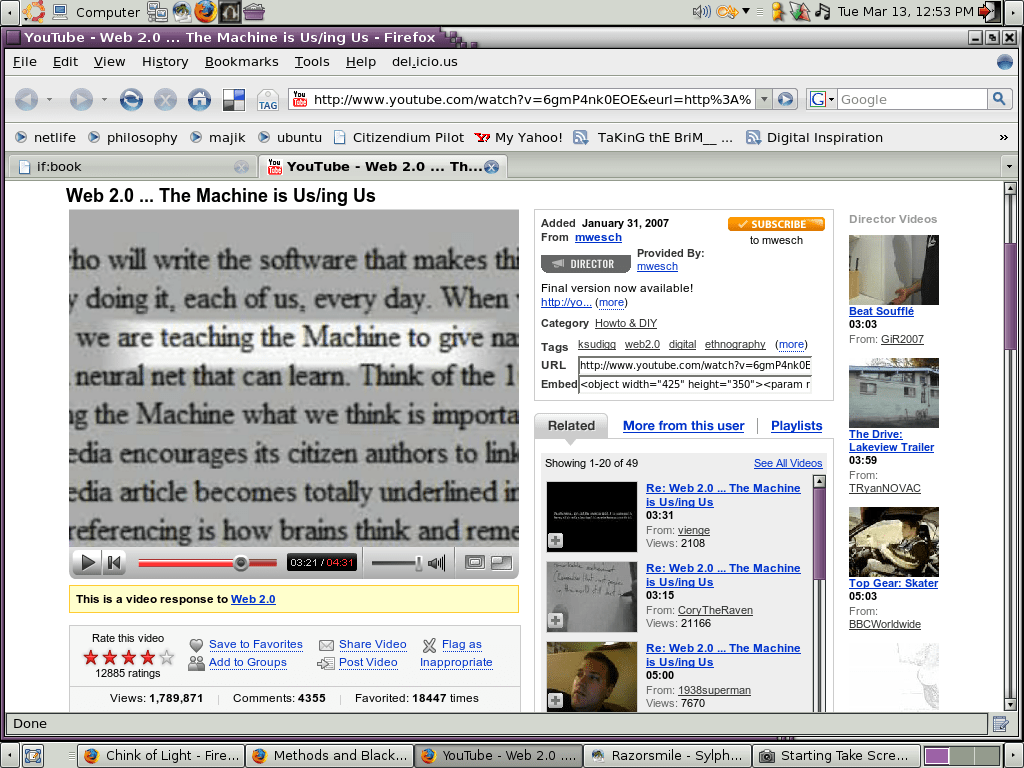
    There’s this peculiar video that’s on YouTube at the moment, an excellent example of contemporary pedagogy in many ways, called ‘The machine is Us/ing Us’. It’s gathered nearly 2 million hits and since it’s only about 4 minutes long, probably most of those people have watched it. There’s a beautifully slick feel to the way the video performs itself. It’s about the ‘Web 2.0’ (the new ‘social web’) and it makes use of the text inputs we make on the ‘net all the time to mix and edit between them, presenting its ideas as the video progresses.

    The main thesis seems quite basic, though one that needs to be kept in mind perhaps, and that is that the new forms of communication are not, in fact, communication but connection. They do not allow the easier flow of some pre-existing material but in fact constitute new material, new connections and new flows (even though they also might allow the easier flow of existing material). It seems reasonably positive, reasonably human, reasonably thoughtful. In effect I agree with what Michael Wesch says (the maker of the video and assistant professor of anthropology at Kansas Sate University). I also applaud his skill and ability to produce this piece. There was, however (of course there’ll be a ‘however’ 😉 one phrase that occurred that stuck in my mind and which seemed, how shall I say it, strange. It seemed, at the very least, strange. (more…)

  • Ah Pook, the destroyer

    Ah Pook, the destroyer

    aion+roman+god+of+time.jpg_5511948381992109266One of my favourite pieces by Burroughs is the short Ah Pook discussion of time, death, control and the ‘ugly american’. I showed it to my Introduction to Philosophy class this week, at the start of the lecture, then came across it again on Muli Koppell’s blog ‘Methods and Black Squares‘ blog. The brief film animation that is famously associated with this Burroughs piece is below, though it misses out (at least in this version) Bryon Gysin’s all purpose nuclear bedtime story from the end, which I’ve previously heard attached to Ah Pook as a kind of coda.

    (more…)