Category: deleuze

  • ‘…souls are everywhere in matter.’ (The Fold – reading notes #1)

    ‘…souls are everywhere in matter.’ (The Fold – reading notes #1)

    Notes on Deleuze’s ‘The Fold’ resulting from the work being done as I attend the excellent new reading group hosted by Matthew Dennis at Goldsmiths College, with thanks to him for the opportunity to study the work and for the others at the group for stimulating and interesting conversations.

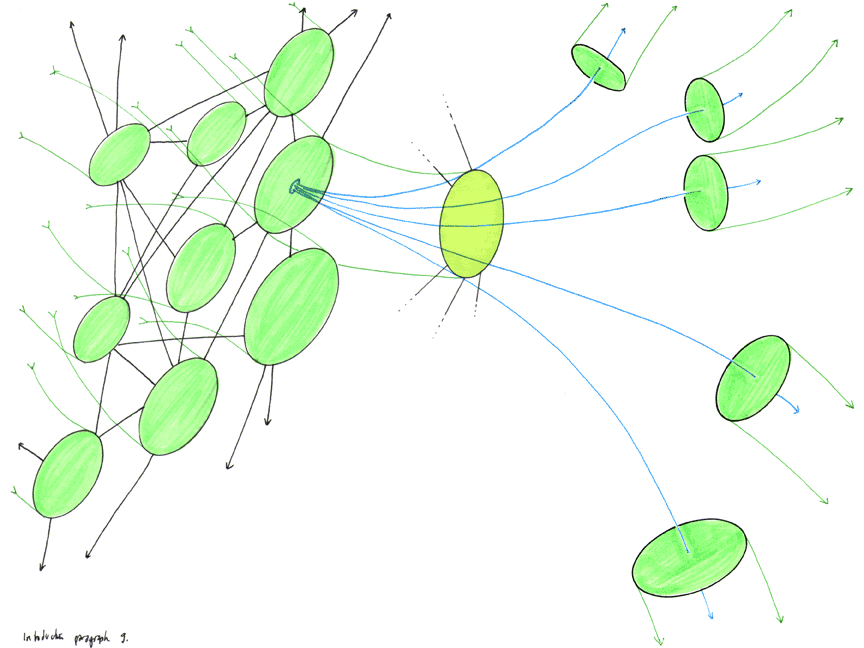
    Matthew Dennis made some introductory remarks when we first met for the reading group and noted that one of the first things encountered in the book is the architectonic metaphor of the room with two levels.  Dennis rightly, I think, drew our attention to the way this particular image can stand in conversation with the Platonic cave.  We can articulate two philosophical dynamics or views by allowing these images to stand as the organising centres of thought.

    Curiously I had tended to glide over the image on this reading of the text.  I’ve read ‘The Fold’ numerous times before, only gradually getting to grips with its peculiarities and only recently feeling even slightly familiar in its surroundings.  The familiarity of the image had perhaps encouraged its disappearance in my horizon, in that common effect of presentation whereby the common becomes the invisible.  It was good to have this foregrounded, therefore and in the course of such foregrounding to have my own familiarities de-familiarised.  I had been reading straight past the image – but what then had I been reading?
    (more…)

  • Continuum and Continuing

    Continuum and Continuing

    Continuum publishers have informed me and my co-editor that the collection of essays on Kant and Deleuze we were working on these last few months is to be released next June.  Go to the Continuum website for the details of contributors and a brief blurb…

    This news, of course, reminds me that I have been neglecting the blog and intend to start posting notes again soon.  I’ve been deep into Deleuze’s Leibniz book and reading Gasset on Leibniz as well, so have been enfolded in folds and foldings.  Notes to come soon.

  • A/V paper now LIVE!

    A/V paper now LIVE!

    lee

    In another email that came through this week the journal A/V let me know that the paper I gave at the Manchester conference on ‘the event’ is now live on their journal.  I have been developing the paper a little more since then as it’s part of an ongoing project that I am working on and the more developed paper was given at the Greenwich University postgraduate conference yesterday, as a keynote address.

    That was a strange event, with lots of interesting papers and some, as usual, that I simply didn’t understand, quite often the case in inter-disciplinary conferences.  I always find my notes form these conferences to be quite strange, littered as they are with various doodles and occasional sketches and the whole experience of conference going has a peculiar set of affects, from boredom and confusion to inspiration and sideways thoughts.  It’s very easy to forget whole swathes of fascinating material as you focus increasingly on single topics, with previous researches put on the shelf and gathering dust until something triggers a connection and suddenly boxes are pulled down and papers strewn everywhere in that search for a particular piece of paper, a particular underlining or note.  During the course of that search other things then turn up and the strange world of research becomes close, that strange world in which there is more than you realise in the background to what you do.

    The paper, the first section at least, called ‘To survive da’ath’, is available on A/V here.

  • Naive notes on crowned anarchy

    Naive notes on crowned anarchy

    To call life itself just or unjust, to conceive life as samsara or suffering, is to judge life and to do so from outside life, from some position which is the ground of a judgement. To encounter life, respond to it, is inevitable and not all responses are equal, this much is inevitable. Too often, however, this encounter and response is thought of as a judgement. To not judge does not mean to not respond or that any response is as good as any other. There are different responses in life, different lives if you like – or different types of life. Life produces its own end, life drives itself to death but in the encounter with death there is another space of response, this time one that shows us the two fundamental ways of response, affirmation and negation, more life or never ending death.

    How am I to think of life? The philosopher must ask this question. They must, moreover, continue to ask this question and to encounter the force of this question with responses – the philosopher must not simply ask an idle question but encounter the problem of the question, the problem the question arises from, responding with thought, with emotion, with passion, with action. Encounter and response constitute the activity of thought and living, though too often this dynamic to-and-fro is congealed, by the social, into regulated habits, pre-formed responses such as the response of the subject, ‘I think…’. Living is a poor name for the habits and habitats of the human. We are all, inevitably, products of the social, products of the inhuman and yet we are not inevitably condemned to remain nothing but product, commodity, object. It is not a matter of striving to become a subject since the subject is that which is subservient, the subject of the monarch. Rather it is a matter of striving for monarchy itself, becoming a crown within life but not a ruler, judge or controller. Crowned anarchy, this is the watchword, a monarch of creation, a singular moment that adds to the abundance of singular moments. In more traditional terms, this is the assumption of an imperative to autonomy, the self (auto) lawmaking (nomos) reality.

    (more…)

  • Revision for Nietzsche and Modern European Philosophy

    Revision for Nietzsche and Modern European Philosophy

    For my 3rd year students in NMEP.  (This is just a brief and partial account of the discussion today and students are welcome to continue the discussion here on on the WebCT bulletin board if they want a little more privacy, this is a public site after all.)

    Today we discussed the way in which we think the subject by exploring the problems involved in the idea of ‘loving a robot/loving a simulation/loving a simulacrum’ and how these might be teased apart.  A large part of our understanding of both Klossowski and Deleuze’s works on Nietzsche involve us in thinking about the way in which there is a problem for them, what exactly it is that motivates them, as it were, to write and think in the way they do, particularly when the initial impression when confronted by these two works (Nietzsche and the Vicious Circle:NVC and Nietzsche and Philosophy:NP) is one of disorientation.  As we approach an exam we need to supplement the detailed exegetical work done in the essays and the reading seminars with a ‘step back’ that enables us to get a broad sense of dynamics and lines of thought.  To that end it is important to remember, I suggested, that Nietzsche is one of the ‘masters of suspicion’ (along with Marx and Freud – the phrase itself originates form Paul Ricoeur) and that both Klossowski and Deleuze begin form a position congruent with such suspicion in that they begin thinking by distrusting the way we think and speak.  We use words and as we use them assume we know what they mean, until we are asked what they mean when we find confusion and disagreement.  The words we use are capable of possessing us with the feeling that we know something, they possess a sense (or affect, feeling) of sense that we need to be suspicious of in order to begin to think critically.  This doers not mean we simply throw out our intuitive relation to meanings and the sense of things, since such a rejection would also imply that we somehow knew what it was we were meaning and now reject it.  Uncritical rejection is no better than uncritical possession.  Thus the task is to ask, how might we think about the concepts of subject when the language and sense of the concept already exists, how might we think, as it were, in spite of the possession of sense.  To do this, I suggested, both Klossowski and Deleuze attempt something we can think of as a reframing of the questions, a redrawing of the lines of debate.  This idea of a reframing of the problem is perhaps simplifying things but for now, as a kind of working device or ‘rule of thumb’ to enable us to develop understanding (what is called a ‘heuristic‘), it will suffice.

    (more…)

  • bordering on coherence

    bordering on coherence

    [NOTE TO ANY READER: this post is a classic example of pinball thought, ricochet rather than writing, a ‘thinking out loud’.  Beware of any apparent seriousness and discussion.]

    In a recent post on his blog Poetix discusses the ‘object oriented’ philosophy of Graham Harman.  I have only recently come across Harmans’ work, primarily because I have only recently returned to work on Heidegger and his various books began appearing in 2002, when I was deeply immersed in Deleuziana.  His approach looks fascinating and is one I hope to more familiar with by the end of the year.

    Poetix begins his post with the claim that an object cannot be fully understood through relationality because it must maintain an unrelatable element.  It must maintain this ‘occult’ aspect of an unrelated element because if it did not then “there would be no object as such, but only the differential field of appearances itself“.  The use of the phrase ‘differential field’ here immediately enables a connection to Deleuze’s philosophy (amongst others perhaps), not least because of his Nietzschean inspired claim that an object is nothing but a conjunction of forces (cf NP).  For Deleuze, then, an object is nothing but that which is produced by a differential field of forces.  It looks like we might have two very different answers to the problem of object-ness at work here, two different answers to a question such as ‘is an object nothing but the relations which constitute it?’  When you can get two clearly different solution vectors to a specific question then there is an opportunity to think a problem (in this case that of the object-ness of objects) through conceptual confrontation, through the tensions of thought.

    (more…)

  • …and a lot of accidents

    …and a lot of accidents

    I’ve been watching some of the YouTube videos posted by the TED group, including one presentation by Murray Gell-Man (he of The quark and the jaguar).  Most of the presentations at TED seem short and sweet, not a lot of technical detail but a good – if broad – explanation of an interesting concept enabling people to gain something like a ‘lay of the land’ within intellectual life.

    One of the things Gell-Man was saying in his presentation which really struck home, however, was the role of accidents.  “The history of the universe is … co-determined by the basic law and an unimaginably long sequence of accidents (outcomes of chance events)” (Time: 4.59).  He re-emphasises this point at various places during the presentation, that accidents are crucial co-determinants of reality together with any basic law that exists.

    For a long time I’ve been fascinated by a short and simple point made by Deleuze.  “It will be said that the essence is by nature the most important thing. This however, is precisely what is at issue: whether the notions of importance and non-importance are not precisely notions which concern events or accidents, and are much more ‘important’ within accidents than the crude opposition between essence and accident itself.” (DR, P189, Athlone edition)

    (more…)

  • Relations and reactions

    Relations and reactions

    dancing+graffiti_40910987In a post on Marx’s dialectical method and Deleuze, Steven Shaviro makes the interesting claim that it is Deleuze’s pluralism that is transcendental.  It is the theory of relations that Deleuze has which underpins his pluralism and this theory of relations, presumably, would be the place to look for a transcendental structure in the sense of a ‘condition of possibility’-type argument (Shaviro makes it explicit he’s referring to a Kantian transcendental when talking of Deleuze’s ‘transcendental pluralism).  Indeed this is plainly the case for Shaviro, since the article begins from the differences and similarities between dialectics and Deleuzian thought in terms of their theory of relations.  He suggests a strong commonality around this area of theory of relations, arguing that:

    There are definite commonalities. (1) Both the Hegelian/dialectical language of negativity, and the James/Bergson/Deleuze language of virtuality, insist that all those things that are omitted by the positivist cataloguing of atomistic facts are altogether real. (2) Both locate this reality by asserting that the relations between things are as real as the things themselves, and that ‘things’ don’t exist first, but only come to be through their multiple relations. (3) Both construct materialist (rather than idealist) accounts of these relations, of how they constitute the real, and of how they continually change (over time) the nature of what is real.  (4) Both offer similar critiques of the tradition of bourgeois thought that leads from Descartes through the British empiricists and on to 20th century scientism and post-positivism. (numbers in brackets inserted)”

    (more…)

  • The individual is not anyone

    The individual is not anyone

    The discussion on Marx, Deleuze and desire continues…my own thoughts seep out of side…

    In Video Veritas responds to Larvalsubjects question ‘Where’s Marx?’ with the claim that he is a ghostlike omnipresence – “Marx is all over the academy, but in a fragmented, ’spectral’ fashion”.  IVV suggests that within disciplines like economics there is a kind of latent Marxism because “what could be more Marxist – in the base-superstructure sense – than a rigorous theory of economic interaction that purports to reduce individual agents to pseudorational little machines of desire and satisfaction?”  I think this is an interesting point, though I think it also may reveal something almost against itself.  In particular the word ‘individual’ here is what, for me, shows the a-Marxist nature of economics.

    (more…)