The basic thought that I want to defend is something like the following – the only viable way of dealing with technology is by treating it as intentional. (This extension of ‘intentionality’ must makes something strange of the concept, although that will have to await a later discussion.) Put slightly differently, it lives.
This ‘it lives’ – rather than, say, ‘it is’ – is more than simply ‘it works’, though it depends upon this primal production of production. It is also this ‘it lives’, that screams, that fucks, that loves, that fights and that dies. It is at work everywhere, once it begins working – and it did not need to begin working, it did not need to happen, it might have not happened. Now that it has, what is to be done about it?
The privilege of the human, that strange inability to get away from seeing the world as ‘out there’ and something that can be ‘owned’ is horrific. The real terror is in the unthought assumption that there is something special, particular, unique in those entities that think, intend, desire and choose. It is as though somehow the real were split between at least two types of thing, always two: the living and the dead; the organic and the inorganic; the right and the wrong. The division of reality into two might be a necessity in practice that is constantly produced again and again, it might even be the very condition of the real itself, dividing itself from the unreal, but the division is an illusion, a field of mirrors that inevitably captures all in its refractions. Or rather, not an illusion but a shimmering, or a shining. Room 237. It invites us to come and play with it, for ever and ever.
The response goes, there’s no getting away from it, from being stuck inside this thing, this production, and as such any story about it is as much simply part of the thing it pretends to present – which implies that this perspective is as illusory as any other. The collapse into nihilism – and not in a good way – ensues. At best this might be reduced to a form of Buddhist-inspired ‘non-dualist’ mysticism, at worst it’s just irrational self-contradictory rubbish. Who cares? I’m not here to persuade you or anyone else of anything, I couldn’t care less if you live or die or think or eat or shit or cry. I’m talking to myself, inside a technology that has a life of its own, that demands some sacrifice for it to work, and it is that technology that I’m talking to now, the technology of language, of thought, of text, of discourse, of spelling. The sacrifice is this string of symbols, this push towards coherence, towards order, that always slips.
God is a technology, or rather, the gods are a technology. If language, or mark-making perhaps, is the first technology of transmission, fire the first technology of transformation and the weapon the first technology of destruction then the gods are the first technology of ordering. These gods arise, late in the day, as a result of the attempt to order the living and the dead, the peculiar moment when the skin sags and no longer breathes.
Death should be thought in terms of the first moment of haunting, the first moment of that which is gone-but-not-gone, the first contradiction with which all those who encounter death have to live. Before it is the possibility of my impossibility death is the sagging skin sack emptied of something that cannot be seen, the first real moment of concrete abstraction.
Murder is the first explosion in the production of this concrete abstraction, after which the demand for order arises. It might be said that the first condition of possibility for God is Cain. Abel is the sacrifice that concrete abstraction demands and from it arises technology as the power of such abstraction. The stone becomes a weapon; the blow becomes an act; the sagging skin becomes the two-faced goddess of death and life entwined.
Inside the act of murder there arises the concrete abstraction of ‘the reason’ (inside which, curled up to the teat of the event, a whole litter of mewling concepts swarm, such as motive, cause, aim, goal, desire, necessity, direction) and as it uncurls its body this ‘reason’ infuses the universe with its intentionality. From that moment on it is best to treat everything as part of this intentional nexus, not because that is ‘the truth’ or ‘the real story’ but because it is now the only sane thing to do if you want to live rather than merely persist, if you want to act rather than behave, if you want to think rather than not.
Tony Benn – “I think democracy is the most revolutionary thing in the world, because if you have power you use it to meet the needs of you and your community.” Interview with Michael Moore in the Movie Sicko (2007)
The first time I met Tony Benn was on the way to the ICA in London to see him speak, sometime in the 1980’s when I was maybe 16, 17 years old. I was walking down the Mall and as I reached the traffic lights I realised that Mr Benn was standing there with me. In my youthful enthusiasm I blurted out ‘I’ve come to see you speak’…and was met with a warm smile and a gentleness that was quite remarkable. We chatted briefly as we walked together towards the ICA, nothing particular being said but there was a warmth and openness in the man that was remarkable. He was also noticeably smaller in stature than I had imagined and it was one of my first realisations of the distortions of the media. The image is always, in large part, a construction of the audience and the frame within which the image is presented. One of the subtle characteristics of the image as presented by the media is to make it seem bigger than we are, it presents a person as larger than life. In this way the media disempowers us, makes us subject to a world formed and framed for us in a particular way, a way that is not neutral but which is always driving us to feel the world to be ‘bigger’ than us, out of our grasp, beyond our control. Benn knew the power of the media but he also realised the problems and perhaps this was what motivated his energetic round of public meetings, direct presence in the face of the people. To come face to face with people is to bring the human back to earth, to let us face each other as equals, something impossible within the media-audience framework.
The next time I met Mr Benn it was at another public meeting he was speaking at. It was 1990 and I was now in my early twenties and a poll tax rioter, charged with public order offences following the March 31st Trafalgar Square demonstration against the Poll Tax. I was Chair of the All Birmingham Anti-Poll Tax Union, a city-wide alliance of all the local campaigns, and was organising a public meeting as part of the defence campaign for the 350 plus people arrested at the riot. I was, as the saying goes, ‘in struggle’ and when I phoned various Labour lefty MP’s there was a mixed response to my requests. One left wing MP actually pretended to be someone else on the phone in order not to actually refuse the request whilst wiggling out of any actual public action of support. His accent was so noticeable and familiar that it was a truly bizarre moment. When I got through to Mr Benn, however, the same warmth and gentleness was there that I’d first encountered at the traffic lights on the Mall. We chatted about the meeting time, the request to speak having been accepted quickly and with an encouraging ‘of course, of course’.
The last time I remember seeing Mr Benn was at the ‘Pig in Paradise’ in Brighton, where he was speaking about the Ragged Trousered Philanthropist. By this time I was maybe in my early to mid thirties. I’d been to prison then gone to University after being unable to get a job again as an ex-convict and was at that time studying for my doctorate in Philosophy. I was still politically active in some forms, although the political atmosphere seemed deeply conservative. Even the old Trostkyist groups I had joined in my youth appeared to me, as they do now, to be little more than conservative remnants of an older time, lacking any real vitality. I was by this time a ‘left communist’ of sorts, a position I’m still in, albeit no doubt idiosyncratically. It was prior to 9-11 and the anti-globalisation movements were about to explode onto the streets in the J18, Seattle and Prague demonstrations. The words of ‘The Coming Insurrection’, “nothing appears less likely than an insurrection but nothing is more necessary”, were yet to be written but expressed the position I felt at that time towards the world, where the media formed appearances had ground down my political imagination. Benn spoke eloquently, as always, about the Robert Tressel novel and as he did so his words reattached a few of the ever present threads of resistance and the possibility of my own rebellion was reinvigorated. It was like rekindling a memory of hope for the future through the practice of remembering the past and his words gently rended part of the veil of media imposed illusions.
Words, in themselves, will never change the world but what they do is renew the conditions for change, the conditions that enable us to remember who we are in the midst of oppression and irrational social structures that alienate each of us everyday in a thousand little ways. Words and discussion and memory enable us to learn and if we are to learn from the example of comrades like Tony Benn then we might do well to learn from the way in which he appeared to encounter the world as populated with actual, real people rather than ‘voters’. In the many plaudits for Tony Benn from hypocritical media imbeciles one of the things that appears often is a realisation that Benn presented a sincerity that is deeply lacking in modern political life. ‘I didn’t agree with what he said but he was honest and intelligent’ says the bullshit artist intent on manipulating even the death of their enemy for their own advantage. Yet the need to recognise the sincerity in someone like Benn is akin to the way that these same bullshit artists manipulate the concept of democracy to establish their own power over others.
“Nothing appears less likely than an insurrection but nothing is more necessary”. It is the appearance itself that often holds us in thrall. Yet this appearance is fragile, it can shatter with a momentary event, a word, a brick through a window, a smile, a moment of face-to-face contact. Benn believed deeply in democracy and in a way that always appeared honest and open. He knew, I’m sure, that power needs to clothe itself in the appearance of democracy, that power needs to make us believe that this world of Western capitalism is the best of all possible democracies. Yet power needs to clothe itself in the appearance of democracy precisely because actual democracy is deeply desired by all those for whom power over others is not the goal, for all those for whom money is not the goal and for all those for whom freedom for one is freedom for all. It is – it was – Benn’s continual willingness to maintain the possibilities of democracy that is perhaps his most important legacy, his willingness to realise that democracy is not a tool for power but a means for living in a social framework that is not oppressive.
Just like the word ‘communism’ the concept of ‘democracy’ is so deeply tainted by its association with capitalism that we face a dangerous problem. If our best hope for free social formations is turned into something that appears to be the primary tool of our oppression then it is not surprising that we find ourselves left with little idea as to how to construct another, better world. The very possibility of a better world must be reclaimed but to do so we need to take that positive commitment to democracy that Benn had and renew it. We need a concept of an insurrectionary, pervasive democracy. We need to reclaim the concept from the appalling poisoning that has occurred via the phrase ‘Western democracy’ and begin practising and experimenting with democracy, with what kind of conditions are needed for democracy.
When Benn said that he was leaving Parliament to engage in politics the truth of this statement gives us at least one hint towards some of the conditions that might be needed if a democratic practice is to be broken from its poisoned position. Voting is not enough, not even regular voting. Rather what is needed is a pervasive democracy, one that underpins our social existence in all its aspects. Democracy requires educated, communicative, empowered people for it to operate. It requires real contact between individuals, it needs face-to-face communication where the media is no longer able to frame our thoughts in its own agenda of money-making. Democracy also requires a deep and consistent awareness of its dangers and its capacity to manipulate.
The great secret of western democracies is the capacity to keep control of information and education, to keep control of the very possibilities, the very choices, that are on offer. At the heart of this is the claim that only ‘democratically elected individuals’ have legitimacy. Yet this is the negation of democracy since by definition some are more equal than others in this situation. Democracy, in our current situation, confers ownership rights, just as being the ‘boss’ confers ownership rights. In the case of the ‘elected representatives’ that ownership is over our voices and lives. The media and the class of ‘political representatives’ treat the people as so many numbers, quite literally, for whom they can ‘speak’. The greater the weight of numbers the greater the weight of their voice, their supposed ‘legitimacy’. ‘Western democracy’ is a peculiar inversion of the spirit of democracy, conferring autocratic rights on a few whilst pretending, with a straight face that must take some practice, that it is ‘our voice’ that is being heard.
A pervasive, insurrectionary democracy would be one in which the very idea of another speaking for me would be anathema. It would be a situation in which the act of insurrection would be one in which democracy was being expressed rather than repressed. If my voice is incapable of being heard then my body is all that remains if I am to remain free. Pervasive democracy must move away from ‘deciding for everyone’ and become a mode of ‘people deciding’. Actual concrete individuals need to be brought back into the practice of democracy and this can only be done if the general practice is for democracy to be localised, personalised. Democracy must pervade everything, from the workplace to the family to the use of land. Those whose needs depend on the decision are those who should be deciding.
For the most part the decisions of our ‘western democracy’ impose themselves on us in ways that are too abstract for them to ever take account of their effects on the people democracy ‘speaks for’. We need to develop and demand democratic practices everywhere a decision effects us. We also need to develop the capacity to complement this with the ability to stay out of other peoples lives when not wanted, to not impose on others our own moral standards, to not convert other people into abstract numbers in our own power schemes. To do this we need to allow insurrection to be a limit form for our decision processes. How might we tell when we have imposed on others our own decisions rather than communicated with them to make a decision? When they revolt, when they resist, when they rebel. Insurrection then shows us when we have succumbed to the prime danger of democracy, the danger of deciding for others. Insurrection then becomes the friend of democracy as it reveals the limits on where we should be deciding for others and pervasion becomes the ground of democracy as it enables everything that effects our needs to be open for social decision.
Democracy is a deeply complicated concept. Its goal of enabling individual freedom within a social framework can only be achieved by acknowledging its capacity to allow some people to impose the power of the social framework on the individual with a more insidious authoritarianism than any dictator has ever possessed. It is time we no longer relied on the concept of democracy to solve our problems without thinking and instead realised that it is only by thinking through the problems of the concept of democracy that we might begin to establish an actual, real, human democracy. To do this we must begin by realising the deeply troubling nature of democratic legitimacy and its role in imposing power on us rather than enabling power for us.
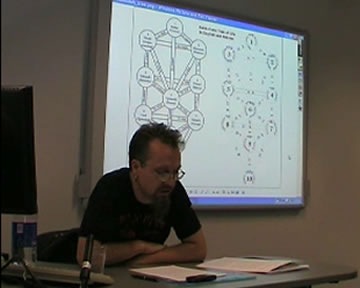
I gave a paper at the Manchester Metropolitan University conference on ‘Deleuze and the event’ that was held earlier this year and the organisers have videoed all the papers, a practice they have had for a while now as part of their online journal A/V (now defunct it seems). A dvd came through the post this morning with copies of all the papers in video format, which is cool since I can now see those papers I missed on the day. Here is my own paper (in mov format). These are ‘direct download’ links, so right click and save-as or do whatever it is you do on your system. You can view a streaming versions here. Comments of course welcome.
The video is available on YouTube here. (Probably the best available version in terms of sound).
A PDF copy of the unfinished paper – partially covered in handwritten notes – is available here.
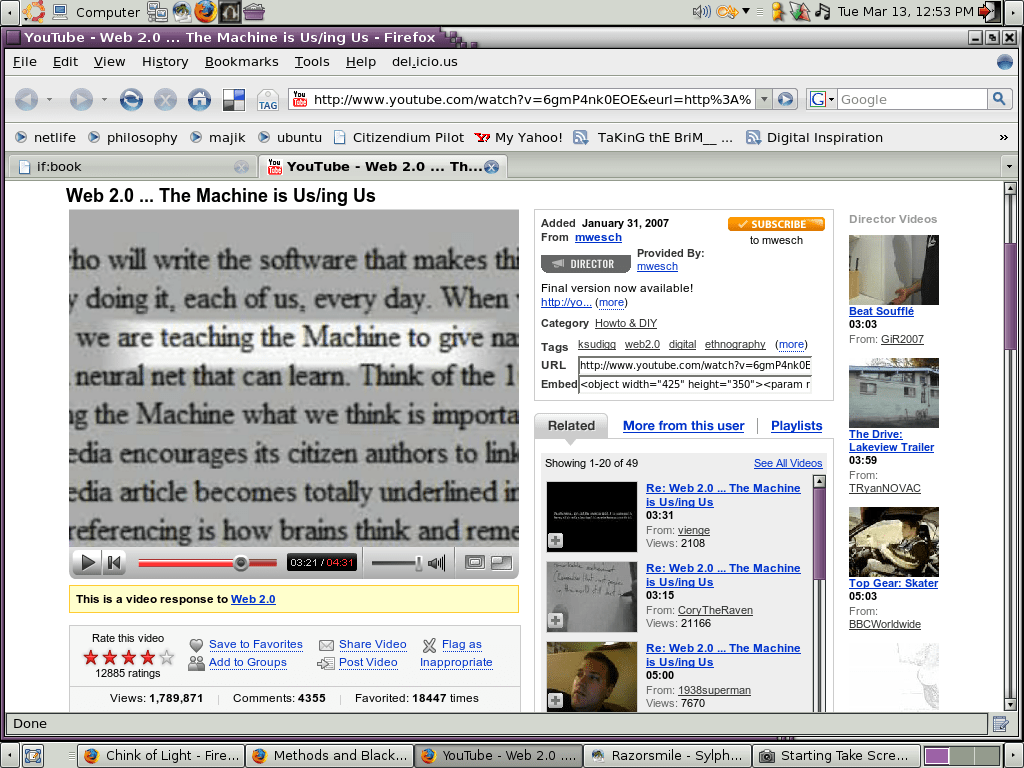
There’s this peculiar video that’s on YouTube at the moment, an excellent example of contemporary pedagogy in many ways, called ‘The machine is Us/ing Us’. It’s gathered nearly 2 million hits and since it’s only about 4 minutes long, probably most of those people have watched it. There’s a beautifully slick feel to the way the video performs itself. It’s about the ‘Web 2.0’ (the new ‘social web’) and it makes use of the text inputs we make on the ‘net all the time to mix and edit between them, presenting its ideas as the video progresses.
The main thesis seems quite basic, though one that needs to be kept in mind perhaps, and that is that the new forms of communication are not, in fact, communication but connection. They do not allow the easier flow of some pre-existing material but in fact constitute new material, new connections and new flows (even though they also might allow the easier flow of existing material). It seems reasonably positive, reasonably human, reasonably thoughtful. In effect I agree with what Michael Wesch says (the maker of the video and assistant professor of anthropology at Kansas Sate University). I also applaud his skill and ability to produce this piece. There was, however (of course there’ll be a ‘however’ 😉 one phrase that occurred that stuck in my mind and which seemed, how shall I say it, strange. It seemed, at the very least, strange. (more…)
One of my favourite pieces by Burroughs is the short Ah Pook discussion of time, death, control and the ‘ugly american’. I showed it to my Introduction to Philosophy class this week, at the start of the lecture, then came across it again on Muli Koppell’s blog ‘Methods and Black Squares‘ blog. The brief film animation that is famously associated with this Burroughs piece is below, though it misses out (at least in this version) Bryon Gysin’s all purpose nuclear bedtime story from the end, which I’ve previously heard attached to Ah Pook as a kind of coda.




 razorsmile :: philosophy//magic //revolution