Category: capitalism

  • The image is already fading

    The image is already fading

    This post was recently found in the drafts folder, lost in the database for some five years.  Meh.

    1.

    The image is already fading.  This is perhaps the only thing we might want to accelerate within capitalism, although capitalism is not the source of the image, or the fading.  Both image and fading have, however, been transformed and accelerated, in some sense, through capitalism.

    It is not to excuse capitalism from any of its horrors to ask, as Marx clearly did, what is capitalism productive of?   The horrors are the most important, the specificity of those horrors compared to analogous events in other socio-economic forms.  Of less importance however, although still not without importance, there are numerous other effects of capitalism.  The vampire is not without its virtues.  The question is, is there some virtue of capitalism that we might want to increase in intensity, so as to provide a route through which to escape capitalism as such.

    Roughly, the answer would be yes.  Capitalism does something that must be acknowledged to be a virtue – it makes knowledge productive in a way that is unprecedented.  Science, a concept that is highly charged, is internally compromised by the sheer voracity of the capitalist virtue of making knowledge productive.  A limit is revealed, the limit of the transparency of knowledge.

    The image is already fading.  The image of the human, the image of thought, the image of the future.  Walking down London Road, high on the walls, stands the reminder of a time before neon and the public relations industry, the ghost sign of W.J.Andrew, Family Grocer, Provision Merchant.  Tomorrow someone will discover that the new filter setting on their phone is called ‘ghost sign’.

    There’s a curiosity between generations in popular music.  The eighties and nineties return, like the repressed, in something that might seem like nostalgia, as though there is no future for the past to fade away from.  It cannot be nostalgia, since that would assume there was some time when today was listening to the past, when in fact today’s listeners hadn’t even been born.  It isn’t nostalgia, or any other lack.  It is instead the flatness of time gradually appearing, through the expanding database. Database flatness, edges of the former times now appear as ragged, those times now, those befores, are less partially inscribed in images and data than now.  Yet it is a transition phase, towards the new database times.  (Or barbarism).  Forward or death, yet there will be no more forward in database time, simply coordinate space.  Without the ‘forward’ it smells like death.  The problem is whether the future is a future with or without temporality?  The image of time is fading in the face of the database.  Everything will be dated, but nowhere will time be found. (A new aeon).

    “Is there not already in the Stoics this dual attitude of confidence and mistrust, with respect to the world, corresponding to the two types of mixtures – the white mixture which conserves as it spreads, and the black and confused mixture which alters?  In the Meditations of Marcus Aurelius, the alternative frequently resounds: is this the good or bad mixture?  This question finds an answer only when the two terms end up being indifferent, that is, when the status of virtue (or of health) has to be sought elsewhere, in another direction, in another element – Aion versus Chronos”. (Logic of Sense, 23rd Series of the Aion, p162).

    The ‘black and confused mixture which alters’ has flown its flag, still flies it, yet indifference reigns.  Even when indifference is not the order of the day, amongst those activists and organisers and leftists for example, their stance is now so hysterically moral and lacking any future as to suggest it is no longer actual rebellion but merely the inverse symptom of generalised indifference.  Moral outrage infects what were once the ‘forces of the future’ with a proto-fascism that will spawn when the conditions call for it.  The demand is to negate the forces of capitalism with the idea of the future, a conception of another world, a transcendence of property and profit, yet without weapons (not words) such negation is, like all negation, hollow.  The candle in the eye of the cow.

    Is this a good or a bad mixture?  The image is fading, time is shifting, temporality undergoing a transition as fundamental as the introduction of clock time and Saint Monday may even make it’s return.  The aion of capitalism has offered us a peculiar time, needs to offer us a peculiar time, at once Chronos crossing labour but simultaneously Aion forcing exchange.  As each moment becomes measured and quantified, de facto, in labour time, each moment also becomes exchangeable, de jure, for any other.  In this tense dynamic the image is already fading.

    2.

    How can we distinguish the image from the event?    Through it’s fading.  This intimacy of the paint peeling, the emulsion yellowing, the edges fraying, the memory failing, this intimacy of fading is in part the ground of the image.  An image that never fades is simply no longer an image.  Yet what if this fading itself was becoming ungrounded, fading out, as we cross-fade into the new form.   The black mixture that alters has wreaked havoc (through the ‘digital revolution’) on the image, that black mixture made up of the bodies of cameras and lcd screens and red buttons, drifting across the earth and our eyes.

    During the late nineties there was an argument amongst film-makers, particularly those who had come into the practice in part because of the digital revolution (the horrors of Blair Witch as symptom).  The dominant position of this argument essentially claimed that emulsion-based techniques were little more than neutral tech that would soon be superseded by the CCD improvements. ‘CCD’ stands for ‘Charge Coupled Device’.  Within digital cameras the CCD is often referred to as the ‘chip’ of the camera, although it is not the same sort of ‘chip’ that is found within a modern PC.  A CCD essentially converts input into electrical charge, as distinguished from emulsion techniques where the film would converts input into chemical charge.  The pro-digital proponents pushed the propaganda that the CCD process was, effectively, better than emulsion because it was more accurate.  Arguing for emulsion was reduced to ‘clinging to a fetish’.  The debate was framed into a ‘forwards/backwards’ push, the digital proponents akin to proto-accelerationists, the emulsion fans converted into something like a luddite technician.

    The real question, however, was always the one of the virtues of the mixture.  The real error was the functionalism of the proto-accelerationist pro-digital fans, the idea that image capture and production was a functional process.  Like all good functionalists, if the process is a function then it is possible to instantiate it in multiple forms and, whilst these forms might have some specificity, this ‘idiosyncrasy’ of the technology was little more than noise in the functional process that could be eliminated in time.  Given the right CCD and the right light the mixture would be functionally indistinguishable from emulsion based processes.  Digital could be made to look like film.  Except it couldn’t, not really, and once that was realised it was soon argued that such attempts to ‘make digital look like film’ were redundant aesthetically.

    The real mixture into which the luddite emulsionites and the accelerationist CCD-lovers were thrust was not driven by image capture and production, it was instead driven by commodities, the basic cell of the capitalist body.  The new digital cameras were a boost in commodity forms, a new gadget to get, crashing the actual cost of image production and capture.   The ‘digital revolution’ occurred not because of the advance of digital technology but because of the cost of film-making.  The debates about fidelity, dynamic range, colour constancy, focal depth and various other arcane aspects of the tech were all strange symptoms of a process that demanded the sale of camcorders.

  • Capitalism and the schizoanalytic unconscious.

    Capitalism and the schizoanalytic unconscious.

    (These notes provided the basis for a talk I gave to the A2Z group in London, March 31st 2017.  I have uploaded the fuller set of notes as a PDF here)

    “I am interested”, Guattari says, “in a totally different kind of unconscious. It is not the unconscious of specialists, but a region everyone can have access to with neither distress nor particular preparation: it is open to social and economic interactions and directly engaged with major historical currents”.  It is useful to think about Guattari’s interest by considering what he says in another essay – “molecular analysis is the will to a molecular power, to a theory and practice that refuses to dispossess the masses of their potential for desire”.  The schizoanalytic practice is thus a means by which desire is brought front and centre without it being subsumed under the priests of interpretation.

    This desire on the part of Guattari, to liberate the role of desire from the prisons of interpretation, is no doubt tricky to embrace.  As he notes in the essay ‘Everybody wants to be a fascist’, the core of this problem lies in the collective reality of desire.  At one point he reflects on the performative contradiction that might be thought to exist in the situation of an individual lecturer offering this schizoanalytic account – “in reality, everything I say tends to establish that a true political analysis cannot arise from an individuated enunciation” because “the individuated enunciation is the prisoner of the dominant meanings.  Only a subject-group can manipulate semiotic flows, shatter meanings, and open the language to other desires and forge other realities”.  

    This problem, of the individuated enunciation in relation to the group ear, becomes clearly visible when Guattari remarks, in the same essay on fascism, that “what’s the use of polemicising: the only people who will put up with listening to me any longer are those who feel the interest and urgency of the micropolitical antifascist struggle that I’m talking about”.  This acute sense of the limitations of those who will ‘put up with’ him appears to echo the actual practice of engagement with strange and psychotic discourses, no doubt reflecting Guattari’s continual concrete engagement with psychotics in institutions like La Borde.  The difficulties of dealing with the repetitions of psychotic language or behaviour often express themselves in terms of precisely this capacity to ‘put up with’ things, a capacity that the wider socius – outside of a clinical setting – generally lacks.  One of the main difficulties someone with a ‘mental health problem’ encounters is the wearing down of their personal relationships as people refuse to ‘put up with’ behaviours and language that disrupts the smooth functioning of the social machine, a difficulty that is shared by anyone who speaks, writes or thinks in a way that doesn’t conform to the easy-mode game of social cues and interactions.  Most people prefer their games set to easy-mode.  So when Guattari  – who is often identified as one of the ‘deliberately obscure’ thinkers – acknowledges that he is difficult to listen to it might be thought that he is acknowledging the idiosyncrasies of his style.  It is, however, not simply the style of his language but the content of his thought that is what becomes difficult to listen to.

    The relation between the specific enunciator and the group ear, constitute the real terms of actual enunciation.  It stands in contrast with the “universal interlocutor”, that great imaginary face of reason in front of whom every rational speaker is supposed to stand, awaiting judgement.  Analysis, reason, explanation, all operate, for the most part, inside this system of the ‘judgement of God’, in which the particularity of the statements are meant to be swept away in favour of the universality of the supposed ‘truth’ they attempt to articulate.  Yet this strange, abstract model of reason hides in plain sight a simple lie, which is that what is said is what matters.  This lie, that it is what is said that matters, removes that crucial and seemingly incontrovertible reality of the ear.  In practice the users of language constantly negotiate with the ear, constantly re-speak their words as they negotiate with the ear of their interlocutor, a negotiation that constitutes the basis of ‘personal relationships’.  The to-and-fro between one individual and another in an intimate relationship reveals the reality of the ear in the word – what the other hears matters more than what words were used and the words are highly fungible in the struggle to make oneself heard or to hear what someone means.  Anyone who fails to realise this will have many failed relationships.  What you think you said matters less than what they know they heard.

    Whilst this problem of the ear is acute in the relations people have with the ‘psychotic’ individual, it is prevalent to one degree or another in all talk, in all discourse.  It’s not a clean problem, however, not an error that can be corrected.  Rather it’s a dirty problematic, one that refuses to be washed away and which calls for other strategies, ones that cannot be prescribed but which must be acquired.  When Guattari says that the ones who will put up with him are the ones ‘who feel the interest and urgency’ of the problem he is addressing it is crucial to hear this emphasis on feeling.  The collective conversation, this coming together of mouth and ear, is grounded in this ‘vague sense’ that we ascribe to feelings.  It may be true that I feel before I think but what is forgotten is that I don’t stop feeling once I begin to think.  Thought is only ever alive and real, actual, when it is within a specific network of feelings.  There is no actual thought in the pages of a book left on the shelf, at best only virtual thought.  There is no thought without a tone of existence, without an ‘affect’ within which it is both produced and constrained.

    It’s easy to find much talk of ‘affect’ in modern philosophy and critical thought, although it is perhaps waning as the flavour of the month.  Yet the connection between ‘affect’ and the ‘schizoanalytic unconscious’ is strong and thinking them together can amplify their capacity to be useful tools in making the world thinkable.  In the contemporary world the problem of a political future distinct from the one we live in is deeply constrained by the problem of ‘thinkability’.  We hear the idea that “a radically different future is unthinkable”, a point that has been made enough times now to become almost second nature to many.  Yet the problem of the unthinkable future is best encountered not through pessimism but through a kind of joy, a joy that rests in the fact that thought is explosive.  What I mean by this is that thought operates not in a causal sequence but in terms of excessive moments, those breakthroughs, sudden glimpses, the shifts and slides of the ‘aha!’ moment, what sometimes goes under the name of ‘insight’, a term not without it’s own difficult implications.  In this situation if the problem of the moment is that the future is unthinkable then, at the same time, this blockage is deeply fragile.  All it takes is for the thought of the future to arrive for the damn to burst.

    This ‘all it takes’ is not nothing, however, it is not there to suggest an easy way to thinking the future but rather to indicate that peculiar fragility which perhaps cannot be perceived in the present but that, nevertheless, we can wager exists.  The wager becomes easier to make if the stakes are placed on the right horse and it is in this that the role of ‘affect’ and the ‘schizoanalytic unconscious’ can help, predominantly by replacing the ‘cognitive priority’ conception of consciousness.  Within this conception of consciousness thought is conceived as a series of moments,usually moving from starting point to conclusion, whereby an ‘input’ is transformed into an ‘output’.  This model of transformation is deeply delusional and massively idealistic.  It assumes some kind of autonomous module that exists within the ‘mind’ and which mediates the input/output relations, relations in the broad sense between ‘world’ as input and ‘behaviour’ as output.  Instead of such an abstractly autonomous module, consciousness is instead a kind of shape, one that exists within a network of relations and which possesses only as much autonomy as is possible within the particular state of relations.  That network of relations which places limits of the amount of autonomy possible is what can be thought with the concepts of ‘affect’ and the ‘schizoanalytic unconscious’.  The material body that thinks exists inside the social relations it is organised into, which it expresses as a particular set of affects (feelings) that in turn constitute the landscape of its possibilities, it’s ‘schizoanalytic unconscious’.

    These four elements – the material body that thinks, the social relations, the sets of affects and the landscape of possibilities – all operate to constitute a world and each is malleable to a greater or lesser degree.  A political thought which takes each seriously and which understands them to be moments of the articulated whole needs to think of causality less as a sequence of temporal moments and more as a fluid articulation of complex connections between points, as a set of vertices and edges.  The shape that is constituted by the vertices and edges is the contemporary world of the subject, it is, in effect, the shape of consciousness at any particular moment.  Within contemporary capitalism the shapes of consciousness continually undergo a set of pressures that attempt to ‘push’ such shapes into a particular mould, that attempt to fit square pegs into round holes, or more exactly that attempt to fit variable pegs into round holes.  The round hole is constituted by ‘capital’, by an abstract, non-conscious yet non-material force – a law of production – that is capable of direct effect on the points and lines that form the shape.  It’s capacity to deform the shapes of consciousness rests in the force it brings to bear on the shapes of consciousness, forces which produce, amongst others, the idea of the ‘wage labourer’, but which operates, fundamentally, as the primary force acting on contemporary consciousness.  To that extent our problematic can be stated quite clearly – capitalism and contemporary consciousness are connected, but is the connection contingent or necessary?.

  • City psychosis.

    City psychosis.

    The twentieth century witnessed the rapid urbanization of the world’s population. The global proportion of urban population increased from a mere 13 per cent in 1900 to 29 per cent in 1950 and, according to the 2005 Revision of World Urbanization Prospects, reached 49 per cent in 2005. Since the world is projected to continue to urbanize, 60 per cent of the global population is expected to live in cities by 2030. The rising numbers of urban dwellers give the best indication of the scale of these unprecedented trends: the urban population increased from 220 million in 1900 to 732 million in 1950, and is estimated to have reached 3.2 billion in 2005, thus more than quadrupling since 1950. According to the latest United Nations population projections, 4.9 billion people are expected to be urban dwellers in 2030. – Source: World Urbanization Prospects: the 2005 Revision

    Inspired by a reading of Lewis Mumford’s ‘The city in history’ I’m currently beginning a slow process of thinking about the role of the City in the human ecology.  I turned to Mumford because of the scattered references to his work in Deleuze and Guattari’s ‘Capitalism and Schizophrenia’ project, and that has already proved productive, not least because of the realization that the ‘paranoid/schizoid’ poles that run throughout that project seem to have some roots in Mumford that I had not registered before.  In Chapter Two, for example, Mumford develops his idea of the City as an ‘implosion’ event in human culture that arises from a dynamic between neolithic ‘villages’ and paleolithic ‘hunters’ which gradually produces the role of Kingship, the catalyst for the implosion event of the City.  With this implosion event, dominated by a central authority, a new  “collective personality structure” (p.60) develops.  The idea that this new collective personality structure is one that connects a paranoid to a schizoid position is clear, for example, in the following:

    Not merely did the walled city give a permanent collective structure to the paranoid claims and delusions of kingship, augmenting suspicion, hostility, non-cooperation, but the division of labour and castes, pushed to the extreme, normalized schizophrenia; while the compulsive repetitious labour imposed on a large part of the urban population under slavery, reproduced the structure of a compulsion neurosis. (p59-60)

    Mumford is enjoyable to read, so far at least, because of his richly interpretative and evocative approach.  He develops a very broad synthesis of ideas and histories in order to tell something like an ‘origin myth’ and this is both the strength and weakness of his book so far.  At times he seems to be simply telling a story, at other times attempting to synthesise existing knowledge, always hovering on the edge of actually showing anything to be the case, instead maintaining this suggestive dynamic, hence why it seems akin to an ‘origin myth’ that is being presented.  That said, this is only the initial impression from the first couple of chapters of the work and is something that I hope changes as I work through his large text.  It would be disappointing to find that ‘origin myth’ style continues for all 650 or so pages, which I doubt it does, but it’s still interesting to encounter it.

    Reading Mumford prompted me to look at some of the data regarding urbanization and some very limited research brought up the recent ‘transition point’ shift taht made the news around about 2006.  The shift from rural to urban world population crossed the 50% urban population mark in 2006-2007 and is still climbing. Using data from the World Bank, as presented by Google, this shift can be seen in the following:

    (UPDATE: missing graph it was here once but got lost in server migrations at some point and reconstructing it now would be a right pita, ML 2022)

    Although a more interesting graph is the one that represents this growth in terms of regions, as follows:

    (UPDATE: again, missing graph it was here once but got lost in server migrations at some point andreconstructing it now would be a right pita, ML 2022)

    In the regionally differentiated graph it’s clear that all areas of the world are subject to the same basic direction of urbanisation, although unsurprisingly it is North America that has the highest ratio of urbanised population.

    Now graphs are terrible things in many ways, delusion engines of the highest degree if taken uncritically, and so I’m not exactly sure quite what these graphs show and wouldn’t want to make any claims about what’s really going on behind these data sets. However, graphs derive their delusionary capacities from their ability to present ‘seemings’, that is, to show how something seems to be operating. Given this rather large caveat, one of the things that seems to be shown in these graphs is that there is a rather uniform and reasonably drastic increase in urbanisation between the years of 1960 and 2012. It also seems that the data within this particular window is a little odd. I haven’t been able to find an easy source for data that goes back, say, to 1860, let alone 1760 or even earlier but one of the things that seems rather obvious is that whatever the function that is operational within the 1960-2012 framework, it must be a different function from that which was operating, for example, between 1760 and 1960 and that seems to be the case for one very simple reason. If we were to take the left hand side of the graph and simply push the numbers down to zero on the basis on some sort of pattern available from the snapshot in the graphs (Rational Health Warning, see footnote *1), it would seem that such a ‘zero urban population point’ would occur around about 1850. That seems a little odd, not least because the City is a function of human life for far longer than the last 170 years. In fact it might reasonably be thought that the City has been one of the central, perhaps even the most central, feature of human life for anywhere between the last two to four thousand years (cf. Mumford). Of course, ‘urbanization’ and the ratio of the urban to rural population is a different phenomena from ‘the City’ so it might be wrong to conflate the two and in addition the ‘1850’ origin moment points towards something like the heart of the industrial capitalist revolution.

    What this data suggests to me is two-fold.  Firstly, that it seems like the urbanization dynamic is strong and rapidly transforming the social relations of the world on a grand scale.  Secondly, more speculatively, that this is a new dynamic.  It’s this second point that interests me after beginning the Mumford and in particular after encountering his idea that the City itself is an implosion event, one that operates like a threshold moment the effects of which are a rapid development of productive forces.  If the new rise of the city, the rapid increase in urbanization, is a contemporary event then one thing that suggests itself is that a new ‘implosion event’ might be on the horizon or – more likely – might be the horizon within which we are living.  Whilst this is deeply connected to capitalist social relations, in may ways it’s also a separate and autonomous dynamic.  If the first implosion event of the City brought forth, as Mumford suggests, a quite radical development of the productive forces then it seems reasonable to think that a new implosion event might do something similar.  Given that the first implosion event also involved some shift in the collective personality, it would again seem reasonable to extrapolate another such shift.  The question that suggests itself, then, is what sort of city psychosis is developing?  If the Kingship role is no longer dominant and the ‘paranoid-schizoid’ spectrum that goes with it is perhaps being superseded, what is the city psychosis of the future?

    (Citations from Lewis Mumford, The city in history, Pelican 1984.)


    *1. I’m talking, very very informally, about interpolating the data in the graph, which would perhaps best be done with some statistical analytical tools. I’m not equipped to do this but just using data points taken at decade long intervals and noting the difference between one decade and another there is, very roughly, something like a 3% increase from decade to decade, although this does increase in more recent decades reaching 4.92% difference between 2000 and 2010. On the basis of a 3% increase decade by decade, and working back from 33.51% at 1960 gives us a 110 year span for the subtraction to hit zero. This is pretty crude and may well hide some obvious problems, so large pinches of salt please, this is just idle speculation on my part at this moment. For example, the difference in growth between decades from 1960 to 2010 increases each year, from 3.08% between 1960 and 1970 to 4.92% between 2000 and 2010. If I were to look at the pattern of this increase, rather than stop at 3%, then I might find that the increase decreases each decade as we move back in time. The increase would then ‘disappear’ at some point, possibly well before 1850, and a ‘stability’ arise in which urban populations remain steady, or relatively steady. This, intuitively, seems far more likely to be the actual case. It seems, intuitively, that there is some point at which urbanisation moves from relatively stable population to relatively dynamic growth, a point which I would imagine coincides somewhat with the rise or industrial capitalism, but I need to find more data sources (and develop my statistical analytical skills) before I could say anything about this. No doubt there is a lot of work already done on this within geography and so I’ll be looking around in that area for some more material.  The ‘World Urbanization prospects’ report linked above notes that in 1900 the world urban population was around 13 per cent in 1900, which would still, very roughly, fit the very rough ‘3% of total per decade’ increase model, since that model gives 15% at 1900.

  • Networked flesh

    Networked flesh

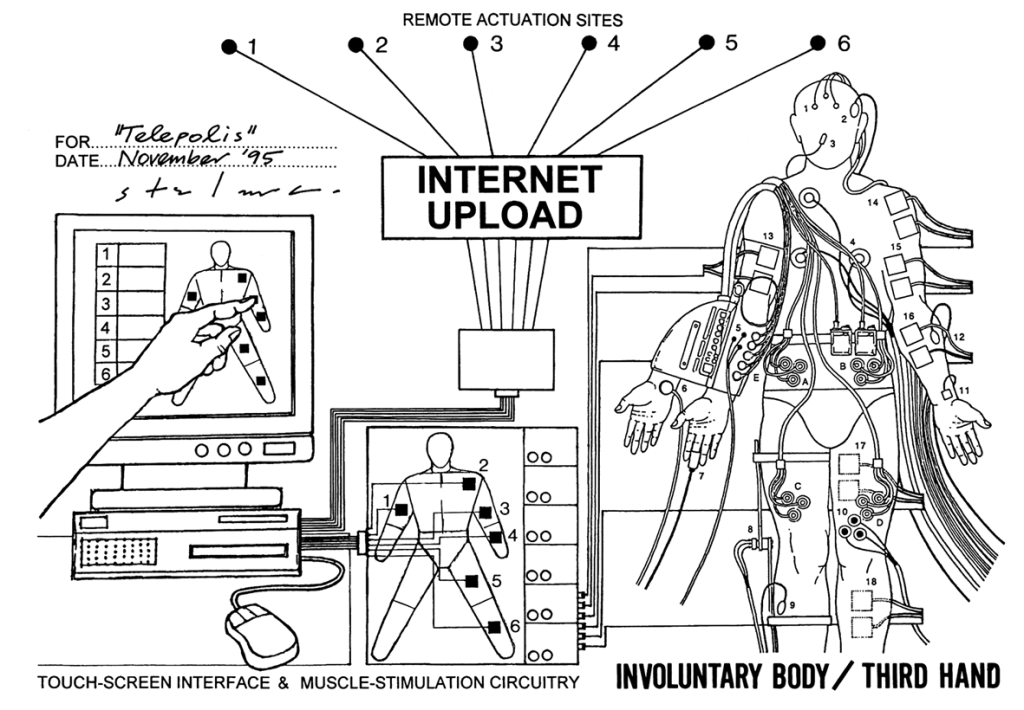
    Fractal flesh - http://cec.sonus.ca/econtact/14_2/donnarumma_stelarc.html
    Fractal flesh

    The question that is pressing in arises from the political problem, the problem of politics in itself, as politics.  Put bluntly, why is there such a thing as ‘politics’?  It is impossible to avoid this problem because we are always caught within the realm of the political.

    An individual member of the human species might find themselves able to step aside from the social, even whilst having inevitably derived their minds from it, but only as a result of the social itself, as a result of some brief area left aside, fallow, by the socialisation of the world.  The social spreads, like the viral trace of the species, across the world.  This is no anthropocentrism and it is not restricted to the human species – the ‘environment’ is nothing more than the complex totality of the multiple systems of social tracks left by the various species of organic life, some more dense and heavy than others.

    The human species treads hardest however.  In fact, the human species treads so heavily that it marks a qualititative break in natural dynamics.  It is not anthropocentric to acknowledge the specificity of the effects of the human species, the discontinuity between the tracks left by the human species and those of – almost – any other living organism.  It borders on the unnatural.

    The discontinuity is able to be understood best when encountering the heaviness of the human tread.  The traces of the social lie on the surface of the natural, the organic formed within the limits of the inorganic.  There are no societies of stones but there are many societies within the stones.  The stones form the fuel for the cells, constitute the surface on which the the social traces of the organic leave their mark.  Each layer rests on the preceding layer.  Yet the human tears through the layers, its weight unable to be borne by the supporting surfaces.

    It is this tearing of the surfaces that produces the political.  As the human species develops the capacity to rip open the world, as it transforms from the simply social animal, from the collective swarm of flesh that is each organism, it encounters the counter-effect of its increasing capacity for the transformation of the world.  This counter-effect is the reconstitution of the human flesh swarm as a new surface, no longer a swarm but now a network of nodes, with a variability of connection, a variability that produces differentials of power across the network.  The human swam transforms into a variable network of power and it is as this variability that politics is born.  Politics is the form of the variable human network that has gradually replaced the swarm of flesh from which it arises.  The type of species that we are is a specific result of the counter-effects of the capacities evolution produced in one form of the flesh.  We are, although not in the way Aristotle perhaps thought, the political animal.  Our animality is specific because we are a political flesh.

    In this situation politics exists not because of needs needing fulfilment, nor because of ideas that want realisation, nor even because of freedom that requires expression.  Politics results from the counter-effect of our capacities as an organism.  Central to these capacities is collective or social labour.  Our break-point with almost all other organisms lies not in language but in social labour.  Social labour is not merely a quantitative addition of arms and muscles but is instead the re-organisation of specific forms of work carried out by an organism into a social form of work that is qualitatively more powerful, social labour.

    Imagine two groups of human beings in conflict, both equally large.  Battle lines are drawn between these two groups as they meet in open territory, maybe a hundred on each side, all armed with little more than bones and clubs.  Now if one side has the capacity to become organised, to act as one, to unite their intentions, to follow orders and to ensure each individual animal acts as a cell within a greater whole, then it is inevitable that they will win the battle.  The more sophisticated that organisation the greater power it has.  Smaller number can overwhelm larger because of their organisation into social labour, into collective labour.  No longer a mere mass of flesh the new organisation brings forth a new organism, one that is now not mere flesh but the network of flesh become body.  It is this simple, basic, fundamental natural fact about social labour that is the ground of our reality, a reality that is inherently, inevitably, political.  Politics exists because social labour exists.  Social labour, however, is the catalyst of a counter-effect, the formation of a new body that rests on the shoulders of the flesh and drives it in its own direction.  For the most part this networked body of the flesh, this body of social labour, operates blindly, and in that sense politics arrives as an externality, as a new force in the world, one that we are still, desperately, trying to master before it drives us off the cliff of extinction.  Our options are to renounce social labour and descend into the earth as flesh once again or to internalise the networked flesh of the body of social labour and become the agents we imagine ourselves to be.

  • Reading Capital (notes #1-Beginning with the commodity)

    The opening line of Capital begins like an axiomatic that will subsequently orientate the work, stating the relationship between wealth in capitalist societies and the role of the commodity.  Wealth appears in the form of the commodity within capitalism, more specifically with the ‘collection of commodities’.  From this starting point the individual commodity is taken to be the basic ‘elementary form’ that will be the starting point for Marx’s investigation into capitalism.  The first thing to note is the choice of elementary form.  Marx does not begin with money, or labour, or scarcity – this last one being the most common starting point for economists.  Instead we begin with Marx with the commodity.  Whilst this might seem rather mundane the implications are touched on immediately when the commodity is understood by Marx to be the means by which human needs are satisfied.  Talk of ‘needs’ however, might seem to suggest something of the ‘scarcity’ emphasis, it might suggest that they are natural or set in stone for example.  If human needs were some basic fact of our existence then the satisfaction of those needs by something we call a commodity wouldn’t really be much to worry about.  The problem is that the needs that the commodity can satisfy are unbounded.

    In the second paragraph (C:125) Marx refers to ‘needs of whatever kind’ and goes on to say that ‘the nature of these needs, whether they arise … from the stomach, or the imagination, makes no difference’ (emphasis added).  In this simple moment the imagination is brought into the system of capitalism, with all its wildness and desire.  If we speculate here then it might be possible to push this idea into some curious territory.  The commodity satisfies needs, any need of the imagination.  Why not say, to put it another way, anything you can imagine is capable of being satisfied within capitalism through the commodity?  If that were the case then to imagine a needed future is to follow a logic where this imagination can be satisfied with a commodity.  Imagine an needed alternative, a needed transgression, a needed rebellion – to the extent there is a need attached to the imagined thing, then capitalism will have the potential to satisfy that need with a simple, elementary commodity or collection of commodities.  This strikes me as close to the concept of recuperation that the situationists develop, in which rebellion itself becomes transformed from an act of resistance to one of consumption – people ‘need’ to resist, to embody their imagined utopian world, so they ‘buy’ the commodity of rebellion, be it in the form of Che Guevara t-shirts and posters or left groups and programmes.  Recuperation is the process of normalisation, a process of regaining normality that occurs when faced with an illness, or a rebellion.  It’s fine to rebel, totally cool to revolt, more than chic to protest.  Indeed the almost classic moment of recuperation occurs in 2003 when George W.Bush applauds the anti-war protestors for their democractic expression of their views; the protests are recuperated, revolution is televised, revolt is normalised.  The dynamic of the commodity is universalistic, it tries to swallow up every bitter pill that arises.

    Putting aside the problem of recuperation, the satisfaction of imaginary needs by the commodity, the next move in Marx’s analysis is to address the way in which the commodity satisfies needs through having a use.  The property of a thing that satisfies a need is a use-value.  The use-value is a way of referring to the ‘usefulness’ of a thing.  A pint of water has a degree of usefulness, as does ‘iron, corn, a diamond’.  This usefulness is ‘conditioned by the physical’. So for the diamond to have the usefulness of cutting glass it needs to have the specific physical properties of highly organised carbon that it has.  Of course we don;t know what use-values something has until it is used and what something is or can be used for changes and is partially ‘natural’ or basic and partially constructed historically and socially.  Sand, for example, has a usefulness in glass-making only once the properties of glass have been discovered and a method of production invented. Marx then says that use-values ‘constitute the material form of wealth, whatever its social form may be’ (C: 126).  Here some curious facts might emerge.  Wealth in a digital age (social form) still needs some material form, in this case the various networks and machines which record and account the figures.  If you wanted to disrupt the capitalist mode of production by directly attacking the wealth it holds then attack the material form in which the social form is constituted.  Switch off the electricity.    Capitalism, at least the big guns of finance capitalism, is susceptible to EMP bombs.  That seems to be a rational conclusion if Marx is right on this point about the material form.


    …………….

    C = Capital Vol 1, trans. Ben Fowkes, Penguin 1979

  • Reading Capital (notes #0–preliminaries)

    1. Some preliminary notes on the fact of the reading group and its method.paris68.jpg_5664408567216169362

    A reading group recently began in London with the aim of reading through Marx’s Capital (Vol.1), Monday nights 7pm at the Red Lion in Hoxton.  It’s part of what seems to be a contemporary revival of interest in Marx’s work driven not by the academy but by a mixture of political activists and people who want to try and find some understanding of the contemporary crisis in capitalism.  (This Facebook group, for example, has links to groups in Liverpool and Sheffield as well as the London group).  

    The first thing I note was about the inaugural meeting and this was the number of people attending.  I am used to reading groups being small in the academic world, quite often only half a dozen people, maybe a dozen or so for larger groups.  In this instance, however, some 40 people turned up to the first meeting and after four sessions the numbers are still around 25 or so.  A number of people expressed their reason for coming in terms of the practical goal of attempting to understand the world around them, the crisis in capitalism that is the contemporary horizon we all live in.  That they have turned to Marx is indicative perhaps of the centrality that he has to any criticism of capitalism.  Even if the name is not mentioned the spectre of Marx nevertheless lurks in the background every time a Banker attracts criticism for being greedy.  There’s a curious logic at work here because there’s no reason to assume Marx will ever simply disappear, anymore than there’s a reason to assume Nietzsche or Freud will disappear.  At times, no doubt, they will inform thought, culture and life in greater or lesser depth but their presence, the possibility of their return, haunts thinking, discourse. dialogue.  These three figures are mentioned because they are gathered together by Ricouer under the title ‘Masters of Suspicion’ and it is the suspicion of belief that Ricouer refers to.  Now whilst this is a problem for faith, as Ricouer himself notes, it is also a problem for trust.  Each time the system of capitalism enters one of its periodic crisis the implicit trust we that we must have in capitalism, almost of necessity, slips sideways.  The world can often seem a little screwy, off-kilter and badly organised but even then we still live as though it were capable of being less so, this active living of our lives relying upon a trust, in this case a trust that the form of life we are in has the capacity to be improved.  The trust that the masters of suspicion displace is a trust in the future within the world as it is now.  Of all the three Marx is perhaps the most radical in this displacement because he radically disrupts the role of the individual, more radically than either of the other two who remain wedded to some sort of future the individual can achieve with their own effort.  If Marx ‘works’ it is in describing the machinic operation of a system that positions the individual as a place within the machine.  It is not without reason that he was fascinated by the story of Faust.  Capitalism is not the result of individuals but results in a type of individual.  Our actions are not just unconscious and perhaps capable of becoming more conscious, or filled with resentiment and capable of becoming less so, instead they are the result of some event that occurred behind our backs and which we might be able to understand but which we will not change merely through understanding.  The machine is real in the sense that Philip K Dick gave to the term ‘reality’.  For Dick the real is what remains when we stop believing in it.  Capitalism is entirely real in this sense, perhaps the epitome of reality.  An anti-capitalism that is more than a mere intellectual dislike or dismissal faces the rather daunting task of both destroying one reality and constructing a new one.  No greater adventure can be imagined than the task facing the anti-capitalist.

    The second thing I note was the way the group reads, which is slowly.  By slowly I mean two to three paragraphs a session at the moment – though this is in part because the starting point for Capital contains a whole range of difficult and curious notions that need quite a lot of attention.  Slow reading is a curious thing, something I’ve mainly come across in academic situations, often with a nod to Nietzsche who is perhaps the first to make explicit the resistance to dominant culture that is involved in slow reading.  For many it’s a difficult thing because it disrupts the common focus of consuming a text, turning it into a tool or resource.  Instead slow reading draws the reader into a process that refuses to allow the reader to simply ‘understand’ the text.  The process combines the attempt to understand a text with an increasing awareness of the resistance and mis-reading we bring to a text, whereby we tend to read into the text.  In the case of most works of philosophy it is a danger to ‘read into’ a text because what happens is that the reader merely reproduces their own pre-existing concepts, overlaying them onto the text rather than reading out of the text the arrangements that exist within it.  The implicit assumption that we all speak the same language is fundamentally what is challenged by slow reading.  The arrangements of concepts within each individual have both particular idiosyncrasies but also cultural and ideological determinations.  For practically orientated work this is not necessarily a problem but for any type of critical activity it is the central difficulty in any act of actual learning.  Too often a student responds not to the text they’re reading but from the position they’re within, one that they live as though it were their own but which is more than likely part of their cultural ‘common sense’.  The resistance to slow reading appears in the need to understand, which often arises in amusing ways.  When faced with a difficult line, a strange phrase or a curious concept what is often used is the strategy of buttressing.  We grab hold of concepts that lie to hand, either from our ‘developed’ understanding or from the ‘common sense’ referred to and we buttress the difficult passage with these other concepts, stabilising it in our minds so we can move on.  What this does, however, is to buttress the difficulty within our own understanding which sounds on the face of it like a reasonable thing to do.  However if the concept we’re trying to understand is in essence hostile to our existing understanding then all we have done is, in effect, to neutralise it and assimilate it.  We de-fang difficult concepts by making them part of our everyday world.  The task is not always to assimilate but to allow the possibility that the concept will destroy our everyday world, change our understanding – what else is actual learning than to undergo a process of change.  If the change that is sought is radical – as I would suggest it is with all the masters of suspicion – then this means that the understanding will undergo some radical change, root and branch destruction to clear the land for new growth.  One of the problems of ‘understanding’ is that it tends to make us passive, it tends to make us feel like we understand rather than give us anything actual, concrete and real.  When we feel like we understand we stop learning, we begin to use words and phrases as though we knew what they meant and what they did, in the process losing the radical experimentation that can offer us new discoveries, radically new discoveries of new worlds that are possible.