
Category: ATP

  • ATP reading notes 7 – the constraints of the constants

    ATP reading notes 7 – the constraints of the constants

    Continuing with Chapter 4 and the third and fourth postulate of linguistics, I’m trying to find a position from which the ‘problem’ that chapter addresses can be understood. As I mentioned in the previous post, the chapter reads in large part as a criticism of linguistics, in a semi-polemical tone, and perhaps because of this its positive content is not always easy to pick out. There are, however, some key notions, such as the role of the order word (the mot d’ordre) and the idea that language operates as a constraint. Taking this as the opening move of the chapter enables us to suggest something like the following: if language is first a form of constraint and because of this is bound up with power and dominance, with policing, then what strategies must be developed to prevent the constraint from becoming restriction. Constraint and restriction are different things. One can be constrained by rules and in so doing participate freely in a game, without restrictions. Alternatively one can be restricted to a particular way of playing and blocked from innovations even if such innovation doesn’t break the rules but re-organises them. In terms of politics and subjectivity this takes on wider ethical and normative connotations. If language constrains and yet at the same time is intimately connected to the very possibility of subjectivity (being able to say ‘I’), then the claim might something like ‘within a dominating normative framework language forms a set of internalised chains’. In this context it is not ‘ideas’ that lock people up – not ‘ideology’ that maintains ‘hegemony’ – but rather the mode of the policing of language, what we might call the operation of the constraints of the constants.

    Whilst the constraint of the constants might be a feature of linguistic practice the operation of such constraints is not but is rather one mode of understanding language. Here we perhaps begin to see the strategy of the chapter. D&G argue throughout Chapter 4 that another way of conceiving language is not only possible but necessary, both politically and theoretically. ‘Linguistics’ is the target of criticism via the four postulates ascribed to it because it fails to understand the constraints of the constants as themselves derived from continuous processes of variation that form the site of political selections. We can accept that language is a practice of constraint organised by the set of constants without falling into the trap of assuming that those constants are ‘natural’, innate or fixed. Chomsky is obviously and clearly one of the key targets of the polemic in the chapter and is the figure of the ‘major’ mode of understanding language in which the constraint of the constants is taken as a kind of fixed or stable feature of linguistic reality. Yet,

    “You will never find a homogenous system that is not still or already affected by a regulated, continuous, immanent process of variation (why does Chomsky pretend not to understand this?). There are not, therefore, two kinds of language but two possible treatments of the same language. Either the variables are treated in such a way as to extract from them constants and constant relations or in such a way as to place them in continuous variation. … Constant is not opposed to variable; it is a treatment of the variable opposed to the other kind of treatment, or continuous variation. So-called obligatory rules correspond to the first kind of treatment, whereas optional rules concern the construction of a continuum of variation.” (ATP 103)

    From this we find the following important implication being drawn:

    “Moreover, there are a certain number of categories or distinctions that cannot be invoked, that are inapplicable and useless as a basis for objections [to the claim that language is a regulated, continuous, immanent process of variation] because they presuppose the first treatment and are entirely subordinated to the quest for constants: for example, language as opposed to speech; synchrony as opposed to diachrony; competence as opposed to performance; distinctive features as opposed to nondistinctive (or secondarily distinctive) features.” (ibid, emphasis and possible ‘object’ added)

    These two different treatments of language are explicitly defined a few pages later as the ‘major’ and ‘minor’ modes of treating language (ATP 106) and the fact that these two modes exist is itself to be accounted for in turn by the order word as the “variable of enunciation that effectuates the condition of possibility of language and defines the usage of its elements according to one of the two treatments” (ibid). To try and state this less formally, what makes language possible are things called ‘order words’ that organise our ways of speaking and this organisation of our ways of speaking can be done in a ‘major’ mode or a ‘minor’ mode’. In the major mode restriction to a norm is the way of organising language whereas in the minor mode creation from a norm is the way of organising language. The major constrains to restrict, whereas the minor constrains to create. What is crucial here is that it is not the order word itself, it is not the constraints, that are the problematic feature, rather it is the operation of the constraints that matters. The ‘major’ or ‘minor’ here are not, then, quantifications but refer rather to major standards or norms and minor deviating practices. Importantly the deviating practices of the minor are identified as the location of autonomy. “Becoming-minoritarian as the universal figure of consciousness is called autonomy” (ATP 106). Becoming-minor, however, is never a fixed constant position, but always something that operates as a flight from ‘the standard’ (deterritorialisation) where ‘the standard’ is part of a process of variation.

    After making this point with regard the order word there is a strange turn in the text that occupies the last three or four pages of the chapter. D&G make the odd statement that “the order word is a death sentence; it always implies a death sentence” (ATP 107). They go on to say that “death is the general incorporeal transformation attributed to all bodies from the standpoint of their forms and substances” (ATP 108). Earlier they argued – as I noted in the first post about this chapter – that the collective assemblage of enunciation organises or polices a set of incorporeal transformations. From this we might assume that different assemblages have varying sets of incorporeal transformations. The example given is of a judge sentencing a convict and maybe it’s possible to imagine a collective assemblage of enunciation that did not have this particular incorporeal transformation as an element in its set. With death, however, we seem to find an element that any set of incorporeal transformations must contain – “Death, death; it is the only judgement, and it is what makes judgement a system” (ATP 107). They continue “in effect, death is everywhere, as that ideal, uncrossable boundary separating bodies, their forms, and states, and as the condition, even initiatory, even symbolic, through which a subject must pass in order to change its form or state” (ibid).

    In this ‘death’ then we find not simple expiration in the colloquial sense, mortality or termination, but something that seems instead closely connected to borders, thresholds, change, transition. The subject here is entwined in a kind of relationship to a ‘death sentence’, to a line it must obey if it is not to ‘die’. The ‘father’s orders to his son’ that they refer to contain within them the possible expulsion of the son from the relationship, the ‘death of the son’, even though this death may not involve the death of the material body that the attribute ‘son of…’ was ascribed to. Father to son: You’re dead to me. This example of a relationship problem, the fact that a relationship can break down in such a way that someone might say “you’re dead to me”, seems to be written into the very operation of language in so far as language is organised through collective assemblages of enunciation that operate on the basis of the capacity to exclude. It’s this capacity to expel the body that underpins the order word.

    At the same time this inherent death sentence within the order word sits alongside the capacity to flee. So the order word contains both expulsion and escape, the former imposed like death and the latter taken up as autonomy. Escape is not simple autonomy however but seems intricately bound into a more complex process of creation, which is perhaps why it is possible to closely align it with autonomy. Escape must avoid ‘black holes’, veering off into some ‘imaginary’, they suggest (ATP 110) and they go on to offer an example from a Herzog film where he says “Who will answer this answer?”

    “Actually, there is no question, answers are all one ever answers. To the answer already contained in a question (cross-examination, competition, plebisicite, etc) one should respond with questions from another answer. One should bring forth the order word of the order word. In the order word, life must answer the answer of death, not by fleeing, but by making flight act and create. There are pass-words beneath order-words. (Il y a des mots de passe sous les mots d’ordre). Words that pass, words that are components of passage, whereas order-words mark stoppages or organised, stratified compositions. A single thing or word undoubtedly has this twofold nature: it is necessary to extract one from the other – to transform the compositions of order into compositions of passage” (ATP 110)

  • ATP reading notes 6 – first two postulates of linguistics

    ATP reading notes 6 – first two postulates of linguistics

    The postulates of linguistics (Chapter 4) have sub-headings that at first sight are a little confusing. To begin with, all four of the postulates have sub-headings in quotation marks, which immediately makes one wonder who is speaking, which ‘position’ is being articulated. Next, the first of these – “Language is informational and communicational” – is something that is clearly not in line with much of what either Deleuze or Guattari say in many places. The first, hesitant, conclusion then is that the sub-headings of the postulates articulate positions that are to be opposed. This suggests that the ‘postulates of linguistics’ are targets of polemic and that this chapter offers a counter to a number of ‘accepted’ (one wonders by whom) postulates. During this counter-argument we may find some kind of ‘linguistic theory’ that we can attribute to D&G but if it is offered in the form of a counter-argument or polemic this does make it necessary to be cautious about positive content since anything that appears positive is so within this context of argument.

    The first apparently positive content comes in the form of the ‘order word’. The example of the school teacher giving commands and orders in a scene of ‘compulsory education’ and the translation of le mot d’ordre as ‘order word’ gives a connotation in English that is odd, and perhaps a little disorientating. It produces a sense of ‘command and control’ and slips into the background someone, something, with power that issues orders. There is a translators note here (fn1 ATP 76) touching on the other connotation, that of the slogan and what is called the ‘military password’, or what is perhaps more colloquially called a ‘watchword’. Mot d’ordre was also one of the communards newspapers during the Paris Commune of 1871. The translators note this and go on to say that “Deleuze and Guattari are also using the term literally: ‘word of order’, in the double sense of a word or phrase constituting a command and a word or phrase creative of order” (ATP 523, emphasis added). This latter sense, being ‘creative of order’, strikes me as the stronger side of the concept.

    Having said that it is worth saying that even if ‘command’ is perhaps problematic, obedience is not. ‘Obedience’ is at the heart of the Social and the Law, two structures that impose conditions of life on the subject. When it comes to a ‘mot d’ordre’ I find the work of someone like shepherd fairy to be cutting a line of subversion and so the connection between the deployment of ‘OBEY’ as a slogan, connected to the eyes of surveillance offers a potent articulation of the operations of the order word. It’s interesting, in this respect to hear fairy talk explicitly both about the connection to those surveillance images of ‘Big Brother’ that Orwell made famous as well as to recount how his own work arose as a re-territorialisation or re-organisation of graffiti, punk marketing and propaganda, in the midst of an attempt to escape the constraints of ‘art history’ as taught in the art school.

    We find then that this first claim, that “the elementary unit of language – the statement – is the order word” (ATP 76) needs to be connected to the first ‘problem’, which is that “the hard part is to specify the status and scope of the order-word. It is not a question of the origin of language, since the order-word is only a language-function, a function coextensive with language.” (ibid). Thus language appears here as a constraining practice, organising and ordering and doing so with an implicit call to ‘obey’. Yet who is it that must be obeyed? The next move that D&G make seems important here. If we slip into transcendental conditions of ‘law’, such that language demands obedience as its condition of possibility, then we can become too quickly involved not in a constraining but in a constrained. We can become part of a discourse that claims that we ‘cannot escape’ language and it’s vital, in this regard, to orientate ourselves in terms of the drive to ‘exit language’. In contrast to this the next claim, that “the first determination of language, is not the trope or metaphor, but indirect discourse” (ATP 76-77) or what they call ‘hearsay’. The use an example here, that of the communication practices of bees. Here they argue that bees do not have language but not because they don’t have ‘tropes’ or coding but rather because they operate within a direct discourse, such that one bee might communicate what they have seen to another, but no bee can ‘pass on’ that transmission successfully. Language thus becomes a kind of ‘passing on’ and this ‘passing’ connects with the idea of the watchword or password in that language becomes that which needs to be said to pass through the social, as it is ordered, without disruption or arrest. Whilst this is both a pragmatics and a performance it is, at the same time, a policing.

    One way of perhaps thinking this ‘policing’ function is to contrast the role of the performative and the illocutionary in two different situations. D&G sit unhappily in any analysis which tends to describe them offering a ‘performative’ account of language, or more exactly in any account of the order word which reads it as a performative function alone. After discussing speech acts and performativity (ATP 77) they go on to say the following:

    “It is true that it is still difficult to see how speech acts or implicit presuppositions can be considered a function co-extensive with language. It is all the more difficult if one starts with the performative (that which one does by saying it) and moves by extension to the illocutionary (that which one does in speaking). For it is always possible to thwart that move.” (ATP 78)

    They then go on to refine their definition of order words in the light of a comparison between Benveniste and Ducrot, who appear as though two sides of a similarly failing coin.

    “We call order words, not a particular category of explicit statements (for example, in the imperative), but the relation of every word of every statement to implicit presuppositions, in other words, to speech acts that are, and can only be, accomplished in the statement. Order-words do not concern commands only, but every act that is linked to statements by a ‘social obligation’. Every statement displays this link, directly or indirectly.” (ATP 79, emphasis added)

    In this context, they argue, it is the collective assemblage of enunciation that then accounts for the social character of language. If we refer back to our notions of ‘performative’ and ‘illocutionary’ we can see that it is this collective assemblage of enunciation that offers a way to grasp how the performative can fail and yet, why there is always an illocutionary force. For example, struggles over gender pronouns are only struggles because they often fail, with people refusing to comply with requests or ‘tripping up’ in particular contexts. The performative role of the gender pronoun is distinct from the illocutionary force, since refusal or failure to use the appropriate pronoun can display variable illocutionary forces, from outright refusal to ‘innocent’ failure. On the other hand, the illocutionary force of speaking is always present, for example marking the child and woman’s voice, the immigrant and the working-class accent, as ‘Other’ to a dominant bourgeois social. There is no escaping illocutionary force whereas the condition of performativity is that it can always fail. It is the collective assemblage of enunciation, the policing function, that can enable this radical distinction to be understood, since this collective assemblage ascribes values to illocutionary forces and authority to performance sources via the function of policing.

    The collective assemblage of enunciation polices a series of ‘acts immanent to language’ (ATP 80) and “these acts seem to be defined as the set of all incorporeal transformations current in a given society and attributed to the bodies of that society” (ibid). Body here is explicitly defined in the ‘broadest sense’. We are asked to distinguish between the “actions and passions affecting those bodies, and acts, which are only non corporeal attributes or the ‘expressed’ of a statement” (ibid). (The use of ‘noncorporeal’ here might seem to be odd given that we’ve just been using ‘incorporeal’ but in looking at the French text it seems that it’s simply distinguishing between that which affects bodies and that which doesn’t.) They then use an example of a judge sentencing a convict to try and show what they’re referring to by these ‘incorporeal attributes’. The judges sentence transforms the accused into the convict and involves, in terms of bodies, that which took place beforehand (the crime), that which takes place after (the imprisonment or punishment) as well as the bodies involved (the person who is convicted, the victim, the prison etc). The sentence itself, however, takes place instantaneously and can be dated (if you ever wondered why the chapters of ATP have dates, this is one of the primary reasons it would appear, in that they ‘name’ incorporeal transformations). Moreover, it is the particular collective assemblage of enunciation and the order words that they constitute that produce the conditions for these instantaneous transformations. Only some things can be said, because the very function of a collective assemblage of enunciation is to police what can be said by whom with what effect. (Here I feel like offering as a slogan that ‘Language is a prison and the first rule of the prisoner is to escape‘.)

    “We have gone from explicit commands to order-words as implicit presuppositions; from order-words to the immanent acts or incorporeal transformations they express; and from there to the assemblages of enunciation whose variables they are. To the extent these variables enter at a given moment into determinable relations, the assemblages combine in a regime of signs or a semiotic machine.” (ATP 83)

    These regimes of signs are plural, mixed and changeable. Yet it is these collective assemblages, these regimes, are vital to the conception of language that D&G want to develop, not least because the last move in the first section of this chapter is to claim that these regimes are the condition of possibility of actual language. There is an attempt to produce something akin to a transcendental structure at this point (ATP 85). I’m not entirely clear how this structure is to be argued for but, very roughly, it seems that they claim the ‘pragmatic variables’ that constitute the collective assemblage / regime form this condition of possibility by forming the limits and conditions of effectiveness of language and it is this capacity to effect, to produce ‘incorporeal transformations’, that make language actual rather than virtual. Whilst this is still, clearly, a pragmatics, it is a pragmatics not of use but of the conditions of usability.

    Moving to the second section of this chapter, the postulate of linguistics presented as “There is an abstract machine of language that does not appeal to any ‘extrinsic’ factor”, once again it seems that this is a postulate to be opposed. In particular we find, towards the end of this section, this highlighted claim:

    “If the external pragmatics of non-linguistic factors must be taken into consideration, it is because linguistics itself is inseparable from an internal pragmatics involving its own factors.” (ATP 91)

    There seems some ambiguity in the English here which may or may not be in the French. I’m not entirely sure whether it’s best to read ‘linguistics’ here as referring to a particular discipline of academic activity or to any account of language. One of the implications is that ‘linguistics’ as a specific object of investigation, or any study of language that takes it as an autonomous field with ‘immanent laws’ or something akin to such, is already on the wrong foot as it cannot take seriously the non-linguistic factors that are the condition of possibility for actual language. Here, on this reading, the implication is, effectively, that ‘linguistics should be abolished’ but there is also a strong implication for practices such as psychoanalysis where language is the primary mode of relation. The ‘talking cure’ might be though, for example, to rely upon the ‘talking’ when in fact it relies upon the conditions of ‘curing’. If this is the ‘strong’ reading of this passage I confess to be somewhat sympathetic but the weaker reading would only imply, perhaps, that linguistics must take account of non-linguistic factors.

    It’s late and I’ll have to catch up on this a little later.

  • ATP reading notes 5 – the three types of strata

    ATP reading notes 5 – the three types of strata

    Picking up the 3rd chapter, the ‘geology of Morals’, from roughly midway through (from the paragraph that begins “Most of the audience had left…” – ATP:57) we find a typology of strata being outlined. Three primary types of strata are posited. These are what I would call (1) the ‘simple’, (2) the organic and (3) the alloplastic or linguistic (I will return to the ‘double naming’ of this last strata). Towards the end of the chapter the difference between these three types – D&G refer to them as ‘major groupings’ (ATP 60) – is identified as located in the particular organisation of the relation between content and expression. D&G claim the following:

    “What varies from stratum to stratum is the nature of the real distinction between content and expression, the nature of the substances as formed matters, and the nature of the relative movements. We may make a summary distinction between three major types of real distinction: the real-formal distinction between orders of magnitude, with the establishment of a resonance of expression (induction); the real-real distinction between different subjects, with the establishment of a linearity of expression (transduction); and the real-essential distinction between different attributes or categories, with the establishment of a superlinearity of expression (translation).” (ATP 72)

    This presents as a highly technical definitional framework and unpicking it should give some insight into the line of argument in Chapter 3. This line of argument has implications for at least two major problems that are more generalised and by placing ATP into relationship with those problems it should be possible to locate its specific contribution as well as its difference form existing responses. The first problematic is the human/animal distinction, which in many senses is a new kind of ‘humanism’ problem, whilst the second problematic is, broadly speaking, the nature of language. Both problematics are often addressed, albeit somewhat obliquely, through discussion of ‘normativity’ or a ‘nature / norms’ or ‘facts / norms’ distinctions. How so? Roughly and crudely, there’s often a sense of distinction between ’causes’ (facts) and ‘reasons’ (norms), a distinction that can be drawn as a dualism when these are posited as distinct phenomenal realms with their own laws. Similarly, there’s often a distinction drawn between ‘behaviour’ (animal) and ‘action’ (human), which is also a distinction that can be drawn as a dualism, one which often appears as a new form of the Cartesian dualism of minds and bodies (res cogitans versus res extensa in Descartes terms) relocated into the ‘political’.

    When these dualisms appear, it is not usually in a ‘flat’ form but with an inbuilt hierarchy and transcendence, one which places the language user, the thinker, res cogitans – or whatever else, in effect, that we have used, since Aristotle, to name the human – above those who aren’t allowed to speak, think or have a mind ascribed to them. This is part of what D&G call ‘the State’ and in part motivates their attempt to produce a ‘rhizomatic book’. “The state as the model for the book and for thought has a long history: logos, the philosopher-king, the transcendence of the Idea, the interiority of the concept, the republic of minds, the court of reason, the functionaries of thought, man as legislator and subject.” (ATP 24). The State, in this sense, is not simply the political formation but a broader concept that often seems to be close to ‘dominant state of affairs’. Within such a dominant state of affairs, particularly in philosophy and psychoanalysis, we commonly find the supposed ‘centrality’ of language. Guattari’s call to ‘exit language’ is one way of thinking a major dynamic of the schizoanalytic project and involves what Lazzarato calls a ‘double decentring’, which is constituted by “detaching subjectivity from the subject, the individual and even the human; while taking care not to turn the unique power of enunciation into the exclusive domain of human subjectivity” (fn1, emphasis added). Thus, there are two things to bear in mind – the first is that the typology of the three strata, the way that typology is drawn, has implications for the human/animal/language problematic and, second, that the direction of travel for these implications is to reduce, remove or counter the ‘dualism’ that results from an illicit human exceptionalism.

    Returning to the technical definitional framework in the quote given above, the three variables that are being deployed to construct the typology are (1) the kind of real distinction that exists between content and expression, (2) the kind of substances involved and (3) what are called the ‘relative movements’ of the strata. The first of these, the kind of real distinction between content and expression, is perhaps the most important to try and clarify precisely because it is the most obscure. The role of real distinction is integral to the description of a strata. “Each strata is a double articulation of content and expression, both of which are really distinct and in a state of reciprocal determination” (ATP 72). ‘Real distinction’ is a curious concept, deployed by John Duns Scotus, whom Deleuze draws on heavily in Difference and Repetition, as well as by Descartes who uses it as a means of underpinning his ‘substance dualism’. In general, we might say that ‘real distinction’ is posited to enable ontological claims, claims about the types of ‘things’ (res) that exist, in contrast to distinctions in how we might know things. So real distinction in Scotus is contrasted to ‘conceptual distinction’, although Scotus also has two other modes of distinction (formal and modal) which fall ‘in between’ the real distinction / conceptual distinction divide.

    Scotus is concerned to work out the relation between ‘creator’ (God) and the ‘created’ and the relation of the Trinity to the unity, or singularity, of God. He adds to the real and conceptual distinction two other types, formal and modal distinctions, distinctions which are neither ‘real’ nor ‘mind dependent’ (i.e. conceptual). These formal and modal distinctions have some ‘degree’ of reality without producing separate things, enabling him to argue that God can be both a Trinity (formal distinction) and a unity. Without drifting too far into either the scholasticism of Scotus or Deleuze’s Difference and Repetition, the role of ‘real distinction’ in Chapter 3 is similarly deployed to show how strata can be described through a ‘both-and’ strategy, that is, as both as a form and substance of content and a form and substance of expression. The thing we need to ask is (a) why do we need the content/expression double articulation and (b) why are different strata grouped according to different forms of ‘real distinction’?

    To the first question we find the following answer – “there is a real distinction between content and expression because the corresponding forms are effectively distinct in the ‘thing’ itself, and not only in the mind of the observer” (ATP 58). Here it appears that D&G are relying on the idea of a ‘formal distinction’, the distinction being drawn in term of real distinct forms in content and expression. How does this play out in terms of the three types of strata? If we begin with the first ‘simple’ strata we find that the molecular content and the molar expression of the strata are found “wherever the molar can be said to express microscopic molecular interactions” (ATP 57). It’s difficult not to read this as a kind of basic physical determinism that is being referred to, albeit one that is trying to avoid any physicalist reductionism. The molar level is real, even as a level of expression of the molecular, and is not merely an ‘appearance’. Specifically, this view would hold that holistic effects of emergence are real, not reducible to more ‘fundamental’ micro-level laws of interaction.

    ‘Emergence’ will play a role in the chapter on the refrain, where the moment of the “emergence of expressive proper qualities” (ATP 322) is discussed. Overall, however, the concept of ’emergence’, understood as the arrival of a new level of ‘macro’ level properties and laws that are irreducible to the molecular level, does not figure explicitly as the motivating factor in the argument of ATP. Despite this, the problematics of emergence might be a useful way to understand the dynamic of the typology, the way that the three strata are laid out. There seems a prima facie case that what is being sketched out in chapter 3 is a system of emergence that accounts for both the organic and the linguistic as distinct from the ‘simple’ physico-chemical. There is a difficulty as the chapter progresses, however, which is that it seems we are presented with a story that goes from the ‘simple’ physico-chemical realm, through the organic to the linguistic. The problem of the chapter can perhaps be identified by suggesting that this story is difficult to grasp precisely because it misses the discontinuities it supposes to explain. In other words, simply restating or re-describing three different ‘realms’ of the physical, organic and linguistic in terms of strata and double articulation fails to account for how the difference between these realms arises. Is the real problem not how the three strata differ but that there are these three radically different strata formations? Is there some genesis of the one from the other or not? If there is, how does this genesis produce radical discontinuity? If there is not, why are there these just three strata and not ten, thirty, an infinity of strata? There is some possible response made to this problem when Challenger discusses the last of his ‘three problems’.

    It’s worth remembering at this point that it is Challenger who is presented here as offering this account, and he is presented in such an ambivalent manner as to make it difficult to pin down whether the account is to be advocated for or against. The opening lines of the paragraph we began with this time, the paragraph that begins “Most of the audience had left…, reset the scene of the lecture the account of which comprises this chapter. It will be reset again, very briefly, once we’ve had the first outline of the three types of strata presented (ATP 63), next when Challenger moves to discuss his ‘three problems’ (ATP 64) and then finally as a coda to the chapter (ATP 73). Each reset operates a little like a ‘section break’, where the discussion moves to another line of thinking or another move in the argument.

    In his discussion of ‘three problems’ Challenger offers some possible means of responding both to the problems of ‘why content and expression’ as well as to the need for the variable mode of real distinction in each strata. The three problems he wants to discuss are (i) the problem of the ‘sign’ (ATP 64-68), (ii) the problem of ‘base-superstructure’ (ATP 68) and (iii) the problem of ‘cosmic evolutionism’ (ATP 69). Taking the last first we read the following:

    “It is difficult to elucidate the system of the strata without seeming to introduce a kind of cosmic or even spiritual evolution from one to the other, as if they were arranged in stages and ascended degrees of perfection. Nothing of the sort. The different figures of content and expression are not stages. There is no biosphere or noosphere, but everywhere the same Mechanosphere.” (ATP 69, emphasis added.)

    On the face of it then if we were to read the account of the three strata as describing a kind of ‘development’ or progress we are being called to account. The claim appears to rest on this use of the concept of ‘mechanosphere’ – machines everywhere – as an all embracing ontological category so that we can then, presumably, assert formal distinctions without positing any kind of substance plurality. In other words, everything is ontologically part of the same world (in so far as everything is machinic, part of the mechanosphere) and yet real distinctions exist between the simple, organic and linguistic, real distinctions that derive form the organisation of the machines, the forms. Here we encounter that curious concept of the ‘plane of consistency’. “The plane of consistency is the abolition of all metaphor: all that consists is real.” (ATP 69). What is it for something to ‘consist’?

    I never quite know what to make of the ‘plane of consistency’ since it is used with abandon so often I can only wonder whether I’ve simply missed something everyone else understands. The cake consists of…the human consists of… In these instances, the elements that are combined are obvious perhaps. The working image I tend to fall back on is one in which what we call ‘objects’ or ‘subjects’ or ‘life’ is driven by a continual process that flows between the unformed through the formed and then back into the unformed as that which has form in turn deforms and reforms. The plane of consistency in this sense would be that which is ‘prior to’ the formed yet which is always there, surrounding formations with blur, fuzzy edges, decomposing lines. When the strata decompose, that which has become organised now becomes disorganised into the “unformed, unstable matters” that Challenger begins with (ATP 40). The trouble with this image is it smells too neat, it’s too ‘cyclic’ and subsuming, so there’s something a little revolting about it.

    If we continue to read we can find D&G making clear that “we cannot content ourselves with a dualism or summary opposition between the strata and the destratified plane of consistency“, rather “the strata themselves are animated and defined by relative speeds of deterritorialisation” (ATP 70). They go on to say that strata are “thickenings on a plane of consistency” (ibid). This ‘thickening’ is a fascinating way to grasp stratification processes. I’ve argued, since my Phd research, that Deleuze operates with an ‘oceanic ontology’, one where ocean currents and formations such as the ‘plastic island’ offer the best model for understanding individuation through difference rather than identity. In such a situation there is a pluriverse rather than a universe, which is to say, multiple worlds entangled by power relations, not forming a singular whole but intimately connected or connectable (fn2). In this sense the ‘mechanosphere’ would map to the ‘pluriverse’ under the reign of the machine.

    So, this realm of the mechanosphere, this reign of the machine, is a continually moving, breathing, heaving world of shapes, forces, objects, subjects. Multiple interactions at varying speeds and directions (vectors) producing specific forms, in different ways. This, the variable production of forms from within a seething movement, constitutes the process of stratification/destratification. Rather than a base / superstructure model with a relatively simple flow from base to superstructure (even if we allow for feedback effects) we instead have a collapse of such directionality of determination. Instead of ‘cosmic evolution’ which again posits relatively simple flow from past to future, from less to more, we again have a collapse of such directionality of determination. Yet as this story begins to seem clearer, the very individuations it supposedly accounts for – in particular, the individuation of language and norms, reason not causes – seems to slip away. Is there any space left for this distinction?

    Here we can begin to see why there are three factors mentioned in the quote which started this section – “the nature of the real distinction between content and expression, the nature of the substances as formed matters, and the nature of the relative movements“. This last factor – the ‘nature of relative movements’ – makes more sense if it’s a mode of distinguishing types of flow or types of ‘dynamic’. The three types strata in this sense become three types of flow, and the typologisation of flows can be found all over the place – river, ocean, whirlpool; pahoehoe, aa, pillow; trains, planes, automobiles. The importance of the ‘directionality’ of the organic and then the alloplastic / linguistic strata begins to become clearer. In the organic stratum the “essential thing is the linearity of the nucleic sequence” (ATP 59, emphasis in original) and in the alloplastic / linguistic it is the fact that “vocal signs have temporal linearity and it is this superlinearity that constitutes their specific deterritorialisation and differentiates them from genetic linearity” (ATP 62, emphasis in original). Yet we’re still left with this nagging doubt, this worry that this story misses the discontinuities it supposes to explain, a discontinuity that might be located at the alloplastic/linguistic, but which is clearly indicated with regard the organic. I’ll finish this section by just indicating this worry.

    As Challenger/D&G begin to explicate the organic stratum they specify that it ‘amplifies’ the relation between the molecular and molar that exists in the first ‘simple’ strata and that this stratum must have a ‘unique character’ that will account for this amplification. They locate this character quite dramatically. In the organic stratum, “expression becomes independent in its own right, in other words, autonomous. Before, the coding of a stratum was co-extensive with that stratum; on the organic stratum, on the other hand, it takes place on an autonomous and independent line that detaches as much as possible from the second and third dimensions.” (ATP 59, emphasis in original). Here, when this sense of ‘autonomy’ is deployed with regard expression on the organic stratum, is where there seems this problem – is it enough to simply assume such autonomy? Do we not need to account for it? And what, really, can be meant by ‘autonomy’ at this point? It seems hard to imagine how it could mean ‘self-giving lawmaker’, an auto
    nomos, yet that is plainly what we are to conceive in some form (fn3). The difficulties of doing this take us directly into those problematics of nature, of animal/human/language and of norms and facts with which I started this section, but it’s still, as yet, unclear quite how to formulate and respond to the philosophical problematics presented in the descriptive framework offered by D&G.

    References:

    1. Maurice Lazzarato – ‘Exiting language’, semiotic systems and the production of subjectivity in Felix Guattari in Cognitive architecture: from bio-politics to noo-politics. Architecture & Mind in the age of communication and information, Rotterdam 2010, pp.502-521, accessed online.
    2. The ‘pluriverse’ is a concept that in large measure is taken from Walter Mignolo, see for example his brief note ‘On Pluriversality‘.
    3. The idea of ‘biological autonomy’ is strange but not absurd, as might be witnessed by its existence in contemporary scientific discussions, cf. Biological autonomy – a philosophical and theoretical enquiry, Moreno and Mossio, Springer 2015.
  • ATP reading notes 4 – milieus and abstract machines

    ATP reading notes 4 – milieus and abstract machines

    I missed the reading group on October 13th, when they discussed Chapter 2 (1914: One or several wolves), and so I’m turning to the Chapter 3 10,000BC: The geology of morals. I will return to Chapter 2 when I have time. We read the first half of Chapter 3 on October 20th, up to but not including the paragraph that begins ‘Most of the audience had left…’ (ATP 57) and will continue with the remainder of Chapter 3 next week. As a reminder, these notes are in no way a report of the reading group, rather they are my notes and thoughts which will be informed by the discussion there, but all mistakes and errors are my own.

    The ‘double articulation’ that is the focus of this chapter is that of the ‘codes’ and ‘territories’ that are probably quite familiar to readers of D&G. The processes of code and territory produce many of those curious ‘jargon’ terms so hated by critics, terms like decoding, overcoding, surplus value of code, deterritorialization, reterritorialization. At heart, these two processes, of code and territory, involve processes and because of this the dynamics of those processes, whether they are opening or closing dynamics, are central to D&G’s discussions. What purpose do these processes have in the analytical model of schizoanalysis? They are replacements or alternatives for more traditional philosophical concepts of ‘form’ and ‘content’ and are intended, I think, to transform the analytical categories that are used to understand specific ‘objects’ (concepts) of discussion. So, when talking, for example, about the ‘nature of subjectivity’, we could analyse it in terms of codes and territories rather than in terms of language, experience, ideology, genealogy or substance. We might presumably do something similar for concepts such as ‘nation’, ‘class’, ‘freedom’ or ‘truth’.
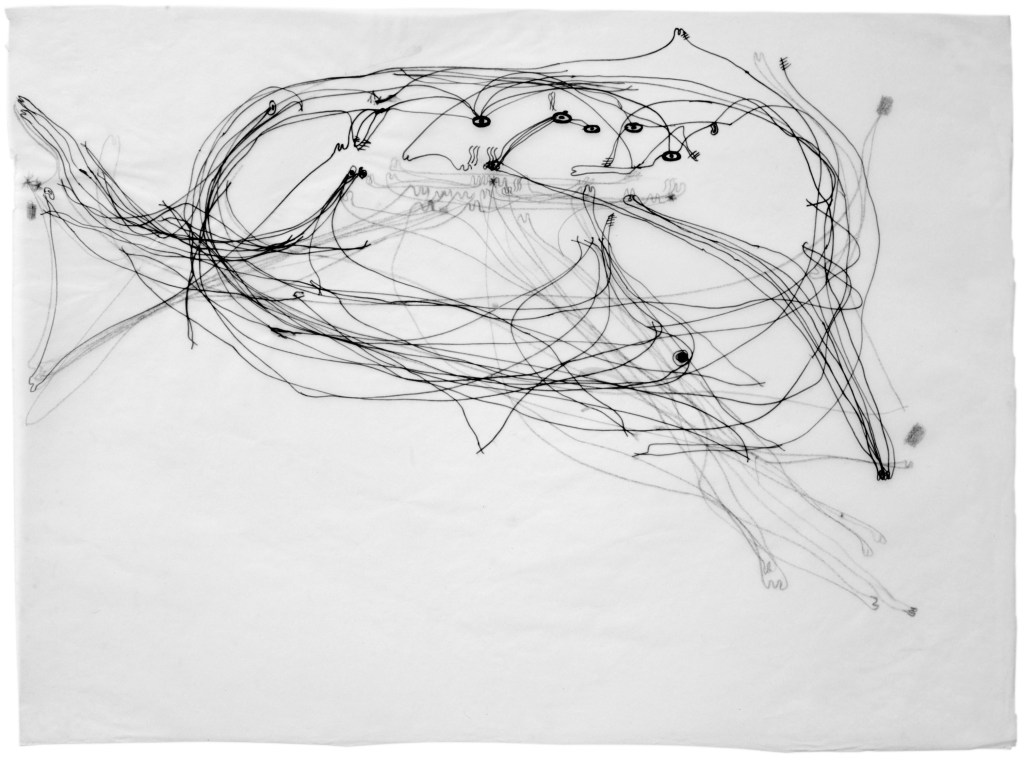

    There is something more than merely a ‘model’ at stake, however, at least the opening of the chapter appears to pose the problem in more fundamental terms. The double articulation of codes and territories – for which the Lobster is an image – is presented as a way to understand the process of ‘stratification’. Stratification arises ‘simultaneously and inevitably’ (ATP 40) alongside or within the ‘unstable, unformed matters’ that constitutes the Earth. Stratification consists “of giving form to matters, of imprisoning intensities or locking singularities into systems of resonance and redundancy, of producing upon the body of the earth molecules large and small and organising them into molar aggregates” (ibid). In other words, stratification – operating through the double articulation of codes and territories – is the process through which something like a ‘primal flux’ comes to be ordered, a process through which the dynamic flows of matter form something like ‘objects’ or ‘substance’.

    Immediately, however, we must double the doubling, specifically we have to take into account the pairing of ‘content’ and ‘expression’ and the fact that each of these terms is, again, doubled. If ‘matter’ is the “unformed, unorganised, nonstratified, or destratified body and all its flows”, then ‘content’ refers to “formed matters, which would now have to be considered from two points of view: substance, insofar as these matters are ‘chosen’, and form, insofar as they are chosen in a certain order (substance and form of content)” whilst ‘expression’ refers to “functional structures, which would also have to be considered from two points of view: the organisation of their own specific form, and substances insofar as they form compounds (form and content of expression)” (ATP 43).

    “Double articulation is so extremely variable that we cannot begin with a general model, only a relatively simple case. The first articulation chooses or deducts, from unstable particle-flows, metastable molecular or quasi-molecular units (substances) upon which it imposes a statistical order of connections and successions (forms). The second articulation establishes functional, compact, stable structures (forms), and constructs the molar compounds in which these structures are simultaneously actualised (substances). In a geological stratum, for example, the first articulation is the process of ‘sedimentation’, which deposits units of cyclic sediment according to a statistical order: flysch, with its succession of sandstone and schist. The second articulation is the ‘folding’ that sets up a stable functional structure and effects the passage from sediment to sedimentary rock.” (ATP 41)

    The first curiosity here is this use of such a ‘geological’ model. It seems, on the face of it, that a model derived from a natural science such as geology is going to produce category mistakes if we deploy it in analysis focussed on the ‘human’. Aren’t issues of meaning, signification, sense and intention more relevant to political and social analysis? Such an assumption begs the question, despite it’s apparent obviousness to many people who are happy to merely assert some human exceptionalism as though it were incontrovertibly the case. Even if we don’t beg the question, however, there seems something a little odd about deploying ‘geological’ models in a text that purports to be about ‘capitalism and schizophrenia’. How might we connect a ‘geological’ concept of stratification to something ‘human’? Whilst this question already assumes too much importance for the human, it might be useful as a way of being able to understand what political or social implications there are in ATP, and that itself might be necessary because I’m assuming that – broadly speaking – most of the people interested in ATP are interested in such ‘human’ issues rather than in subjects such as geology, which is not to deny that there is also possible interest in the text for geologists.

    There is a second curiosity, however, which is that the specific ‘stratum’ that is addressed in the chapter is not geological or even human but the organic. The chapter is staged as a lecture being delivered by Professor Challenger, a character from Arthur Conan Doyle stories. At one point there is clearly a sense of a merging of Challenger with the authors of ATP, most notably when Challenger is described as having “invented a discipline he referred to by various names: rhizomatics, stratoanalysis, schizoanalysis, nomadology, micropolitics, pragmatics, the science of multiplicities.” (ATP 43). Amusingly the text continues as follows – “Yet no one clearly understood what the goals, method, or principles of this discipline were.” (ibid). To return to the discussion in the chapter/lecture hybrid, what we’re reading soon moves from the rather abstract account of double articulation to something more concrete – “the question we must ask is what on a given stratum varies and what does not? What accounts for the unity and diversity on a stratum?” (ATP 45) and this question focusses on the ‘organic’. At the heart of this is a discussion (ATP 45-49) that begins from a staging of the debate between Geoffroy Saint-Hilaire and Cuvier. An account of this debate is given – “Challenger imagined a particularly epistemological dialogue of the dead, in puppet theatre style” (ATP 46) – the purpose of which, however, is to present the ‘paradigm shift’ introduced by Darwin. At the end of the staged debate we find the following passage:

    “We have not even taken Darwin, evolutionism, or neoevolutionism into account yet. This, however, is where a decisive phenomenon occurs: our puppet theatre becomes more and more nebulous, in other words, collective and differential. Earlier, we invoked two factors, and their uncertain relations, in order to explain the diversity within a stratum – degrees of development or perfection and types of form. They now undergo a profound transformation. There is a double tendency for types of forms to be understood increasingly in terms of populations, packs and colonies, collectivities or multiplicities: and degrees of development in terms of speeds, rates, coefficients, and differential relations. A double deepening. This, Darwinism’s fundamental contribution, implies a new coupling of individuals and milieus on the stratum. (ATP 47-48)”

    It is this ‘new coupling of individuals and milieus on the stratum’ that is the link between ‘geology’ and ‘morals’ and through which the first curiosity I mentioned is in some sense made clearer by the second. It is this ‘new coupling’ that offers a productive and ‘transferable’ set of categories, ones that can move across the analysis of the processes of geological sedimentation into the analysis of the processes of individuation more generally, although quite how generally is still up for question as there is plainly no direct and obvious route from Darwinism to politics or sociology, or at least no direct uncontested route since at the very least we can find ‘socio-biology’ suggesting one, albeit highly contested, possibility of generalisation. The route to generalisation taken by ATP, however, is distinct from any socio-biology I’m aware of, primarily because it’s primary category of generalisation is to be the ‘abstract machine’.

    The problem that is posed as the motivation for Challenger’s discussion is the “unity and diversity of a single stratum”, what is it that enables a single stratum to have a “unity of composition, which is what allows it to be called a stratum” (ATP 49). This problem directly arises from the ‘science of multiplicities’, what I called the ‘method of the rhizome’ in my discussions of the first chapter of ATP. If ‘multiplicity’ is to be taken as a substantive and in doing so replace problematics involving a ‘dialectic’ between the One and the All, then the ‘problem of individuation’ can be posed in terms of how it is possible to call something a thing in the singular, in this case, how is it possible to discuss a stratum from within a model of the double articulation of stratification, where at any moment there is always more than one involved – the double bind of double articulation.

    In the paragraph that starts “To begin with, a stratum does indeed have a unity of composition…”, just following a brief remark re-emphasising the staging of the chapter as a lecture by Challenger, an initial move to introduce the abstract machine is made. Here the process of individuation of a stratum is posed in terms of “a change in organisation, not an augmentation” and the factors involved in a relation between a stratum and a substratum are reciprocal rather than hierarchical, hence why D&G declare that “we should be on our guard against any kind of ridiculous cosmic evolution” (ATP 49). A substratum is posed as a milieu, as an “exterior milieu for the elements and compounds of the stratum under consideration, but they are not exterior to the stratum” (ibid). They try to illustrate this reciprocal relation of exterior / interior in the composition of a stratum by first offering the example of a crystalline stratum developing from the seed and medium and then move to claim that “the same applies to the organic stratum: the materials furnished by the substrata are an exterior medium constituting the famous prebiotic soup, and catalysts play the role of seed in the formation of interior substantial elements or even compounds” (ATP 49-50). Crucially there are three elements at work here, viz. (1) the (exterior) milieu, the molecular materials (2) the (interior) seed, interior substantial elements, and (3) the limit of exchange between the two, the “membrane conveying the formal relations”, or surface. The abstract machine is the ‘synthesis’ or result of the reciprocal relations between these three elements and is given the name of Ecumenon in contrast to what they call a Planomenon.

    Before moving forward it’s worth considering why this abstract machine is important. It offers us the mode of individuation that is going to be able to explain the existence of organisation from the background of a disorganised flow of matter, although ‘explain’ might be too strong here – it offers an account or descriptive framework. It’s worth noting that the whole discussion of stratification within which this existence of the abstract machine plays its role is offered from a factical staring point, that is, the ‘simultaneous and inevitable phenomenon of stratification’ is simply offered alongside the account of the ‘body without organs’, “…the Earth, – the Deterritorialized, the Glacial, the giant Molecule…” (ATP 40). Putting aside the status of the description one thing we can note, however, is that the discussion of abstract machines, the production of an ‘Ecumenon’, is a positive account that in many ways can complement the dissolution that is often associated with D&G. Quite commonly we come across an emphasis on ‘how to make yourself a body without organs’, which might be read as a way to ‘liberate’ oneself from having been organised behind our backs by culture or social norms or ‘ideology’, or some other mode of social construction. The discussion in this chapter, however, offers an account of “how to ‘make’ the body an organism” (ATP 41), which offers itself immediately as a compliment, almost as the other side of the coin of that process of ‘making yourself a body without organs’. As such, for those interested in how D&G or schizoanalysis might offer a route to resistance or revolution and who might be left wondering where the constructive or productive process might be discussed, this is one place to look, at how one might conceive something like the abstract machine of revolution.

  • ATP reading notes 3 – mapping and tracing

    ATP reading notes 3 – mapping and tracing

    Turning to the 5th and 6th characteristics of the rhizome – the principle of cartography and decalcomania – we move from discussions of the book, of evolutionary science, of music, to discussions of psychoanalysis, the first real moment in which a continuity between ATP and Anti-Oedipus really makes itself felt.

    First, a brief note on that strange word ‘decalcomania’, and an even briefer note on ‘cartography’. Cartography, or map-making, involves the active ‘making’ of maps and that active ‘making’ element is important here, which is why it is not the principle of ‘maps’ but of ‘cartography’, or more colloquially, of ‘mapping’. The productivity of cartography is put in relationship to the practice of ‘tracing’, which is a restrictive, constricting practice. In one sense we can understand cartography as producing openings and decalcomania as producing constrictions. Decalcomania itself appears to refer to a practice of tracing that developed in the 19th century as a form of decorating pottery. It involved a process of producing a ‘decal’ that was then laid onto pottery or glass and the Wikipedia entry also indicates a couple of other fascinating connections, first to some surrealist practice and second to some work with regard fractals. I’m not sure why D&G would use the idea of ‘decalcomaia’ rather than simply ‘tracings’ here if it wasn’t to at least allude to these particular forms of tracing, since the actual discussion – at least in the English translation – reverts to the term ‘tracings’.

    In terms of the actual principles themselves, it’s important to note that they are not claiming that maps are simply better than tracings, even though at one point they say “the rhizome is altogether different, a map and not a tracing. Make a map, not a tracing.” (ATP 12). In the very next paragraph they attempt to make clear that they do not intend to “revert to a simple dualism” (ie, of the form maps=good tracings = bad). Rather the tracing has the danger of ‘neutralising’ the rhizome and in particular “what the tracing reproduces of the map or rhizome are only the impasses, blockages, incipient taproots, or points of structuration” (ATP 13). Therefore “it is a question of method: the tracing should always be put back on the map” (ibid).

    The map, in this situation, is an open, experimental and productive process, hence why it is possibly better thought of as ‘mapping’ rather than ‘the map’. In one of the most interesting lines, they claim that “the map does not reproduce an unconscious closed in upon itself; it constructs the unconscious. It fosters connections between fields, the removal of blockages on bodies without organs, the maximum opening of bodies without organs onto a plane of consistency” (ATP 12). In the discussion that follows the concrete examples they draw on come from psychoanalysis – Freud on Little Hans and Klein on Little Richard – and here the rhizome connects clearly to the thematics of Anti-Oedipus. In their criticism of psychoanalysis they say the following:

    “You will be allowed to live and speak, but only after every outlet has been obstructed. Once a rhizome has been obstructed, arborified, it’s all over, no desire stirs; for it is always by rhizome that desire moves and produces. Whenever desire climbs a tree, internal repercussions trip it up and it falls to its death; the rhizome, on the other hand, acts on desire by external, productive outgrowths.” (ATP 14)

    It becomes increasingly clear that the rhizome is being developed as a method because of it’s political (micro-political) implications. In this situation, the reference made to the relationship between mapping and tracing as involving a method makes more sense – it is a question of method assuming that we wish to liberate desire, it’s a question of a method for the schizoanalyst. In this context, one small reference stands out and that is to the work of Fernand Deligny. As the discussion on psychoanalysis comes to an end D&G refer to “Deligny’s method: map the gestures and movements of an autistic child, combine several maps for the same child, for several different children.” (ibid) Deligny’s work appears to have become a focus for research in recent years and in particular he seems closely connected to the idea of ‘lines of flight’.

    (Here’s a short essay on what Deligny called ‘wander lines’ that gives a brief introduction to him and his work and have a look at this Google search for recent researches and connections.) Deligny will return in Chapter 8, the ‘Three novellas’ chapter, at an important moment in the discussion of lines of flight, as a key positive source of inspiration (ATP 202-203), and again at the beginning of Chapter 11, ‘Of the refrain’, once more in a positive ‘opening’ moment (ATP 311-312, fn.1).

    After having given these 6 characteristics we find D&G moving the discussion through a kind of loose comparative analysis, whereby they look at the possible understanding of an arborescent/rhizomatic difference in specific fields, primarily in a discussion of a debate from within information science that they read in terms of an arborescent/rhizomatic difference, but there are also comments on the nature of  the difference between West and East in terms of the role of the tree, as well comments about America and bureaucracy. After 4 or 5 pages of this kind of discussion they again summarise the ‘characteristics’ of the rhizome (ATP 21) and then explain their use of ‘plateaus’, which is derived from Gregory Bateson’s work and deployed in order to subvert the book having a beginning, since each plateau is always ‘in the middle’ (intermezzo). Even in this closing discussion, however, we again find a kind of quick, rough and ready comparative analysis being deployed when they briefly discuss history, making the claim that ‘what is lacking is a nomadology’ (ATP 23).

    What we find by the end of this first introductory chapter is a baroque and convoluted form of philosophy, one in which a methodology is put forward (the rhizome) as the means by which a particular practice can be developed (schizoanalysis) but where this is done almost in a performative way, as thought it were presenting an example of the kind of rhizomatic practice being articulated and advocated for. Reading through ATP I am reminded of how often I have spun off into one of the references, such as the Deligny, not in order to simply understand what D&G are saying but because the connection offered through that reference opens a whole new world of possibilities. This ‘opening of a world of possibilities’ is, I think, one of the most important ways of encountering the rhizome, the lines of flight, the multiplicity that is schizoanalysis. It is at times intensely infuriating, particularly if what you want to do is ‘understand’ D&G quickly (usually in order to be able to dismiss it in favour of some preferred model). If, however, the goal is to develop what we might call a ‘schizoanalytic’ method, then this first chapter offers a clear example of both the possibilities and problems involved.

    One final note – the ‘philosophical’ background to much of the discussion of the rhizome – from within the work of Deleuze – lies in the problem of ‘multiplicity’ and at the heart of that are a whole bunch of interesting discussions regarding space and time, discussions that move from Kant’s account of the pure intuitions, through Bergson, Husserl and Heidegger up to the work of Deleuze in his Bergson book and elsewhere. I haven’t really noted any of this in any detail but wanted to leave a couple of references here for when I return to these notes:

    This extract from a lecture by Deleuze on Bergson’s theory of multiplicities, and this useful summary by John Protevi of Chapter 2 of Deleuze’s ‘ book Bergson’ on ‘Time and Free Will’.

    There is also this interesting connection to Anti-Oedipus and what is said about multiplicity as a substantive there:

    It is only the category of multiplicity, used as a substantive and going beyond both the One and the many, beyond the predicative relation of the One and the many, that can account for desiring-production: desiring-production is pure multiplicity, that is to say, an affirmation that is irreducible to any sort of unity. (AO Ch1, Part 6 end of first paragraph: Athlone 42).

    This obviously connects closely to what is said in the 3rd principle of the rhizome (ATP 8).

  • ATP reading notes 2 – the first 4 principles of the rhizome

    ATP reading notes 2 – the first 4 principles of the rhizome

    There are 6 principles of the rhizome that are outlined in the first chapter of ATP. They are introduced as ways of characterising the rhizome, although these are only “approximate characteristics” (ATP 7). There is something a little incongruous about the way they are introduced. The function of these characteristics, approximate as they may be, is to give a definition for the key methodological framework of the book, the rhizome, but the way that D&G introduce this set of defining principles is by saying that “we get the distinct feeling that we will convince no one unless we enumerate certain approximate characteristics of the rhizome” (ibid). The element of this that strikes me as incongruous is this way of phrasing things – “we get the distinct feeling that we will convince no one…” – which sounds almost patronising or dismissive. On the one hand, presumably, they are acknowledging an intention to ‘convince’ but on the other hand the ‘distinct feeling’ reads as though it were a kind of realisation that the people they are trying to convince would fail to follow along if D&G were to simply do their own thing. It’s as though these principles are offered as a kind of sop to stupidity, as though the need for a clear definition cannot be avoided, even though such a definitional mode is itself almost inherently non-rhizomatic because it presents itself as a foundational moment, a root or radicle.

    This performative paradox of a text that advocates rhizomatic readings having to begin by defining what a rhizome is as its foundation is most likely what underlies this odd way of introducing the principles of the rhizome. Despite what they say later in this introduction, that “a rhizome has no beginning or end; it is always in the middle, between things, interbeing, intermezzo” (ATP 25), the book has a physical front and back, it presents in a linear fashion, it builds upon itself as it progresses, it’s a tree, not a rhizome. Advocating for a rhizomatic book inside a book that is classically formed is most odd. In a time of non-linear text functions, with hyperlinks and e-books offering all range of possible horizons of reading, ATP feels a little old-fashioned and incongruous in many ways, advocating for a future in a form from the past that seems almost childishly limited in its possibilities. At the same time, the worry is that something deeper than mere form is the source of the problem here, something closer to the very function of philosophy, reason, argument and ‘convincing’ intellectual positions. Is it, in fact, possible to conceive a rhizomatic thought, one that can begin from the middle? Doesn’t all thought get structured by the fact that it always must begin somewhere and that this beginning is never, can never be, a middle? The problem of the ‘beginning’ of thought would take us right back to Hegel, Husserl and Heidegger and their obsessions with beginnings, and perhaps it’s as an attempt to break away from this that best accounts for the move towards the rhizome.

    The six principles are as follows:

    • 1 and 2 – principles of connection and heterogeneity
    • 3 – principle of multiplicity
    • 4 – principle of asignifying rupture
    • 5 and 6 – principles of cartography and decalcomania

    Some simple observations to begin with. There are supposedly 6 principles but as can be seen the first and last pairs are linked together. It’s also worth noting that in the discussions of both P1&2 and P5&6 the work of Chomsky is in the background as a contrasting perspective. The longest single discussion of any of these principles is of P4, where 3 paragraphs are devoted to it. In comparison P1, 2, and 3 get only a single paragraph each and P5&6 gets 5 paragraphs. It’s also worth noting that the famous example of the wasp and orchid is part of the discussion of P4, asignifying ruptures, not as one might assume from a lot of pub conversation, part of the map/territory discussion of P5&6. Finally, it’s worth noting that P5&6 is not the principle of the map and territory, even though there is a discussion of such, rather it’s the principle of maps and tracings. This notion of the trace, a concept we might more commonly associate with Derrida, is what underlies that strange word ‘decalcomania’. Having made these simple observations, I will briefly work through each principle. Before I do, however, one impressionistic response, which is the following: the presence and centrality of Chomsky, asignification, abstract machines and the rhizome itself seem likely to be derived far more from Guattari than from Deleuze, whereas in Anti-Oedipus the role of the three syntheses, the 5 paralogisms and the general structure of the argument as diagnosing a post hoc ergo procter hoc fallacy within psychoanalysis seems far closer to Deleuze’s classical style of doing philosophy. Roughly and impressionistically speaking this would suggest that of the two volumes of Capitalism and Schizophrenia, Deleuzian influence is strongest conceptually in AO and Guattarian influence stronger conceptually in ATP.

    1 and 2 – principles of connection and heterogeneity – “any point of a rhizome can be connected to anything other, and must be” (ATP 7). This begins the attempt to ‘exit language’ that underpins the rhizome as a method, the attempt to break open the linguistic, language and speaking priorities that dominate philosophy and academic analysis more widely, opening our analyses of assemblages to “organisations of power, and circumstances relative to the arts, sciences, and social struggles.” (ibid). It is not meaning that matter but function, although this does not imply that there is no meaning, only that meanings and connections between meanings are little more than moments of wider, more diverse (heterogeneous) types of connections. In Anti-Oedipusthis is the first synthesis, the synthesis of connection, where desire is involved in ‘putting to work’ the body – its’ formula or mode would be = ‘and’, ‘and then…’ (production).  [Paranoiac machine] (cf. Anti-Oedipus, Ch1, S.1; Ch.2, S3). One of the most notable aspects of the discussion of these first two principle is the claim that their criticism of linguistic models “is not that they are too abstract but, on the contrary, that they are not abstract enough, that they do not reach the abstract machine that connects a language to the semantic and pragmatic contents of statements, to collective assemblages of enunciation, to a whole micropolitics of the social field. (ibid)”. This is the first mention of ‘micropolitics’ to occur in ATP. It is, however, the second mention of these curious things called ‘abstract machines’ which are not to be mistaken for ‘abstractions’. I’m still curious about these ‘abstract machines’. They seem to be deployed against abstractions and universals, aiming to perhaps take over the functional role of those concepts whilst removing the recuperative and neutralising effect that Guattari thinks they have (cf. The Machinic Unconscious p52).

    3 – principle of multiplicity – “it is only when the multiple is effectively treated as a substantive, ‘multiplicity’, that it ceases to have any relation to the One as subject or object, natural or spiritual reality, image and world.” The heart of this principle appears to be an attempt to avoid a series of philosophical problematics that produce paradox or capture arguments, traps that traditional philosophical argument lays for the unwary. In particular, the strategic core of this principle, registered in the phrase ‘only when … effectively treated’, is aimed at attempts to find the essence or unity behind an assemblage under analysis. The key claim here is that “unity always operates in an empty dimension supplementary to that of the system considered (overcoding). The point is that a rhizome or multiplicity never allows itself to be overcoded…” and the reason it can never be overcoded is that in the act of overcoding (as when providing a ‘unity’ through an explanatory essence or principle perhaps) the multiplicity changes its nature (ATP 8). It might be interesting to compare Derrida’s thinking about supplementarity and the quasi-transcendental at this point, but that will have to wait for another time.

    4 – principle of asignifying rupture – “against the oversignifying breaks separating structures of cutting across a single structure” (ATP 9). If there is one moment that indicates clearly why we might accurately describe the project of D&G as ‘post-structuralist’ it might be this. If there was one principle I think is most productive for the practice of rhizomatic thinking that is being advocated for in this first chapter of ATP then I think it is this one. Philosophy and academic thinking, in particular, is so heavily imbued with the need to find ‘dualisms’, dichotomies, structural significations (the ‘break’, ‘turn’ or ‘transformation’) that it runs almost counter to rhizomatic thinking. Instead, the ‘wisdom of the plants’ that we might find by apprenticing ourselves to gardening, growing, cultivation, particular on a small non-industrial scale, teaches us far more easily than intellectual chatter. I’m going to declare an entirely biased position at this point, because I’ve been spending the last few years developing an increasing interest in growing and cultivating but despite this rather comical self-bias I can’t help but shake the sense that there is something critical here, something in the messy, connected, dirty business of gardening that has an insight which might be crucial, methodologically, for grasping the rhizome. It is in some sense trivial, but if you want to know what a rhizome is, start growing potatoes and then try removing them – or simply try and deal with an active rhizomatic organism such as bindweed. It is perhaps no surprise that it is in the discussion of this asignifying rupture that we encounter the charlatan shaman Castenada, there is always a fine line between wisdom and foolishness in the words that come out of the mouths of the shamans, although usually, such distinctions disappear rather abruptly in practice. (The other major example of a rhizomatic practice that appears is that of music – this in part explains the image at the head of the chapter and will no doubt connect to the role of the ‘refrain’).

    Despite this strong connection to a non-intellectual ‘wisdom’ the core point of the rhizome and of the principles that D&G are outlining is still to provide a methodology for analysing assemblages (for analysing systems in the world) that is effective and useful, that is, we might even want to say ‘better’ (although that always depends on what it is better at). In particular the concept of aparallel evolution that is deployed at this point in the discussion connects strongly with debates, practices and possibilities for evolutionary science, in effect suggesting that one method for thinking about nature within an evolutionary framework is better than another, where better here would mean something like ‘having greater explanatory power’ (ie: it would be better abductive reasoning to deploy rhizomatic methodology). In terms of understanding schizoanalytic ‘jargon’, in particular, the concept of deterritorialization, the discussion of aparallel evolution is illuminating. As opposed to the model of ‘lines of development’ and the evolutionary tree, where the most complicated form might be something like co-evolution or forms of symbiosis, aparallel evolution posits a far higher degree of ‘flow’ and ‘conjunction’ – “evolutionary schemas would no longer follow models of arborescent descent going from the least to the most differentiated, but instead a rhizome operating immediately in the heterogeneous and jumping from one already differentiated line to another” (ATP 10).

    At this point I’ll take a break and return to this chapter, beginning from the last two principles, in the next post in this series. This week (13 October) the reading group was covering Chapter 2 (1914: one or several wolves) and next week will be starting on Chapter 3, so my plan is to catch up to where we are at in the group so I can write up my notes after each session.

  • Reading ‘A Thousand Plateaus’ #1 – ‘rhizome, root and radicle’

    Reading ‘A Thousand Plateaus’ #1 – ‘rhizome, root and radicle’


    A new year and a new reading for the London based group, with ‘A Thousand Plateaus’ (ATP from now on) being this years choice. I skipped most of last year when they were reading ‘Difference and Repetition’, mainly because I’m very familiar with that book but also because it doesn’t currently play a central part in my research, so it’s interesting to be back in the space of that reading group.

    I haven’t read ATP in a group setting before but as Guattari has increasingly come to be central to my own thinking, taking over from Deleuze in many ways, ATP and Anti-Oedipus have obviously begun to play more central roles in my work. These posts will aim to contain my notes and reflections as I work through the text.

    For information I will be referring to the 1996 Athlone edition of the text.

    Introduction: Rhizome

    This first chapter took us a couple of weeks to work through, in part no doubt because the first week was given over to introductions, some reading out loud and some ‘set-up’.

    D&G begin the book with self-reflection and methodology, most noticeably with a discussion about what a ‘book’ is. The very first line of ATP refers the reader back to Anti-Oedipus, but also to the multiple authorship of that text. Unlike the other chapters of ATP, this one has no date, reflecting the methodological role it plays with regard the other ‘plateaus’ or chapters.

    Methodologically D&G reject both the unified authorial role and what might be thought of as an established image of what a book is. The book is an assemblage (ATP: 4) but that’s hardly surprising, since assemblage seems such a generic term at this point that anything previously called an ‘object’ is now going to come under the term ‘assemblage’. What is specified is that assemblages have two sides, one that faces ‘the strata’ – which I suppose I read as that side of ontology that focusses on the more stable, fixed sense of things, where we can find ongoing identities and meaning – and another side that faces the ‘body without organs’ (BwO), that rather beautiful concept, derived from Antonin Artaud and developed in Anti-Oedipus. I suppose I read the BwO as something like that side of ontology that focusses on the more changeable, fluid sense of things, where we find something that has not yet entered the realm of identity but which is still fully material, real, bodied (my route into this was though the concept of ‘affect’ in D*G’s text ‘What is Philosophy’, so that’s the colour or tone to this sense of the BwO that I have). The assemblage is that nexus where flux and stability, BwO and Strata, are producing specific forms. Assemblage, then, becomes a concept in some sense analogous to ‘form’, although maybe more like ‘formation’. Perhaps we might substitute salva veritate ‘formation’ for ‘assemblage’.

    One important principle, however, derives from the thought that the book is an assemblage, which is that assemblages are to be specified not in terms of meanings but in terms of ‘quanta’ or function. As such trying to understand some core ‘meaning’ to ATP would be a little bit like trying to describe the deep meaning of a Haynes manual, which is a category error. The Haynes manual either functions well, by enabling someone to fix an engine, or it doesn’t. In practice, however, Haynes manuals tend to be useful to a degree. If you have enough basic knowledge, if you have the tools, if the vehicle or engine you’re working on hasn’t been modified, and if you don’t have any problems in understanding the manual itself, then it is quite probably going to be useful – but that’s a lot of variables to consider. On the other hand, there are often few options available for the person wanting to fix their engine themselves rather than employ a mechanic, although the advent of YouTube tutorials has expanded those possible options. If the analogy is to be pursued, it’s not immediately obvious what role ATP is to play nor what variables are at work in enabling it to be successful.

    Very soon after this first methodological point about books has been made D&G claim something which appears to many people to be problematic. They connect their comments on the book as an assemblage to the wider practice of literature – not, it’s worth noting, the wider practice of philosophy – and say the following:

    “A book itself is a little machine; what is the relation (also measurable) of this literary machine to a war machine, love machine, revolutionary machine, etc – and an abstract machine that sweeps them along? We have been criticised for overquoting literary authors. But when one writes, the only question is which other machine the literary machine can be plugged into, must be plugged into in order to work. Kleist and a mad war machine, Kafka and a most extraordinary bureaucratic machine … (What if one became animal or plant through literature, which certainly does not mean literarily? Is it not first through the voice that one becomes animal?). Literature is an assemblage. It has nothing to do with ideology. There is no ideology and never has been.”

    The thing that is often picked up here is the last couple of lines, in particular the claims about ‘ideology’, but this is to miss the far more curious claim at the heart of this passage. To begin with, ideology is simply not a concept D&G think useful and it’s discarded in Anti-Oedipus as a mistaken notion of truth imposed on the reality of desire. For someone who takes classical Marxism (particularly Frankfurt School stuff), Lacan or Zizek as their touchstone for radical politics this denial of ideology should indicate clearly why D&G are in many ways radically distinct from such positions. As a sidenote, this denial of ideology should also point fairly clearly towards why any ‘political theory’ that might arise from D&G is going to differ from the recent fashion for accounts that come under the framework of ‘political theology’.  Explicating and understanding this denial of ideology would go a long way to clarifying the major differences in position and method between D&G and those other political-philosophical trends. Yet for me it would also miss that curious claim which is far more interesting than worries about political theory, the claim that is framed as a rhetorical question, viz. “Is it not first through the voice that one becomes animal?” In the context of the passage in which this question arises it is literature, or the literary machine, that is a rather important piece of the puzzle.  I’d go so far as to think that the ‘literary machine’ is the most important methodological framework for understanding ATP.

    If this sense of the literary machine is the core methodological mode of ATP, then I think it makes it clearer why the development of the concept of the rhizome, in contrast to the root and radicle, is first explicated in terms of forms of books. If the root book constrains multiplicity by fixing it to a single ‘root’ principle or unifying concept, producing the ‘classical book’, the arborescent model of a literary machine, then the “radicle-system, or fascicular root” (ATP: 5) continues to constrain multiplicity by maintaining this root through a process of withdrawal or supplementarity, which presents as fragmentation but which hides its unifying concept in the depths. This supplementarity is the place where D&G try to distinguish the rhizomatic literary machine from the most ‘radical’ forms of the book, those forms offered by Burroughs, Joyce and Nietzsche, forms where we might suggest that the ‘deep unity’, the ‘spiritual root’ is language itself. “A strange mystification: a book all the more total for being fragmented” (ATP: 6).

    The next couple of moves lead up to the listing of the ‘characteristics of the rhizome’. The first move, having distinguished the rhizome from the root and radicle, is to claim that “the multiple must be made.…”, and this process of construction is described as ‘subtract the unique from the multiplicity’, which isn’t particularly helpful for me.  I don’t have much of a response to this. After this claim regarding the necessity of construction, however, there is another curious move, one in which plant and animal life are brought to the fore, with some sense that the choice of the rhizomatic is one that intends directly to draw upon or learn from the ‘natural world’. There is a deeper problematic here, one which I’ll no doubt return to, but it would form around something like the following question: do D&G use the rhizomatic mode in ATP because they think this is a more ‘natural’ mode, that it somehow has less distortion effects on our understanding of the world? The root and radicle modes of the literary machine are rejected because they constrict multiplicity, with the rhizomatic presumably therefore allowing such multiplicity greater freedom – but does enabling multiplicity this greater freedom somehow better ‘reflect’ reality? Now this imposition of the problem of ‘reflection’ is a huge mistake as it seems clear, even at this early stage in ATP, that any understanding ATP can offer will not be through producing an ‘accurate’ picture, model or reflection of reality, rather it’s going to have a use in so far as it’s productive of becomings we wish to engage in (becoming animal or becoming plant for example). Those ‘becomings’ displace the need that underlies the question of reflection with an alternative route to solutions through the problem that ‘accuracy of reflection’ is trying to overcome. This maybe enables us to refine the question: is the rhizomatic literary machine capable of producing a greater range of becoming-X than the root or radicle literary machine? D&G seem to think so. It’s interesting to wonder why, however, because I think answering this question enables us to understand the role of ‘deterritorialisations’. Roughly, a rhizomatic literary machine, with a greater degree of freedom in its possible connections, a greater degree of freedom as a multiplicity, presents a higher number of vectors of connection with other multiplicities / assemblages, a higher number of lines of flight. This production of a greater range of lines of flight constitutes a better way of connecting (rather than reflecting) the world around. Connection rather than reflection is the mode here. Not ‘is it true’ but ‘is it a good connection’.  After all, truth, if it isn’t simply deflated into triviality, is presumably just some kind, one kind, of ‘good connection’.

    I’ll pause here and take up the ‘characteristics of the rhizome’ (ATP: 7) next time.