Blog

  • Reading Notes 29 8 2015

    Reading Notes 29 8 2015

    (Caveat – reading notes are NEITHER summaries NOR commentaries, they operate as individuated sets of connections and references, individuated on my own research paths.)

    Gary Genosko, A-signifying semioticsThe public journal of semiotics II (1), January 2008, pp 11-21

    (I’ve been struck by the a-signifying and machinic recently, so this is part of some research into that area.)

    The essay is short and tight, with the use of ATM / magstripes to illustrate the role of a-signifying semiotics (ASS).  ‘Reorientation’ argument, attempting to place AAS on the table for semioticians.  (1) suspend hierarchy of sign/signal, where signal is lower in status because of capacity to be “computed quantitatively irrespective of their possible meaning” (def. Eco), (2) quantitative / machinic aspect of signals to be theorised as positive, not negative.  Signals as subset of ASS, the latter theory being what underpins the retheorisation of the signal.

    Signals are ASS to the extent they transmit information.  But ASS [“non linguistic information transfer” (p12)] fundamentally are: non-representational, non-mental, strict and precise.  Operation through ‘part-signs’ (aka. particle-signs, point-signs).  No ‘lack’ of meaning in ASS (not “denying something to someone” p13) and not reducible to a behaviourist model.  ASS part of the route by which the Ucs. can be theorised outside structuralist and psychoanlaytic models.  (The ‘exit from language’).

    Signifying semiologies (SS) form on “the stratified planes of expression and content” which are “linguistified”.  The SS structured by “the axes of syntagm and paradigm” (syntagmatic = series of terms (c0-present), paradigmatic = constellation of terms, indeterminate (lacking co-presence).  Bosteels suggests ASS ‘add a third, diagrammatic axis’ but “this is a conservative maneuver, at best” (p14).  Nor enough to take ASS as ‘disturbing’ binary of SS, as this still allows despotic signifier to reign – “It would be easy to trap a third axis in the prodcution of a certain kind of subjectivity if it was always linked to a specific expression substance like a despotic signifier.  This despotism may be deposed if it is linguistic, but it’s relation to power, even the power of the psychoanalyst, is not vanquished” p14).  [The despotism that comes to mind here is that of the therapist, guru, ‘master’, even if they use extreme non-linguistic forms (Primal therapy perhaps as an example here?  What about art therapy, eg the LSD therapy with holocuast survivors, or ‘art brut’?  A connection with the logic of sensation here perhaps but a very different ‘tone’ in that concept compared to ASS?).]

    [ASS deployed in ‘cultural’ analysis would appear to be strictly opposed to the Geertzian model but would they ground an ‘experimental science in search of law’?  That seems unlikely, but if not then what prevents law- or function-procedures from operating or being established?]

    ASS ” ‘automate’ dominant significations by ‘organizing systems of redundancy’ on the levels of expression and content: automation entails normalization, invariance and consensus” and also “stabilization”(p14) and as such are inherently political (micro-p) rather than ‘scientific’.  (The ASS ‘operationalise local power’ and such operations are ‘encoded in the magstripe‘.)

    SS in fact rely upon ASS, the former being deployed as ‘tools’.  [Is there here an ‘ideology’ type idea of the SS as ‘illusions’ benefiting, for example, class interests.  The central difference being that there are no ‘ideas’ necessary in this type of activity, no ‘ideology’ is needed for ‘ideology’ to operate.  Ideology, itself, as a kind of SS, deployed by an ASS.  Is this a latent / manifest divide again?]

    ASS is machinic, machine is not limited to technical devices but despite this Guattari’s “repeated description of how the a-signifying semiotics trigger processes within informatic networks highlights the interactions initiated with a plastic card bearing a magnetic stripe in activating access to a bank or credit account, engaging an elaborate authentication process, makes it clear that we are dealing with a complex info-technological network.” (p15)  [This does sound as though there is something specific to modern capitalism with regard ASS, but even if ASS derived from or depended on ‘complex info-technological networks’ (ITN) it would seem appropriate to describe the brain as just such an ITN, particularly once engaged in technics, particularly if that technics is one of things rather than ideas (here I’m thinking of Barad – “Apparatuses are not Kantian conceptual frameworks: they are physical arrangements” – Barad, 2007, 129).  There is something in the ‘trigger’ that makes me think of neuro-biological structures as well.  This would push ASS into a space where they might perhaps be able to ground an Ucs on something other than meanings / language.  Still, even if an ‘extended’ brain (via technics), how far would this be capable of being operationalised?  Into the Earth itself?  Or stopping at the World? (ASS of evolutionary dynamics, extended phenotype perhaps, pushing into the Earth and beyond the World?)]

    “Triggering is the key action of part-signs”. (p17).  Guattari cited – “algorithmic, algebraic and topological logics, recordings and data processing systems that utilize mathematics, sciences, technical protocols, harmonic and polyphonic musics, neither denote nor represent in images the morphemes of a referent wholly constituted, but rather produce these through their own machinic characteristics” (p18).  Constraint does not close the machine but is the condition of its productivity within the space of ‘machinic potentialities’.

    The role of triggering – Guattari “extricates himself from the Piercean trap of subsuming diagrams under Icons” (p17), distinguishing between the semiotic regimes of the image (symbolic) and the diagram (a-signifying).  This is a “relatively straightforward … splitting of diagrams from icons and substitution of reproductive fro productive force” (p18).

    Brief paragraph on the Hjelmslevian form/content appropriation that Guattari makes (p18-19).

    Final section (V) on the connection to politics (an ‘essential’ connection) via the role of information and organisation.  “Repetitive machinic signaletic stimuli are the stuff of the info capitalist technoverse” (p19).  The ‘means of escape’ [always this question] – “the key to overcoming this straightjacket of technological deterministic formal correspondence would be to look at the alternative ontological universes opened by a-signifying semiotics and the kind of subjectivities attached to them” (p20).

    Other references:

    Karen Barad, Meeting the universe halfway, Duke 2007.

  • The role of the philosopher in relation to life – some notes on creativity and stupidity

    The role of the philosopher in relation to life – some notes on creativity and stupidity

    I’ve just posted the text of a talk I gave at ‘Kant’s Cave’ a couple of years back.  The paper presents a ‘creative’ concept of philosophy that is central to the work of both Nietzsche and Deleuze and one of the problems that such creativity encounters, the problem of stupidity. One note of caution – the text is primarily a ‘reading’ intended for a philosophically aware but generalised audience and aimed to prompt discussion about the role of the individual in relation to the social, so it skims over some key epistemological problems, such as the concept of ‘experience’ and it does not directly explore ontological issues surrounding the concept of ‘life’.   It is available on academia.edu .


    thumbnail-of-theroleofthephilosopherinrelationtolife-talk version
    The role of the philosopher in relation to life


  • It lives.

    It lives.

    The basic thought that I want to defend is something like the following – the only viable way of dealing with technology is by treating it as intentional. (This extension of ‘intentionality’ must makes something strange of the concept, although that will have to await a later discussion.)  Put slightly differently, it lives.

    This ‘it lives’ – rather than, say, ‘it is’ – is more than simply ‘it works’, though it depends upon this primal production of production.  It is also this ‘it lives’, that screams, that fucks, that loves, that fights and that dies.  It is at work everywhere, once it begins working – and it did not need to begin working, it did not need to happen, it might have not happened. Now that it has, what is to be done about it?

    The privilege of the human, that strange inability to get away from seeing the world as ‘out there’ and something that can be ‘owned’ is horrific.  The real terror is in the unthought assumption that there is something special, particular, unique in those entities that think, intend, desire and choose. It is as though somehow the real were split between at least two types of thing, always two: the living and the dead; the organic and the inorganic; the right and the wrong.  The division of reality into two might be a necessity in practice that is constantly produced again and again, it might even be the very condition of the real itself, dividing itself from the unreal, but the division is an illusion, a field of mirrors that inevitably captures all in its refractions. Or rather, not an illusion but a shimmering, or a shining.  Room 237.  It invites us to come and play with it, for ever and ever.

    The response goes, there’s no getting away from it, from being stuck inside this thing, this production, and as such any story about it is as much simply part of the thing it pretends to present – which implies that this perspective is as illusory as any other.  The collapse into nihilism – and not in a good way – ensues.  At best this might be reduced to a form of Buddhist-inspired ‘non-dualist’ mysticism, at worst it’s just irrational self-contradictory rubbish.  Who cares?  I’m not here to persuade you or anyone else of anything, I couldn’t care less if you live or die or think or eat or shit or cry.  I’m talking to myself, inside a technology that has a life of its own, that demands some sacrifice for it to work, and it is that technology that I’m talking to now, the technology of language, of thought, of text, of discourse, of spelling.  The sacrifice is this string of symbols, this push towards coherence, towards order, that always slips.

    God is a technology, or rather, the gods are a technology.  If language, or mark-making perhaps, is the first technology of transmission, fire the first technology of transformation and the weapon the first technology of destruction then the gods are the first technology of ordering.  These gods arise, late in the day, as a result of the attempt to order the living and the dead, the peculiar moment when the skin sags and no longer breathes.

    Death should be thought in terms of the first moment of haunting, the first moment of that which is gone-but-not-gone, the first contradiction with which all those who encounter death have to live.  Before it is the possibility of my impossibility death is the sagging skin sack emptied of something that cannot be seen, the first real moment of concrete abstraction.

    Murder is the first explosion in the production of this concrete abstraction, after which the demand for order arises.  It might be said that the first condition of possibility for God is Cain.  Abel is the sacrifice that concrete abstraction demands and from it arises technology as the power of such abstraction.  The stone becomes a weapon; the blow becomes an act; the sagging skin becomes the two-faced goddess of death and life entwined.

    Inside the act of murder there arises the concrete abstraction of ‘the reason’ (inside which, curled up to the teat of the event, a whole litter of mewling concepts swarm, such as motive, cause, aim, goal, desire, necessity, direction) and as it uncurls its body this ‘reason’ infuses the universe with its intentionality.  From that moment on it is best to treat everything as part of this intentional nexus, not because that is ‘the truth’ or ‘the real story’ but because it is now the only sane thing to do if you want to live rather than merely persist, if you want to act rather than behave, if you want to think rather than not.

  • The class war in our heads

    The class war in our heads

    1469799942301.jpg_5631408793549855746Why bother with Freud today, a century after his work and ideas first began to have their effect?  Is psychoanalysis really taken seriously anymore?  Isn’t the whole dirty, sorry, splintered image of psychoanalysis something to be forgotten, something to put behind us as one more moment of false enlightenment?

    The image of psychoanalysis within the Western intellectual realm is deeply problematic, rejected by many as inherently unscientific, accused by others of being little more than charlatanism and self-serving duplicity and yet the practice remains, indeed it often appears like it is increasingly called for by health practitioners and state services.  If the intellectuals tend to relegate psychoanalysis to curious theory, the state and capital still find it to have some place in the tools of modern governance.  Why bother with Freud today?  One answer is that we have no option to consider Freud again and again because in modern capitalist society, if we are to think against the stream, against the state, against capital, then we are faced with the effects of Freudianism, of psychoanalysis, in the very tissue of our lives.  In the realm of advertising and public relations we encounter the legacy of Edward Bernays and the tradition of manufacturing consent, in the clinical practices of everyday life we find human lives can be affected, often positively, by psychoanalytic techniques and in the malaise or revolutionary politics we re-encounter – time and again – the problems of self-repression group psychology that Reich so notoriously placed centre stage.  The fact that Freud still haunts our streets and minds might, however, suggest a more radical surgery is needed, that we need to redouble our efforts to unmask the charlatans, convince others of the unscientific nature of the whole practice and finally eject the psychoanalysts from polite society.

    A lingering doubt remains, however, that this is not the right course of action.  Not least this arises because of the peculiar polarisation of positions that can be encountered in modern debates about agency, politics, the mind and consciousness.

    On one side we find the neuroscientists who increasingly develop their capacity to understand the wiring of the brain as well as their skill at re-engineering the mind.  There is no avoiding the fact that neuroscience is rapidly developing into one of the most fascinating and powerful new tools in the human arsenal of war against the given, a war led by science, which finds wonder and joy in the subjugation of nature and the extension of the possibilities of human life.  Neuroscience does already and will increasingly offer new possibilities for liberation and yet this is not its central purpose and it has equal potential to provide weapons of mass subjugation.  Neuroscience is powerless to answer the question of who rules the technology, who wields the policies and potentials of the capacities it will unleash.  It will no doubt produce those who cry out at the conversion once more of ploughshares into weapons but it has no inherent capacity to prevent such conversion and the likelihood of those who rule successfully using such tools as weapons is, as always with any technology, bordering on the absolute.   Nor does it have any power over the risks of the profit potential of the mass deployment of neuroscientific techniques, the insidious conversion of yet another piece of knowledge into a simple means of extending the range of exchange values regardless of the consequences.  Neither the state, nor the capitalist, care much for ethics, empowerment or human extension other than as means to their own inherent goals – those goals, as always, being distinct from often humanistic concerns that might motivate the neuroscientists.

    On the other side, however, we find too often the simplistic claim that no matter how much the physicalist tells us about the psychical, there will always remain some leftover capacity to choose, to act against our natures, to make ourselves differently in the face of our biological destiny or structure.  We can affirm, in the face of the physical, the irreducibility of the psychical, although this crude dualism is often couched in far more sophisticated terms nowadays.  The realm of freedom, of self-giving laws, of loyalty to the idea, of choice, this, we are told, trumps the scanners and chemicals and scalpels.  If only that were so but who, today, can seriously hold to a concept of some mysterious power that appears to resist the physical in a simply willful way.  We can no more avoid our brains than we can gravity.  And yet…

    It is not for a middle path that we need to look again, yet again, at Freud.  It is, instead, because of a completely different option opened up by Freud (and by Marx and Nietzsche), one that is not inherently fixed on the often unthought assumption that the goal is to determine the way things are determined, by reasons or causes or a mixture of both perhaps.  Freud offers one of the routes to the senses of production within which we might find both the production of determinations and the production of indeterminations.  These senses of production, modes of production, are more than simply determinations because they are the conditions of any concrete determinations.    They are – and this cannot be avoided – far more complex processes than any to be found in either the physical or the psychical.  The very distinction between a mind and a body is resultant from, grounded in, such modes of production and is no more a natural fact than the division between the ‘races’ or ‘genders’ or ‘classes’.  To put it crudely – and with a view to shunning away from this text all who are already inherently agents of capitalism – there is a class war in our heads.  Freud is worth turning to again because he was perhaps the first to encounter this, even if he distorted it as he did so.  To fight this war we cannot simply discard those tools of the enemy that work, they must instead be turned from weapons back into ploughshares.

    If this emphasis on the class war suggests a partisan relation to the material at hand, then so be it.  Only those who are too stupid to know that tools need to work no matter what task they are used for would think that such partisanship perverts enquiry.  This emphasis is, of course, one that places universal abstractions and absolute truths in the service of some wider goal, the goal of the liberation of the working class and the oppressed from the disgusting spectacle of capitalism.  This language, however, is riddled with connotations that have little practical use any more.  The days of the Communist Party – official or otherwise – are over, the mass party having given way to the mass movement and thence into the mass war.  We have been living in the Third World War for the last twenty years at least, probably longer, a war not amongst nation states and the capitalist class but a war against the working class and the oppressed.  Yet the greatest single fact of this war is it is always ‘over there’.  If the front lines of the war ever reach you in the form of guns and bombs and drones this is just the particular technology deployed in specific geopolitical spaces.  At all other times the war ‘over there’ goes on everywhere and nowhere and the casualties mount up in so-called ‘symptoms of modernity’ – mental health problems, curious behaviours, collective impotence and the failure of politics as a place of solutions.   At one point the class war occurred in the factory and the streets.  Now it has occupied the mind.  There is a class war in your brain.

    This is to state baldly, polemically, what needs to be argued for, it is little more than assertion at this stage and the task at hand is to offer some insight into this war and some tools with which to fight it that are not already in the hands of the enemy – and there is without doubt an enemy.  We are not ‘all in this together’ nor have we ever been.  We may only hope that if we fight and win we might be able, at some point, to remove the enemy from reality and consign the very concept to what will eventually become a pre-history of the new earth.

    The cards are on the table.  Our first question arises from the basic problem, which is not an intellectual one, abstract and polite, but a problem of determinate social production.  The question is then, what, in the face of the onslaught of a capitalist society, can Freud offer us as tools of understanding and weapons of survival?  If you want the polite, but insidiously abstracted version of this question, we might naively say something like “In the face of life, how can Freud offer us means of coping, or helping others cope?”  If we did, however, use such insipid words then we would, at once, be complicit with the very problem that forces us to find weapons of survival in the first place.   This thus brings us to our second question – does psychoanalysis offer us the means by which we might arm ourselves?  The response to this is firmly, hysterically, negative.  The prison warder is no friend, even if the prisoner must at times smile and say “yes sir”.  We are not left with a simple rejection, however, and it is because of a curious problem that arises – we are not the first to note this of course – between Freud and psychoanalysis as an institution that we will explore whether the tools are instead to be found in schizoanalysis.  We think schizoanalysis might offer weapons of liberation – and we say ‘might’ very consciously and explicitly because we are not yet, perhaps never will be, certain of this.  The ghost of Freud will therefore be joined by those of Deleuze and Guattari.  Hopefully we have, at this point, driven away the last of the readers we wish to avoid.


  • City psychosis.

    City psychosis.

    The twentieth century witnessed the rapid urbanization of the world’s population. The global proportion of urban population increased from a mere 13 per cent in 1900 to 29 per cent in 1950 and, according to the 2005 Revision of World Urbanization Prospects, reached 49 per cent in 2005. Since the world is projected to continue to urbanize, 60 per cent of the global population is expected to live in cities by 2030. The rising numbers of urban dwellers give the best indication of the scale of these unprecedented trends: the urban population increased from 220 million in 1900 to 732 million in 1950, and is estimated to have reached 3.2 billion in 2005, thus more than quadrupling since 1950. According to the latest United Nations population projections, 4.9 billion people are expected to be urban dwellers in 2030. – Source: World Urbanization Prospects: the 2005 Revision

    Inspired by a reading of Lewis Mumford’s ‘The city in history’ I’m currently beginning a slow process of thinking about the role of the City in the human ecology.  I turned to Mumford because of the scattered references to his work in Deleuze and Guattari’s ‘Capitalism and Schizophrenia’ project, and that has already proved productive, not least because of the realization that the ‘paranoid/schizoid’ poles that run throughout that project seem to have some roots in Mumford that I had not registered before.  In Chapter Two, for example, Mumford develops his idea of the City as an ‘implosion’ event in human culture that arises from a dynamic between neolithic ‘villages’ and paleolithic ‘hunters’ which gradually produces the role of Kingship, the catalyst for the implosion event of the City.  With this implosion event, dominated by a central authority, a new  “collective personality structure” (p.60) develops.  The idea that this new collective personality structure is one that connects a paranoid to a schizoid position is clear, for example, in the following:

    Not merely did the walled city give a permanent collective structure to the paranoid claims and delusions of kingship, augmenting suspicion, hostility, non-cooperation, but the division of labour and castes, pushed to the extreme, normalized schizophrenia; while the compulsive repetitious labour imposed on a large part of the urban population under slavery, reproduced the structure of a compulsion neurosis. (p59-60)

    Mumford is enjoyable to read, so far at least, because of his richly interpretative and evocative approach.  He develops a very broad synthesis of ideas and histories in order to tell something like an ‘origin myth’ and this is both the strength and weakness of his book so far.  At times he seems to be simply telling a story, at other times attempting to synthesise existing knowledge, always hovering on the edge of actually showing anything to be the case, instead maintaining this suggestive dynamic, hence why it seems akin to an ‘origin myth’ that is being presented.  That said, this is only the initial impression from the first couple of chapters of the work and is something that I hope changes as I work through his large text.  It would be disappointing to find that ‘origin myth’ style continues for all 650 or so pages, which I doubt it does, but it’s still interesting to encounter it.

    Reading Mumford prompted me to look at some of the data regarding urbanization and some very limited research brought up the recent ‘transition point’ shift taht made the news around about 2006.  The shift from rural to urban world population crossed the 50% urban population mark in 2006-2007 and is still climbing. Using data from the World Bank, as presented by Google, this shift can be seen in the following:

    (UPDATE: missing graph it was here once but got lost in server migrations at some point and reconstructing it now would be a right pita, ML 2022)

    Although a more interesting graph is the one that represents this growth in terms of regions, as follows:

    (UPDATE: again, missing graph it was here once but got lost in server migrations at some point andreconstructing it now would be a right pita, ML 2022)

    In the regionally differentiated graph it’s clear that all areas of the world are subject to the same basic direction of urbanisation, although unsurprisingly it is North America that has the highest ratio of urbanised population.

    Now graphs are terrible things in many ways, delusion engines of the highest degree if taken uncritically, and so I’m not exactly sure quite what these graphs show and wouldn’t want to make any claims about what’s really going on behind these data sets. However, graphs derive their delusionary capacities from their ability to present ‘seemings’, that is, to show how something seems to be operating. Given this rather large caveat, one of the things that seems to be shown in these graphs is that there is a rather uniform and reasonably drastic increase in urbanisation between the years of 1960 and 2012. It also seems that the data within this particular window is a little odd. I haven’t been able to find an easy source for data that goes back, say, to 1860, let alone 1760 or even earlier but one of the things that seems rather obvious is that whatever the function that is operational within the 1960-2012 framework, it must be a different function from that which was operating, for example, between 1760 and 1960 and that seems to be the case for one very simple reason. If we were to take the left hand side of the graph and simply push the numbers down to zero on the basis on some sort of pattern available from the snapshot in the graphs (Rational Health Warning, see footnote *1), it would seem that such a ‘zero urban population point’ would occur around about 1850. That seems a little odd, not least because the City is a function of human life for far longer than the last 170 years. In fact it might reasonably be thought that the City has been one of the central, perhaps even the most central, feature of human life for anywhere between the last two to four thousand years (cf. Mumford). Of course, ‘urbanization’ and the ratio of the urban to rural population is a different phenomena from ‘the City’ so it might be wrong to conflate the two and in addition the ‘1850’ origin moment points towards something like the heart of the industrial capitalist revolution.

    What this data suggests to me is two-fold.  Firstly, that it seems like the urbanization dynamic is strong and rapidly transforming the social relations of the world on a grand scale.  Secondly, more speculatively, that this is a new dynamic.  It’s this second point that interests me after beginning the Mumford and in particular after encountering his idea that the City itself is an implosion event, one that operates like a threshold moment the effects of which are a rapid development of productive forces.  If the new rise of the city, the rapid increase in urbanization, is a contemporary event then one thing that suggests itself is that a new ‘implosion event’ might be on the horizon or – more likely – might be the horizon within which we are living.  Whilst this is deeply connected to capitalist social relations, in may ways it’s also a separate and autonomous dynamic.  If the first implosion event of the City brought forth, as Mumford suggests, a quite radical development of the productive forces then it seems reasonable to think that a new implosion event might do something similar.  Given that the first implosion event also involved some shift in the collective personality, it would again seem reasonable to extrapolate another such shift.  The question that suggests itself, then, is what sort of city psychosis is developing?  If the Kingship role is no longer dominant and the ‘paranoid-schizoid’ spectrum that goes with it is perhaps being superseded, what is the city psychosis of the future?

    (Citations from Lewis Mumford, The city in history, Pelican 1984.)


    *1. I’m talking, very very informally, about interpolating the data in the graph, which would perhaps best be done with some statistical analytical tools. I’m not equipped to do this but just using data points taken at decade long intervals and noting the difference between one decade and another there is, very roughly, something like a 3% increase from decade to decade, although this does increase in more recent decades reaching 4.92% difference between 2000 and 2010. On the basis of a 3% increase decade by decade, and working back from 33.51% at 1960 gives us a 110 year span for the subtraction to hit zero. This is pretty crude and may well hide some obvious problems, so large pinches of salt please, this is just idle speculation on my part at this moment. For example, the difference in growth between decades from 1960 to 2010 increases each year, from 3.08% between 1960 and 1970 to 4.92% between 2000 and 2010. If I were to look at the pattern of this increase, rather than stop at 3%, then I might find that the increase decreases each decade as we move back in time. The increase would then ‘disappear’ at some point, possibly well before 1850, and a ‘stability’ arise in which urban populations remain steady, or relatively steady. This, intuitively, seems far more likely to be the actual case. It seems, intuitively, that there is some point at which urbanisation moves from relatively stable population to relatively dynamic growth, a point which I would imagine coincides somewhat with the rise or industrial capitalism, but I need to find more data sources (and develop my statistical analytical skills) before I could say anything about this. No doubt there is a lot of work already done on this within geography and so I’ll be looking around in that area for some more material.  The ‘World Urbanization prospects’ report linked above notes that in 1900 the world urban population was around 13 per cent in 1900, which would still, very roughly, fit the very rough ‘3% of total per decade’ increase model, since that model gives 15% at 1900.

  • Networked flesh

    Networked flesh

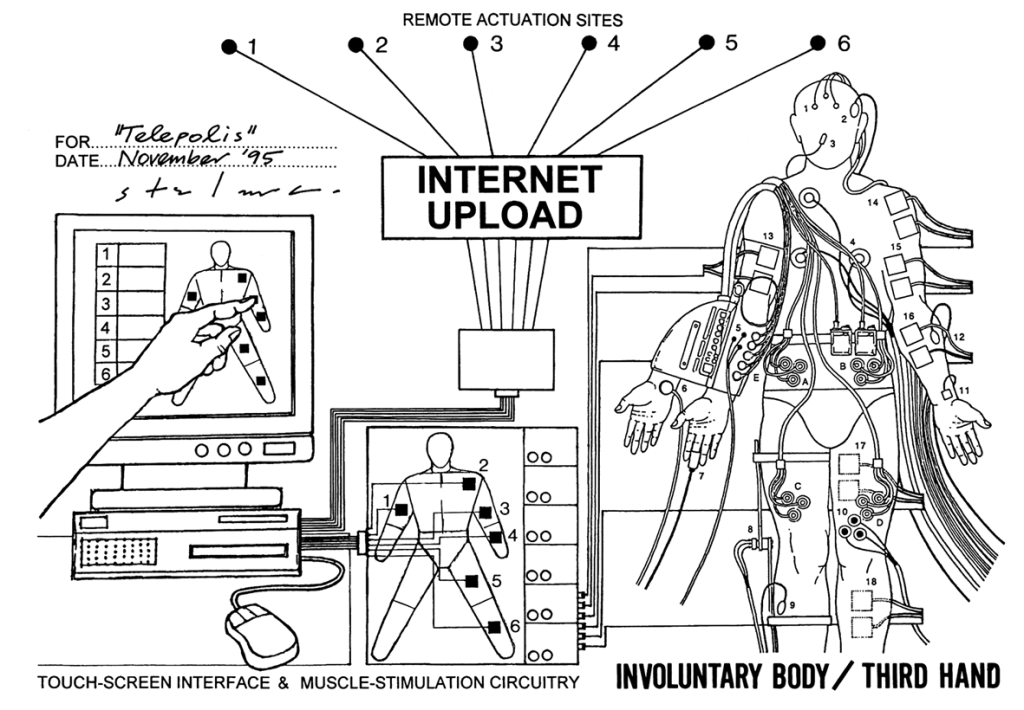
    Fractal flesh - http://cec.sonus.ca/econtact/14_2/donnarumma_stelarc.html
    Fractal flesh

    The question that is pressing in arises from the political problem, the problem of politics in itself, as politics.  Put bluntly, why is there such a thing as ‘politics’?  It is impossible to avoid this problem because we are always caught within the realm of the political.

    An individual member of the human species might find themselves able to step aside from the social, even whilst having inevitably derived their minds from it, but only as a result of the social itself, as a result of some brief area left aside, fallow, by the socialisation of the world.  The social spreads, like the viral trace of the species, across the world.  This is no anthropocentrism and it is not restricted to the human species – the ‘environment’ is nothing more than the complex totality of the multiple systems of social tracks left by the various species of organic life, some more dense and heavy than others.

    The human species treads hardest however.  In fact, the human species treads so heavily that it marks a qualititative break in natural dynamics.  It is not anthropocentric to acknowledge the specificity of the effects of the human species, the discontinuity between the tracks left by the human species and those of – almost – any other living organism.  It borders on the unnatural.

    The discontinuity is able to be understood best when encountering the heaviness of the human tread.  The traces of the social lie on the surface of the natural, the organic formed within the limits of the inorganic.  There are no societies of stones but there are many societies within the stones.  The stones form the fuel for the cells, constitute the surface on which the the social traces of the organic leave their mark.  Each layer rests on the preceding layer.  Yet the human tears through the layers, its weight unable to be borne by the supporting surfaces.

    It is this tearing of the surfaces that produces the political.  As the human species develops the capacity to rip open the world, as it transforms from the simply social animal, from the collective swarm of flesh that is each organism, it encounters the counter-effect of its increasing capacity for the transformation of the world.  This counter-effect is the reconstitution of the human flesh swarm as a new surface, no longer a swarm but now a network of nodes, with a variability of connection, a variability that produces differentials of power across the network.  The human swam transforms into a variable network of power and it is as this variability that politics is born.  Politics is the form of the variable human network that has gradually replaced the swarm of flesh from which it arises.  The type of species that we are is a specific result of the counter-effects of the capacities evolution produced in one form of the flesh.  We are, although not in the way Aristotle perhaps thought, the political animal.  Our animality is specific because we are a political flesh.

    In this situation politics exists not because of needs needing fulfilment, nor because of ideas that want realisation, nor even because of freedom that requires expression.  Politics results from the counter-effect of our capacities as an organism.  Central to these capacities is collective or social labour.  Our break-point with almost all other organisms lies not in language but in social labour.  Social labour is not merely a quantitative addition of arms and muscles but is instead the re-organisation of specific forms of work carried out by an organism into a social form of work that is qualitatively more powerful, social labour.

    Imagine two groups of human beings in conflict, both equally large.  Battle lines are drawn between these two groups as they meet in open territory, maybe a hundred on each side, all armed with little more than bones and clubs.  Now if one side has the capacity to become organised, to act as one, to unite their intentions, to follow orders and to ensure each individual animal acts as a cell within a greater whole, then it is inevitable that they will win the battle.  The more sophisticated that organisation the greater power it has.  Smaller number can overwhelm larger because of their organisation into social labour, into collective labour.  No longer a mere mass of flesh the new organisation brings forth a new organism, one that is now not mere flesh but the network of flesh become body.  It is this simple, basic, fundamental natural fact about social labour that is the ground of our reality, a reality that is inherently, inevitably, political.  Politics exists because social labour exists.  Social labour, however, is the catalyst of a counter-effect, the formation of a new body that rests on the shoulders of the flesh and drives it in its own direction.  For the most part this networked body of the flesh, this body of social labour, operates blindly, and in that sense politics arrives as an externality, as a new force in the world, one that we are still, desperately, trying to master before it drives us off the cliff of extinction.  Our options are to renounce social labour and descend into the earth as flesh once again or to internalise the networked flesh of the body of social labour and become the agents we imagine ourselves to be.

  • Some thoughts on democracy and the death of Tony Benn

    Some thoughts on democracy and the death of Tony Benn

    RIP Tony Benn and Bob Crow
    RIP Tony Benn and Bob Crow

    Tony Benn – “I think democracy is the most revolutionary thing in the world, because if you have power you use it to meet the needs of you and your community.” Interview with Michael Moore in the Movie Sicko (2007)

    The first time I met Tony Benn was on the way to the ICA in London to see him speak, sometime in the 1980’s when I was maybe 16, 17 years old. I was walking down the Mall and as I reached the traffic lights I realised that Mr Benn was standing there with me. In my youthful enthusiasm I blurted out ‘I’ve come to see you speak’…and was met with a warm smile and a gentleness that was quite remarkable. We chatted briefly as we walked together towards the ICA, nothing particular being said but there was a warmth and openness in the man that was remarkable. He was also noticeably smaller in stature than I had imagined and it was one of my first realisations of the distortions of the media. The image is always, in large part, a construction of the audience and the frame within which the image is presented. One of the subtle characteristics of the image as presented by the media is to make it seem bigger than we are, it presents a person as larger than life. In this way the media disempowers us, makes us subject to a world formed and framed for us in a particular way, a way that is not neutral but which is always driving us to feel the world to be ‘bigger’ than us, out of our grasp, beyond our control. Benn knew the power of the media but he also realised the problems and perhaps this was what motivated his energetic round of public meetings, direct presence in the face of the people. To come face to face with people is to bring the human back to earth, to let us face each other as equals, something impossible within the media-audience framework.

    The next time I met Mr Benn it was at another public meeting he was speaking at. It was 1990 and I was now in my early twenties and a poll tax rioter, charged with public order offences following the March 31st Trafalgar Square demonstration against the Poll Tax. I was Chair of the All Birmingham Anti-Poll Tax Union, a city-wide alliance of all the local campaigns, and was organising a public meeting as part of the defence campaign for the 350 plus people arrested at the riot. I was, as the saying goes, ‘in struggle’ and when I phoned various Labour lefty MP’s there was a mixed response to my requests. One left wing MP actually pretended to be someone else on the phone in order not to actually refuse the request whilst wiggling out of any actual public action of support. His accent was so noticeable and familiar that it was a truly bizarre moment. When I got through to Mr Benn, however, the same warmth and gentleness was there that I’d first encountered at the traffic lights on the Mall. We chatted about the meeting time, the request to speak having been accepted quickly and with an encouraging ‘of course, of course’.

    The last time I remember seeing Mr Benn was at the ‘Pig in Paradise’ in Brighton, where he was speaking about the Ragged Trousered Philanthropist. By this time I was maybe in my early to mid thirties. I’d been to prison then gone to University after being unable to get a job again as an ex-convict and was at that time studying for my doctorate in Philosophy. I was still politically active in some forms, although the political atmosphere seemed deeply conservative. Even the old Trostkyist groups I had joined in my youth appeared to me, as they do now, to be little more than conservative remnants of an older time, lacking any real vitality. I was by this time a ‘left communist’ of sorts, a position I’m still in, albeit no doubt idiosyncratically. It was prior to 9-11 and the anti-globalisation movements were about to explode onto the streets in the J18, Seattle and Prague demonstrations. The words of ‘The Coming Insurrection’, “nothing appears less likely than an insurrection but nothing is more necessary”, were yet to be written but expressed the position I felt at that time towards the world, where the media formed appearances had ground down my political imagination. Benn spoke eloquently, as always, about the Robert Tressel novel and as he did so his words reattached a few of the ever present threads of resistance and the possibility of my own rebellion was reinvigorated.  It was like rekindling a memory of hope for the future through the practice of remembering the past and his words gently rended part of the veil of media imposed illusions.

    Words, in themselves, will never change the world but what they do is renew the conditions for change, the conditions that enable us to remember who we are in the midst of oppression and irrational social structures that alienate each of us everyday in a thousand little ways. Words and discussion and memory enable us to learn and if we are to learn from the example of comrades like Tony Benn then we might do well to learn from the way in which he appeared to encounter the world as populated with actual, real people rather than ‘voters’. In the many plaudits for Tony Benn from hypocritical media imbeciles one of the things that appears often is a realisation that Benn presented a sincerity that is deeply lacking in modern political life. ‘I didn’t agree with what he said but he was honest and intelligent’ says the bullshit artist intent on manipulating even the death of their enemy for their own advantage. Yet the need to recognise the sincerity in someone like Benn is akin to the way that these same bullshit artists manipulate the concept of democracy to establish their own power over others.

    “Nothing appears less likely than an insurrection but nothing is more necessary”. It is the appearance itself that often holds us in thrall. Yet this appearance is fragile, it can shatter with a momentary event, a word, a brick through a window, a smile, a moment of face-to-face contact. Benn believed deeply in democracy and in a way that always appeared honest and open. He knew, I’m sure, that power needs to clothe itself in the appearance of democracy, that power needs to make us believe that this world of Western capitalism is the best of all possible democracies. Yet power needs to clothe itself in the appearance of democracy precisely because actual democracy is deeply desired by all those for whom power over others is not the goal, for all those for whom money is not the goal and for all those for whom freedom for one is freedom for all. It is – it was –  Benn’s continual willingness to maintain the possibilities of democracy that is perhaps his most important legacy, his willingness to realise that democracy is not a tool for power but a means for living in a social framework that is not oppressive.

    Just like the word ‘communism’ the concept of ‘democracy’ is so deeply tainted by its association with capitalism that we face a dangerous problem. If our best hope for free social formations is turned into something that appears to be the primary tool of our oppression then it is not surprising that we find ourselves left with little idea as to how to construct another, better world. The very possibility of a better world must be reclaimed but to do so we need to take that positive commitment to democracy that Benn had and renew it. We need a concept of an insurrectionary, pervasive democracy. We need to reclaim the concept from the appalling poisoning that has occurred via the phrase ‘Western democracy’ and begin practising and experimenting with democracy, with what kind of conditions are needed for democracy.

    When Benn said that he was leaving Parliament to engage in politics the truth of this statement gives us at least one hint towards some of the conditions that might be needed if a democratic practice is to be broken from its poisoned position. Voting is not enough, not even regular voting. Rather what is needed is a pervasive democracy, one that underpins our social existence in all its aspects. Democracy requires educated, communicative, empowered people for it to operate. It requires real contact between individuals, it needs face-to-face communication where the media is no longer able to frame our thoughts in its own agenda of money-making. Democracy also requires a deep and consistent awareness of its dangers and its capacity to manipulate.

    The great secret of western democracies is the capacity to keep control of information and education, to keep control of the very possibilities, the very choices, that are on offer. At the heart of this is the claim that only ‘democratically elected individuals’ have legitimacy. Yet this is the negation of democracy since by definition some are more equal than others in this situation. Democracy, in our current situation, confers ownership rights, just as being the ‘boss’ confers ownership rights. In the case of the ‘elected representatives’ that ownership is over our voices and lives. The media and the class of ‘political representatives’ treat the people as so many numbers, quite literally, for whom they can ‘speak’. The greater the weight of numbers the greater the weight of their voice, their supposed ‘legitimacy’. ‘Western democracy’ is a peculiar inversion of the spirit of democracy, conferring autocratic rights on a few whilst pretending, with a straight face that must take some practice, that it is ‘our voice’ that is being heard.

    A pervasive, insurrectionary democracy would be one in which the very idea of another speaking for me would be anathema. It would be a situation in which the act of insurrection would be one in which democracy was being expressed rather than repressed. If my voice is incapable of being heard then my body is all that remains if I am to remain free. Pervasive democracy must move away from ‘deciding for everyone’ and become a mode of ‘people deciding’. Actual concrete individuals need to be brought back into the practice of democracy and this can only be done if the general practice is for democracy to be localised, personalised. Democracy must pervade everything, from the workplace to the family to the use of land. Those whose needs depend on the decision are those who should be deciding.

    For the most part the decisions of our ‘western democracy’ impose themselves on us in ways that are too abstract for them to ever take account of their effects on the people democracy ‘speaks for’. We need to develop and demand democratic practices everywhere a decision effects us. We also need to develop the capacity to complement this with the ability to stay out of other peoples lives when not wanted, to not impose on others our own moral standards, to not convert other people into abstract numbers in our own power schemes. To do this we need to allow insurrection to be a limit form for our decision processes. How might we tell when we have imposed on others our own decisions rather than communicated with them to make a decision? When they revolt, when they resist, when they rebel. Insurrection then shows us when we have succumbed to the prime danger of democracy, the danger of deciding for others. Insurrection then becomes the friend of democracy as it reveals the limits on where we should be deciding for others and pervasion becomes the ground of democracy as it enables everything that effects our needs to be open for social decision.

    Democracy is a deeply complicated concept.  Its goal of enabling individual freedom within a social framework can only be achieved by acknowledging its capacity to allow some people to impose the power of the social framework on the individual with a more insidious authoritarianism than any dictator has ever possessed.  It is time we no longer relied on the concept of democracy to solve our problems without thinking and instead realised that it is only by thinking through the problems of the concept of democracy that we might begin to establish an actual, real, human democracy.  To do this we must begin by realising the deeply troubling nature of democratic legitimacy and its role in imposing power on us rather than enabling power for us.

  • Primal Repression and autonomy

    Primal Repression and autonomy

    freudscouch2The concept of primal repression is central to the psychoanalytic theories of Freud and those who, to one degree of another, follow in Freud’s footsteps.  It might be thought that it is the concept of the Unconscious that defines Freud, or perhaps the notion of the Oedipus complex.  Both, however, depend upon the concept of primal repression.  It is primal repression that creates or produces the unconscious and which is the first step in the production of the type of self which Freud posits, a self that arises from the tension between sexual instincts and ego instincts.  Primal repression is where we begin.

    In his essay ‘Die Verdarangung’ (Repression), Freud writes that “we have reason to assume that there is a primal repression, a first phase of repression, which consists in the psychical (ideational) representative of the instinct being denied entrance into the conscious.  With this a fixation is established; the representative in question persists unaltered from then onwards and the instinct remains attached to it.  This is due to the properties of unconscious processes…” (PFL 11:147).  The key notion here, the one that seems at first sight so innocuous, is this claim that the ‘representative’ of an instinct is ‘denied entrance’ to consciousness.  The mechanism by which this occurs, the ‘how’ of this denial, is the problem of primal repression.

    Freud offers us a curious illustration of this process of denying entrance.  Primal repression consists in either expelling an idea from consciousness or blocking it from entering (PFL 11:152).  The difference between expelling and refusing access is illustrated through the use of the metaphor of an undesirable guest in his house.  I can either kick them out of my house after I have found them undesirable or refuse them entrance if I believe them to be troublesome.  In addition I will need to set up some sort of “permanent guard” (PFL 11:153,fn1).

    The curiosity here is that the mechanism of expelling or refusing a guest clearly involves some sort of agent with the power to carry out these actions.  In crude terms this would imply that there was some sort of homunculus inside our heads that operated like a ‘father of the house’, an authority that stood aside from the various guests and judged and selected amongst them.  The question of how that authority actually operates, how it is they make their choices and have the authority to enforce them, is ignored.  The very fact we want to understand and explain is simply pushed back into the metaphoric story which appears so obvious but which covers over the lack of actual explanation of the process of primal repression itself.  To try and understand the apparatus that underlies primal repression it is necessary to broaden out the view of Freud, beginning with the basic framework of his model.

    First, the peculiar notion of the ‘instinct’ in Freud should be addressed.  There is a notorious tension between translating the German word Freud uses (Trieb) as ‘instinct’ or ‘drive’.  Common usage, perhaps derived from a background of biological ideas, takes the notion of instinct to refer to something like established behavioural responses to environmental stimuli that are grounded in physiological conditions, with a common example being that of the salmon returning to spawning grounds.  Freud, however, has a curious way of posing the notion of instinct, one which is best thought of as a specific Freudian concept.  For Freud, instinct is produced at the borderline between the psychic and the somatic.  Instinct is the meeting place of the body and mind and in this sense we should note that only animals with minds have instincts.

    Secondly, the ‘properties of unconscious processes’ that Freud refers to are “exemption from mutual contradiction, primary process (mobility of cathexis), timelessness, and replacement of external by psychical reality” (PFL11:191).  The unconscious, Freud claims, operates with different rules than the conscious.  The four core properties that are summarised here give the outline of the unconscious system, as distinct from the conscious.

    The first property, exemption from mutual contradiction, arises from the claim that “in the Ucs. there are only contents, cathected with greater or lesser strength” (PFL 9;190)  The contents of the Ucs. are ‘wishful impulses’ and it is entirely possible to have two such impulses in existence which appear to completely contradict each other.  The existence of the wishful impulses is not constrained by mutual conceptual compatability, as in the case of beliefs.  Instead the wishful impulses are constrained only by the amount of cathexis.  Cathexis is itself the ‘degree of activity’ (PFL 11::151) of a particular wishful impulse.  Freud also speaks of “an idea or group of ideas which is cathected with a definite quota of psychical energy (libido or interest) coming from an instinct” (PFL 11:152).  Cathexis is, we might say, the strength of the instinct expressed in the idea.  The idea is not the instinct but its representative.

    The second property, that of the ‘primary process’ or the ‘mobility of cathexis’ rests upon the distinction between the instinct and its representative.  Whilst instincts are the motor force of the Ucs. they exist in cathected forms – in other words, the instinct exists as an idea with an amount of energy or charge.  This is why Freud’s instincts are a borderline phenomena; the instinct is always and only an idea with a degree of energy.  Despite this, however, the energy that is attached to an idea is contingently connected and can slip from one idea to another.  The energy of the impulses is mobile (mobility of cathexis) and can move from one idea to another.  There are two basic forms of this movement, according to Freud: displacement and condensation.  In displacement the energy attached to idea A is taken over by idea B, in condensation the energy attached to idea B takes over the energy of idea A, C, D ….    The two terms appear to refer to the same process but from different perspectives, although they are not simply co-extensive.  Displacement can take place without condensation but condensation depends upon displacement. Condensation involves the displacement of two or more ideas and a synthesising complication, whereas displacement may simply be a change in representative.

    The third property, of timelessness, refers to the lack of any temporal directionality governing the unconscious, the idea that an ordering in time is an aspect of conscious ideas but inapplicable to the unconscious.  Whilst this notion of timelessness is fascinating, it is the final property that is of more direct interest at the moment.  The crux of this property is the emphasis on the autonomy of the domain of the psychic, driven not by rational considerations but instead by an economics of pleasure and pain.  The processes of the unconscious precede conscious ‘thinking’ and are ‘primary processes’ which are governed by the ‘pleasure-unpleasure’ principle, “or more shortly the pleasure principle” (PFL 11:36).  Repression arises from the regulation of wishes and desires that cause unpleasure.

    This model of the unconscious poses it as prior to the conscious.  In ‘Two principles of mental functioning’, for example, Freud clearly poses a developmental relation between the unconscious and the conscious, the latter arising from the introduction of a ‘reality principle’ alongside the ‘pleasure principle’.  This reality principle arises from the failure of the hallucinatory wishes of the unconscious and the need to acknowledge rather than simply repress unpleasure.  The reality principle arises from the failure of the pleasure principle to adequately regulate the organism within external reality (PFL 11:37).  As Freud develops his ideas, however, he grapples with numerous problems of internal coherence and empirical observation.  His system changes, eventually resulting in the more familiar notions of Ego, Id and Super-Ego.  Central to this development is what is meant by ‘the unconscious’.  From an earlier position in which the unconscious in some sense preceded the conscious Freud arrives at a position in which ‘consciousness’ increasingly loses any real meaning.  The whole of psychic life becomes nothing more than the play of drives, the conscious surface as much a result of these drives as the unconscious dynamics.  From a position in which the unconscious is granted autonomy we reach a position in which the conscious life loses autonomy.  Ideas are emptied of autonomy in the face of the drives of the instincts.

    The colonisation of our understanding of the conscious life of thought by the unconscious drives is deeply problematic for reason because it can be taken to be a denial of the rational autonomy of ideas and of thinking as a processing of those ideas.  Instead of an honest thinker behind the thought we now find a hidden series of forces that constitute the truth of the idea.  Psychoanalysis over-writes the model of the human rational agent with a new practice grounded in a fundamentally metaphysical production.  Its power arises not from the absolute accuracy of the metaphysics of the unconscious but from its efficacy in social manipulation.  Yet the efficacy is quite specific and is not located in psychoanalytic therapy, the efficacy of which is debatable.  The real strength of ‘Freudianism’ rests not in ‘the talking cure’ but in the power of propaganda and the efficiency of sales techniques, it rests in the capacity to change the group mind not the individual psyche.

    Two fundamentals arise from Freud, from his metaphysics of the mind.  The first is the way in which ideas and instincts are conjoined in a contingent connection that can be manipulated.  The second is the efficacy of a practice that engages with these Instincts within a social rather than an individual situation.  The conjoined effect of these two facts is to render society manipulable.  It is possible to change the minds of the people even if it is difficult to change the mind of a person.  If it is possible to disconnect and reconnect instincts and drives then different ideas can be inserted into the minds of the people, in a form of reprogramming.  If this process operates at the level of the group rather than the individual then this has the potential to disarm subjective autonomy by overwhelming it with group minds.  If we can reprogramme the people then individual resistance can become irrelevant by virtue of being pathologised.  Resistance to the social group mind becomes, in this scenario, a form of illness rather than opportunity.

    If psychoanalysis is simply wrong then the problem is one of explaining its efficacy in the realm of public relations, propaganda and social manipulation.  It is important here not to mistake efficacy with control.  The claim is not that the group mind can be completely controlled but simply that the use of techniques that are derived from and dependent on the Freudian metaphysic can be effective in limited and specific ways, specifically in terms of selling products or ideas, installing them into the group psyche.  Given a limited set of goals (sell product X, promote idea Y) and a wide ranging input into the social imagination, it is possible to remove resistances and attach desires to new products posing as ideas.   On the other hand, if psychoanalysis is right, then the prospects for a rational enlightened socius are greatly weakened when the techniques of social manipulation are not acknowledged.  Autonomy is outflanked by desire.

    This poses the problem as a struggle, a kind of war, between autonomy and desire.  The refusal to acknowledge the role of desire leaves any purported agent vulnerable to its workings. (“The greatest trick the devil ever pulled was convincing the world he didn’t exist”.)  If an understanding of agency begins with the assumption that there are a set of drives at work in the establishment of the value and weight of ideas, then it is possible to move beyond the naive position of an honest thinker.  If agency involves distrust of agency, distrust of why a particular thought arises, distrust of the immediate reactions to news stories, distrust of ‘gut reactions’, then might this not open a way to avoid the outflanking of autonomy by desires?  Might some degree of distrust of the self not constitute the ground of the autonomy of the self?

    It should only take a moment’s reflection to realise that there is something quite peculiar involved here.  What, for example, is doing the distrust?  Or perhaps, who distrusts whom?  There is some odd doubling of the self that is not obviously a possible let alone a viable strategy.  In addition, is there not a desire for autonomy?  If that is the case and the agent is being being persuaded to distrust the desires that underlie ideas, might this not apply to the very desire for autonomy and agency itself?

  • (This is an exercise in the rational imagination).

    (This is an exercise in the rational imagination).

    1. Imagine a universal intelligence. It isn’t hard to do.

    2. Of course it is hard to do.

    3. But not impossible.

    4. Nothing rules it out…everything rules it in.

    5. Does the imagination pay dividends here? Of a sort. What sorts of dividends? (more…)

  • Don’t let it fade away

    Don’t let it fade away

    image

    Where did they find you?  They found me in New York…I enjoy what I see, it reminds me a lot of the mid west.  Every new boy that you meet…here she comes again.  Dancing beneath the starry sky.

    The broken memory, the one that is prompted by the Madeleine, into which we are thrust, chest first, breaks the sheen of the surface of today’s past.  The broken memory makes the past rewritable.  It reminds us that we might remember something.  That which is remembered was not there.  This is the problem; if it wasn’t already there, at hand, how could it become that which was remembered.

    image

    Anyway you do it, that’s liquid gold.  I wish you’d shut your noise.  I don’t care what other people say, I’ll just keep strumming.

    http://instagram.com/p/fqjYgaMVlu/