Blog
-
Plato and Deleuze
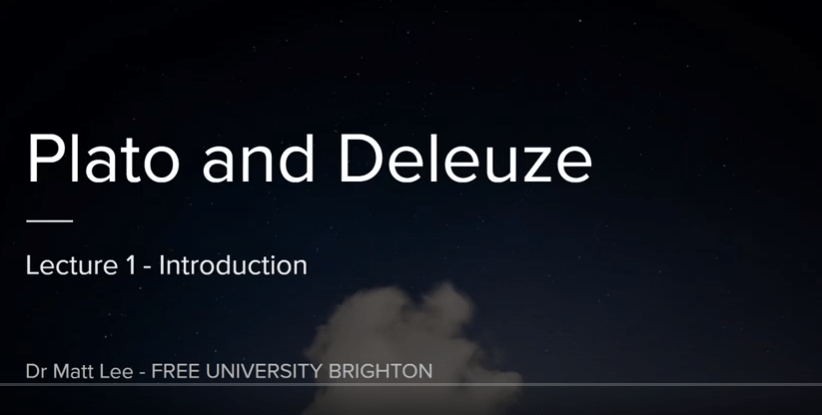
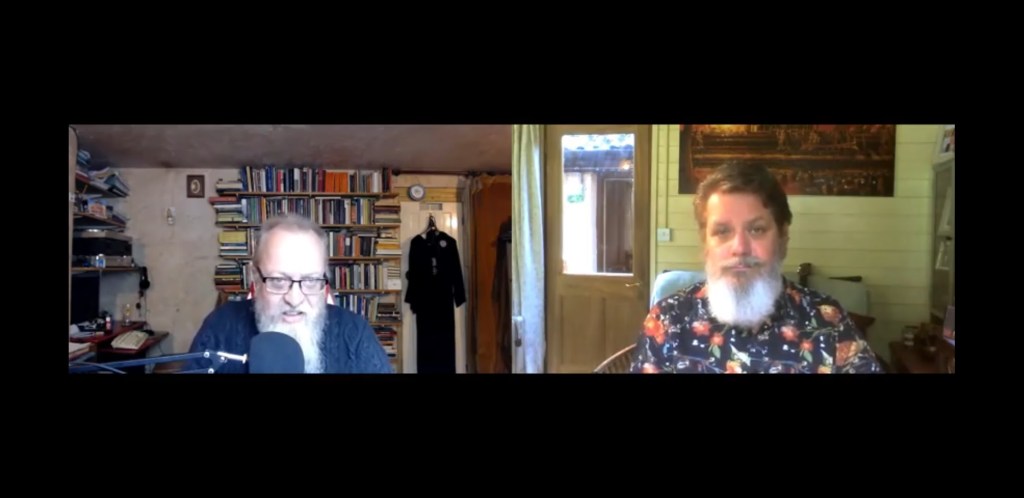
I’ve just started a new course at the Free University Brighton looking at Plato and Deleuze. Here’s the course outline and the first lecture. If you want to join in you’re welcome to join my Discord if you’re not in the Free University Brighton, details on the about page.
The first lecture in the new course on Plato and Deleuze The playlist for the course is here.
Course Outline
The aim in this course will be to read three of Plato’s texts in the light of the critical response offered by the French philosopher Gilles Deleuze. From Plato we will read Phaedrus , Statesman and Sophist which look a t questions of love, politics and knowledge. We will examine the Socratic method, as Plato develops it, that involves dialectic , a process of conflict and irony (elenchus) that enables the truth to be found even if it doesn’t actually present it in a specific package for easy consumption.
From Deleuze we will read a selection of extracts from his works because his comments on Plato are scattered throughout numerous books and essays. Deleuze claims that at the heart of Plato’s work is the problem of selection how to choose between rival contenders to a claim. Who is it who truly knows? Who is it who truly loves? Who is it who is truly just? For Deleuze, the problem with Plato is that the method he uses to determine the true claimant is flawed from the beginning because of the way in which it establishes a ‘model copy’ relationship that is conceptually incoherent.
Reading
Plato
The Phaedrus
The Statesman
The SophistDeleuze
‘Plato and the simulacrum’ (from The Logic of Sense)
‘Introduction: the question then…’ (from What is Philosophy)
‘Plato, the Greeks’ (from Essays critical and clinical)
‘To have done with judgement’ (from Essays critical and clinical)
extracts 1 (from Difference and Repetition) -

Notes for Eric #6
I’m using video streaming as part of my work at the moment. Beginning last week – 3rd August – I’m trying to do a Philosophy Research Discussion online. I missed this week, due to feeling really unwell with heat exhaustion, but the last session had 3 or 4 ‘sections’ to it. I’m cutting those up and uploading to YouTube at the moment and this is the first of those edits, primarily intended for Eric Harper who I’m working with on a project. It discusses something Deleuze said to a friend about what makes a worthwhile book, and I reflect on this with regard to our project.
-
Streams and Dreams
The COVID crisis meant that the Free University of Brighton moved online during the Summer term and I was teaching a philosophy course on Existentialism, mainly focused on Kierkegaard’s Fear and Trembling, followed by a close look at Sartre’s account of pre-reflective consciousness in Transcendence of the Ego, Sketch for a Theory of the Emotions and his chapter on Bad Faith in Being and Nothingness.
I decided, after some research into options, to host lectures on Twitch and then do seminars via Zoom. I’ve added a new page to the blog that explains how the stream works, which you can check out here.
The aim was to keep the class ‘open’ in some ways, as one of the great joys of FUB is that we have a very open class structure. Often I find that FUB courses have a core set of students for the class, alongside another section of people who attend more loosely, usually because of time. The open, almost ‘drop-in’ nature of classes is important as it shifts the dynamics in the space – the class isn’t closed in on itself, producing a kind of insularity to conversation, rather the fact that there might be a more random element forces discussions to be alert to assumptions because someone who is following more loosely might need things to be explained differently. I’ve also been interested in the shifts in the Twitch and streaming community, with a large increase in recent years in the ‘Just Chatting’ category, and so it offered an interesting space to experiment with ‘doing philosophy in public’.
I’m still pretty new to that whole Twitch/YouTube streaming space but the class seemed to go well. The lecture streams get automatically recorded on Twitch and then easily exported to YouTube, and you can check out the Existentialism class playlist over at Twitch or on YouTube. One thing I ended up doing was using some specific software, getting to know the tech behind streaming and getting a decent (ish) mic, as there’s nothing worse than poor sound in a lecture type space.
As I mention during the last lecture session (lecture 9), I’m intending to carry on doing a Monday evening stream, the idea being to report on that weeks philosophical research, sometimes chat to others and sometimes to go through specific short texts or sections of text. Monday evenings from about 7pm – if you follow the Twitch channel you can get notified when I go online.
This week I’m hoping to start the ‘weekly research seminar’ sessions by talking to Eric about the ‘Freudian Spaceship’ project we’ve been working on for a few years, where we’re developing a Fanonian Schizoanalysis. One of the things I want to chat about is the role of dreams and dreaming, which I’d rather use as a concept than ‘ideology’ or ‘false consciousness’. Part of the background to this is something Deleuze says about getting trapped in the other’s dream. Here’s a little instagram introduction to that.
//www.instagram.com/embed.js
-

Hold your own
Do not do what you desire – do what is necessary.
Robert Cochrane
Take all you are given – give all of yourself.
What I have – – – I hold!
When all else is lost, and not until then, prepare to die with dignity -

Notes for Eric #5
Group formation I mentioned earlier that the assemblage, the community, is never static and can become something reactionary as well as revolutionary. The group is also an assemblage, and my first thought is about the difference in the assemblage ‘group’ and in the assemblage ‘community’. They obviously share a lot of features – not least being that they can become reactionary as well as revolutionary. They can fuck you up as much as lift you up.
Maybe there’s a difference in scale between a group that is reactionary (fucking you up) and one that is revolutionary (lifting you up) – one that is felt acutely, if incoherently, by anyone involved in revolutionary groups – but I think it’s not really about scale directly. They fuck you up as easily as they lift you up if you’re not careful, but if you are careful then they are the only way in which some which of our capacities can be expressed.
That ‘be careful’ is often taken as a warning but it shouldn’t be, at least not all the time. It’s all in the tone, perhaps, which never comes across so easily online as in a face to face setting (or at least, we tend to think it doesn’t). Is it too easy to just play with the words? Careful, full of care. And who can be full of care all the time? Maybe it’s a function that exists, as Guattari might say, transversally, that only exists in so far as it cuts across a series of ‘care full filling practices’ that are being carried out by different individuals and sub-units of a group, or community.
There’s an interesting connection between ‘care’ and group or community. As assemblages they differ in the way that ‘care’ can be given, or received. I think in some sense the feeling of what care is, differs from group assemblage to community assemblage in such a way as to distinguish the one from the other. There’s that thing about scale again, at what scale do I encounter care (either in terms of giving, receiving or noticing)? At its most intense it’s thought to be commonly found at the one to one level, but this seems like it will feel different from what we’ll find at the group level and then again different at the community level, and I almost feel like I might be able to navigate the movement from one space to the other by the feel of the care relationship that exists, or has the potential to exist (whatever that might mean).
Summer time This week I rode to Bristol for the Plan C Congress. It’s the second longish ride out on the new bike, previously I rode to just outside Sheffield. Interestingly enough, that was to go to Plan C Fast Forward Festival. Obviously I don’t travel widely unless it’s for something kind of political. Both times the rides to the venues were done in the pouring rain, although both times I also got sun filled rides home, even if the roads were still wet in places. As I came into Sussex, I rode down the B2141, one of those curious roads seemingly in the middle of nowhere but which is in pretty decent nick. So many of the roads I ride appear to be fucked up it’s noticeable when you get a well maintained, or newish, bit of tarmac. Things flow well on good roads. In the middle of this moment, filled with all that lush green countryside, there was the body of a roe deer, lying full and large on the left hand side and I slowed as I passed it, checking in. It was clearly dead, ‘roadkill’. At what scale does my care for that doe get to be felt? It kind of bounces around, shifting the resonances after the encounter.
-

Notes for Eric #4
https://youtu.be/c2m-FfP1UDQThis week I began teaching ‘Schizoanalysis for Beginners‘ again. I haven’t taught it for 4 years and haven’t spent time reading Anti-Oedipus all the way through for maybe two or three years. I return to it quite regularly but in chunks and so it’s interesting to begin reading through it again, in a new space and time, in a new setting. I’m finding it shouts at me, it’s speed and all the connections it sparks once again being mobilised but this time the machine is one I’ve had around for a while and that hasn’t been oiled properly, so in getting it going again I’m noticing the creak of my old bones.
Machines and assemblages have this curious entropy that we all probably are familiar with. Paint peels, rooms get dusty. I’ve gathered a shelf full of tools and potions to accompany my motorbike and recently we got a new set of shelves for the kitchen to put these things on. We got them cheap, of course, and this week we had to remove them, a failed experiment, they were bowing under the weight of the tools. So the shelves came down and everything on them was piled back into the ‘study cum temple space cum living room cum bedroom basement space’ next to our kitchen. Inside my house, where I work, the study and the altar – the two space that I relate to mostly in the sitting position – form little zones of ‘stillness’ or ‘sitting’ amidst a myriad of mixed elements. In the other corner is my partners work zone. Across the walls are elements of mnemonic tech for when I’m working in a standing position, doing some kind of standing meditation or ritual, or shelves of books and notes that attach themselves like invisible threads to my desk and words via my body, hands, brain and eyes. Constantly these things fill up, break down, need cleaning and re-arranging.
The sun shone yesterday and I rode out. Bikes have to be ridden regularly or be put into hibernation properly. If not ridden regularly they can get cranky, rust up, deposit crud in the fuel lines. Engines generally need to work regularly. They need to flow, heating up and cooling down, lubricating their elements, breathing.
As always, the wind is met at about 60 to 70mph. I crouch forward across the tank, let my hands relax on the bars, grip in with my knees and lean the bike as the road curves, feeling a joy that only speed, machine, body and noise can bring. The wind is noisy, rushing and howling across my helmet, buffeting my chest, filling the space, underneath the engine runs hard, never able to drown out the wind. On the outside, across the way, the walker can only hear the engine, the roar of that machine, but inside only the wind. As I slow down I sit back up, my body catching the wind and the resistance braking the bike as I slowly grip the lever harder. Everything works together, actively, a group of flows distinct from the passive cages of the cars that surround me, where the individual is anaesthetised behind a mediation of technology. Soon the driver will be redundant in the car, sleeping or watching a screen inside the beautiful robots that will carry them, like gestating foetuses, to their promised land.
You refer to Foucault and his thoughts about community in the draft chapter. Foucault is apparently ‘the most cited researcher across all fields’ ( https://foucault.info/articles/#citation_ref_1 ). On Google Scholar, which is this curious machine to ‘measure’ the value of academic work on the basis of the criteria of citations, that is, on the basis of how many times someone has referred to them. Foucault citations seem to peak in 2016. Of course this data is no doubt deeply flawed, not least because it probably depends on how it is sourced, when such measuring started and other factors that are quite contingent on curious accidents of knowledge production. Yet I had a small smile to myself. We’ve passed peak-Foucault. I’m not unhappy about that.

There are, as you note, three types of community that are spoken about by Foucault – the given community I identify with, the tacit community that sets the conditions of membership and the critical community of freedom, where the individual is able to reach themselves in so far as they find the community ‘intolerable’. Freedom comes with critical distance it would appear. Yet again, as with Benjamin, this relationship can easily seem to be set up as being between two nodes – the community and the individual – and this seems to start from somewhere that prevents positive movement. I can’t help but feel that the ‘critical distance = freedom’ position is just another form of saying ‘we academics, with our critical skills, are the ones who are truly free’. Nothing is more self-indulgent bullshit than the idea that academic knowledge produces freedom, and individuals who hold to this seem to be self-deluded, making excuses for their own choice of survival. We all have to survive. I hold no-one to account for the necessity of their survival strategy. When in prison the books people sent were exactly that, survival strategies. As I read, I slipped the bars, and explored new lands of thought and sensation. As I began to learn I felt the exhilaration of the ‘critical distance’. The capacity to produce my own values, to become autonomous, or to feel autonomous to be more precise, grew and eventually this was the background for my own entry into academia. Yet my story is incomplete if it reads too quickly as ‘books let me escape’. This was only a background condition and one that wasn’t completely neutral.
In prison I learned more than just how to read a lot, something I had always done. I learned to read intensely, often going over and over things, almost learning them by heart. Comrades would send me all sorts of history and political books. Amongst the various books that arrived, however, there was a set of ten Bond novels by Fleming, originals I think, in their pulp fiction covers and cream, slightly brittle paper. Those novels were odd things. I hadn’t really devoured pulp fiction before and found I could sit and read a Bond novel in an evening. Once the cell doors had shut – there was no TV in our cells in those days – I would settle down with a small blim and some of the godawful tea we picked up in our flasks before lockup and just read through a Bond novel from start to finish. It was like watching a film. When bored, or antsy and irritable and unable to concentrate on something more ‘serious’, I would return to these Bond novels and over the course of the months they formed a very strange affect, unlike anything I had encountered in reading before – they produced a kind of dream-like state of images, odd phrases and tranced breathing. They relaxed me. Gradually this affect, once built, began to transfer to other texts, sometimes poetry or biography or even – much later – ‘theory’. What it absolutely was not was a ‘critical distance’.
It’s a simplification, perhaps, to reduce the idea of a ‘critical community’ to ‘critical distance’. If becoming part of a critical community involves moving beyond a sense of ‘being an individual’, perhaps in a movement that breaks out of the dominance of this way of being, that transcends it in some sense, then it contains potentials to embrace. Yet these potentials have too easily been re-incorporated into an academic mode of being that is itself, fundamentally, rooted in proper names, individuals, careers – flows of knowledge production, recording and distribution that have been easily integrated into capitalism and which academics seem incapable, in large part, from resisting. It’s almost impossible, for example, to get an academic not to participate in the ‘paywall’, a seemingly obvious and easy step (‘free the knowledge’) but one that is constantly met with excuses of one sort or another. In this situation it is not theory that offers a route to a critical community, nor the experience of theory, but something radically outside theory that is not simply ‘practice’.
What that other thing is, outside and beyond theory or the experience of theory in ‘critical distance’, is the group. In the organisation of the three modes of being, one to one, group and community, it is the group that is often peculiarly left out, only occasionally being the focus, such as in the work of the psychoanalyst Bion. As with most psychoanalysts, of course, the ‘group’ in Bion is in fact nearly always referring to a ‘group of humans’ or a ‘group of subjects’. My own sense is that ‘group’ operates always and intimately as a form closer to ‘pack’ and animal than either of the other two modes and that this might explain the repulsion that theory and theorists have for such assemblages. The group is the first moment in which a new power is found, one which can liberate or dominate. This new power, before community and beyond the one to one, may contain capacities yet to be explored or acknowledged, threatening and intimidating capacities that are capable of making thinking something other.


 razorsmile :: philosophy//magic //revolution