Author: Razorsmile

  • Zizek, Chesterton and restrictions.

    Zizek, Chesterton and restrictions.

    Zizek, in an essay that primarily focuses on the debate between Derrida and Foucault on the subject of ‘madness’, makes some interesting comments on the nature of the limit.  To quote at some length:

    This brings us to the necessity of Fall: what the Kantian link between dependence and autonomy amounts to is that Fall is unavoidable, a necessary step in the moral progress of man. That is to say, in precise Kantian terms: “Fall” is the very renunciation of my radical ethical autonomy; it occurs when I take refuge in a heteronomous Law, in a Law which is experience as imposed on me from the outside, i.e., the finitude in which I search for a support to avoid the dizziness of freedom is the finitude of the external-heteronomous Law itself. Therein resides the difficulty of being a Kantian. Every parent knows that the child’s provocations, wild and “transgressive” as they may appear, ultimately conceal and express a demand, addressed at the figure of authority, to set a firm limit, to draw a line which means “This far and no further!”, thus enabling the child to achieve a clear mapping of what is possible and what is not possible. (And does the same not go also for hysteric’s provocations?) This, precisely, is what the analyst refuses to do, and this is what makes him so traumatic – paradoxically, it is the setting of a firm limit which is liberating, and it is the very absence of a firm limit which is experienced as suffocating. THIS is why the Kantian autonomy of the subject is so difficult – its implication is precisely that there is nobody outside, no external agent of “natural authority”, who can do the job for me and set me my limit, that I myself have to pose a limit to my natural “unruliness.” Although Kant famously wrote that man is an animal which needs a master, this should not deceive us: what Kant aims at is not the philosophical commonplace according to which, in contrast to animals whose behavioural patterns are grounded in their inherited instincts, man lacks such firm coordinates which, therefore, have to be imposed on him from the outside, through a cultural authority; Kant’s true aim is rather to point out how the very need of an external master is a deceptive lure: man needs a master in order to conceal from himself the deadlock of his own difficult freedom and self-responsibility. In this precise sense, a truly enlightened “mature” human being is a subject who no longer needs a master, who can fully assume the heavy burden of defining his own limitations. This basic Kantian (and also Hegelian) lesson was put very clearly by Chesterton: “Every act of will is an act of self-limitation. To desire action is to desire limitation. In that sense every act is an act of self-sacrifice.”

    (Zizek; Cogito, Madness and Religion: Derrida, Foucault and then Lacan, http://www.lacan.com/zizforest.html, Lacan.com 2007; accessed 3/12/2012.  The Chesterton quote is from Orthodoxy, FQ Publishing, 2004.  The passage is also found in Mythology, Madness, and Laughter: Subjectivity in German Idealism; Markus Gabriel and Slavoj Zizek, Continuum 2009, p98. Emphasis added.)

    The reference to Chesterton is interesting, particularly when put back into context.  Chesterton is a curious figure, not one I resonate with. For Zizek he appears as a kind of perennial coach. For my part, my distaste probably stems from the whiff of hypocrisy that attends the Catholic intellectual. The suggestion of Sainthood that was apparently once raised in relation to Chesterton only added to that bad smell. Despite this, the role of paradoxical thinking in his work is one that, elsewhere, I have found fascinating and it is no doubt this role of paradox that Zizek latches onto and that underlies that particular formula Zizek extracts. The Chestertonian formula is aimed at those, like Nietzsche, who are taken to have a general and productive or positive concept of the will.  The will, for Chesterton, is negative, a privative, restrictive concept that always, by definition, limits by negating.  To quote Chesterton, again at some length:

    (more…)
  • Vide, Aude, Tace

    Vide, Aude, Tace

    Pagans, occultists and magicians seem increasingly incapable of being silent.  The horizon of the occult community seems increasingly dominated by the rapid rise of publications, books and trinkets for sale and the increasingly vociferous voices that seem insistent on telling us how it is.  The noise is almost overwhelming, the signal increasingly distorted.

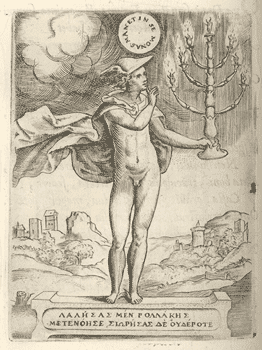
    HermesasHarpocratesHarpocrates, son of Isis and “the god who holds his tongue, and urges silence, thumb in mouth”, has long been a favourite figure amongst magicians.  Usually the connection is with the notion of secrecy, one shared by the masons in the figure of Angerona.  It is the association with secrecy that has been the reason the lesson of silence has slipped away from too many within the pagan, occult and magical community.

    Secrecy is connected with abuses of power, with manipulation and exclusion and often rightly so.  The power of secrecy is partially connected to its capacity to manipulate so this is unsurprising.  It has, like many substances, a pharmakon nature – too much is a poison, just enough is efficacious, but how much is just enough?  Yet Harpocrates is not simply about secrecy, it is the source for the ‘sign of silence’, of the ‘Tace’ in the motto Video, Aude, Tace – to see, to dare, to be silent.  Secrecy and silence are not the same, though closely related.  Secrecy, if just enough is taken, can be a means of binding together those who are allowed into a group and hold its secret as the thread of their interiority as well as a tool for prompting direct experience as one searches for the secret.  Silence, on the other hand, is a source of self-control and a means for opening the ear onto the world.  It is also a consequence of the realisation that all occultists should hold as first principle – words are power.  To speak is to act.   If one insists on simply speaking all the time then most likely what occurs is a directionless acting.

    In our current Western society this notion of silence – of ‘holding your tongue’ – goes against much that informs the implicit imperatives of capitalism.  The idea that one should ‘express yourself’ or ‘speak truth to power’ are thought to be liberating and important to hold to, although this is actually a doubtful truth.  Occasionally these ideas may apply, occasionally, but in general the rule ‘hold your tongue’ has more sense and should perhaps be the default.  Unless absolutely necessary and no other course is possible, holding ones tongue is usually the least damaging course of action – and for one, very simple reason.  To act is to assume knowledge and has great risk because it is almost always certain that something in that situation we are acting on is beyond our knowledge.  To act is to trust in ourselves that our act is a positive effect on the world and such trust should be assumed only with some humility.  To act is to dare.

    Please_Do_Not_Feed_The_TrollSilence also has other benefits.  In communities that exist online, in social media like facebook, forums and blogs, it is too easy for conversations to become explosive.  This is a long recognised factor in internet communication in general and  led to the early identification of the fairy figure of the Troll.  Once identified it was also recognised that the only effective way of dealing with Trolls is to stop feeding them, hence the numerous DNFTT acronyms that sprung up in early forms of the ‘net.  The role of the social media in community life, particularly in small communities of affinity, is highly problematic.  It mitigates against the possibility of silence, because anyone anywhere can simply blurt out anything they want.  Moreover those words, often spoken in haste, drunkenness or anger, can then remain indelibly etched onto the record, lingering and mouldering.   In addition these social media continue on 24/7 whereas the actual community of bodies may only meet once every now and then.  The social media, once thought to facilitate, now becomes dominant and the body meetings become distorted through the continuous presence of the online, often unthought, words that never seem to cease being spoken.

    It’s not only social media, however, that brings the problem of too much talk, it’s also the ‘literary’ nature of many communities, the absence of the oral imperative.  With the amount of books, magazines, journals, musical compositions and media in general people begin to become part of a community only through these disembodied extensions of their selves.  Instead of these media becoming aids and providing assistance, as tools, to a more profound and rounded (body included) community, what tends to occur is that the community disappears into the tools, the texts and medias that fly forth in an era of increasing expression.  This then produces a curious dynamic, whereby if one doesn’t ‘produce’ these things then one doesn’t exist.  The dynamic is to force people to speak, to produce, to ‘express themselves to exist’.  Even when they do produce, however, the drive of the form insists that once is not enough, they must do it again, and again, junkie to the new ephemerality of the mass media form.

    In all of this, in the online disputes, the flood of new productions, the trivialisation and – let’s be frank – increasing stupidity and tedium of these expressions, all that is occurring is the gradual assimilation of the occult community into the wider capitalist imperative (eat, consume, die).  The occult spark itself will dwindle inside these communities, taken up and living on elsewhere, in secrecy and silence.  The occult communities will be unlikely to learn those lessons it needs to as long as it maintains its incessant cacophony of expression, its incessant drive to talk rather than listen, its incessant failure to learn the lesson of silence.

    Consider for a moment what exactly would be lost if everyone simply shut up for a year.  Instead of writing that new article, posting that oh so necessary comment on the latest crucial problem that has flared up online or getting the latest piece of media online and sold out, just shut up and listen.  Stop talking, producing, insisting on expressing yourself.  Stop and read, stop and wait, stop and just be, for a while, someone who watches and sees, who watches and sees not just what others say but how you react to that, how it makes you feel, what it makes you think, what you might learn.  Allow the world to be something your own existence is part of, allow yourself to be visible not to others but to yourself.  Then, before opening your mouth again, think about whether there is a positive answer to the question – do I need to say this? Note that this is not the question, do I want to say it but do I need to say it?  If that need is only for yourself, only because you feel you would burst without saying it, then your are – and should recognise – inflicting yourself on others.  This is not something to be shunned.  At times it is perhaps vital to someone’s spirit to do so but it is, nevertheless, an infliction, not a liberation.  It is necessary to scream into the void at times, but it is still a scream.  We might sometimes need to scream but we must want to stop, to be at a point when the scream is not dragged from us.  We must want to be able to be silent, to desire that calm being of a moment of peace and quiet.  If that desire is to be fulfilled then we, too, must become part of the silence, not the constant, oppressive, cacophony. The lesson of silence is not, in its heart, one of oppression but one of liberation.

  • Reading Capital (notes #1-Beginning with the commodity)

    The opening line of Capital begins like an axiomatic that will subsequently orientate the work, stating the relationship between wealth in capitalist societies and the role of the commodity.  Wealth appears in the form of the commodity within capitalism, more specifically with the ‘collection of commodities’.  From this starting point the individual commodity is taken to be the basic ‘elementary form’ that will be the starting point for Marx’s investigation into capitalism.  The first thing to note is the choice of elementary form.  Marx does not begin with money, or labour, or scarcity – this last one being the most common starting point for economists.  Instead we begin with Marx with the commodity.  Whilst this might seem rather mundane the implications are touched on immediately when the commodity is understood by Marx to be the means by which human needs are satisfied.  Talk of ‘needs’ however, might seem to suggest something of the ‘scarcity’ emphasis, it might suggest that they are natural or set in stone for example.  If human needs were some basic fact of our existence then the satisfaction of those needs by something we call a commodity wouldn’t really be much to worry about.  The problem is that the needs that the commodity can satisfy are unbounded.

    In the second paragraph (C:125) Marx refers to ‘needs of whatever kind’ and goes on to say that ‘the nature of these needs, whether they arise … from the stomach, or the imagination, makes no difference’ (emphasis added).  In this simple moment the imagination is brought into the system of capitalism, with all its wildness and desire.  If we speculate here then it might be possible to push this idea into some curious territory.  The commodity satisfies needs, any need of the imagination.  Why not say, to put it another way, anything you can imagine is capable of being satisfied within capitalism through the commodity?  If that were the case then to imagine a needed future is to follow a logic where this imagination can be satisfied with a commodity.  Imagine an needed alternative, a needed transgression, a needed rebellion – to the extent there is a need attached to the imagined thing, then capitalism will have the potential to satisfy that need with a simple, elementary commodity or collection of commodities.  This strikes me as close to the concept of recuperation that the situationists develop, in which rebellion itself becomes transformed from an act of resistance to one of consumption – people ‘need’ to resist, to embody their imagined utopian world, so they ‘buy’ the commodity of rebellion, be it in the form of Che Guevara t-shirts and posters or left groups and programmes.  Recuperation is the process of normalisation, a process of regaining normality that occurs when faced with an illness, or a rebellion.  It’s fine to rebel, totally cool to revolt, more than chic to protest.  Indeed the almost classic moment of recuperation occurs in 2003 when George W.Bush applauds the anti-war protestors for their democractic expression of their views; the protests are recuperated, revolution is televised, revolt is normalised.  The dynamic of the commodity is universalistic, it tries to swallow up every bitter pill that arises.

    Putting aside the problem of recuperation, the satisfaction of imaginary needs by the commodity, the next move in Marx’s analysis is to address the way in which the commodity satisfies needs through having a use.  The property of a thing that satisfies a need is a use-value.  The use-value is a way of referring to the ‘usefulness’ of a thing.  A pint of water has a degree of usefulness, as does ‘iron, corn, a diamond’.  This usefulness is ‘conditioned by the physical’. So for the diamond to have the usefulness of cutting glass it needs to have the specific physical properties of highly organised carbon that it has.  Of course we don;t know what use-values something has until it is used and what something is or can be used for changes and is partially ‘natural’ or basic and partially constructed historically and socially.  Sand, for example, has a usefulness in glass-making only once the properties of glass have been discovered and a method of production invented. Marx then says that use-values ‘constitute the material form of wealth, whatever its social form may be’ (C: 126).  Here some curious facts might emerge.  Wealth in a digital age (social form) still needs some material form, in this case the various networks and machines which record and account the figures.  If you wanted to disrupt the capitalist mode of production by directly attacking the wealth it holds then attack the material form in which the social form is constituted.  Switch off the electricity.    Capitalism, at least the big guns of finance capitalism, is susceptible to EMP bombs.  That seems to be a rational conclusion if Marx is right on this point about the material form.


    …………….

    C = Capital Vol 1, trans. Ben Fowkes, Penguin 1979

  • Reading Capital (notes #0–preliminaries)

    1. Some preliminary notes on the fact of the reading group and its method.paris68.jpg_5664408567216169362

    A reading group recently began in London with the aim of reading through Marx’s Capital (Vol.1), Monday nights 7pm at the Red Lion in Hoxton.  It’s part of what seems to be a contemporary revival of interest in Marx’s work driven not by the academy but by a mixture of political activists and people who want to try and find some understanding of the contemporary crisis in capitalism.  (This Facebook group, for example, has links to groups in Liverpool and Sheffield as well as the London group).  

    The first thing I note was about the inaugural meeting and this was the number of people attending.  I am used to reading groups being small in the academic world, quite often only half a dozen people, maybe a dozen or so for larger groups.  In this instance, however, some 40 people turned up to the first meeting and after four sessions the numbers are still around 25 or so.  A number of people expressed their reason for coming in terms of the practical goal of attempting to understand the world around them, the crisis in capitalism that is the contemporary horizon we all live in.  That they have turned to Marx is indicative perhaps of the centrality that he has to any criticism of capitalism.  Even if the name is not mentioned the spectre of Marx nevertheless lurks in the background every time a Banker attracts criticism for being greedy.  There’s a curious logic at work here because there’s no reason to assume Marx will ever simply disappear, anymore than there’s a reason to assume Nietzsche or Freud will disappear.  At times, no doubt, they will inform thought, culture and life in greater or lesser depth but their presence, the possibility of their return, haunts thinking, discourse. dialogue.  These three figures are mentioned because they are gathered together by Ricouer under the title ‘Masters of Suspicion’ and it is the suspicion of belief that Ricouer refers to.  Now whilst this is a problem for faith, as Ricouer himself notes, it is also a problem for trust.  Each time the system of capitalism enters one of its periodic crisis the implicit trust we that we must have in capitalism, almost of necessity, slips sideways.  The world can often seem a little screwy, off-kilter and badly organised but even then we still live as though it were capable of being less so, this active living of our lives relying upon a trust, in this case a trust that the form of life we are in has the capacity to be improved.  The trust that the masters of suspicion displace is a trust in the future within the world as it is now.  Of all the three Marx is perhaps the most radical in this displacement because he radically disrupts the role of the individual, more radically than either of the other two who remain wedded to some sort of future the individual can achieve with their own effort.  If Marx ‘works’ it is in describing the machinic operation of a system that positions the individual as a place within the machine.  It is not without reason that he was fascinated by the story of Faust.  Capitalism is not the result of individuals but results in a type of individual.  Our actions are not just unconscious and perhaps capable of becoming more conscious, or filled with resentiment and capable of becoming less so, instead they are the result of some event that occurred behind our backs and which we might be able to understand but which we will not change merely through understanding.  The machine is real in the sense that Philip K Dick gave to the term ‘reality’.  For Dick the real is what remains when we stop believing in it.  Capitalism is entirely real in this sense, perhaps the epitome of reality.  An anti-capitalism that is more than a mere intellectual dislike or dismissal faces the rather daunting task of both destroying one reality and constructing a new one.  No greater adventure can be imagined than the task facing the anti-capitalist.

    The second thing I note was the way the group reads, which is slowly.  By slowly I mean two to three paragraphs a session at the moment – though this is in part because the starting point for Capital contains a whole range of difficult and curious notions that need quite a lot of attention.  Slow reading is a curious thing, something I’ve mainly come across in academic situations, often with a nod to Nietzsche who is perhaps the first to make explicit the resistance to dominant culture that is involved in slow reading.  For many it’s a difficult thing because it disrupts the common focus of consuming a text, turning it into a tool or resource.  Instead slow reading draws the reader into a process that refuses to allow the reader to simply ‘understand’ the text.  The process combines the attempt to understand a text with an increasing awareness of the resistance and mis-reading we bring to a text, whereby we tend to read into the text.  In the case of most works of philosophy it is a danger to ‘read into’ a text because what happens is that the reader merely reproduces their own pre-existing concepts, overlaying them onto the text rather than reading out of the text the arrangements that exist within it.  The implicit assumption that we all speak the same language is fundamentally what is challenged by slow reading.  The arrangements of concepts within each individual have both particular idiosyncrasies but also cultural and ideological determinations.  For practically orientated work this is not necessarily a problem but for any type of critical activity it is the central difficulty in any act of actual learning.  Too often a student responds not to the text they’re reading but from the position they’re within, one that they live as though it were their own but which is more than likely part of their cultural ‘common sense’.  The resistance to slow reading appears in the need to understand, which often arises in amusing ways.  When faced with a difficult line, a strange phrase or a curious concept what is often used is the strategy of buttressing.  We grab hold of concepts that lie to hand, either from our ‘developed’ understanding or from the ‘common sense’ referred to and we buttress the difficult passage with these other concepts, stabilising it in our minds so we can move on.  What this does, however, is to buttress the difficulty within our own understanding which sounds on the face of it like a reasonable thing to do.  However if the concept we’re trying to understand is in essence hostile to our existing understanding then all we have done is, in effect, to neutralise it and assimilate it.  We de-fang difficult concepts by making them part of our everyday world.  The task is not always to assimilate but to allow the possibility that the concept will destroy our everyday world, change our understanding – what else is actual learning than to undergo a process of change.  If the change that is sought is radical – as I would suggest it is with all the masters of suspicion – then this means that the understanding will undergo some radical change, root and branch destruction to clear the land for new growth.  One of the problems of ‘understanding’ is that it tends to make us passive, it tends to make us feel like we understand rather than give us anything actual, concrete and real.  When we feel like we understand we stop learning, we begin to use words and phrases as though we knew what they meant and what they did, in the process losing the radical experimentation that can offer us new discoveries, radically new discoveries of new worlds that are possible.

  • Enochian Working 9 – Ormn –20 July 2011

    king-of-coins

    We met in the basement temple, Morrigan operating and Razorsmile scrying.  We called on ORMN, from the Air subangle of the Elemental Tablet of Earth.  ORMN is one of ‘16 good angels most skilled and powerful in medicine and the curing of disease’.

    What taste do you have? Nothing to do with taste.

    What colour?

    What feeling? Slimy but not slimy, wet but not wet.  You wouldn’t like it. They’re not watery but that’s where they are.  No why.  It’s not water…it is ‘that which things are in’.

    What sound? …  What smell? …

    What emotion?  Relaxing, drift down.

    Someone is sitting in a chair, leg crossed, small amount of light.  Strange head.  Can see their chest, fish head of some sort.  Chest is sloping out.  No mouth, just a hole.  He moves slowly, not sure whether he’s old.  They’re not sure.  Not a he, doesn’t like it.  Not lonely, not on own. Something about the way we should … taking images, taking them in.

    We should be taking them in more clearly.

    What is their happiness? A little silver ring.

    What is their sadness?  don’t know

    They’re very dismissive.  They don’t think of us, they just don’t really think of us.

    What do they think of?  The silver ring.  They do the silver ring, the silver ring is an activity, a thing not an an object.

    Not interested in us going back.  Go somewhere else.

  • After Finitude, notes #3

    MVC-006F

    Meillassoux expresses the problem that the correlationist has with the arche-fossil via the concept of ‘the given’.  For the correlationist the arche-fossil is quite straight-forwardly a self-contradictory concept because it suggests that there is a ‘givenness of being anterior to givenness’.  The correlationist points out that what we should do is conceptualise the scientific quantitative facts that the arche-fossil is aimed at as modes of ‘given-ness’.  For the correlationist, “being is not anterior to givenness, it gives itself as anterior to givenness” (AF:14).  The presentation of this argument is close to the bizarre notion that somehow God placed dinosaur fossils in the rocks in order to ‘test our faith’, a curious convoluted manoeuvre that is blatantly designed to maintain some sort of ‘biblical consistency’ in the face of science.

    In once sense the argument is curiously distorted by the idea of givenness, because if we begin by accepting that ‘the given’ is the starting point from which we know the world then we are already inside the determinative framework which leads to correlationism.  Think of this in terms of the analogy with the argument about God and the dinosaur bones.  If the existence of god as outlined in the Bible is already axiomatic then any empirical fact must be determined within the determinative framework of the biblical frame.  If I find geological evidence of timespans that appear inconsistent with such a framework, if I find fossils that appear to be located in geological layers older than is seemingly possible within the biblical axiomatic, then the appearance must be deceptive.  The axiomatic determines the range of possible solutions.  This is the crux of Meillassoux’s argument – the axiomatic of the given determines the range of possible solutions available to us in terms of knowledge of the world.

    (more…)

  • After Finitude, notes #2

    In the first of these notes on After Finitude the focus was on the initial move in the book, the retrieval of the concept of primary properties.  Even though this is the first move it is still vital to realise that it is the starting point for a more prolonged attack on the dominant contemporary philosophical mode of thinking. This contemporary mode of thinking is what Meillassoux calls correlationism. Correlationism begins with the ‘transcendental revolution’, which finds its origin in Kant. If we have no access to the in-itself then what we are left with are different types of subjective representation. It is no longer the case, the correlationist thinks, that we distinguish between representations which are correct because they adequately represent the object and representations which are distorted by subjective influence (primary properties fulfilling the formal role and secondary properties the latter). We should now distinguish between representations that we must all agree upon and representations that do not demand universal consent. “From this point on, intersubjectivity, the consensus of the community, supplants the adequation between the representations of a solitary subject and the thing itself as the veritable criterion of objectivity, and of scientific objectivity more particularly.” (AF:4). (more…)

  • After Finitude, notes #1

    tgonewlogo2This is part of a series of notes, intended primarily to work through the arguments in Quentin Meillassoux’s book After Finitude.

    The first move made in Meillassoux’s book is to attempt to retrieve the viability of ‘primary properties’ as a philosophical concept that can do serious lifting.  The origin of the explicit ‘primary’ versus ‘secondary’ properties distinction is in Locke – although he uses the term ‘qualities’ rather than properties –  and it’s core problem is perhaps found in Berkeley.  Locke posits primary properties of an object as those which, we might say, are in the object itself and secondary properties as those which are in the perception of the object 1.  The former might be extension, solidity and motion whilst the latter might be colour, taste and smell.  Berkeley’s objection to the distinction is to the primary property as being ‘in the object itself’ – for Berkeley all we have are ideas and even if there is a distinction among our ideas of an object that matches the ‘primary/secondary distinction, this is still a distinction only amongst ideas and has no necessary bearing or connection on anything outside the mind.

    There has been debate over what exactly might be listed under the category of ‘primary property’ but in the initial outlining of the distinction the primary properties are those that are divisible.  “Take a grain of Wheat, divide it into two parts, each part still has Solidity, Extension, Figure and Mobility; divide it again, and it retains still the same qualities; and so divide it on, till the parts become insensible, they must retain still each of them all those qualities.”  The crucial move here – ‘and so divide it on, till the parts become insensible, they must retain still …’ – indicates the presence of a non-empirical principle.  The necessity that these particular qualities must exist in any object whatsoever, no matter how large or small, is not something that we extract from experience but something with which we organise or understand experience.  Primary properties, then, are what belong to the objects themselves as objects not as perceived objects.  The existence of these properties does not depend on any subject, any observer, discovering them – they are properties in the object itself.

    (more…)