Author: Razorsmile

  • Holocasting/Fly

    Flames flap in the wind as standards
    marking spaces in which they with
    little thought of tomorrows passing draw
    slight succour from yesterday’s loss.

    The sun sign silhouetted amidst black
    shadows falling across the nightline
    dances in the skylight crimson
    dresses of evening dinner and wine.

    Thundrous roars peak and molotov
    cocktails speak freely of time
    and light utterances so easily spoken now
    in words that will never be found.

    (more…)

  • INTERVIEW ABOUT ENOCHIAN VISION MAGICK

    INTERVIEW ABOUT ENOCHIAN VISION MAGICK

    A recent email from on Milo Duquette,

    Contrary to what you might have read, my new book, ENOCHIAN VISION MAGICK – An Introduction and Practical Guide to the Magick of Dr. John Dee and Edward Kelley, is out and available worldwide. http://www.lonmiloduquette.com/_books.html

    In fact I was just interviewed by Lee Prosser of Ghost Village.com and answered a number of questions concerning the book. You can read the whole interview at: http://www.ghostvillage.com/library/2008/lib_duquette2.shtml

    If you are at all interested in this fascinating subject (and my unique perspective on it) I urge you to order a copy today. http://www.lonmiloduquette.com/_books.html

    Here’s a blurb: Enochian Vision Magick is not just another rehash of the Golden Dawn/Aleister Crowley systems of Enochian magick. Dr. John Dee (1527-1608) was one of the greatest minds of the Elizabethan Age, and his system of angelic communication was the result of the most dramatic magical operation ever recorded. It has survived to become the cornerstone of the modern ceremonial magician’s practice. In 1582 Dee and his clairvoyant partner Edward Kelley made magical contact with a number of spiritual entities who identified themselves as angels — the same that communicated with Adam, Enoch, and the patriarchs of the Old Testament. Over the next three years they revealed to Dee and Kelley three distinct magical systems of vision magick. The third and last of these incorporated a series of “calls” to be recited in an angelic language in order to raise the consciousness of the magician to a level where angelic contact is possible. This new book seizes upon elements of the original Dee and Kelley material overlooked by adepts of the Golden Dawn and Aleister Crowley, (the Ring, the Lamen, the Holy Table, the Sigillum Dei Ameth, the Table of Nalvage) and demonstrates how modern magicians can use these powerful tools to attune themselves in the same step-by-step manner that first prepared Dee and Kelley.

    http://www.lonmiloduquette.com/_books.html

  • A/V paper now LIVE!

    A/V paper now LIVE!

    lee

    In another email that came through this week the journal A/V let me know that the paper I gave at the Manchester conference on ‘the event’ is now live on their journal.  I have been developing the paper a little more since then as it’s part of an ongoing project that I am working on and the more developed paper was given at the Greenwich University postgraduate conference yesterday, as a keynote address.

    That was a strange event, with lots of interesting papers and some, as usual, that I simply didn’t understand, quite often the case in inter-disciplinary conferences.  I always find my notes form these conferences to be quite strange, littered as they are with various doodles and occasional sketches and the whole experience of conference going has a peculiar set of affects, from boredom and confusion to inspiration and sideways thoughts.  It’s very easy to forget whole swathes of fascinating material as you focus increasingly on single topics, with previous researches put on the shelf and gathering dust until something triggers a connection and suddenly boxes are pulled down and papers strewn everywhere in that search for a particular piece of paper, a particular underlining or note.  During the course of that search other things then turn up and the strange world of research becomes close, that strange world in which there is more than you realise in the background to what you do.

    The paper, the first section at least, called ‘To survive da’ath’, is available on A/V here.

  • Events without distinction

    Events without distinction

    Notes on Heidegger – ITM (polemos, deinon and the gathering of distinction)

    war is the father of all and the king of all, and it has shown some as gods and others as human beings, made some slaves and others free” (Heraclitus, Fragment 53) – it is also worth noting something similar is said in Fragment 80, though this is not mentioned by Heidegger.

    Heideggers’ translation takes this seemingly socio-political statement and reads it in terms of his central problematic of emergence and appearance.  “Confrontation is indeed for all (that comes to presence) the sire (who lets emerge), but (also) for all the preserver that holds sway.  For it lets some appear as gods, others as human beings, some it produces (sets forth) as slaves, but others as free” (ITM 47[1. References are to the Tale Nota Bene edition and marginal page numbers])

    The war, the polemos, Heidegger contends, cannot be a mere socio-political fact since this is merely a human fact and it is necessary for the polemos under question to be prior to the human.  To ‘show some as gods and others as human beings’ the polemos to which Heraclitus directs us “must hold sway before everything divine and human” (ibid).  Polemos is not mere human war, it is the distinguishing event that brings forth the human as distinct from the divine.  Polemos is thus also not mere divine conflict but prior to the divine as much as it is prior to the human.  Polemos is the ground of immortal mortality.

    (more…)

  • Building the temple of Tiphareth

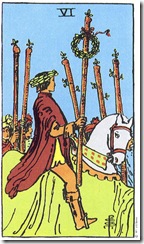
    wands06

    As of writing, May 2008, the Kabbalah meditation group continues and we’ve now been working weekly for over a year, developing a consistent practice and learning a lot as we go.  Our attitude is relaxed and flexible, primarily because the aim of the group was always to provide a space of grounding and recharge for a group of active magicians whose work in other areas can be complemented by this regular co-creation of sacred space.  During the first year we have worked the bottom of the tree, most recently working the Death and Devil paths, gradually building up paths as we go, adding layers of symbolism and becoming intimate with the tree.  We have now completed the QShTh or ‘rainbow’ and have already touched Tiphareth but the time now comes to begin to build Tiphareth.

    When we began we worked the temple of Malkuth, giving us a strong grounding place from which to explore.  The temple was perhaps the most vividly drawn and the one we spent most time in since we would often begin and end a journey by entering and exiting through Malkuth.  Now the same process is to be done with Tiphareth, building it as a vivid ground from which to begin exploring the upper triads of the tree.

    Whilst we use the Dion Fortune text, Mystical Qabalah, as the ‘book’ on the altar space and the ground of the associations we use, the temples are built intuitively, from hints and encounters and spontaneity.  To a large extent this ends up being something that comes from my imagination as I work the paths myself and then share what I’m doing in the pathworking, so I’m aware that there’s probably a huge idiosyncracy in the way in which we work.  At present this seems unproblematic, since this first ascent of the tree aims to install it into our consciousness in a way that enables it to be built upon in future and the tree feels strong enough to sustain any idiosyncratic presentation, at least one that comes from an intuitive response.  The overwhelming nature of the tree and its associations is something I encountered before and in this project there was an unconscious avoidance of any necessity to install a ‘correct’ tree and the emphasis was on ‘what worked’, what enabled people in the group to work the path, visualise strongly and connect intimately.  cups06

    The temple of Tiphareth, then, is being built as a Golden Castle with a Child of Light at its heart.  In our previous approaches we came through the path of  Temperance and the working would involved a scene in which we fired a bow and then became the tip as it flew through the air, before landing in Tiphareth.  Now I wanted to install a direct path into the castle, in the same way that we have a direct path that goes into Malkuth.

    … you walk along a gravel path, through a line of trees that lead to a open grass park, with people playing and relaxing on a sunny day.  You feel the crunch of the gravel under your feet, hear the sounds of the people in the distance.  As you come to the end of the path and move onto the grass, feeling its soft bouncy texture, you feel the warmth of the sun on your face.  You continue towards the Golden castle in front of you towards a doorway.  The door to the castle is on the corner of two walls, with the Castle itself imagined as a hexagon.  You ask Raphaels’ permission before entering the door and once within there are the Malachim, white robed figures moving to and fro along a pathway around the walls.  Within the temple there is a courtyard, at the centre of which is a space of light, bright white light with hints of gold and pink.  You move towards the light until it overwhelms your eyes and surrounds you in its presence.  Gradually shapes become visible as your eyes adjust to the light, though everything is still surrounded by the bright light.  In the centre of the space a child sits on a cushion, behind them a tall crowned man stands.
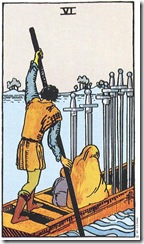
    swords06 You move towards the child and sit on a cushion next to them.  They place a hand on your chest and rest your hand on theirs and as they do a flow of light can be felt moving into and through you, filling you up, flowing into your body, filling your feet, your hands, your whole being.  The child slowly withdraws their hand, as do you and then they rest it gently on your forehead and offer you pents06a vision.
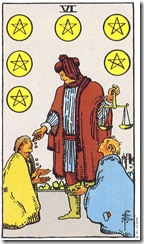
    The child stands and offers you their hand. You stand and the child leads you, hand in hand, to the the right, where there is a door marked Death.  The child then turns about and walks to the direct opposite side of the space and another door appears, this time marked Devil.  Finally the child leads you back to the centre and you face the crowned man. Around the feet of the man and underneath the cushion the child was sitting on are rose petals.  Behind the man there are five doors, too distant to make out any marking as as yet.  The child lets go of your hand and sits down again, saying goodbye.  You turn to leave, walk back the way you came and find yourself once more in the courtyard with the Malachim, one of whom opens the door and nods goodbye, smiling as they do so.  you leave the Golden Castle, making your way across the grass, onto the gravel path and back to this world …

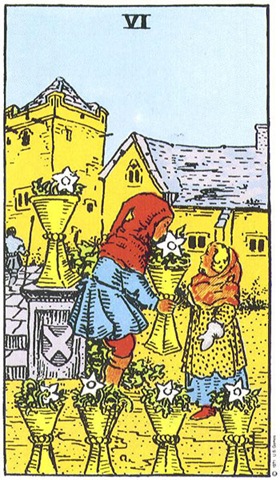
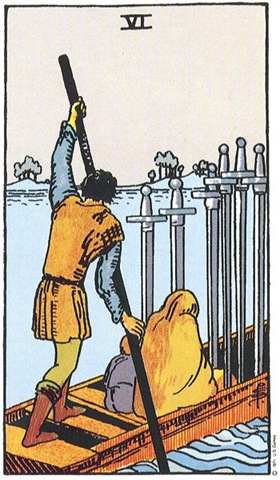
    6 wands – victory, 6 cups – joy, 6 swords – earned success, 6 pentacles – material success

  • Collapse Bulletin 7: Publication of Volume IV ‘Concept Horror’

    Collapse Bulletin 7: Publication of Volume IV ‘Concept Horror’

    The following announcement arrived today and I encourage anyone interested in philosophy, thinking and life to Collapse.

    ———————————————

    collapse7

    We are delighted to announce that Collapse Volume IV will be published May 2008 and is now available for advance purchase online.

    Contributors to this volume include: Kristen Alvanson, Jake and Dinos Chapman, Iain Hamilton Grant, Graham Harman, Michel Houellebecq, Oleg Kulik, Thomas Ligotti, Quentin Meillassoux, China Miéville, Reza Negarestani, Benjamin Noys, Rafani, Steven Shearer, George Sieg, Eugene Thacker, Keith Tilford, Todosch, James Trafford.

    Collapse IV features a series of investigations by philosophers, writers and artists into Concept Horror. Contributors address the existential, aesthetic, theological and political dimensions of horror, interrogate its peculiar affinity with philosophical thought, and uncover the horrors that may lie in wait for those who pursue rational thought beyond the bounds of the reasonable. This unique volume continues Collapse’s pursuit of indisciplinary miscegenation, the wide-ranging contributions interacting to produce common themes and suggestive connections. In the process a rich and compelling case emerges for the intimate bond between horror and philosophical thought.


    (more…)

  • Naive notes on crowned anarchy

    Naive notes on crowned anarchy

    To call life itself just or unjust, to conceive life as samsara or suffering, is to judge life and to do so from outside life, from some position which is the ground of a judgement. To encounter life, respond to it, is inevitable and not all responses are equal, this much is inevitable. Too often, however, this encounter and response is thought of as a judgement. To not judge does not mean to not respond or that any response is as good as any other. There are different responses in life, different lives if you like – or different types of life. Life produces its own end, life drives itself to death but in the encounter with death there is another space of response, this time one that shows us the two fundamental ways of response, affirmation and negation, more life or never ending death.

    How am I to think of life? The philosopher must ask this question. They must, moreover, continue to ask this question and to encounter the force of this question with responses – the philosopher must not simply ask an idle question but encounter the problem of the question, the problem the question arises from, responding with thought, with emotion, with passion, with action. Encounter and response constitute the activity of thought and living, though too often this dynamic to-and-fro is congealed, by the social, into regulated habits, pre-formed responses such as the response of the subject, ‘I think…’. Living is a poor name for the habits and habitats of the human. We are all, inevitably, products of the social, products of the inhuman and yet we are not inevitably condemned to remain nothing but product, commodity, object. It is not a matter of striving to become a subject since the subject is that which is subservient, the subject of the monarch. Rather it is a matter of striving for monarchy itself, becoming a crown within life but not a ruler, judge or controller. Crowned anarchy, this is the watchword, a monarch of creation, a singular moment that adds to the abundance of singular moments. In more traditional terms, this is the assumption of an imperative to autonomy, the self (auto) lawmaking (nomos) reality.

    (more…)

  • Revision for Nietzsche and Modern European Philosophy

    Revision for Nietzsche and Modern European Philosophy

    For my 3rd year students in NMEP.  (This is just a brief and partial account of the discussion today and students are welcome to continue the discussion here on on the WebCT bulletin board if they want a little more privacy, this is a public site after all.)

    Today we discussed the way in which we think the subject by exploring the problems involved in the idea of ‘loving a robot/loving a simulation/loving a simulacrum’ and how these might be teased apart.  A large part of our understanding of both Klossowski and Deleuze’s works on Nietzsche involve us in thinking about the way in which there is a problem for them, what exactly it is that motivates them, as it were, to write and think in the way they do, particularly when the initial impression when confronted by these two works (Nietzsche and the Vicious Circle:NVC and Nietzsche and Philosophy:NP) is one of disorientation.  As we approach an exam we need to supplement the detailed exegetical work done in the essays and the reading seminars with a ‘step back’ that enables us to get a broad sense of dynamics and lines of thought.  To that end it is important to remember, I suggested, that Nietzsche is one of the ‘masters of suspicion’ (along with Marx and Freud – the phrase itself originates form Paul Ricoeur) and that both Klossowski and Deleuze begin form a position congruent with such suspicion in that they begin thinking by distrusting the way we think and speak.  We use words and as we use them assume we know what they mean, until we are asked what they mean when we find confusion and disagreement.  The words we use are capable of possessing us with the feeling that we know something, they possess a sense (or affect, feeling) of sense that we need to be suspicious of in order to begin to think critically.  This doers not mean we simply throw out our intuitive relation to meanings and the sense of things, since such a rejection would also imply that we somehow knew what it was we were meaning and now reject it.  Uncritical rejection is no better than uncritical possession.  Thus the task is to ask, how might we think about the concepts of subject when the language and sense of the concept already exists, how might we think, as it were, in spite of the possession of sense.  To do this, I suggested, both Klossowski and Deleuze attempt something we can think of as a reframing of the questions, a redrawing of the lines of debate.  This idea of a reframing of the problem is perhaps simplifying things but for now, as a kind of working device or ‘rule of thumb’ to enable us to develop understanding (what is called a ‘heuristic‘), it will suffice.

    (more…)

  • Blu19

    Blu19

    This is an old Real audio radio programme I made.  I’ve been thinking of doing some more work with sound and so dug this out and had a listen and I still find it interesting, so it has an audience of 1 at least 😉

    Blu19 real audio file (right click to save-as)

    If anyone can convert it to an MP3 then that would be cool (I don’t have an app on my machine and am not about to buy one just for this one task).

    (UPDATE – 2022 – In time all things come to pass – even file conversions…here’s an MP3 version of the piece.  I’ve left the Real Media file here as archive, ML).

  • NVC Reading notes #1

    NVC Reading notes #1

    (Notes primarily for the use of my 3rd year undergrad students on the Nietzsche and Modern European Philosophy course, terms 2 and 3, in which we’re studying Klossowski’s ‘Nietzsche and the Vicious Circle’ and Deleuze’s ‘Nietzsche and Philosophy’ and exploring the problematic of post-structuralism.  Page references to the Continuum impacts edition of NVC).

    The intention here is to follow a ‘reading strategy’ in which we acknowledge that the style of thinking that occurs within NVC (and perhaps more widely within post-structuralist thinkers) is that of a weave or tapestry, in which words and concepts are introduced without explicit definition and these words are then employed (used) within a line of thought.  The meaning of the terms within the text is to be produced through the work of the text, such that the book will constitute its own context within which key terms can be thought through rather than simply argued about.  This is not to say that argument is irrelevant, not at all, but rather to emphasise something like a principle of ‘meaning is use’ that underlies much of NVC.  Structuralism itself made use of ‘binaries’ in order to begin its analysis with structures and not elements (employed/employer: man/woman: expert/amateur etc), for the simple methodological fact that a single term would be an element and if we are to begin with structures then this must mean, in terms of language and conceptualisation, beginning from relations between words or concepts (what for ease I will simply refer to as ‘terms’)Post-structuralism, then, will continue its emphasis on structures, and as such will continue to find much of interest in the technique of using binaries or pairings of terms although it will not want to presuppose a final and definite order that can be produced from such an analysis.  Our reading strategy, then, works on the basis of trying to identify interesting ‘key-words’ that we then try to understand conceptually by examining their oppositional terms.  Concretely this begins from finding something that we can identify as a claim and then working backwards and forwards within the immediate context in which the claim is made to try and clarify the relations at work in a particular space of the text.  These ‘partial analyses’ will then enable us to begin to reconstruct something like a ‘line of thought or argument’ that is made by the text (or perhaps, better, one of many lines of argument that will be made by the text).

    Beginning at the bottom of page 8 and going onto page 9, we find some of the central questions within the first chapter, ‘The combat against culture’, sitting at the head of a short (3 paragraphs) line of argument.  Here, as part of that partial analysis just mentioned, I want to pick out four ‘key-words’: reciprocity, idiosyncracy, culture and objectivation.

    (more…)