Author: Razorsmile

  • A symbolic representation of the Universe

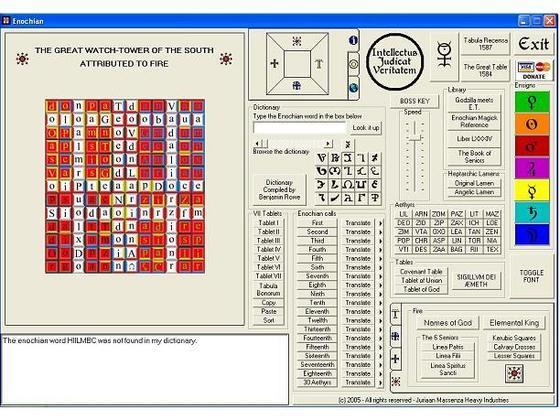
    This nice little bit of software displays the Tabula Recensa, Liber Scientiae, all the calls, the tablets of the 49 good angels, vocalizations of the calls, the Tabula Bonorum, the Sigillum Dei Aemeth, the ring of Solomon, the heptarchic lamens and more along with animations and other gadgets.

    I have tried installing several Enochian applications in the past and this was the only one that worked.

    Just click on this download link, get the program from there and unzip the files into the same folder, then run the setup program from the unzipped folder (the download is about 8.7MB).

    If you have a newer operating system, you will probably encounter some error messages during installation:

    • A file being copied is older than the file currently on your system.
      Do you want to keep this file?

    Each time you see this message, just click ‘Yes’.

    • C:\Windows\…blablabla.dll
      An access violation occurred while copying the file.

    When you see this message, just click on ‘Ignore’. You might be asked to confirm.

    • An error occurred while registering the file C;\…blablabla.dll

    Just click on ‘Ignore’ again.

    You should now see a message box telling you that the program was installed successfully. It worked on my computer and on G’s. Any problems, give me a shout and I’ll see if I can help.

    I find the program very useful because it shows where everything on the tables (Names of God, the Angels etc.) can be found at the click of a mouse button (and the student can switch between Latin and Enochian alphabet).

    It also contains an Enochian translation tool and several e-books for those interested in looking at Enochian Magick from different angles and a vocalisation of the calls (not in high quality but it gives a rough idea).

    I’m looking forward to hearing what others think!

    A symbolic representation of the Universe (more…)

  • Food and the return of something-or-other

    After the intense experience of having undergone months of nausea, semi-starvation and near-paralysis due to the lack of any kind of energy to draw upon, I had the delightful experience of being able to enjoy two days with almost zero obligations other than to regenerate my vital life forces and keep myself as happy and relaxed as I wanted to be. Making even the simplest tasks an act of impossibility, the effect of my stressed nervous and vegetative system on any kind of activity was an exclusively numbing one. Having returned to my observation platform high up in the clouds earlier on I felt myself grasped by an irresistable urge to keep myself busy and get some tasks out of the way, some of which had been asking for completion for over a year – laying out the conditions necessary for some serious magical work which despite a large amount of interest had previously been subject to having slipped near the bottom of any imaginary priority list.

    The effect of the previous two days on my appetite are however a profound one. All of a sudden my taste buds are finding themselves confrontated with a seemingly unquenchable hunger for old and new ideas and the rest of the body seems happy to give its best to satisfy those demands.

    So with a full belly and a content smile, knowing that experiencing the bottomless abyss of wandering through the barren plains of tortured souls and the associated feeling of everything dissolving into nothingness lie somewhere tangible and yet pleasantly distant in the near past, this body and mind are settling for an earlier night’s sleep than they have had for months.

    Late Nite Six
    06-03-2010
  • Elemental

    I was chatting to Fi recently when she asked me how we got to/developed into this whole Enochian thing … here’s a paraphrase of my answer.

    I consider Enochian to be high magic, by which I mean ritual magic requiring a fair degree of discipline and commitment.  It’s something I’ve been interested in for a long time and thought to explore earlier with a couple of other groups.  What stopped me with group A was a grumbling sense of inflated ego/s, my own included.  There’s only so far a projection of your own personae is going to take you before it becomes blindingly apparent, to everyone involved, that there’s something of a magical pissing contest going on.  Group B was, well, bluntly put, untrustworthy.

    What makes this group different then?

    As I was saying to Fi, I get a strong feeling that we compliment each other and the best way I seemed to be able to describe this was as follows:-

    Matt is wood/wooden, but I don’t mean that in terms of someone who’s stiff or unable express themselves with any sort of genuine emotion.  Wood is amazing stuff, we can burn it for heat and light, make furniture out of it, carve art into/from it, and it’s so beautiful.  If you soak it right it can bend amazingly well.  It’s been used to make massive henges, round houses, toy swords and shields, fences, cartwheels … Very versatile stuff wood, both in its natural and treated form.

    I see Adam as stone, actually quite a specific sort of stone, a large, oval-shaped grey stone.  This stone, that I imagine Adam to be, is outside, solitary and under sunlight.  I’m not sure why I think this, but perhaps it’s related to a chapter in ‘A Thousand Plateaus’, a book I’ve never been able to understand at all.  In my efforts to find a way in I took chapter 3, which might be called ‘Geology of Morals’, and simply copied out the first sentence from each paragraph.  This created a very strange poem.  Afterwards I realised it was quite  appropriate, given how geology works in terms of magma, up thrusts, etc, and what I had left, morally, geologically, intellectually, whatever, was an accidental interpretation.  The stone is always the stone, you see, except when it’s not the stone.

    Jen, for me, is air; partly because I associate air with intellect and partly because I never know when I open the front door whether a warm summer breeze type thing will greet me or whether a hurricane will blow through my house/head.  I don’t really feel like I have to explain air.  Air is also breath for me.

    G, well, water, and maybe that’s because I know about his water practice already, or it could be to do with how I perceive water, ie as healing, flowing.  G doesn’t seem jerky at all.  Water is powerful as well though, it’s not just a summer’s day stream with sun twinkling off its surface.

    Me and Fi, I don’t know, I thought we might both be fire, but it’s always easier to see other people than yourself.

    I suppose what’s a bit curious to me about this is that it’s not Wiccan.  It’s so much part of the magical scenery to talk about ‘the elements’ in terms of earth, air, fire and water and I wonder if I got the wood and stone symbolism from G … but that’s what I mean, I believe we, as a group, can exert those kind of subtle forces on each other.

    Interestingly, or perhaps not, it was only after this conversation with Fi that I discovered we would be working with the elementals, funny huh.

  • On Catkins and Lawrence

    ‘Do you really think, Rupert,’ she asked … ‘do you really think it is worth while?  Do you really think the children are better for being roused to consciousness?’ …

    ‘They are not roused to consciousness,’ he said, ‘consciousness comes to them willy-nilly.’

    ‘But do you think they are better for having it quickened, stimulated?  Isn’t it better that they should remain unconscious of the hazel, isn’t it better that they should see it as a whole, without all this pulling to pieces, all this knowledge?’

    ‘Would you rather, for yourself, know or not know, that the little red flowers are there, putting out for the pollen?’ he asked harshly …

    ‘I don’t know,’ she replied …

    ‘But knowing is everything to you, it is all your life,’ he broke out.  She slowly looked at him.

    ‘Is it?’ she said.

    ‘To know, that is your all, that is your life – you have only this, this knowledge,’ he cried, ‘There is only one tree, there is only one fruit in your mouth.’

    … She was sometime silent.  ‘Is there?’ she said at last, with the same untouched calm.  And then in a tone of whimsical inquisitiveness:  ‘What fruit, Rupert?’

    ‘The eternal apple,’ he replied in exasperation, hating his own metaphors.

    ‘Yes,’ she said.  There was a look of exhaustion about her.  For some moments there was silence.  Then, pulling herself together with a convulsed movement, Hermione resumed, in a sing-song, casual voice.  ‘But leaving me apart, Rupert; do you think the children are better, richer, happier, for all this knowledge; do you really think they are?  Or is it better to leave them untouched, spontaneous.  Hadn’t they better be animals, simple animals, crude, violent, anything, rather than this self-conscious, this incapacity to be spontaneous.’ … ‘Hadn’t they better be anything than grow up crippled, crippled in their souls, crippled in their feelings – so thrown back – so turned back on themselves – incapable – ‘  Hermione clenched her fist like on in a trance – ‘of any spontaneous action, always deliberate, always burdened with choice, never carried away.’ … ‘Never carried away, out of themselves, always consciousness, always self-conscious, always aware of themselves.  Isn’t anything better than this?  Better be animals, mere animals, with no mind at all, than this, this nothingness -‘

    ‘But do you think it is knowledge that makes us unliving and self-conscious?’ he asked irritably.

    She opened her eyes and looked at him slowly.  ‘Yes,’ she said.  She paused, watching him all the while, her eyes vague.  The she wiped her fingers across her brow, with a vague weariness.  It irritated him bitterly.  ‘It is the mind,’ she said, ‘and that is death.’  She raised her eyes slowly to him:  ‘Isn’t the mind – ‘ she said, with the convulsed movement of her body, ‘isn’t it our death?  Doesn’t it destroy all our spontaneity, all our instincts?  Are not the young people growing up today, really dead before they have a chance to live?’

    ‘Not because they have too much mind, but too little,’ he said brutally.

    ‘Are you sure,’ she cried, ‘It seems to me the reverse.  They are over-conscious, burdened to death with consciousness.’

    ‘Imprisoned within a limited, false set of concepts,’ he cried.

    But she took no notice of this, only went on with her own rhapsodic interrogation.  ‘When we have knowledge, don’t we lose everything but knowledge?’ she asked pathetically.  ‘If I know about the flower, don’t I lose the flower and only have the knowledge?  Aren’t we exchanging the substance for the shadow, aren’t we forfeiting life for this dead quality of knowledge?  And what does it mean to me after all?  What does all this knowledge mean to me?  It means nothing.’

    ‘You are merely making words,’ he said; ‘knowledge means everything to you.  Even your animalism, you want it in your head.  You don’t want to BE an animal, you want to observe your own animal functions, to get a mental thrill out of them.  It is all purely secondary – and more decadent than the most hide-bound intellectualism.  What is it but the worst and last form of intellectualism, this love of yours for passion and the animal instincts?  Passion and the instincts – you want them hard enough, but through your head, in your consciousness.  It all takes place in your head, under that skull of yours.  Only you won’t be conscious of what ACTUALLY is; you want the lie that will match the rest of your furniture … It’s all that Lady of Shallot business,’ he said, ‘you’ve got that mirror, your own fixed will, your immortal understanding, your own tight conscious world, and there is nothing beyond it.  There, in the mirror, you must have everything.  But now you have come to all your conclusions, you want to go back and be like a savage, without knowledge.  You want a life of pure sensation and “passion”.’

    He quoted the last word satirically against her.  She sat convulsed with fury on violation, speechless, like a stricken pythoness of the Greek oracle.

    ‘But your passion is a lie,’ he went on violently.  ‘It isn’t passion at all, it is your will.  It’s your bullying will.  You want to clutch things and have them in your power.  You want to have things in your power.  And why?  Because you haven’t got any real body, any dark sensual body of life.  You have no sensuality.  You have only your will and your conceit of consciousness, and your lust for power, to KNOW …

    ‘Spontaneous!’ he cried.  ‘You and spontaneity!  You, the most deliberate thing that ever walked or crawled!  You’d be verily deliberately spontaneous – that’s you.  Because you want to have everything in your own volition, your deliberate voluntary consciousness.  You want it all in that loathsome little skull of yours, that ought to be cracked like a nut.  For you’ll be the same till it is cracked, like an insect in its skin.  If one cracked your skull perhaps one might get a spontaneous, passionate woman out of you, with real sensuality.  As it is, what you want is pornography – looking at yourself in mirrors, watching your naked animal actions in mirrors, so that you can have it all in your consciousness, make it all mental.’ …

    ‘But do you really WANT sensuality?’ [Hermione] asked puzzled.

    Birkin looked at her, and became intent in his explanation.  ‘Yes,’ he said, ‘that and nothing else, at this point.  It is a fulfillment – the great dark knowledge you can’t have in your head – the dark involuntary being.  It is death to one’s self – but it is the coming into being of another.’
  • Quite how to do it…

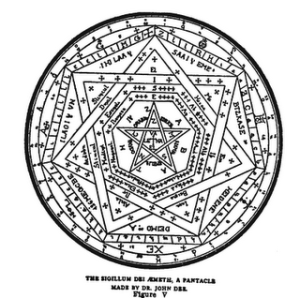
    Sigillum Dei AemethThis post offers a review of the Brighton groups activities so far as we move into a new series of workings and an initial protocol for those new workings.  The first section is the review, the second the protocol of practice.

    Looking back

    The small group of us in Brighton have come together through the activities of the kabbalistic meditation group that was originally set-up in May 2007 as a place of regular group ‘recharge’ activity.  There are some notes on this in earlier posts, some of which also track the changes that take place as the group developed and moved.  Towards the end of last year we once again made a shift to a new phase of work after focussing for a while on practising the SIRP .  The decision we took was to try and practice the Enochian magick that Lon Milo DuQuette had made so accessible in his recent book, Enochian Vision Magick. The start of the new year therefore found us shifting focus from the practice oriented sessions we had been involved with to a series of study sessions in preparation for the Enochian work.

    We have now had four sessions.  The first was an initial planning session for how we were to approach things.  This operated as a kind of overview and then a talking stick session, with a view to maintaining the strengths we had whilst we explored a new practice.  Our first issue was working out how to move into a whole new type of practice without losing what we had so far built.

    In the previous set of practices we had taken a decision very early on to make the sessions very similiar each time in order to establish a simple routine, rather than to have an eclectic mix of activities that shifted and changed every time we met.  In part this came from the initial impulse to form the meditation group, which arose out of a group of magicians, most of whom were ‘chaos magick’ inspired and already meeting in a local CM cell.  In many CM sessions the format is for participants to each bring a rite and then for the group to go through a whole series of different activities during the session.  This can be extremely exciting and vibrant but also quite draining and so the meditation group was almost a reversal of this, with a format that was fairly fixed.  We would meet, do the Qabalistic Cross (x3), an LBRP, the QC again (x3) then a series of Middle Pillar chants, 5 as a round and 5 unified.  After that we would have a silent meditation of 20 mins followed by a pathworking.  This basic format was adjusted at times but in effect the same thing would occur each time, the main difference of content being in the pathworking.

    Gradually we adjusted elements as we developed.  We moved our pathworkings further up the tree, we took it in turns to do these pathworkings and then we shifted from the LBRP to the SIRP.  We did a slightly more organised set of pathworkings (the 3 Letter workings) which aimed to establish a personal contact on the tree for each participant.  One of the participants was an experienced Chi Qung practitioner, so we added some CQ into the beginning of the meetings.  Each change was small and built on the established routine of the sessions.The strengths of these practices lay in their regularity.  This regularity meant we all knew what was going to happen each time we met, or at least the basic outline.  The coherence of the rites was easier to build, energy easier to raise and a sacred space faster to establish because there was little or no need to discuss what we were doing each time we would meet – we simply met, did the work and generated the space in which we existed for that time.  So our first job in planning the new work was to once again build on what we had.

    We had a long chat about what it was people got form the existing work, what stage of development people were at magically and agreed a few groundrules for the new practice.  Some of these are obviously private to the group but I think most importantly we agreed to continue the meditation sessions as ‘energy gains’ in between the Enochian work.  So we will be doing 2 session of Enochian, followed by a 2 session break during which time we will have meditation session.  We also agreed that for the first half dozen or so session of the Enochian practice we would all be there for the session to go ahead.  In our meditation work it usually didn’t disrupt things greatly if one person couldn’t get along for one week, they would simply slip back into it the week after.  In this new practice it seemed sensible to ‘all be new together’.  Once we’ve overcome the initial ‘shock of the new’ together and have a shared vocabulary of experience we can again continue with a session even if one participant isn’t able to get along that week.

    Having established some ground rules we then met again three times to do some study sessions on DuQuette’s book and get a rough, shared familiarity with the material we were going to work with.  The first session looked at the Sigillum Dei Aemeth and everyone drew one out from the various tables and sources.  The second session looked at the Ring, Lamen and Holy Table and then a third session spent time looking at the Holy Tables, clarifying the work in the Aethyrs with the symetrical characters of the Governors and the work in the Elements, with the Golden Talisman and the Elemental squares.  Lots of material, lots of discussion, lots of fun – but all very school-like in many ways.  Last night we finished off this initial set of preparations and sketched out the basic outline of how we’re going to begin the work.

    Looking forward

    In general we’re going to follow DuQuette fairly closely.  Our own flavour of things will probably be most noticeable in the form of Middle Pillar exercise we do, the chanting in the round.  After some discussion, however, this is the agenda of activity for the sessions:-

    1) 3x Qabbalistic Cross, LBRP, 3x Qabbalistic Cross

    2) Middle Pillar Chants

    3) Temple Ceremony ( the Heptarchical operation)

    4) Elemental working (the Scrying session)

    5) Close

    We begin in two weeks (initial session planned for 17th March) to give people time to adjust their practices in preperation.  In particular this means maintaining or renewing regular Qabbalistic Cross, Middle Pillar, and LBRP activity (having been focussed on the SIRP, the shift back to the LBRP will be interesting for people).  It’s a good time to look at the Whare Ra documents again, which you can find over here.  The DuQuette book is the reference for the activity.  He gives a classic form of the LBRP at the start of Appendix 1 (page 191) , the main differences to our previous practice being the triplicity of the Qabalistic Cross (‘Ateh, Malkuth etc’) at the beginning and ending  and the way we pronounce the first pentagram, YHVH.  The Temple Ceremony is what DuQuette calls the ‘ceremony of preparation’ (page 193-195) and the place of  the ‘elemental working’  is indicated on page 193 but the content is effectively given on pages 179 – 181 (this protocol was one of the study session hand-outs).   The content of the elemental workings are the subesctions on pages 179-181 in DuQuette’s book, titled ‘The Call(s)’, ‘Addressing the Hierarchy’ and ‘Calling your target angel’.  DuQuette gives an example which you could work through, replacing this with our first point of activity, one of the the four basic Earth of Earth angels.  I will prepare the Calls and the Address to the Hierarchy for our first session but this is a task that will land on everyone at some point.  For the first session the Scryer and the Recorder have been decided (you know who you are) and the set of questions we use as the base from which to work is given in Enochian Vision Magick on pages 173-174.

    We can use the comments thread here to discuss any initial adjustments we might feel we want to make to this protocol.

  • Images of the elemental tables in Photoshop

    An interesting blog post over here at Lemegeton.  This person has built Photoshop files of the elemental tables, all beautifully coloured.  I know at least one person in our group has an interest in Photoshop so thought these might come in useful.

  • assorted synchronicities

    I noticed that a few coincidences/synchronicities clustered around our first meeting to discuss working the Enochian system, and later when I finished reading Duquette’s Enochian Vision Magick.

    First John Dee was mentioned in two books I was reading. Then a man with the name got in touch. He sent pictures of himself dressed as Freddy Mercury from Queen. Couple of interesting associations here – of course J.Dee was the Queen’s conjurer, employed in her service at the time for his astrological and other skills. Mercury is analagous with Hermes – my first thought being his role as messenger of the gods and his obvious import in the carrying of messages, which is presumably what we will be doing in the Enochian work. He’s also known as “patron of boundaries and of the travelers who cross them” which seems apt considering the nature of the work being undertaken, which could some kind of trans-dimensonal contact, or at the least a departure from everyday consciousness. Hermes/Mercury has often come up for me, interesting to see his presence here again.

    On the way to the first meeting I called into a newsagent to get something to eat for dinner. I chose a vegetable samosa and went to the counter to pay. The bored looking man at the till had a piece of A4 paper with what looked like four grids on it. The grids were drawn in pencil and contained many small squares. Inside each were either numbers or letters, I’m not sure which. It didn’t look like sudoko, and was hand drawn. I was struck by the superficial similarity of these grids of information to the grids used in the Enochian system. Later, at the meeting we had a plate of vegetable samosas. I don’t make a habit of eating this particular foodstuff, so to choose one and then later be confronted with a plate of them seemed an odd coincidence. As to its occult significance – something about triangles? – I’ll spare you my speculation.

    On Sunday 28/2/10 I finished the Duquette book and noticed a couple of angelic mentions in the same day. First was from the film Southland Tales, when an ex-soldier is about to inject himself with a futuristic drug: “Then you take the blood train. You talk to God without even – without even seeing him. You hear his voice, and you see his disciples. They appear like… like angels under a sea of black umbrellas. Angels who can see through time.”

    An hour later I was reading a book of poetry by Goethe, and turned randomly to poem number 76: Higher and Highest Matters, which contains the lines

    Yet in other dialects men

    and angels make communication:

    Secret grammars, speech of roses,

    And the poppy’s conjugation.

  • druid podcast

    damh the bard, one of the local brighton druids, has a podcast that I’ve not noticed before but which is worth a listen – take yourself over here

  • Colours on the tree

    An interesting and useful discussion of the way the grades of the GD, the colours associated with the sephira and the elemental associations combine can be found over at the Mishkan ha-Echad blog.

  • Branding thought

    whatitsaysonthetin

    A new speculative realist  journal is about to begin and has issued a cfp, details over here.  The new journal seems to be only an online journal, although I’m not entirely sure about that.  No details of a print version are mentioned.  Unfortunately it’s not very imaginatively titled, simply called ‘Speculations’, although I suppose this is kind of a ‘it does exactly what it says on the tin‘ name.

    The new speccy movement has a large number of virtues no doubt, although I’ve never been that comfortable with the whole ‘branding’ attitude.  Mark Fisher reports Graham Harman talking about branding in a positive light, claiming that it is a ‘universally recognised method of of conveying information while cutting through information clutter.   The claim is, as seems quite common, both provocative, far-reaching and seemingly ‘against the orthodoxy’, although I’m afraid I don’t quite buy it.  Easily able to be hidden inside the ‘conveying information’ phrase is a major assumption, namely that information is neutral.  This would then miss the point of those who might criticise branding as a problematic device, something that is deployed to manipulate information flows rather than merely convey. It connects, however, with something I read Harman saying on another website, which is that he specifically envisages the creation of a philosophical movement as a project.   There is something intensely interesting here in the way the speccies, with the force of Harman at their centre, create a series of alliances, devices and connections.  Just as in the case of the pasteurisation of France, a kind of alliance of associations is underway, with the explicit ‘naming’ (branding) of the movement as a form of ‘fulcrum point’.  Harman has, no doubt, learnt the lessons of Latour.  Under this assumption I take it that the point of speculative realism is to create an asymetrical moment, to win a battle and shift the terrain of forces.

    Obviously this idea of  asymmetry, a form of ‘breaking history in two’, has some resonance with Nietzschean attitudes to forces, though there is something uniquely ‘human’ in the way the speccies are going about the job.  Rather than the thinker engaging in time, valiantly trying to carry out the heroic task of untimeliness (some latent transcendent existentialism no doubt), the speccies offer up a movement.   Now sometimes this is not quite so obvious.  I get the sense that speculative realists are often taken to be offering a new argument.  For example, Steven Shaviro comments that  ‘what’s so energizing about Harman’s “object-oriented philosophy,” or about “speculative realism” more generally, is that it refuses to subordinate its arguments about the nature of the world (or about anything, really) to (second-order) arguments about how we can know whether such (first-order) arguments are correct.’  Now, of course, there are always new arguments and all of the speccies, in one form or another, bring forward new arguments.  The ‘new’ here is not yet the New (whatever that would be, if indeed it is at all).  The idea, for example, that philosophy should make first-order arguments about the world is not that uncommon.  The point, presumably, is that it’s uncommon in our current philosophical conjuncture.  It is not so much, I feel, the arguments that are crucial (not that they’re unimportant by any means) since they seem to be unable to be discussed without being located within the movement that is speculative realism.

    The slight problem I have, however, is that this notion of a movement that attempts to re-invigorate philosophical first-order arguments under the banner of ‘speculative philosophy’ seems aimed specifically at philosophy.  The content, of course, still comes forward as first order arguments, but the structure or dynamic of the movement looks on this account to be second-order (a kind of ‘metaphilosophical’ movement).  That may or may not be a positive thing, I’m not sure, although I’m certainly uncertain.  What is clear, however, is that a new fashion is on the rise and at the centre of it is a brand name rather than a ‘proper name’.    Despite any misgivings – and a terribly old-fashioned dislike of fashions on my part – it will be interesting to see how this movement continues to develop and what possibilities for thought it opens up.

    Speculations journal details over here