Author: Razorsmile

  • Enochian working 1 – Axir – 14 April 2010 – (with notes and thoughts for further actions)

    (We decided to use the questioning format DuQuette suggests as a guide to begin with and may modify as we go along: for source see DuQuette, 2008: p.173-174)

    earth2_medium

    Wednesday April 14th 2010

    The action intended to call Axir, Earth of Earth ‘servient angel’, who are ‘powerful and learned in transformation’.  The action was operated according to the protocol we’ve drawn up, which was outlined in this post and the script for which is here.   (more…)

  • The space of blogging and the demands of reason – on arguments to be avoided.

    The space of blogging and the demands of reason – on arguments to be avoided.

    The space of blogging is a particular instance of the space of writing and the space of philosophical blogging is itself a particular instance of the space of writing that intersects with a more general ‘space of reasons’. This last is the name given by Wilfrid Sellars to the particular realm of justificatory discourse, although it is sometimes taken to refer more broadly to the realm of any discourse whatsoever. For Sellars, ‘to know something’ is not a general fact which can be empirically tested somehow by checking a mental or neurological state of the entity claiming to know, it is rather to to identify an object that operates inside a particular ‘game of giving and asking for reasons’. This implies that if we characterise something as a knowledge claim then we are entitled to ask for reasons for the claim – how and why do you know this? That we’re entitled to ask for reasons doesn’t imply that we have to. We may well – and commonly do – accept a large number of claims that we take to be knowledge claims on the basis of a kind of trust, a default acceptance that operates until we are prompted to challenge the claim.

    Some people want to extend the space of reasons to be co-extensive with the space of discourse itself. This is the move made in Kukla and Lance’s book, ‘ “Yo!” and “Lo!”: the pragmatic topography of the space of reasons’ (Harvard, 2009). Robert Brandom defines the space of reasons as a space of ‘inferential relations’, in which each participant occupies a slightly different perspective because of their variable observational position but is able nonetheless to engage with others, governed by ‘deontological score-keeping’. Both of these develop Sellars initial idea in interesting directions but the point of the original distinction was to distinguish a space of reasons from a space of causality, thereby enabling a kind of double-articulation theory which prevented radical reductionism. No longer would it be necessary or possible to reduce propositional, conceptual or intentional objects to physical, empirical or material objects. The space of reasons aimed to guarantee an autonomy to propositional, conceptual or intentional objects. These objects would be found in the form of claims of one sort of another.

    If the space of discourse is co-extensive with the space of reasons then any mode of discourse is open to a call for justification. The nature of the justification, however, would still depend largely on the nature of the object. If the object is a knowledge claim then it calls for reasons but there is an ambiguity here. Some objects of discourse might be thought of as expressions of knowledge, others as expressions of an absence of knowledge. The latter would, it seems, no longer be subject to the call for justificatory reasons. If the expression ‘I don’t understand’ were responded to with the question, ‘well why not?’ then the ‘justification’ is likely to be entirely circular – ‘because I don’t’. Pedagogically these type of cases call for careful negotiation – a good teacher who is faced with a pupil who simply says ‘I don’t understand’ has a duty, owing to the social role they’re engaged in, to try and work out why there is an absence of understanding. Usually this might involve taking the pupil back to a position they’re happy with and feel they do understand and then slowly working forward again to find the gap or breach in the discursive network. Nothing, however, guarantees that this strategy is capable of success. In principle some things are simply not available to be understood by some understanders. To think otherwise would be to suggest that a complete coincidence of position can occur between two perspectives, which would be absurd since this would render the very ‘perspectival’ nature that prompts dialogue to be non-existent. Put another way, there is only a need to ask for reasons if there is a condition of difference between the claimant and the respondent and a ‘pure co-understanding’ by a respondent of the claimant would render communication and discourse no longer necessary.

    The space of blogging offers a curious example of this necessary failure of pure understanding which renders philosophical activity almost redundant if such activity is taken to involve the production of agreement, a kind of commonality akin to pure co-understanding. Occasionally philosophical bloggers produce arguments that are ‘stand-alone’ objects but more commonly they produce arguments in the more mundane sense of a disagreement. Here, in the disagreeable blog, the argument is a series of claims, with justifications, as to why X is wrong, bad, weak, incorrect or somehow or other in error, with a general view to reduce the value of the opponent in what presents itself as a zero-sum game, a trial of strength. There are occasionally ‘argument objects’ produced but these respond not to any specific opponent but rather to the demands of reason more generally. It is more common to find these argument objects within philosophical books, not least because of the mitigation of ‘call-response’ dynamics that are the condition of the space of blogging. It is, perhaps, for this reason that in general philosophical discussion in blogs is weak, limited and riven by a kind of personal politics that is amusing to watch but perhaps exhausting and unproductive to participate in. Philosophy and in particular the production of argument objects benefits less from discussion than might originally be thought. Perhaps this is why Deleuze seems to touch on something important when he decries the value of arguments in general – it is not that he doesn’t want to argue with you, rather that he wants to respond more directly to the demands of reason.


  • Objects and all that…

    Objects and all that…

    The blog here has been a little quiet as I’ve become more and more immersed in my research. I took a years unpaid sabbatical from the University of Greenwich where I work as a part-time philosophy lecturer in order to work on a book tentatively titled ‘Necessary Matter’. Things are progressing with that project and hopefully there will be some concrete output fairly soon from this long process of immersion in texts and thoughts. In the course of the research, which initially began from a curious encounter between my interests in Leibniz, Deleuze and Brandom, I have engaged more and more with the interest in objects that has arisen over the last few years. The work of Harman and Bryant, coming out of the speculative realist current and drawing on Bruno Latour, strikes me as interesting if unsatisyfing. This, I find, is often the most productive type of encounter. The uninteresting simply passes by, whereas the satisfying offers a kind of succour that might be ill-advised but is often rapidly consumed. Satisfaction leads to passivity, not usually a good thing in terms of thought, although no doubt it is necessary at times.

    (more…)

  • Laying the table

    Laying the table

    Holy Table and Sigillum

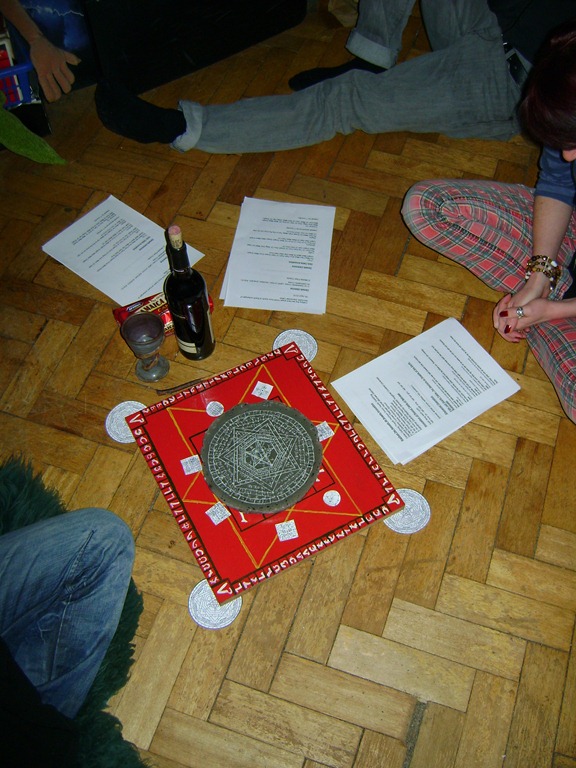
    On Wednesday just gone we gathered together for the first action in the ongoing Enochian work we began this year.  The scryer for the session was unwell, toothache, so the five of us that were there took the Holy Table and Sigillum Dei Aemeth that had been made for the workings and performed the action up to the end of the ‘Temple Ceremony’ as a form of ‘activating’ the table and sigillum.  The script for the rite is linked here and there are some pictures taken during the making of the Holy Table linked to the picture on the left.

    It was a good rite, with a strong LBRP and Middle Pillar chants.  This was very satisfying, as last time we’d been active we’d been using the SIRP.  The ‘Temple Ceremony’ aspects from DuQuette’s book then followed, the 7 chants of the Holy Table side letters, then the 7 chants of the middle 12, each one first 3, then 4.  After this the calling fo the 49 names of the Sigillum and the whispering incantation of the Round table of Nalvage.  We noted that each of us whispering, almost to themselves, the final Nalvage chant had a kind of re-centring role after the earlier chants of the letters.  Those whispered chants at the end were repeated until each person felt they ended, rather than in unison, which may be why they worked like that.

    After that we banished with laughter and chatted about the rite.  Timewise it seemed to take about 35-40 minutes only to get to the elemental scrying operation.  That would mean that there is enough time in the rite so far for there to be a comfortable scrying session of anything from 10 minutes to half an hour, with possibly room for other activity after the scrying if we wanted to consider that at a later point.  It’s possible we might find scrying sessions go on longer, though I doubt it at this early stage of the work.

  • Enochian Pronunciation

    A few weeks ago I received an interesting ebook on Enochian Pronounciation. The PDF contained links to the archive at hermetic.com where the original material can be found. This link will take you there.

  • Journal of the Western Mystery Tradition – on angelic work

    The latest issue of the Journal of the Western Mystery Tradition (No. 18, Vol. 2. Vernal Equinox 2010) has a focus on Angelic work and has some interesting looking articles on Enochian work which might be of particular interest – go here and take a look

  • 14th March

    so as i was reading thru the ring chapter, in preparation to make my lovely paper ring, i noticed the instructions had been given on 14th march 1582, funny, as today is also 14th march.

  • The Lamen

    Beware of wavering. Blot out suspicion of us, for we are God’s creatures that have reigned, do reign, and shall reign forever. All our Mysteries shall be known unto you.

    – The Angel BRALGES, one of the Angelic Princes named on the Lamen, November 16, 1582

    Another one of my Photoshop efforts, this time the Lamen which serves as a link between the Magician and the Table.

    I wasn’t able to link the images to the full resolution versions, so they can be found here (Simple Lamen) and here (Golden Lamen).

    The Enochian Lamen
    The Lamen
    The Golden Enochian Lamen
    The Golden Lamen
  • The complete Sigillum Dei Æmeth

    Fresh from Cosmillogica’s paint box.

    I couldn’t find a decent quality image of the sigil anywhere, so I decided to make one myself. This modernised version took about two afternoons to make. I’m pretty sure that’s a lot faster than carving it out of wax!

    I can’t recommend exercises like this enough!

    The original Photoshop file is about 4k x 4k so large enough to print out wall-size without quality loss if desired …

    Sigillum Dei Aemeth
    Sigillum Dei Aemeth, with excerpt from MS. Sloane 3188 by John Dee
  • Photoshop as therapy

    or: What Happened on a Cold Day in a Draughty Flat High Up in the Clouds

    I hope that maybe the one or other has some use for the complete coloured Great Table as Revised by Raphael (Tabula Recensa). If not, it was still a great exercise.

    The Revised Great Table in colour (1587)

    If anyone needs a larger version, let me know – the full resolution is 1500 x 1620.

    Original elemental tables from http://lemegeton.wordpress.com/2009/01/18/enochian-tablets-building-your-own/, see also https://razorsmile.wordpress.com/blog/2010/03/03/181/.