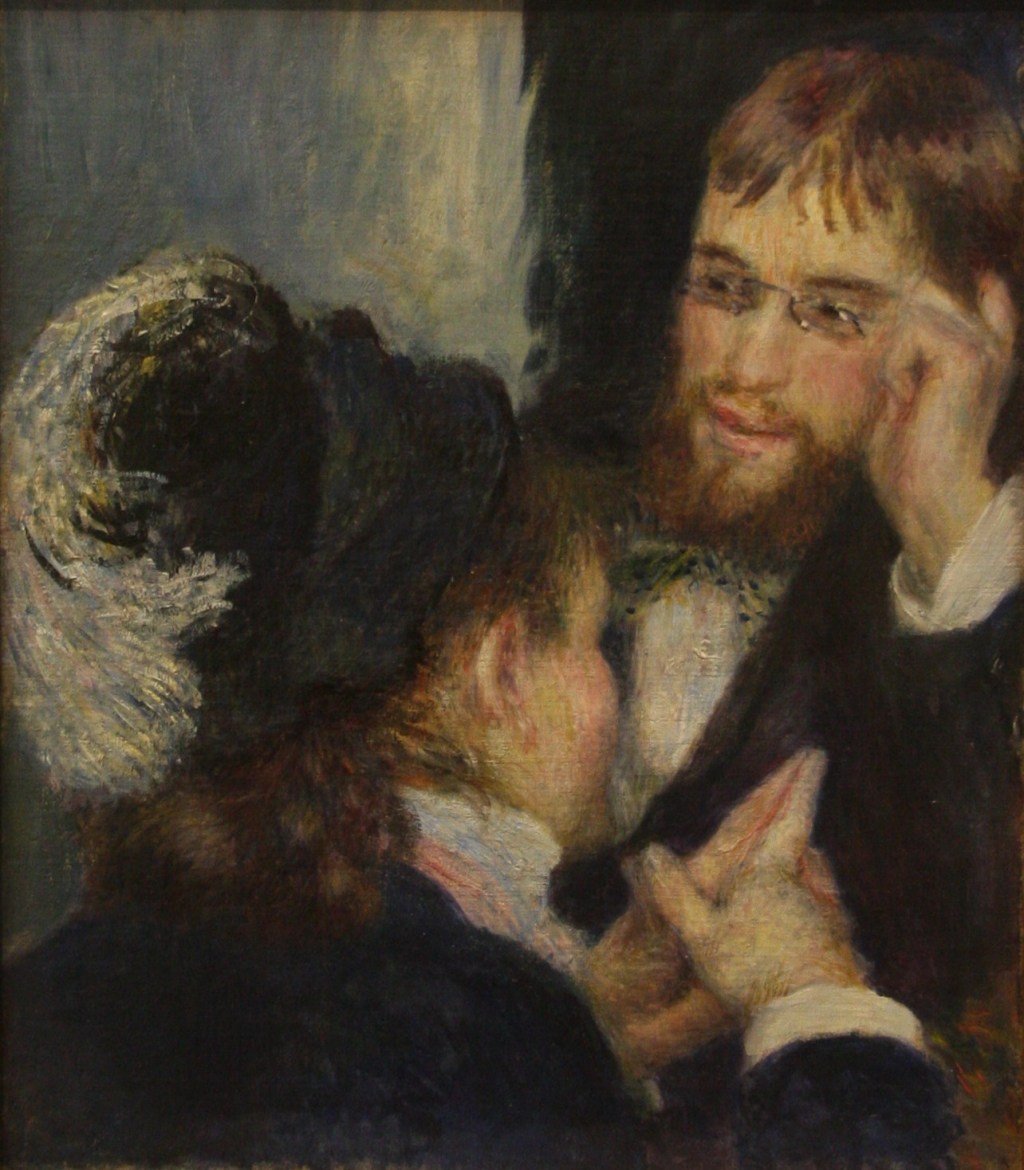
It’s difficult to imagine the practice of a philosopher without it involving some moments of teaching. Within these moments of teaching it’s difficult to imagine it taking place without, at some point, the philosopher having to offer some kind of account of philosophy. What is philosophy? That might be a bad question, or at least a question liable to too many answers to help us much. Still, some kind of account of philosophy is demanded. What exactly do you think you’re doing if you say you are doing philosophy?
When I try to explain philosophy to a new group of students one of the things I emphasise is that it’s an activity, that it involves argument and reason, that it has tools it uses regularly and that it relies upon texts and the study of texts. Almost without fail, however, there appears the question of progress. The idea of progress in a discipline, of something like an accumulation of more knowledge, of better refined knowledge, comes into play one way of another, usually through a students question. Increasingly over the years I have come to respond to this idea of progress with the idea of conversation. The response takes the form of something like the following claim: with regard to philosophy it is a category mistake to evaluate it in terms of the idea of progress, it is more appropriate to conceive of it in terms of an idea of a ongoing conversation which has moments and dynamics but which has no external goal towards which it aims.
This idea of philosophy as a conversation is not unique by any means, although it may well be quite a conservative image of thinking. What I mean by this is that it is generally encountered as a liberal political idea, almost inherently opposed to any degree of radicalism. For example, in the essay The voice of poetry in the conversation of mankind by the conservative political philosopher Michael Oakeshott we find the following definition.
conversation is not an enterprise designed to yield an extrinsic profit, a contest where a winner gets a prize, nor is it an activity of exegesis; it is an unrehearsed intellectual adventure … properly speaking, it is impossible in the absence of a diversity of voices: in it different universes of discourse meet, acknowledge each other and enjoy an oblique relationship which neither requires not forecasts their being assimilated to one another
Voice in the conversation of mankind, in Rationalism in Politics, London 1962, p198-199, available online here.
Here we can see an almost classical liberal ideal world, one in which all questions of power have disappeared in favour of something we might call the liberal ‘image of thought’. This is the world in which conversation is implicitly held out as the most ‘human’ or ‘civilised’ mode of politics, despite its all too obvious mismatch with actually existing political conversation. There is no extrinsic goal, there is the necessity of diversity and there is the absence of ‘assimilation’, all of which produce, supposedly, a respect for the individual within a collective social situation. The radical in me, the part of me that has learnt about suplus value from Marx for example, or the impact of colonialism from Fanon, finds this naive in the extreme, but the part of me that is a philosopher finds something that should be right within this idea. It’s this conflict or tension that I’m thinking about here.
The tension is between two different orders of things. On the one hand there is a tension between the conversational model of philosophy and the conversational ideal of the human. For Oakeshott, for example, conversation is not the model of philosophy but rather the model of the human. Philosophy is, he suggests, “the impulse to study the quality and style of each voice, and to reflect upon the relationship of one voice to another” and “must be counted a parasitic activity; it springs from the conversation, because this is what the philosopher reflects upon, but it makes no specific contribution to it” (ibid, p200). Again an apparent confusion might be suggested, here between what is needed in order to do philosophy and what philosophy does. One of the conditions of philosophical work is close reading and attention to both the said and the unsaid within a work. The unsaid is encountered in rhetoric, style and relationship – how something is said, to whom is it said, in what tone is it said, who is it that is doing the saying – all these issues matter in trying to understand what is being said. To that extent the claim would be that to do philosophy one must study the ‘quality and style’ of a voice and ‘reflect upon the relationshiop of one voice to another’. And yet there is no need for there to be a conversation that pre-exists this reflection, not only because the philosopher can and should reflect upon their own work, but also because much of the time the study is not of conversation but of talk. It might be true that philosophy is parasitic on the existence of talk, but it’s another matter to suggest that talk only exists in conversations. Indeed it might be more likely that conversation itself is parasitic on philosophies reflection on talk.
Talk and conversation are quite distinct. Most of the time human language is in the mode of talk, not conversation. It implicitly and explicitly imposes itself on an audience, often with an extrinsic goal and commonly in an attempt to assimilate the audience. Talk is, to this extent, something like the opposite of conversation as defined, and more importantly it seems that it is prior to conversation, both in practical terms (conversation presupposes a capacity to talk) and in conceptual terms (conversation diverges and is distinct from talk). Talk itself is a curious thing, more than mere vocalisation of common meanings or ‘communication’. Talk is a mode of relationship that is asymetrical and organises itself, when succesful, on the basis of an ear, a listener. Indeed talk becomes most interesting perhaps when the one that hears is at the same time the one that is talking. To hear yourself…

 razorsmile :: philosophy//magic //revolution
Leave a comment